
Cash Reserves in Retirement: How Much Liquidity Do You Really Need?

Picture a hypothetical retired couple with $3.2 million in retirement savings. Nearly $900,000 of it is sitting in money market funds and savings accounts. They sleep well at night — but they are quietly bleeding purchasing power at a rate of roughly $25,000 per year to inflation, and they do not even realize it.
On the other end, plenty of retirees keep almost nothing liquid. When the market drops 20% and the roof needs replacing in the same month, they face an ugly choice: sell investments at a loss or put a $15,000 expense on a credit card at 24% interest. When the market dropped 20% and their roof needed replacing in the same month, they faced an ugly choice: sell investments at a loss or put a $15,000 expense on a credit card at 24% interest.
The right amount of cash in retirement is not a single number. It is a balance between protecting yourself from forced selling during downturns, covering genuinely unexpected expenses, and avoiding the silent cost of holding too much money in accounts that barely keep pace with inflation.
Table of Contents
- Why Cash Reserves Matter More in Retirement Than During Your Working Years
- The Real Cost of Too Much Cash
- The Real Cost of Too Little Cash
- A Three-Tier Cash Reserve Framework
- How to Size Your Cash Reserve: A Hypothetical Example
- Where to Keep Your Cash Reserves
- How Cash Reserves Fit Into a Bucket Strategy
- When to Adjust Your Cash Position
- Key Takeaways
- Frequently Asked Questions
Why Cash Reserves Matter More in Retirement Than During Your Working Years
During your working years, an emergency fund of 3-6 months of expenses is standard advice. You have a paycheck coming in, and if the market drops, you can simply keep contributing and wait it out. Time is on your side.
In retirement, the equation flips. You are no longer adding to your portfolio — you are drawing from it. And if a market downturn forces you to sell investments to cover living expenses, you lock in losses that your portfolio may never recover from. This is the sequence-of-returns risk that makes the first five to ten years of retirement the most financially vulnerable.
Cash reserves serve as a buffer between your spending needs and your investment portfolio. When markets drop, you can draw from cash instead of selling stocks at depressed prices. When an unexpected expense hits — a medical bill, a home repair, a family emergency — you can handle it without disrupting your investment strategy.
The difference between a retiree who weathers a bear market comfortably and one who panics is often not the size of their portfolio. It is whether they have enough liquid reserves to avoid selling at the worst possible time.
The Real Cost of Too Much Cash
While cash provides security, it comes with a price that is easy to overlook: the erosion of purchasing power.
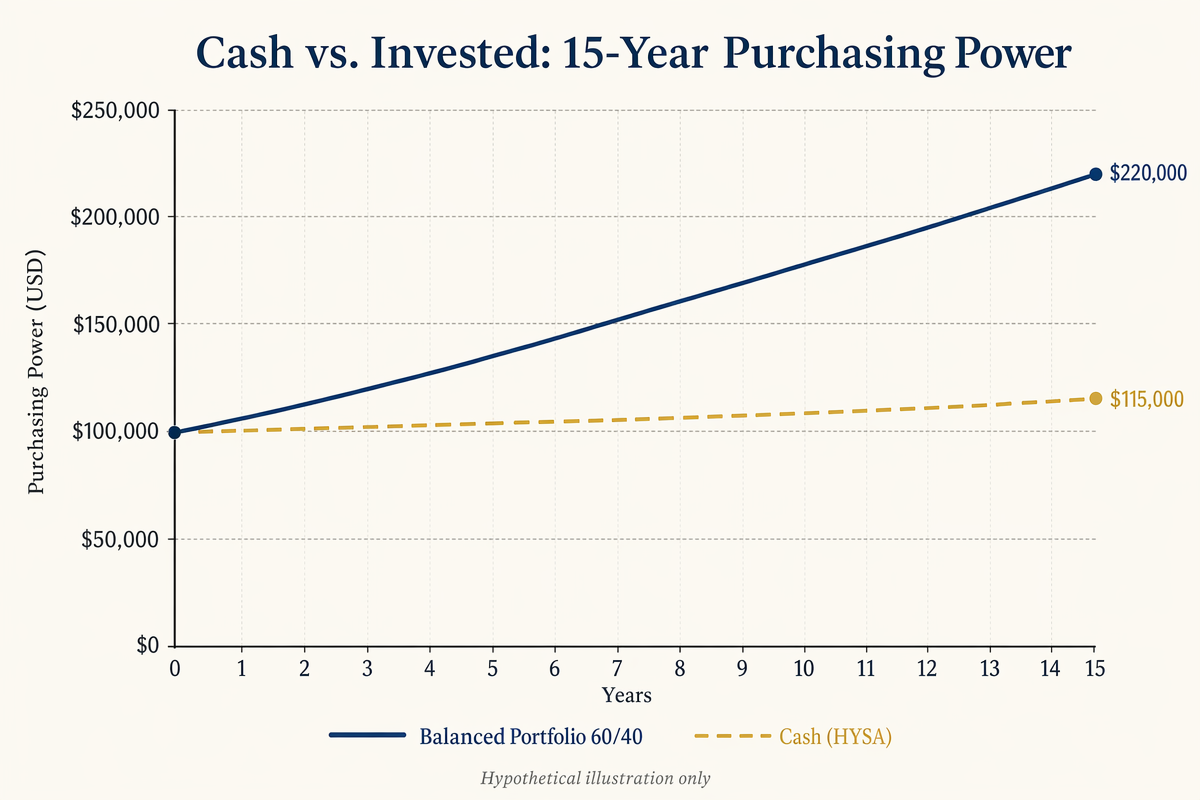
Consider this: if inflation averages 3% annually (close to the long-term historical average tracked by the Bureau of Labor Statistics), a dollar today buys only about 74 cents worth of goods in 10 years and 55 cents in 20 years. A high-yield savings account paying 4-5% in today’s rate environment helps, but rates fluctuate — and historically, cash savings have barely outpaced inflation over long periods.
This is a hypothetical comparison for illustrative purposes only.| Scenario | Starting Value | Value After 15 Years (nominal) | Purchasing Power After 15 Years |
|---|---|---|---|
| Cash at 3% average yield | $200,000 | $311,594 | ~$199,000 (flat in real terms) |
| Balanced portfolio at 6% average return | $200,000 | $479,312 | ~$307,000 (real growth) |
| Difference | — | $167,718 | ~$108,000 in real purchasing power |
That $108,000 gap in purchasing power represents vacations not taken, healthcare costs not covered, or legacy not left. Cash feels safe, but too much of it can quietly undermine the longevity of your retirement plan.
Thomas’ Take: I describe excess cash as “comfortable but expensive.” Retirees who hold more than 2-3 years of spending in cash are typically doing so because of fear, not math. Fear is a valid emotion — but there are better ways to manage it than sacrificing six figures in long-term purchasing power. Fear is a valid emotion — but there are better ways to manage it than sacrificing six figures in long-term purchasing power.
The Real Cost of Too Little Cash
The opposite extreme is equally dangerous. Without adequate cash reserves, you become a forced seller in every downturn.
Consider a hypothetical retiree who entered the 2022 bear market with no cash buffer. The S&P 500 dropped roughly 25% from peak to trough. To cover $5,000 in monthly expenses, this retiree would have needed to sell approximately $6,667 in equities each month (selling $5,000 worth of needs from a portfolio that has declined 25% in value means selling more shares to generate the same dollar amount).
Over 9 months of a downturn, that could mean selling tens of thousands of dollars in equities at depressed prices — shares that would have recovered and then some if they could have waited. This is the retirement withdrawal mistake that does the most damage: forced selling at market lows.
Insufficient cash reserves also create behavioral problems. When you know every market dip directly threatens your ability to pay bills, the stress can lead to panic selling, abandoning your investment strategy, or making emotional decisions that compound the financial damage.
A Three-Tier Cash Reserve Framework
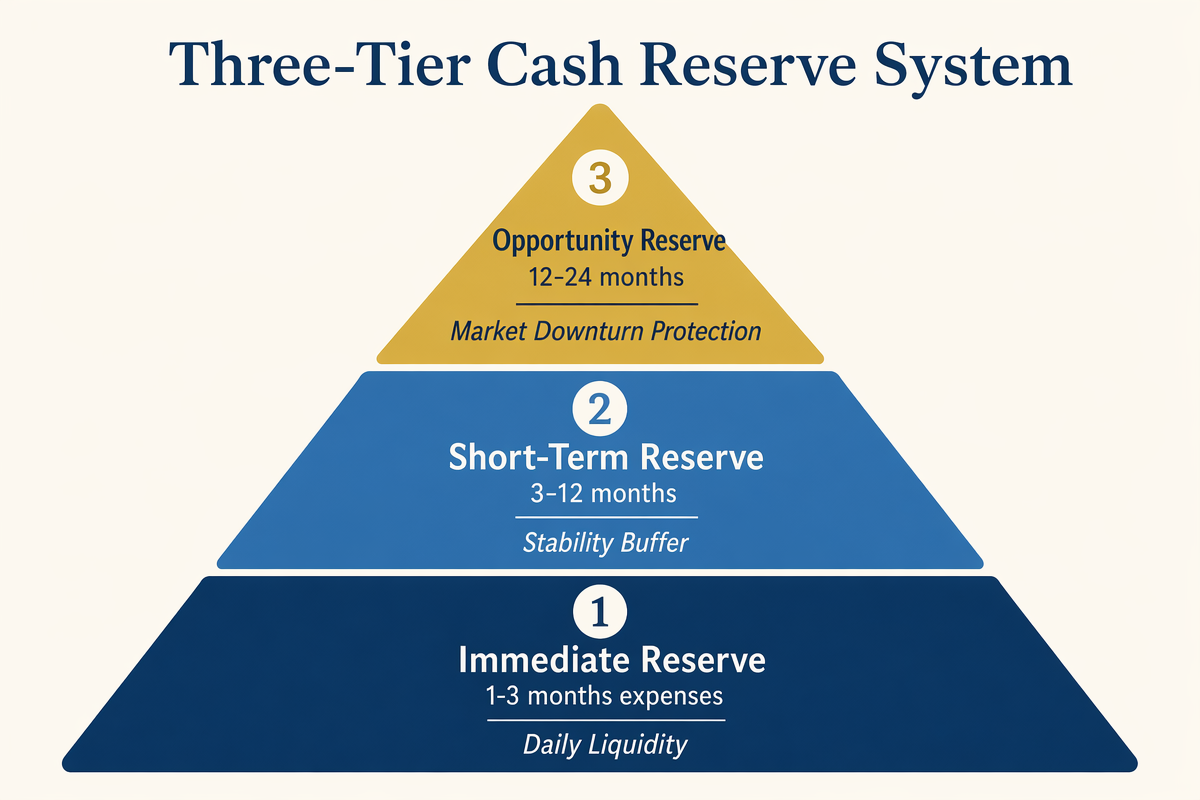
Rather than picking a single “right” number, I find it helpful to think about cash reserves in three tiers, each serving a different purpose:
Tier 1: Immediate Spending (1-2 Months)
This is your checking account — the money that covers this month’s and next month’s bills. Think of it as your operational cash flow. This should cover:
- Mortgage/rent, utilities, groceries, insurance premiums
- Regular subscriptions and recurring charges
- Any bills due in the next 30-60 days
Tier 2: Income Replacement Buffer (6-18 Months)
This is the core of your cash reserve strategy — the money that allows you to stop drawing from investments during a market downturn. It sits in a high-yield savings account or short-term treasury fund, earning modest interest while remaining fully accessible.
The size of this buffer depends on:
- Your monthly spending that is not covered by guaranteed income (Social Security, pensions, annuities)
- Your risk tolerance — how many months of market decline you want to be able to ride out
If your monthly expenses are $6,000 and Social Security covers $3,500, your gap is $2,500 per month. A 12-month buffer would be $30,000.
Typical amount: $20,000 to $60,000 depending on spending and guaranteed incomeTier 3: Opportunity and Contingency Reserve (Variable)
This tier is not about monthly expenses. It covers:
- Major home repairs or replacements (HVAC, roof, vehicle)
- Healthcare costs beyond what Medicare and supplemental insurance cover
- The flexibility to act on opportunities (helping a family member, travel while you can, a grandchild’s education)
This money can sit in slightly less liquid instruments — a short-term CD ladder, Treasury bills, or an I Bond allocation — since you do not need instant access.
Typical amount: $15,000 to $50,000 depending on home age, health situation, and lifestyle goalsTotal Framework
For a hypothetical retiree couple spending $6,000 per month with $3,500 in Social Security:
| Tier | Purpose | Amount |
|---|---|---|
| Tier 1: Immediate | Monthly bills | $12,000 |
| Tier 2: Buffer | 12 months of the $2,500 gap | $30,000 |
| Tier 3: Contingency | Home, health, opportunities | $25,000 |
| Total | $67,000 |
That $67,000 represents roughly 6-7% of a $1 million portfolio — a meaningful but not excessive allocation to cash.
How to Size Your Cash Reserve: A Hypothetical Example
This is a hypothetical example for illustrative purposes only and does not represent any actual client situation.Let’s say Jim and Carol are both 65, recently retired with a $1.4 million portfolio. Their monthly spending is $7,200. They receive:
- Social Security: $4,200 combined
- Small pension: $800
- Monthly gap to fill from portfolio: $2,200
Using the three-tier framework:
- Tier 1 (Immediate): $14,400 (2 months of full spending)
- Tier 2 (Buffer): $26,400 (12 months × $2,200 gap)
- Tier 3 (Contingency): $30,000 (their home is 22 years old; HVAC and roof may need attention)
The remaining $1,329,200 stays invested in a diversified portfolio appropriate for their risk tolerance and time horizon. If markets drop 20%, Jim and Carol can continue drawing their $2,200 monthly from the cash buffer without selling a single share. After 12 months, they would reassess — if markets have recovered, they replenish the buffer from portfolio gains. If not, they may extend the drawdown from Tier 3 while continuing to wait.
This approach is a core element of the bucket planning strategy — segmenting your assets by time horizon to match your spending needs with appropriate investment vehicles.
Where to Keep Your Cash Reserves
Not all “cash” is created equal. Here is where each tier fits best:
| Tier | Best Vehicles | Why |
|---|---|---|
| Tier 1 (Immediate) | Checking account, linked savings | Instant access for bill payment, debit card, and transfers |
| Tier 2 (Buffer) | High-yield savings, money market fund, short-term Treasury ETF | FDIC insurance or government backing, modest yield, same-day or next-day access |
| Tier 3 (Contingency) | Short-term CD ladder, Treasury bills, I Bonds | Slightly higher yield, 1-12 month access depending on instrument |
A few important notes:
- FDIC insurance covers up to $250,000 per depositor per institution. If your cash reserves exceed this, spread across multiple banks or use a brokerage sweep account with SIPC coverage.
- I Bonds are excellent for Tier 3 — they are inflation-protected and exempt from state taxes. However, they have a one-year lockup and a 3-month interest penalty if redeemed before 5 years. You can purchase up to $10,000 per person per year through TreasuryDirect.
- Money market funds at brokerages are not FDIC-insured but are generally considered very safe if they invest in government securities. Read the fund prospectus to understand what you own.
Pro Tip: Automate your Tier 2 replenishment. When your portfolio has a good quarter, set up a systematic transfer to refill the buffer back to its target level. This removes the emotional decision of “when to sell” and keeps your cash reserves at the right level without overthinking it.
How Cash Reserves Fit Into a Bucket Strategy
If you follow a bucket planning approach, your cash reserves map directly onto Bucket 1 (the short-term bucket):
- Bucket 1 (Cash — Years 1-2): Tiers 1 and 2 from the framework above. Covers near-term spending so you never have to sell investments to pay bills.
- Bucket 2 (Income — Years 3-7): Bonds, short-term fixed income. Replenishes Bucket 1 as it depletes, and provides a secondary buffer if markets stay depressed.
- Bucket 3 (Growth — Years 8+): Equities, real assets. The growth engine that funds the rest of your retirement, left undisturbed during downturns.
The bucket approach works because it physically separates “spending money” from “investment money” in your mind. When the stock market drops 30%, you can look at Bucket 1 and say, “My next two years of income is right here, not in the stock market.” That psychological separation prevents panic selling — which, as we discuss in our article on the psychology of spending in retirement, is one of the most destructive forces in a retiree’s financial life.
When to Adjust Your Cash Position
Your cash reserve is not a set-it-and-forget-it allocation. Several events should trigger a review:
Increase your cash when:- Markets are at all-time highs and you are within 2 years of retirement (de-risk gradually)
- A major expense is on the horizon (planned surgery, home renovation, vehicle replacement)
- Your guaranteed income changes (pension reduction, Social Security claiming delay)
- You are entering the first 5 years of retirement (the highest sequence-of-returns risk window)
- Interest rates are low and cash is earning well below inflation
- Your guaranteed income has increased (both spouses now claiming Social Security, for example)
- Markets have been down significantly and you have already used your buffer — now focus on replenishing from portfolio recovery rather than holding excess cash
- Your overall portfolio is small enough that excess cash meaningfully reduces your growth potential
Thomas’ Take: A reasonable cadence is to review cash reserve levels at least twice a year — in the spring (after tax season reveals the prior year’s spending) and in the fall (to position for year-end tax moves and the coming year’s income plan). It should not be more complicated than that. It should not be more complicated than that. The goal is to avoid both the “too much” and “too little” extremes, not to optimize every last dollar.
Key Takeaways
- Cash reserves in retirement serve a fundamentally different purpose than a working-years emergency fund — they protect you from forced selling during market downturns, not just unexpected expenses.
- Too much cash erodes purchasing power. Over 15 years, the difference between holding excess cash and keeping it appropriately invested can exceed $100,000 in real purchasing power for a $200,000 allocation.
- The three-tier framework (immediate spending, income replacement buffer, and contingency reserve) gives you a structured way to size your cash without guessing.
- Most retirees need 5-10% of their portfolio in cash — enough to cover 12-18 months of portfolio withdrawals plus a contingency cushion, but not so much that it drags on long-term returns.
- Replenish systematically. When markets recover and your portfolio grows, refill the buffer so it is ready for the next downturn.
Frequently Asked Questions
Is the old rule of “6 months of expenses in cash” still valid for retirees?The 6-month guideline was designed for working-age adults with steady income. In retirement, you may need more — typically 12-18 months of the gap between your spending and guaranteed income sources (Social Security, pensions). The right amount depends on your specific income sources and spending level.
Should I count my home equity as part of my reserves?No. Home equity is not liquid. Accessing it requires selling the home, taking out a reverse mortgage, or obtaining a home equity line of credit — all of which take time and involve costs. Cash reserves should be in assets you can access within days, not months.
What about keeping cash in my brokerage account’s money market sweep?Brokerage money market sweep accounts are a reasonable option for Tier 2 reserves. They offer easy access and competitive yields. Just be aware they are not FDIC-insured (though they are covered by SIPC up to certain limits). Government money market funds at major brokerages are generally considered very low risk.
How do interest rates affect how much cash I should hold?When interest rates are high (as they have been recently), the opportunity cost of holding cash is lower because your savings are earning meaningful yields. When rates drop near zero, holding excess cash becomes more costly because you are earning almost nothing while inflation erodes value. Adjust your target slightly based on the rate environment, but do not swing between extremes — the primary purpose of cash reserves is liquidity and stability, not yield.
Finding the right cash reserve balance is one of the most important — and most often misjudged — decisions in retirement planning. Retirees who handle it well tend to share one trait: they treat cash reserves as a tool with a specific job, not as a comfort blanket or an afterthought.
For more on retirement income, bucket planning, and Social Security claiming, browse the retirement planning archive or sign up for the weekly newsletter at the bottom of any page.
This article is published by Confluence Media Group LLC, an independent publisher of educational financial content. Thomas Clark is a Series 65 Investment Advisor Representative. The information provided is for educational and informational purposes only and is not personalized financial, tax, or legal advice. Past performance does not guarantee future results. All investing involves risk, including potential loss of principal. Consult a qualified professional before making financial decisions.
Confluence Media Group LLC is a separate entity from Confluence Capital Management, the investment advisory practice through which Thomas Clark provides advisory services. Advisory services are not offered through this publishing platform.

Thomas Clark is a Series 65 licensed investment advisor and experienced trader. He specializes in investing, retirement planning, and market analysis, helping individuals build wealth and make informed financial decisions.
