
Charitable Remainder Trusts: A Tax-Smart Strategy for Retirees with Appreciated Assets
Charitable Remainder Trusts: A Tax-Smart Strategy for Retirees with Appreciated Assets
Table of Contents
- What Is a Charitable Remainder Trust?
- The Two Types: CRAT vs. CRUT
- The Four Tax Benefits of a CRT
- How the Income Stream Works: Payout Rates and the Four-Tier Tax System
- Who a CRT Is Best For
- IRS Minimum Requirements: The 10% Remainder Test and the 5% Payout Floor
- CRT vs. QCD: Which Is Better for Your Situation?
- CRT vs. Donor-Advised Fund: A Side-by-Side Comparison
- Risks and Downsides You Need to Understand
- A Hypothetical Walkthrough with Real Numbers
- Key Takeaways
- Frequently Asked Questions
Let me walk you through a scenario that comes up more often than you might expect for retirees holding long-term appreciated assets.
You own a stock position that is now worth $500,000. You paid $50,000 for it 20 years ago. If you sell it today, you will owe roughly $67,500 in federal capital gains tax — and potentially more if your state taxes capital gains or if the Net Investment Income Tax applies. That is a real and immediate cost just for converting an asset you already own.
But here is where it gets interesting. There is a strategy that lets you avoid that capital gains tax entirely, convert the asset into a reliable income stream for the rest of your life, support a cause or institution you care about, and take a current income tax deduction in the year you set it up.
That strategy is a charitable remainder trust — a CRT.
I want to be direct with you: a CRT is not for everyone. It is a sophisticated estate planning tool with real tradeoffs, setup costs, and irreversibility. This guide is educational — not a recommendation for your specific situation. You will need a qualified estate attorney and your financial advisor working together to determine whether a CRT makes sense for you. But if you hold highly appreciated assets, have philanthropic intent, and want to think through every arrow in your quiver, this is a strategy worth understanding deeply.
Let me walk you through how it works.
What Is a Charitable Remainder Trust?
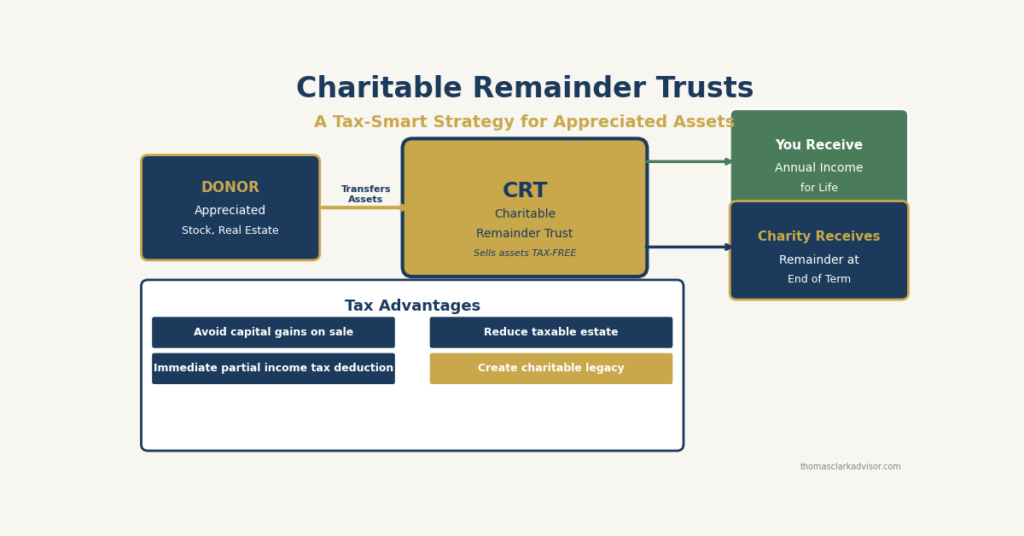
A charitable remainder trust is a type of irrevocable split-interest trust recognized under federal tax law. Here is the basic structure:
- You (the “grantor”) transfer appreciated assets — stock, real estate, a business interest — into the trust.
- The trust sells those assets without paying capital gains tax on the gain.
- The trust pays you (and/or a named beneficiary, such as a spouse) an income stream for a set period — either for life or for a specified term of up to 20 years.
- At the end of that period, whatever remains in the trust passes to the charitable organization or organizations you designated.
The trust is irrevocable. Once you transfer assets in, you cannot take them back. The charity is the ultimate beneficiary of the “remainder” — which is where the name comes from. You receive the income now; charity receives the remainder later.
The legal authority for CRTs lives in IRS Publication 561 and the underlying rules in IRC Sections 664 and 170. The IRS provides detailed guidance on the specific requirements at IRS.gov — Charitable Remainder Trusts.
CRTs are sometimes described as a “win-win-win-win” strategy: you avoid capital gains tax, you receive income, you support charity, and you get a deduction. That framing is accurate — but it elides real complexity, real costs, and real tradeoffs, which I will cover fully below.
Thomas’s Take: Thomas’s Take: The CRT gets dismissed by readers who assume it’s only for the ultra-wealthy or the deeply philanthropic. Neither is true. The threshold is really about the type of asset you own — specifically, whether you are sitting on a large embedded gain that a capital gains event would be painful to realize. If that description fits, the CRT conversation is worth having regardless of overall net worth. Neither is true. The threshold is really about the type of asset you own — specifically, whether you are sitting on a large embedded gain that a capital gains event would be painful to realize. If that description fits, the CRT conversation is worth having regardless of your overall net worth.
The Two Types: CRAT vs. CRUT
There are two primary flavors of charitable remainder trust, and choosing between them is one of the first decisions you and your attorney will make.
Charitable Remainder Annuity Trust (CRAT)
A CRAT pays a fixed dollar amount each year, determined at the time the trust is established. If you fund a CRAT with $500,000 and set a 6% payout rate, you receive $30,000 per year for the term of the trust — no more, no less, regardless of how the trust assets perform.
Advantages of a CRAT: – Predictable, fixed income — works well if you are budgeting retirement income – Simpler structure in some respects
Disadvantages of a CRAT: – No inflation protection — $30,000 in year one is $30,000 in year twenty, which may feel very different – No additional contributions allowed after the trust is funded – If trust assets decline, the trust could eventually be depleted before the term ends
Charitable Remainder Unitrust (CRUT)
A CRUT pays a fixed percentage of the trust’s fair market value, recalculated annually. If you fund a $500,000 CRUT at a 6% payout rate and the trust grows to $550,000, your next payment is 6% of $550,000, or $33,000. If it declines to $480,000, your payment drops to $28,800.
Advantages of a CRUT: – Income adjusts with trust performance — provides some inflation protection if the portfolio grows – Additional contributions can be made after funding (unlike a CRAT) – More flexible payout structures available (net income CRUT, flip CRUT — useful for illiquid assets like real estate)
Disadvantages of a CRUT: – Income variability can be difficult for budget-focused retirees – More administrative complexity
For most retirees considering this strategy, the CRUT is the more common choice — particularly when the goal includes some income growth over time or when the initial asset is illiquid (like real estate, where a “flip CRUT” structure can convert to a standard CRUT after the property is sold).
Pro Tip: If you are funding a CRT with an illiquid asset — commercial real estate, for example — talk to your estate attorney about a “flip CRUT.” This structure allows the trust to hold the illiquid asset, generating minimal income initially, and then “flip” to a standard percentage payout after the property is sold. It is an elegant solution to the timing mismatch between a large illiquid asset and the desire for income.
The Four Tax Benefits of a CRT
This is where the strategy earns its reputation. A well-structured CRT can deliver four distinct tax benefits, and understanding each one helps you evaluate whether the tradeoffs are worth it for your situation.
1. Avoidance of Capital Gains Tax on Contribution
When you contribute a highly appreciated asset to a CRT, the trust sells it without recognizing capital gains. Because the CRT is a tax-exempt entity, the proceeds from the sale — the full $500,000, not $500,000 minus $67,500 — are available to be reinvested and generate income for you.
This is the headline benefit for most people. The capital gains tax that would have cost you tens or hundreds of thousands of dollars simply does not occur. The trust does not pay capital gains tax on the sale, and you do not pay it on contribution.
It is important to note: you are not eliminating the capital gains tax forever. As I will explain in the section on the four-tier system, some of your distributions will eventually be taxed as capital gain income. But that tax is spread over the income stream period, rather than hitting all at once in the year of sale.
2. Charitable Income Tax Deduction
In the year you establish and fund the CRT, you are entitled to a charitable deduction equal to the present value of the remainder interest — the portion that will ultimately go to charity. The IRS uses actuarial tables (based on the payout rate, the term of the trust, and the IRS Section 7520 rate for the month) to calculate this value.
This deduction is taken in the year of funding and can offset up to 30% of your adjusted gross income for contributions of appreciated property (or 60% for cash contributions). Unused deductions carry forward for up to five years.
In a typical structure, this deduction might represent 20–40% of the initial contribution, depending on the payout rate and term. On a $500,000 CRT, that could mean a $100,000–$200,000 charitable deduction — a meaningful offset against ordinary income in the year of funding.
3. No Immediate Capital Gains on the Sale
Expanding on benefit one: because the trust is the seller, not you, the gain is not recognized at the time of sale. This is a timing and magnitude benefit. Rather than paying $67,500 (or more) in the year you sell, the gain is embedded in the trust’s income stream and distributed — and taxed — gradually under the four-tier system.
4. Estate Planning Benefit
Assets contributed to a CRT are removed from your taxable estate. For larger estates, this can reduce estate tax exposure. For all estates, it eliminates the asset from the probate process, since the trust has a named charitable beneficiary already designated.
How the Income Stream Works: Payout Rates and the Four-Tier Tax System
The income you receive from a CRT is not all taxed the same way. The IRS requires that CRT distributions be characterized using a specific ordering rule known as the “four-tier” system. Understanding this is important because it affects how your income is actually taxed over time.
Payout Rates
CRT payout rates must be at least 5% and no more than 50% of the initial net fair market value of the trust (for a CRAT) or the annual value (for a CRUT). In practice, most CRTs are structured with payout rates in the 5–8% range. Higher payout rates produce more income but leave less in the trust as a remainder for charity — and must still satisfy the 10% remainder value test (more on that below).
Choosing the payout rate is one of the most important structural decisions. It determines: – How much annual income you receive – Whether the trust satisfies IRS requirements – How large your charitable deduction is (higher payout = smaller deduction, since less is expected to remain for charity)
The Four-Tier Taxation of Distributions
When you receive a distribution from a CRT, the IRS requires it to be characterized in this order:
Tier 1 — Ordinary income: If the trust has ordinary income (interest, non-qualified dividends), distributions are taxed as ordinary income first, at your marginal tax rate.
Tier 2 — Capital gains income: Once the trust’s ordinary income is exhausted, distributions are characterized as capital gains — either short-term (taxed as ordinary income) or long-term (taxed at preferential capital gains rates). The capital gain from the original appreciated asset you contributed flows out here.
Tier 3 — Tax-exempt income: If the trust holds tax-exempt bonds or other tax-exempt instruments, that income flows out next, tax-free.
Tier 4 — Return of corpus: Finally, once all the above tiers are exhausted, distributions are treated as a tax-free return of principal.
What this means in practice: In the early years of a CRT funded with appreciated stock, most of your distributions will likely be characterized as capital gains income — you are, in effect, spreading the recognition of the embedded gain over many years of distributions. Eventually, as the trust generates ongoing investment income, the character of distributions shifts toward Tier 1 ordinary income. Over the full term of the trust, you pay tax on the distributions you receive — but spread over time, rather than all in year one.
 Alt text: Diagram comparing early-year versus later-year distribution tax characterization from a charitable remainder trust, illustrating how capital gains income gradually shifts to ordinary income under the IRS four-tier system.
Who a CRT Is Best For
After studying retirement income and estate strategies for nearly 20 years, I can tell you that a CRT is a powerful tool — but it is the right tool for a specific kind of situation. Here is the profile that tends to make this strategy genuinely compelling:
1. Retirees with highly appreciated, low-basis assets The capital gains tax avoidance is the core benefit driver. If your assets are already at or near their original cost basis, the CRT’s primary advantage largely disappears. This strategy shines when the embedded gain is large — typically when your cost basis is 30% or less of the current value.
Common scenarios: concentrated stock from a career or business, real estate held for decades (including rental properties or a business property you are ready to exit), family business stock before or after a sale, or legacy positions from an inheritance that have appreciated substantially.
2. Retirees who want a reliable income stream The CRT replaces a lump sum with a structured income stream. If you were planning to sell an appreciated asset and invest the proceeds to generate income anyway, the CRT essentially lets you do that — while keeping more of the proceeds working for you by avoiding the upfront capital gains hit.
3. Retirees with philanthropic intent This is non-negotiable. The charity is the remainder beneficiary — they receive what is left after your income stream ends. If passing maximum assets to your heirs is the primary goal, a CRT works against that objective. The strategy is most powerful when you have a genuine desire to benefit a charitable organization or cause, and when your legacy planning for heirs is addressed through other means.
4. Retirees with diversification needs If you have a concentrated position in a single stock — particularly a former employer’s stock — you may have been reluctant to diversify because selling triggers a massive capital gains tax. A CRT lets you effectively diversify (the trustee sells and reinvests across a broader portfolio) without the immediate capital gains hit.
5. Retirees looking for estate tax reduction For larger estates approaching or exceeding federal exemption thresholds, removing an appreciated asset from the taxable estate while generating income can be a meaningful strategy.
IRS Minimum Requirements: The 10% Remainder Test and the 5% Payout Floor
The IRS imposes specific mathematical requirements that a CRT must meet to qualify. Understanding these is essential, because they constrain how the trust can be structured.
The 10% Minimum Remainder Value Test
At the time the CRT is established, the present value of the charitable remainder interest must be at least 10% of the initial net fair market value of assets transferred to the trust. This is calculated using IRS actuarial tables, the Section 7520 rate (the applicable federal rate for the month), the payout rate, and the term of the trust.
In practical terms: if interest rates are low and you set a high payout rate with a long expected term, the projected remainder for charity may fall below 10%, disqualifying the CRT. This is why working with an estate attorney who can run the actuarial calculations is essential. The CRT must be specifically designed to meet this test.
When interest rates are higher, it is generally easier to structure a CRT that passes the 10% test, because the discount rate makes the projected remainder look larger in present value terms.
The 5% Minimum Payout Rate
CRT distributions must be at least 5% of the initial trust value (CRAT) or current fair market value (CRUT). You cannot set a 3% payout to maximize the charitable remainder — the IRS requires meaningful income to the non-charitable beneficiaries.
The 50% Maximum Payout Rate
To prevent structures that are de facto non-charitable, the IRS caps payouts at 50%.
Term Limits
A CRT can be structured for a fixed term of up to 20 years, for the life of the income beneficiary (or beneficiaries), or a combination. For life-term CRTs, the actuarial tables use the life expectancy of the income beneficiary to calculate the present value of the charitable remainder.
Thomas’s Take: The 10% remainder test is where many potential CRT structures fail in a low interest rate environment. If rates are low when you are exploring this strategy, your estate attorney may need to adjust payout rates or terms to get the numbers to work. That said, even in rate environments that make the math tighter, well-structured CRTs can still qualify. Run the numbers before assuming it will not work.
CRT vs. QCD: Which Is Better for Your Situation?
I get this comparison question often, and the answer is genuinely situational. A qualified charitable distribution and a charitable remainder trust both involve giving to charity — but they are entirely different tools designed for different circumstances.
What a QCD Is
A qualified charitable distribution allows IRA owners aged 70½ or older to transfer up to $105,000 per year (2026 limit, indexed for inflation) directly from a traditional IRA to a qualified charity. The QCD counts toward your required minimum distribution but is excluded from taxable income — effectively giving you a tax benefit equivalent to a deduction, even if you take the standard deduction.
When a QCD Is the Better Choice
- Your charitable giving comes from IRA assets (QCDs are IRA-specific)
- The amounts are relatively modest — $10,000 to $105,000 range per year
- You want a simple, low-cost, annual process with no trust setup or administration
- You do not have a large embedded capital gain problem — you just want to satisfy RMDs charitably
- You want to preserve appreciated non-IRA assets for heirs (with a potential step-up in basis)
When a CRT Is the Better Choice
- You have a large, highly appreciated non-IRA asset you want to liquidate (stock, real estate, business interest)
- You need an income stream from the proceeds, not just a charitable transfer
- The transaction involves hundreds of thousands or millions of dollars
- You want a current year tax deduction for a significant charitable contribution
- You have a specific charitable beneficiary or cause in mind for the remainder
The Short Summary
QCDs are the right tool for ongoing, IRA-based charitable giving at manageable amounts. CRTs are the right tool for large, one-time charitable conversions of appreciated non-IRA assets where income generation and capital gains avoidance are key objectives. They are not competing strategies — many retirees use both, for different assets and different purposes.
For a deeper look at how QCDs work in the context of RMD planning, see my guide on qualified charitable distributions.
CRT vs. Donor-Advised Fund: A Side-by-Side Comparison
Another comparison that comes up frequently is the charitable remainder trust versus the donor-advised fund (DAF). These are often mentioned in the same breath as charitable planning tools, but they work very differently.
What a Donor-Advised Fund Is
A DAF is a charitable giving account — you contribute assets to a sponsoring organization (Fidelity Charitable, Schwab Charitable, Vanguard Charitable, etc.), take an immediate tax deduction, and then recommend grants to qualified charities over time. The assets in the DAF belong to the sponsoring organization, but you retain advisory privileges over how they are invested and distributed.
Key Differences
| Feature | Charitable Remainder Trust | Donor-Advised Fund |
|---|---|---|
| Income stream to you | Yes — for life or term | No — no income back to donor |
| Capital gains avoidance | Yes, on contribution | Generally yes, on appreciated assets |
| Income tax deduction | Yes — partial (present value of remainder) | Yes — full fair market value of contribution |
| Flexibility | Low — irrevocable, fixed structure | High — easy to open, no minimum grant schedule |
| Setup cost | $2,000–$5,000+ (legal fees) | Often $0–$500 |
| Ongoing administration | Required (annual returns, trustee) | Minimal |
| Heirs receive remainder | No — charity does | No — charity does |
| Grant timing control | Fixed by trust terms | Donor recommends grants at any pace |
| Multiple charities | Specified at setup (some flexibility) | Full flexibility to support many charities |
When to Choose Which
Choose a DAF when: You want simplicity, full flexibility on charitable beneficiaries, and do not need income back. A DAF is ideal for ongoing philanthropic giving from appreciated securities with a full deduction and no income requirement.
Choose a CRT when: You specifically need the income stream back to you, and you want to monetize a large appreciated asset while avoiding capital gains. The CRT’s distinguishing feature is the income back to the donor — without that requirement, a DAF is often simpler and more flexible.
Consider both: Many clients use a DAF for ongoing annual giving and a CRT for a specific large liquidity event (selling concentrated stock, exiting a business, monetizing appreciated real estate). They serve different roles in the same charitable planning strategy.
For more context on how these fit into a broader estate planning and tax strategy for retirees, see my guide on that topic.
Risks and Downsides You Need to Understand
My goal in writing is to give you the full picture — not just the highlights — and a CRT has real drawbacks that anyone presenting this strategy should address head-on. A CRT has real drawbacks, and anyone presenting this strategy without addressing them is not doing you a service.
1. It Is Irrevocable
Once you transfer assets to the CRT, you cannot get them back. If your financial circumstances change dramatically — an unexpected health crisis, a family emergency, a change in your charitable intentions — you cannot undo the trust. This is the most significant limitation. The irrevocability is what makes the tax treatment possible, but it is a real constraint that requires careful consideration before committing.
2. Heirs Do Not Receive the Remainder
The charitable organization gets what is left after your income stream ends. If your primary goal is to maximize what passes to your children or grandchildren, a CRT works against that objective. Some advisors pair a CRT with a wealth replacement strategy — using some of the tax savings to fund a life insurance policy held in an irrevocable life insurance trust, which can replace the value transferred to charity for heirs. This adds another layer of complexity and cost.
3. Setup Costs Are Not Trivial
Establishing a CRT requires a qualified estate attorney to draft the trust document, and you should expect to spend $2,000 to $5,000 or more in legal fees at setup. For very large transactions, this cost is easily justified. For smaller ones, the math may not work. As a rough rule of thumb, CRTs are generally cost-effective for initial contributions of $250,000 or more. Below that, the fixed setup and administration costs consume a larger portion of the benefit.
4. Ongoing Administration Requirements
A CRT is a separate legal entity and requires ongoing administration: annual trustee duties, investment management within the trust, annual tax returns (Form 5227), and proper recordkeeping of the four-tier income characterization. If you are the trustee of your own CRT, this is your responsibility. Many people use a professional trustee (a bank trust department, a community foundation, or the charity itself) which adds ongoing fees.
5. Complexity of Structuring
Getting the structure right — payout rate, term, asset selection, trustee — requires expertise. A poorly structured CRT that fails the 10% remainder test or other IRS requirements can lose its tax benefits entirely. This is not a DIY strategy. It requires a team: estate attorney, CPA, and financial advisor.
6. Investment Risk Within the Trust
The trust is invested, and investment performance affects your income (especially in a CRUT) and the ultimate remainder to charity. A poorly managed trust that loses significant value could reduce both your income and the charitable bequest.
Pro Tip: Before pursuing a CRT, have a frank conversation about your priorities: Do you need the flexibility to change your mind? Do your heirs depend on inheriting that specific asset? Is the setup cost proportionate to the tax benefit? These questions often clarify whether a CRT or a simpler alternative — a direct charitable gift, a DAF, or simply holding the asset for a step-up in basis at death — is the right path. For more on year-end tax moves that can complement a CRT strategy, see my post on that topic.
A Hypothetical Walkthrough with Real Numbers
To make this concrete, let me walk through a hypothetical scenario. This is for educational purposes only — actual results will vary significantly based on individual circumstances, payout rates, trust performance, IRS Section 7520 rates, and other factors. This is not a projection or guarantee. Consult a qualified estate attorney and financial advisor before making any decisions.
The scenario:
Margaret, age 68, is a retired executive. She holds 5,000 shares of a technology company she received as employee stock options during her career. Current fair market value: $500,000. Her original cost basis: $50,000. Embedded gain: $450,000.
If Margaret sells the stock outright: she owes 20% federal long-term capital gains tax on $450,000, or $90,000. She may also owe the 3.8% Net Investment Income Tax on the gain, adding another $17,100, for a total potential federal tax hit of approximately $107,100. (State taxes vary — North Carolina taxes capital gains as ordinary income.)
Margaret has four grandchildren she helps support financially, and she has always intended to make a significant gift to the university she attended. She is also worried about over-concentrating in one stock in retirement.
The CRT structure (hypothetical):
Margaret works with her estate attorney to establish a Charitable Remainder Unitrust (CRUT) with a 6% payout rate, naming herself as the income beneficiary for life, and her university as the remainder beneficiary.
- Trust funded with the 5,000 shares (FMV: $500,000)
- Trust sells the shares — no capital gains tax at the time of sale
- Full $500,000 reinvested in a diversified portfolio within the trust
- Annual distribution at 6% of trust value: approximately $30,000 in year one
- Charitable income tax deduction: based on actuarial calculations (dependent on IRS Section 7520 rate and her life expectancy), Margaret’s deduction might be in the range of $100,000–$175,000, which she can use to offset ordinary income over the current and up to five future tax years
What Margaret achieves:
- Avoids the immediate capital gains tax on $450,000
- Converts a concentrated single-stock position into a diversified portfolio (inside the trust)
- Receives approximately $30,000 per year (adjusting annually based on trust value) for her lifetime
- Takes a substantial current-year charitable deduction
- Makes a meaningful eventual gift to her university
- Removes $500,000 from her taxable estate
What Margaret gives up:
- The $500,000 (and whatever it grows to) cannot pass to her heirs as an inheritance from this asset
- She cannot revoke the trust or reclaim the shares
- She incurs setup legal fees and ongoing administration costs
Over 20 years (purely illustrative):
If the trust earns 7% annually and pays out 6%, the trust grows slightly over time. At Margaret’s death 20+ years later, the university might receive $600,000–$700,000 as the remainder — a meaningful gift that Margaret was always philosophically committed to making, while she received decades of income and significant upfront tax benefits.
Again — these numbers are illustrative only. Real outcomes depend on investment performance, actual payout rates, IRS rate environment at time of setup, her actual life expectancy, and many other variables. The point is to show the structure, not to project a guaranteed result.
For context on how capital gains strategies like this fit into a broader retirement tax plan, see my posts on tax-loss harvesting in retirement and 2026 tax bracket changes for retirees.
You can also find detailed CRT educational resources at Fidelity Charitable’s CRT overview and the IRS Charitable Remainder Trusts page.
Key Takeaways
- A charitable remainder trust is an irrevocable trust that converts a highly appreciated asset into a lifetime income stream, avoids capital gains tax at contribution, provides a current charitable deduction, and ultimately transfers the remainder to a designated charity.
- There are two primary structures: a CRAT (fixed dollar annuity) and a CRUT (fixed percentage of trust value, recalculated annually). Most retirees with diversification and income growth goals are better served by a CRUT.
- CRTs are not for everyone. They work best for retirees with large embedded capital gains in non-IRA assets, genuine philanthropic intent, and a willingness to accept irrevocability and setup costs. If these conditions do not fit your situation, a QCD, donor-advised fund, or simply holding for a step-up in basis at death may be more appropriate.
- The IRS imposes strict mathematical requirements: a minimum 5% payout rate, a maximum 50% payout rate, and a 10% minimum charitable remainder test. The structure must be carefully designed by a qualified estate attorney to meet these requirements.
- This strategy requires professional guidance. A CRT involves an estate attorney to draft the trust, a CPA to manage the annual tax filing and four-tier income characterization, and a financial advisor to guide the investment strategy within the trust. It is not a DIY tool.
Frequently Asked Questions
Can I be the trustee of my own charitable remainder trust?
In most cases, yes — you can serve as the trustee of your own CRT. This keeps you in control of investment decisions within the trust, though you must adhere strictly to the trust document and IRS requirements. Many people choose this route to avoid trustee fees. However, if the CRT holds illiquid assets or if you prefer not to manage the administrative burden (annual Form 5227 filings, investment oversight, four-tier income tracking), a professional trustee — a bank trust department, a community foundation, or the charity itself — may be worth the cost.
What types of assets can I contribute to a charitable remainder trust?
Publicly traded stock is the most common and straightforward asset for a CRT. But the strategy also works for real estate (often using a flip CRUT), closely held business stock (with some additional complexity around valuation and marketability), and other appreciated capital assets. You generally cannot contribute retirement account assets (IRA, 401(k)) to a CRT — those withdrawals are taxable as ordinary income before they could be contributed, which changes the calculus significantly. The CRT’s capital gains avoidance benefit is most powerful with assets that have a very low cost basis relative to current fair market value.
What happens to my CRT if my chosen charity closes or loses its tax-exempt status?
A well-drafted CRT should include successor charitable beneficiary provisions that allow you (or the trustee) to name an alternative charity if the primary beneficiary ceases to qualify. This is one of the reasons working with an experienced estate attorney — not a generic online template — matters. Your attorney should anticipate these scenarios and build in appropriate flexibility within the trust document.
Is a charitable remainder trust the same as a charitable lead trust?
No — they are mirror images of each other. In a charitable remainder trust (CRT), the income goes to you for a period and charity receives the remainder. In a charitable lead trust (CLT), charity receives the income for a period and your heirs receive the remainder. CLTs are primarily an estate planning and wealth transfer tool for those who want to reduce taxable gifts to heirs while supporting charity during an interim period. CRTs are primarily an income generation and tax management tool for the donor. Both have their place in sophisticated estate planning, but they serve different objectives.
Ready to Explore Whether a CRT Makes Sense for You?
Charitable remainder trusts sit at the intersection of tax planning, income planning, estate planning, and philanthropy. Getting the structure right requires a coordinated team — an estate attorney, a CPA, and a fiduciary financial advisor who can help you model the full picture before you commit.
If you hold a highly appreciated asset — concentrated stock, a rental property you are ready to exit, business stock — and you have been reluctant to sell because of the capital gains tax, I am happy to walk through the numbers with you and help you evaluate whether a CRT, a QCD, a donor-advised fund, or another approach makes the most sense for your specific situation.
For more on retirement income, bucket planning, and Social Security claiming, browse the retirement planning archive or sign up for the weekly newsletter at the bottom of any page.
This article is published by Confluence Media Group LLC, an independent publisher of educational financial content. Thomas Clark is a Series 65 Investment Advisor Representative. The information provided is for educational and informational purposes only and is not personalized financial, tax, or legal advice. Past performance does not guarantee future results. All investing involves risk, including potential loss of principal. Consult a qualified professional before making financial decisions.
Confluence Media Group LLC is a separate entity from Confluence Capital Management, the investment advisory practice through which Thomas Clark provides advisory services. Advisory services are not offered through this publishing platform.

Thomas Clark is a Series 65 licensed investment advisor and experienced trader. He specializes in investing, retirement planning, and market analysis, helping individuals build wealth and make informed financial decisions.
