
Medicare and Travel: What’s Covered When You Leave Home
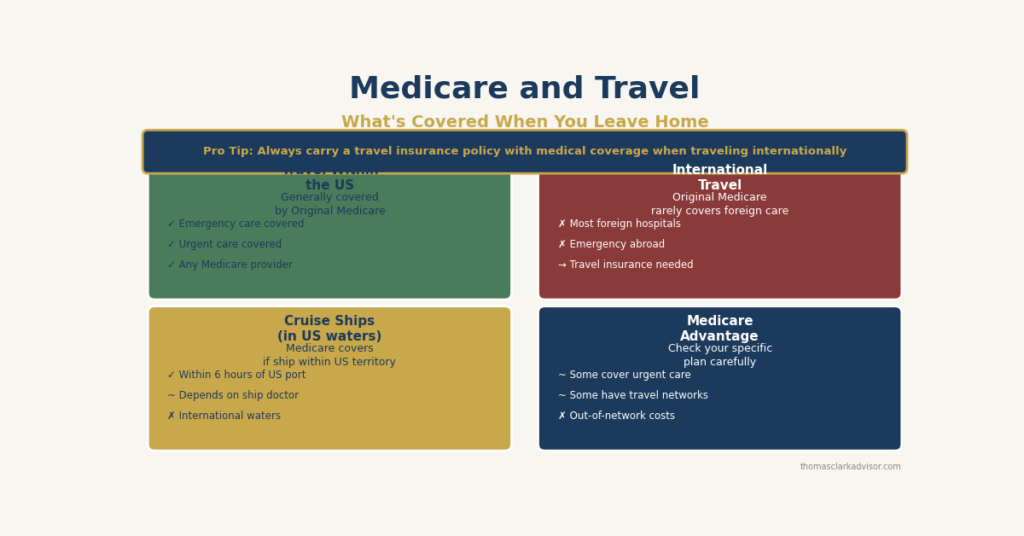
Medicare and Travel: What’s Covered When You Leave Home
You’ve dreamed of spending winters in Arizona, summers in Maine, and maybe a few weeks in Europe each year. But before you book that flight, do you know whether your Medicare plan will cover you if something happens 2,000 miles from home?
This is one of the most common questions I hear from readers who are either approaching retirement or recently enrolled in Medicare. The answer depends heavily on which type of Medicare coverage you have — and getting it wrong could leave you with a significant unexpected medical bill in the middle of an otherwise perfect trip.
People make very costly assumptions about Medicare travel coverage. A Medicare Advantage plan that works beautifully at home can leave you scrambling to pay out-of-pocket for care in another state. A Medigap policy, on the other hand, can give you remarkable flexibility everywhere you go in America — and even abroad.
Let me walk you through exactly what each type of Medicare covers when you travel, where the gaps are, and how to make sure you’re protected no matter where retirement takes you.
Table of Contents
- Original Medicare (Parts A & B): The Nationwide Safety Net
- Medicare Advantage: The Network Problem
- The Snowbird Problem: Spending Months Away From Home
- International Travel: Where Medicare Falls Short
- Medigap and Foreign Travel Emergency Coverage
- Travel Insurance for Retirees: What to Look For
- Telehealth While Traveling: Medicare Now Has You Covered
- Prescription Drug Coverage When You’re Away From Home
- Original Medicare + Medigap vs. Medicare Advantage for Active Travelers
- Checklist: What Every Traveling Retiree Should Do Before They Go
- Key Takeaways
- Frequently Asked Questions
Original Medicare (Parts A & B): The Nationwide Safety Net {#original-medicare-travel}
If you’re enrolled in Original Medicare — Part A (hospital insurance) and Part B (medical insurance) — you have one significant advantage when it comes to travel: Medicare follows you anywhere in the United States.
There are no network restrictions with Original Medicare. You can walk into virtually any hospital or see virtually any doctor anywhere in the country, as long as that provider accepts Medicare assignment. And the vast majority of U.S. hospitals and physicians do.
Here’s what that looks like in practice:
- You fall and break a hip while visiting family in Portland, Oregon. Original Medicare covers your emergency room visit and inpatient hospital stay, just as it would at home in Charlotte.
- You have a cardiac event on a cruise ship that docks in Miami. If you’re seen at a Medicare-participating facility, you’re covered.
- You spend the winter in Scottsdale and see a cardiologist for a routine follow-up. If that cardiologist accepts Medicare, your Part B covers it at the standard cost-sharing rates.
The trade-off: Original Medicare alone has no out-of-pocket maximum. That means you’re exposed to potentially unlimited costs — 20% coinsurance on Part B services, daily inpatient co-pays after the 60th day of hospitalization, and so on. Most people who choose Original Medicare pair it with a Medicare Supplement (Medigap) policy to cap those costs.
Pro Tip: Before you travel domestically, go to Medicare.gov’s care compare tool to search for Medicare-participating providers in your destination area. It takes five minutes and can save you significant stress if something comes up.
Medicare Advantage: The Network Problem {#medicare-advantage-travel}
Medicare Advantage (Part C) plans have become enormously popular — and for good reason. Many offer $0 premiums, bundled drug coverage, dental, vision, and hearing benefits you won’t find in Original Medicare. For people who stay close to home and use providers within their plan’s network, they can be excellent coverage.
But Medicare Advantage plans are built around networks, and that’s where travel creates serious complications.
Most Medicare Advantage plans operate as HMO or PPO networks tied to a specific geographic service area. When you’re within that service area and seeing in-network providers, you’re well-covered. When you travel outside it, the rules change dramatically.
Here’s the critical distinction:
- Emergency care: All Medicare Advantage plans are required by federal law to cover emergency care anywhere in the United States, even outside your service area. If you have a heart attack in Denver, you’re covered for the emergency.
- Urgently needed care: Most plans also cover urgently needed care when you’re temporarily away from your service area — the kind of care that can’t wait until you get home.
- Routine or ongoing care: This is where things get problematic. If you want to see a specialist, get a follow-up visit, or manage a chronic condition while you’re traveling, your Medicare Advantage plan likely will not cover it outside the network.
Some plans offer out-of-network PPO coverage, but it typically comes with higher cost-sharing than in-network care — and in some cases, you’ll need to pay out of pocket and seek reimbursement, which is its own administrative headache.
Thomas’s Take: Heavy travelers — especially those who spend extended time in another region — should actually read their Medicare Advantage Evidence of Coverage document to understand what’s covered outside their service area. Most haven’t. to understand what’s covered outside their service area. Most haven’t. That document is the binding legal description of your benefits, and the travel provisions vary significantly from plan to plan.
The Snowbird Problem: Spending Months Away From Home {#snowbird-problem}
Here’s a scenario that plays out regularly: imagine someone enrolled in a Medicare Advantage plan with a regional HMO network. Their copays are low, they like their doctors, and the plan has a zero-dollar premium. Then they decide to spend November through April in Naples, Florida. Their copays are low, they like their doctors, and the plan has a zero-dollar premium. Life is good.
Then they decide to spend November through April in Naples, Florida — a dream they’ve had for years.
What happens to their coverage?
With a regional HMO plan, spending six months in another state is not considered “temporary travel.” Medicare Advantage plans are designed for people who live within the service area. When you move away for an extended period — even seasonally — you’re in a coverage gray zone that many people don’t anticipate.
Some plans address this with:
- Multi-state or national PPO networks: Larger national MA plans like some AARP/UnitedHealthcare PPO plans have broader networks that span multiple states, giving you more coverage flexibility.
- Special Enrollment Periods: If you move to a new permanent (or part-time) residence outside your plan’s service area, you may qualify for a Special Enrollment Period to switch plans. Understanding Medicare enrollment deadlines and penalties is essential so you don’t miss these windows.
- Seasonal exceptions: A handful of plans have provisions for snowbirds, but they’re the exception, not the rule.
The cleanest solution for snowbirds, in my experience, is often Original Medicare paired with a Medigap plan — which I’ll address in depth below. That combination gives you seamless coverage everywhere in the U.S., no network worries, and predictable out-of-pocket costs.
Important: Always verify your specific plan’s snowbird provisions directly with your plan carrier before you commit to an extended stay away from home. Don’t rely on assumptions or what you were told at enrollment.
International Travel: Where Medicare Falls Short {#international-travel}
This is the section that surprises people the most.
Original Medicare generally does NOT cover medical care received outside the United States. The United States, for Medicare purposes, includes the 50 states, the District of Columbia, Puerto Rico, the U.S. Virgin Islands, Guam, the Northern Mariana Islands, and American Samoa — but not anywhere else in the world.
So if you’re traveling through Europe, taking a river cruise in Southeast Asia, or spending time in Canada or Mexico, Original Medicare will not pay for your care in most circumstances.
There are a small number of narrow exceptions:
- Canadian and Mexican proximity: If you are in the contiguous United States and a Canadian or Mexican hospital is closer to you than the nearest U.S. hospital, and you have an emergency, Medicare may cover care at that foreign hospital. This is a very specific and limited exception.
- Ship travel: If you’re on a ship that is sailing in U.S. territorial waters (within 6 hours of a U.S. port), Medicare may cover care provided on the ship. Beyond 6 hours from port, you’re generally not covered.
Outside these narrow exceptions, if you need medical care abroad, you are paying out of pocket unless you have supplemental coverage that addresses international care.
The U.S. State Department explicitly advises American travelers — including Medicare beneficiaries — to purchase travel health insurance before traveling internationally. This is advice I strongly echo.
Pro Tip: Medical evacuation can cost $50,000 to $100,000 or more if you need to be airlifted back to the U.S. from a foreign country. No part of standard Medicare covers this. Travel insurance with medical evacuation coverage is not a luxury for international trips — it’s a genuine necessity.
Medigap and Foreign Travel Emergency Coverage {#medigap-foreign-travel}
If you have Original Medicare plus a Medigap (Medicare Supplement) policy, you may have more international protection than you think — though the limits are important to understand.
Specific Medigap plans include foreign travel emergency coverage:
Plans C, D, F, G, M, and N all include a foreign travel emergency benefit. Here’s how it works:
- Coverage trigger: The benefit applies to emergency care that begins during the first 60 days of a trip outside the U.S.
- What’s covered: Medically necessary emergency care while traveling abroad.
- Cost sharing:
- $250 per calendar year deductible (this is a separate deductible from your Medicare deductibles)
- 80% of covered costs after the deductible
- $50,000 lifetime maximum benefit
This is meaningful coverage, but it has real limits. For a short trip to Europe or a Caribbean cruise, it may be sufficient. For someone who spends months abroad each year, or who has complex medical needs, the $50,000 lifetime cap can be reached faster than expected — especially if a serious illness or hospitalization occurs in a country with high medical costs.
A couple of important notes:
- Plan availability: Since June 2010, Plans C and F have been closed to new Medicare enrollees (those who became eligible after January 1, 2020). If you’re newly enrolling in a Medigap plan, you’re most likely looking at Plans G and N as your primary options with foreign travel emergency coverage.
- This is NOT the same as comprehensive travel insurance. Medigap foreign travel coverage is emergency-only. It does not cover trip cancellation, routine care abroad, or care for pre-existing conditions being managed abroad.
For a deeper comparison of Medigap options, take a look at my breakdown of Medigap vs. Medicare Advantage costs in 2026.
Thomas’s Take: I think of Medigap’s foreign travel benefit as a safety net for acute emergencies — a heart attack in Paris, a bad fall in Rome. For the kind of comprehensive protection that international travel really warrants, you should layer actual travel insurance on top of it, not treat them as interchangeable.
Travel Insurance for Retirees: What to Look For {#travel-insurance-retirees}
Given Medicare’s international limitations, dedicated travel insurance is worth serious consideration for any retiree who travels abroad — or even domestically if they have a Medicare Advantage plan with network restrictions.
Two primary structures to understand:
1. Single-trip travel insurance Purchased for one specific trip, priced based on trip cost, destination, traveler age, and trip length. Good for one-off international trips or a big anniversary vacation. Be sure to read the fine print on pre-existing condition clauses — many policies require purchase within 10–14 days of your initial trip deposit to get a pre-existing condition waiver.
2. Annual multi-trip travel insurance Covers all trips taken within a 12-month period, typically with a per-trip day limit (60 or 90 days is common). For retirees who travel frequently — multiple international trips per year or extended snowbird-style domestic travel — this often makes more financial sense than buying individual policies each time.
Key features to look for:
- Medical coverage amount: Look for at least $100,000 in emergency medical coverage. $250,000 or more is even better, especially if you’re visiting countries with high healthcare costs (Switzerland, Japan, etc.).
- Medical evacuation coverage: Should be separate from the medical maximum and should ideally cover $500,000 or more. Evacuation costs can far exceed medical treatment costs.
- Pre-existing condition coverage: Understand the waiver terms and purchase timeline requirements.
- Cancel for any reason (CFAR): An optional upgrade that reimburses 50–75% of trip cost if you cancel for reasons not otherwise covered. Relevant if you have health concerns that may require trip cancellation.
- “Primary” vs. “secondary” coverage: Primary coverage pays your claim first; secondary pays after Medicare or other insurance. Primary is generally preferable.
The Centers for Medicare & Medicaid Services (CMS) provides clear guidance on what Medicare does and does not cover internationally — reviewing it before a big trip is worth the few minutes it takes.
Telehealth While Traveling: Medicare Now Has You Covered {#telehealth-traveling}
One of the more encouraging developments for traveling retirees is the significant expansion of Medicare telehealth coverage in recent years.
Medicare now covers telehealth services across state lines, meaning you can connect with your own doctors — the ones who know your history — even when you’re hundreds of miles away. This is particularly valuable for:
- Routine follow-up visits with your primary care physician or specialists
- Medication management and prescription renewals
- Mental health services, which have expanded telehealth access
- Chronic disease management for conditions like diabetes, hypertension, or heart disease
For Medicare Advantage enrollees, telehealth often helps bridge the gap when you’re traveling outside your service area. If you can handle a health concern via telehealth with your in-network provider, you avoid the network complications of an in-person visit at your travel destination.
A few practical notes:
- Not all providers are set up for telehealth across state lines — some have limitations based on state licensing laws for physicians. Check with your provider’s office before assuming telehealth is available everywhere.
- Telehealth coverage details can vary between Original Medicare and Medicare Advantage. Review your Medicare Part B coverage details or your plan’s Evidence of Coverage.
- Ensure you have a reliable internet connection for video visits. Audio-only telehealth may be covered in some circumstances, but video visits are typically preferred and more broadly reimbursed.
Prescription Drug Coverage When You’re Away From Home {#prescription-drug-travel}
Whether you have a standalone Medicare Part D plan or drug coverage bundled into a Medicare Advantage plan, prescription drug coverage while traveling is an area worth understanding before you go.
Here are the key rules and considerations:
The 30-day emergency supply rule Most Part D plans allow you to obtain an emergency supply of medication (typically up to a 30-day supply) at an out-of-network pharmacy when you’re traveling and can’t reach an in-network pharmacy. Cost-sharing may be higher than in-network, but the coverage is there. For a deeper dive on how Part D works, see my guide to understanding Medicare Part D.
In-network pharmacy networks span the country The major Part D pharmacy networks — CVS, Walgreens, Rite Aid, Walmart, and others — have locations nationwide. Most travelers will find in-network pharmacy options wherever they go in the U.S. Check your plan’s pharmacy locator tool before you leave to confirm in-network options at your destination.
Mail-order pharmacies If you take maintenance medications (prescriptions you take regularly for ongoing conditions), a mail-order pharmacy may be the most practical solution for extended travel. Mail-order can typically supply a 90-day supply, which covers most trips. Your Part D plan’s preferred mail-order pharmacy is usually the most cost-effective option.
International travel and prescriptions Medicare Part D does not cover prescriptions filled at foreign pharmacies. If you need medication while abroad, you’ll pay out of pocket. For trips of meaningful length, consider getting a 90-day supply before you leave — and carry a copy of your prescriptions and medication list (generic names, not just brand names, as branding varies internationally).
The broader picture on healthcare costs Prescription drug coverage is just one piece of the retirement healthcare puzzle. For a full look at how healthcare costs fit into a comprehensive retirement plan, see my article on healthcare costs in retirement planning.
Pro Tip: When traveling internationally, carry a letter from your physician listing all medications, dosages, and the conditions they treat. This is invaluable if you need emergency care abroad and medical staff need to understand your health history quickly.
In-Article Image: An infographic with navy (#1B3A5C) and gold (#C9A84C) brand colors showing a side-by-side comparison table: Original Medicare vs. Medicare Advantage travel coverage across three scenarios — Domestic Travel, Extended Snowbird Stay, and International Travel. Background light cream (#F8F6F0). Alt text: Comparison infographic showing Original Medicare versus Medicare Advantage coverage for domestic travel, snowbird stays, and international travel.
Original Medicare + Medigap vs. Medicare Advantage for Active Travelers {#original-vs-advantage-travelers}
This is the core strategic question for retirees who travel frequently, and it’s one I address with clients regularly.
Here’s my honest, experience-based take:
The case for Original Medicare + Medigap for active travelers is strong.
If you spend significant time away from your home area — whether that means multi-month snowbird stays, frequent domestic travel, or international trips — the structural advantages of Original Medicare’s nationwide coverage combined with Medigap’s supplemental protection are hard to match:
- No network restrictions anywhere in the U.S. — you see any Medicare-participating provider, period.
- Predictable out-of-pocket costs regardless of where you receive care.
- Foreign travel emergency coverage on Plans G and N (with the limits discussed above).
- No need to navigate “out-of-area” rules or worry about whether a provider is in-network in a city you’ve never visited.
The trade-offs are real:
- Higher monthly premiums for Medigap compared to many MA plans.
- No bundled dental, vision, or hearing coverage (you pay for those separately).
- Part D drug coverage requires a separate standalone policy.
The right answer depends on your specific health situation, travel patterns, budget, and risk tolerance. When you run the numbers for someone who travels extensively, the premium differential between a Medigap plan and a zero-premium MA plan is often recovered quickly once you account for cost-sharing certainty and coverage flexibility.
If you haven’t already compared these options head-to-head, my detailed analysis of Medicare Supplement vs. Medicare Advantage and the 2026 cost comparison are good starting points.
Thomas’s Take: I’m not a Medicare insurance agent and I don’t sell plans — my job is to help you think through the strategic layer. But I’ll say this plainly: if travel is a cornerstone of your retirement vision, the coverage flexibility of Original Medicare + Medigap is worth the premium cost for most people. The one thing you can’t predict is where you’ll be when something goes wrong.
Checklist: What Every Traveling Retiree Should Do Before They Go {#travel-checklist}
Before any trip — domestic or international — here’s a practical checklist I share with clients:
Before You Leave Home
- [ ] Carry your Medicare card. Your red, white, and blue Medicare card should be in your wallet whenever you travel. Keep a photocopy in a separate bag as backup.
- [ ] Know your Medicare Advantage plan’s out-of-area rules. If you have an MA plan, re-read your Evidence of Coverage section on travel and out-of-area coverage before each trip.
- [ ] Confirm telehealth availability with your primary care physician and any specialists you see regularly.
- [ ] Refill prescriptions before you leave. Aim for a 90-day supply for maintenance medications.
- [ ] Prepare a medication list — generic drug names, dosages, and the conditions being treated. Keep a copy in your wallet and share with a trusted contact at home.
- [ ] Locate in-network pharmacies at your destination using your Part D plan’s locator tool.
- [ ] Purchase travel insurance for international trips. Look for robust emergency medical and medical evacuation coverage.
- [ ] Save emergency numbers:
- Medicare: 1-800-MEDICARE (1-800-633-4227)
- Your Medicare Advantage plan’s member services line (if applicable)
- Your Medigap carrier’s customer service line (if applicable)
- Your travel insurance provider’s emergency assistance line
For International Travel Specifically
- [ ] Understand that Original Medicare does not cover care abroad (except narrow exceptions).
- [ ] Know your Medigap foreign travel emergency benefit limits (if applicable): $250 deductible, 80% coverage, $50,000 lifetime max.
- [ ] Carry your travel insurance documentation and emergency assistance contact number.
- [ ] Register your trip with the U.S. State Department via their STEP program for safety alerts and emergency assistance.
- [ ] Carry a physician letter detailing your medical history, conditions, and medications.
- [ ] Know the U.S. embassy or consulate location at your destination in case of emergency.
Key Takeaways {#key-takeaways}
-
Original Medicare (Parts A & B) covers you everywhere in the U.S. with no network restrictions — it’s the most travel-friendly base coverage available.
-
Medicare Advantage plans are network-based and typically only cover emergency and urgent care outside your service area. Routine care away from home may not be covered, which creates real complications for snowbirds and frequent travelers.
-
Original Medicare does not cover care outside the U.S. in most circumstances — Medigap plans with foreign travel emergency benefits (Plans C, D, F, G, M, N) provide 80% coverage after a $250 deductible, up to a $50,000 lifetime maximum.
-
Travel insurance with robust emergency medical and evacuation coverage is essential for international travel and strongly recommended for any retiree whose Medicare coverage has geographic limitations.
-
For retirees who travel extensively, the combination of Original Medicare plus a Medigap plan often provides superior coverage flexibility compared to Medicare Advantage, despite the higher premium cost.
Frequently Asked Questions {#faq}
Q: Does Medicare cover me if I visit Canada or Mexico?
A: Generally no. Original Medicare does not cover care in Canada or Mexico in most situations. There is a narrow exception if you are in the contiguous U.S. and a Canadian or Mexican hospital is closer than the nearest U.S. hospital during an emergency. Otherwise, you are responsible for costs. Medigap foreign travel emergency benefits do apply in Canada and Mexico, as do travel insurance policies. If you visit either country frequently, travel insurance or a robust Medigap plan with foreign travel coverage is important protection to have.
Q: I have a Medicare Advantage plan. Can I switch to Original Medicare if I want better travel coverage?
A: Yes, but timing matters. You can switch from Medicare Advantage to Original Medicare during the Annual Enrollment Period (October 15 – December 7 each year) or during the Medicare Advantage Open Enrollment Period (January 1 – March 31). However, if you want to add a Medigap plan after you’ve had Medicare Advantage, you may face medical underwriting in most states — meaning your health history could affect your eligibility or premium for a Medigap policy. The exception is if you’re within your guaranteed issue rights window. Understanding Medicare enrollment deadlines and penalties is critical before making this move.
Q: My Medicare Advantage plan advertises “nationwide coverage.” Does that mean I’m fully covered when I travel?
A: Not necessarily — read the fine print carefully. “Nationwide coverage” in a Medicare Advantage plan typically means coverage for emergency and urgently needed care anywhere in the U.S., which is required by federal law for all MA plans. It does not necessarily mean full in-network benefits for routine care outside your plan’s service area. Some national PPO plans do offer broader coverage, but cost-sharing outside the home network is often higher. Always review your Evidence of Coverage document for the specific terms.
Q: Does Medicare cover a medical evacuation flight back to the United States from another country?
A: No. Neither Original Medicare nor Medicare Advantage covers international medical evacuation. This is one of the most important reasons to purchase travel insurance with dedicated medical evacuation coverage when traveling abroad. Evacuation flights can cost anywhere from $30,000 to over $100,000 depending on the location and your medical condition. This is not an expense to leave to chance.
Ready to Talk Through Your Coverage?
Medicare decisions are among the most consequential financial choices retirees make — and they intersect directly with how and where you want to live in retirement. If you’re an active traveler, a snowbird, or planning international adventures, making sure your healthcare coverage keeps up with your lifestyle is part of a well-built retirement plan.
Medicare-and-travel decisions are easiest to make in the context of your full financial picture, not in isolation. New TCA posts arrive weekly — sign up at the bottom of this page for more on the intersection of Medicare and retirement planning.
For more on retirement income, bucket planning, and Social Security claiming, browse the retirement planning archive or sign up for the weekly newsletter at the bottom of any page.
This article is published by Confluence Media Group LLC, an independent publisher of educational financial content. Thomas Clark is a Series 65 Investment Advisor Representative. The information provided is for educational and informational purposes only and is not personalized financial, tax, or legal advice. Past performance does not guarantee future results. All investing involves risk, including potential loss of principal. Consult a qualified professional before making financial decisions.
Confluence Media Group LLC is a separate entity from Confluence Capital Management, the investment advisory practice through which Thomas Clark provides advisory services. Advisory services are not offered through this publishing platform.

Thomas Clark is a Series 65 licensed investment advisor and experienced trader. He specializes in investing, retirement planning, and market analysis, helping individuals build wealth and make informed financial decisions.
