
Pension Lump Sum vs. Annuity: How to Actually Decide
Your pension may offer a monthly check for life or a one-time lump sum you roll to an IRA. Here's how to actually decide — five questions that matter more than any break-even age, plus the tax trap to avoid.

The letter from HR looks like a form to sign. It isn’t. It’s one of the largest, most permanent financial decisions you’ll ever make, and once you sign it, there’s usually no taking it back. Your pension is offering you a choice: a monthly check for the rest of your life, or a one-time lump sum you can roll into an IRA and manage yourself.
Most people walk into this asking the wrong question — “which one gives me more money?” — and let a break-even spreadsheet answer it. The right question is what kind of retirement each choice buys you, and whether you’re giving up something you can’t easily rebuild.
My honest bias up front: for many retirees, that monthly pension is worth more than it looks, because it’s the one thing retirement income is hardest to manufacture — a paycheck that shows up whether the market is up or down and never runs out. But “many” isn’t “all,” and there are real situations where the lump sum is clearly the better call. Here’s the framework to tell them apart.
What you’re actually being offered
A traditional pension — a defined benefit plan — promises you a set monthly payment for life, calculated from your salary and years of service. When you retire (or when a company decides to “de-risk” its plan), you’re often given a one-time election:
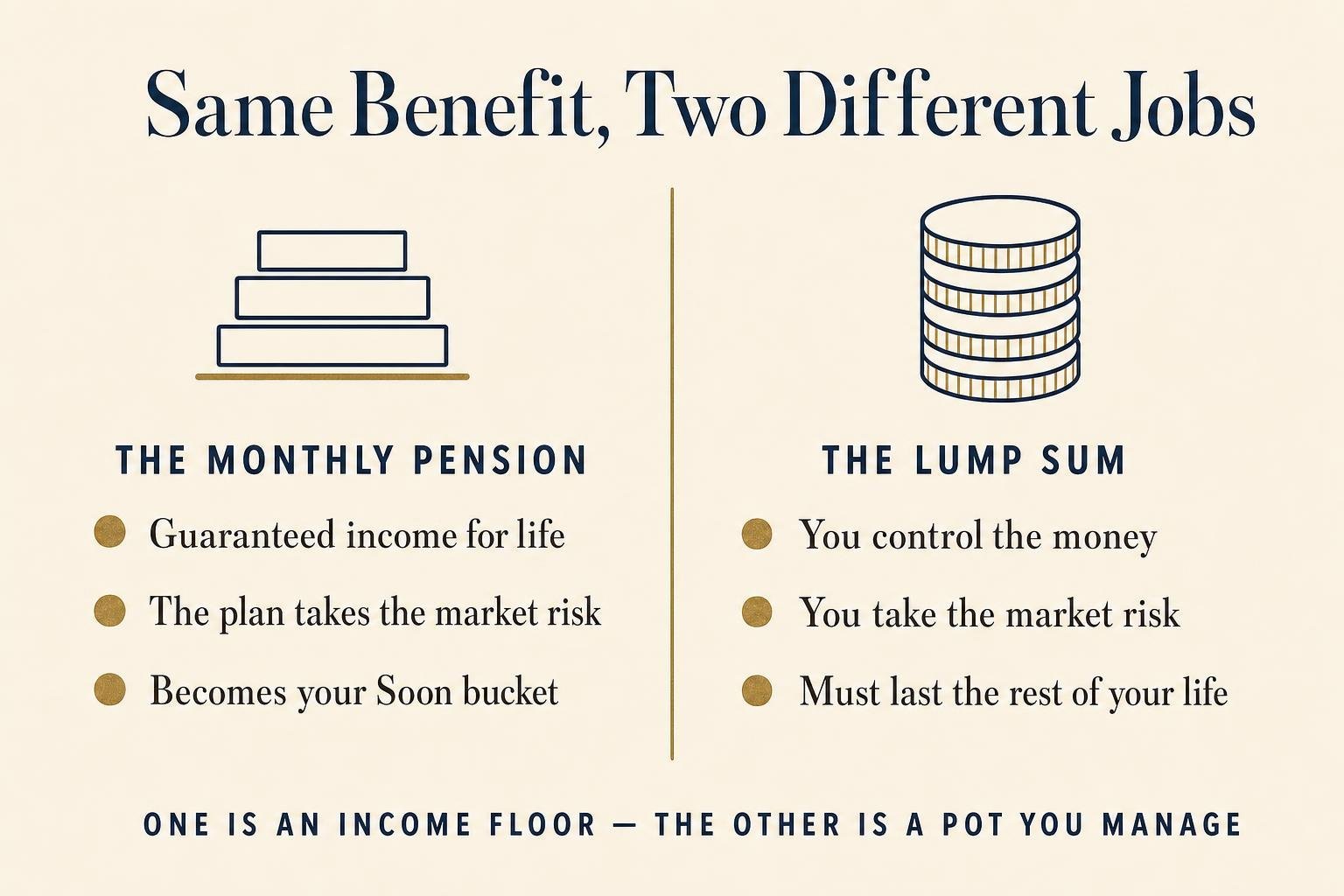
The monthly annuity. A fixed check every month for as long as you live. You’ll usually choose between a single-life option (larger check, stops when you die) and a joint-and-survivor option (smaller check, but it continues to your spouse after you’re gone). This is guaranteed income in the truest sense of the word.
The lump sum. The plan hands you the present value of that future stream — often several hundred thousand dollars — which you roll directly into an IRA. From that day forward, the money is yours to invest, spend, and pass on. So is the responsibility of making it last 30 years. And the election is almost always irreversible: take the lump sum and the monthly pension is gone for good, which is exactly why it deserves more than a signature.
The monthly pension is a bucket you didn’t have to build
Regular readers know I organize retirement income into three buckets: a Now bucket for near-term spending, a Soon bucket that produces a guaranteed income floor to cover your essential bills, and a Later bucket invested for growth. The hardest of the three to build from scratch is the Soon bucket — the guaranteed floor. It’s why so much of my writing on sizing that floor and on the annuities that fill it comes back to the same idea: guaranteed lifetime income is expensive to buy and priceless to have.
A monthly pension is that floor, already built and paid for. Trading it for a lump sum means tearing down your Soon bucket and betting you can rebuild an equal or better income stream yourself — through the market, or by buying a commercial annuity. Sometimes you can. Often, at today’s prices, you can’t. That’s the piece the “just take the cash and let me manage it” advice quietly skips.
Thomas’ Take: A guaranteed income floor doesn’t just pay your bills — it changes how you experience every market downturn. When your essentials are covered by a check that can’t fall, a 20% drop in your portfolio is a headline, not an emergency. That psychological cushion is the real product a pension delivers, and it never shows up in a break-even calculation.
The five questions that should actually decide it
Forget the break-even age. These five questions — the kind of factors FINRA urges retirees to weigh before choosing a payout method — tell you far more.
1. Is the plan healthy — and is your benefit federally guaranteed? Private single-employer pensions are insured by the Pension Benefit Guaranty Corporation (PBGC). If your employer fails, the PBGC steps in — but only up to a cap. For plans terminating in 2026, that maximum guarantee is $7,789.77 per month (about $93,477 a year) for a 65-year-old taking a straight-life benefit, and it’s lower if you start earlier or elect survivor protection. If your promised benefit sits comfortably under that cap and the plan is well funded, your monthly check is about as safe as money gets. If your benefit runs well above the cap and the plan is shaky, that uninsured excess is a genuine reason to consider taking the lump sum off the table while you can. Note that government and most public-sector pensions are not PBGC-insured — they’re backed by the plan sponsor instead.
2. What “payout rate” is the pension really offering? Divide the annual pension by the lump sum. If the monthly option pays $2,900 ($34,800 a year) and the lump sum is $520,000, the pension is effectively paying out about 6.7% of the cash value every year — for life, with no market risk. Then ask the honest follow-up: at today’s interest rates, would $520,000 buy you a $2,900 monthly check for life from an insurance company? Frequently the answer is no. And there’s a timing wrinkle in your favor right now.
3. How’s the survivor and inflation protection? Most private pensions pay a level benefit with no cost-of-living adjustment, so inflation erodes its purchasing power over decades — a real mark against the monthly option. But the survivor feature cuts the other way: a joint-and-survivor election keeps paying your spouse for the rest of their life, which a self-managed lump sum only does if your investing goes well and you don’t overspend. Weigh both honestly.
4. Do you already have a guaranteed income floor — and do you need liquidity? If Social Security plus this pension would cover essentially all of your essential bills, your floor is secure, and taking the lump sum to fund your Later bucket for growth and legacy can make sense. But if this pension is your floor — the difference between covering the mortgage and not — that’s precisely the income you should think hardest before dismantling.
5. What do longevity and health tell you? A lifetime pension is longevity insurance: it pays most for the person who lives a long time — exactly the risk your savings can’t easily cover. Strong health and a family history of long life push the monthly annuity’s value up. A serious health condition and no spouse to protect pushes toward the lump sum, money you control now and can leave to heirs.
Why the monthly option looks stronger in 2026
Lump-sum offers aren’t pulled from thin air. Federal law requires plans to calculate them using IRS segment rates — corporate bond interest rates that move inversely to the payout. When rates are high, it takes less cash today to fund your future payments, so the lump sum shrinks. When rates are near zero, lump sums balloon.
Back in 2020–2021, with rates near historic lows, lump-sum offers were unusually generous. Today, with segment rates meaningfully higher, the same monthly benefit produces a noticeably smaller lump sum. In plain terms: the pension is handing you less cash to walk away from the same guaranteed check — the opposite of the setup that made cashing out so popular when rates were rock-bottom.
Pro Tip: Before you decide, request your plan’s annual funding notice (or find its Form 5500). It tells you how well funded the plan is. A plan funded at 100%+ backing a benefit under the PBGC cap is a very different risk picture than an 80%-funded plan promising you more than the insurance covers.
When the lump sum is genuinely the better call
I’m not anti-lump-sum. Take it seriously when:
- Your benefit exceeds the PBGC guarantee and the plan is underfunded — you’re carrying uninsured risk.
- You have a serious health condition and no spouse to protect, so lifetime income is worth less to you than money you can use and leave behind.
- You already have a large guaranteed floor from Social Security or another pension, and this money is better deployed for growth and legacy.
- You want the flexibility to control withdrawals for tax planning — for instance, doing Roth conversions in your low-income years, which a fixed pension check doesn’t allow.
Consider a hypothetical case: Gary, 63, is retiring from a manufacturer outside Greensboro. His plan offers $2,900 a month for life (about $2,600 with 100% survivor protection for his wife, Denise, 61) or a $520,000 lump sum. The plan is well funded and his benefit sits under the PBGC cap. Gary and Denise’s Social Security plus the survivor pension would cover nearly all their essential spending. For them, keeping the joint-and-survivor annuity as their locked-in Soon bucket — and investing Gary’s separate 401(k) as their Later bucket — builds a sturdier retirement than managing one $520,000 pile flawlessly for 30-plus years. Flip two facts — a shaky plan with a benefit above the cap, or a serious health issue and no survivor to protect — and the lump sum becomes the smarter move.
This is exactly the kind of trade-off worth modeling before you sign. A planning tool like ProjectionLab lets you run “keep the monthly pension” against “invest the lump sum across my buckets” side by side, with your real Social Security and spending numbers, so you’re deciding on evidence instead of instinct. (ProjectionLab is a paid tool; the link is an affiliate link, which means I may earn a small commission at no extra cost to you. I only recommend tools I’d use myself.)
The tax trap most people trigger by accident
If you do take the lump sum, one rule matters above all others: never have the check made out to you. Do a direct rollover — plan straight to IRA custodian — so no tax is due. If the plan cuts you a check instead, it’s required to withhold 20% for taxes, and if you don’t redeposit the full amount (including the withheld portion) within 60 days, the shortfall becomes taxable income and may trigger a 10% early-withdrawal penalty. The IRS rollover rules are unforgiving here. And once the money is safely in the IRA, remember it’s not a windfall to spend — it’s the entire guaranteed income stream you just gave up, now sitting in your lap to make last.
Key takeaways
- The pension election is usually permanent — treat it like the major decision it is, not a form.
- A monthly pension is a pre-built guaranteed income floor (your Soon bucket); a lump sum makes you rebuild that floor yourself.
- Decide with five questions — plan health and PBGC coverage, the payout rate, survivor/inflation protection, whether you already have a floor, and longevity — not a break-even age.
- Higher 2026 interest rates mean smaller lump sums for the same benefit, which tilts many decisions back toward the monthly income.
- If you take the lump sum, use a direct rollover to avoid the 20% withholding and 60-day trap.
Frequently asked questions
Can I change my mind after I make the election? Almost never. Once you elect and payments begin, the choice is locked. Some plans allow a short window to adjust survivor options, but the core lump-versus-monthly decision is permanent — which is why it’s worth slowing down for.
Is my pension safe if my company goes bankrupt? For private single-employer plans, the PBGC insures your benefit up to the annual maximum ($7,789.77/month at 65 for 2026 terminations). If your promised benefit is under that cap, you’re well protected. If it’s above the cap and the plan is underfunded, the excess is at risk — a real factor in favor of the lump sum.
Should I take the lump sum just because rates are high? It’s usually the reverse. High interest rates shrink lump-sum offers, so today’s cash-out is smaller relative to the monthly benefit than it was a few years ago. That generally strengthens the case for keeping the guaranteed monthly income, not cashing it out.
Whatever you decide, decide on purpose. A pension is the closest thing most people will ever have to a personal, guaranteed paycheck for life — and a choice this permanent deserves more than the few minutes it takes to sign the form. If you want the framework behind all of this, start with the Now, Soon, Later bucket approach.
This article is published by Confluence Media Group LLC, an independent publisher of educational financial content. Thomas Clark is a Series 65 Investment Advisor Representative. The information provided is for educational and informational purposes only and is not personalized financial, tax, or legal advice. Past performance does not guarantee future results. All investing involves risk, including potential loss of principal. Consult a qualified professional before making financial decisions.
Confluence Media Group LLC is a separate entity from Confluence Capital Management, the investment advisory practice through which Thomas Clark provides advisory services. Advisory services are not offered through this publishing platform.
About Thomas Clark
Thomas Clark is the founder of Confluence Media Group LLC and a Series 65 Investment Advisor Representative. He has spent nearly two decades working with families on retirement planning, with a focus on Social Security optimization, retirement income coordination, and the bucket planning approach to building a guaranteed income floor.
Thomas writes and publishes at thomasclarkadvisor.com and is the author of The Just in Case Binder — a 148-page printable family financial organizer for households who want to make sure the people they love know where everything is.
He lives in North Carolina with his family.
Subscribe to the weekly newsletter · Get the Just in Case Binder

Thomas Clark is a Series 65 licensed investment advisor and experienced trader. He specializes in investing, retirement planning, and market analysis, helping individuals build wealth and make informed financial decisions.
