
Building a Retirement Income Floor: Guaranteed vs. Variable Sources

Key Takeaways
- Your income floor is the guaranteed income that covers essential expenses — housing, food, healthcare, utilities, and insurance — regardless of what the stock market does.
- Social Security is the cornerstone of most income floors, providing inflation-adjusted payments for life. Delaying to age 70 can increase this foundation by 76% compared to claiming at 62.
- The gap between your essential expenses and guaranteed income is the most important number in retirement planning — it tells you how much additional income you need from savings.
- Annuities can fill income floor gaps but come with tradeoffs — guaranteed payments in exchange for reduced liquidity and potential growth.
- Once your floor is covered, your investment portfolio can focus on growth — you won’t be forced to sell stocks in a downturn to pay for groceries.
Table of Contents
- What Is a Retirement Income Floor?
- Why the Income Floor Matters More Than Total Net Worth
- The Three Pillars of Guaranteed Income
- How to Calculate Your Essential Expense Number
- Measuring the Gap: Where Your Floor Falls Short
- Filling the Gap: Annuities and Other Options
- The Income Floor and Your Investment Strategy
- A Hypothetical Income Floor in Action
- FAQ
What Is a Retirement Income Floor?
Picture your retirement finances as a house. The floor — the foundation — is income you can count on no matter what happens in the economy, the stock market, or interest rates. It arrives every month like clockwork, it lasts your entire lifetime, and it isn’t affected by market crashes or recessions. Your retirement income floor is the guaranteed income that covers your non-negotiable monthly expenses. If your essential costs are $5,000 per month and your guaranteed income from Social Security and a pension is $4,200, you have a $800 monthly gap. That gap is the most important number in your retirement plan — because how you fill it determines how well you’ll sleep at night. The income floor concept comes from the financial planning philosophy that separating “needs” from “wants” is the foundation of a stress-free retirement. When your essential expenses are covered by income you can’t outlive, market volatility becomes a concern for your portfolio — not for your grocery budget.Why the Income Floor Matters More Than Total Net Worth
Some retirees with $2 million saved are anxious about running out of money, while others with $600,000 sleep soundly — the difference often comes down to whether essential expenses are covered by guaranteed income. The anxious millionaire often has most of their money in investment accounts with no pension and minimal Social Security. Every dollar they spend comes from selling investments — which means every market downturn directly threatens their lifestyle. The relaxed $600,000 saver typically has a strong combination of Social Security (especially if they delayed to 70), a pension or annuity, and a manageable essential expense budget. Their portfolio is supplemental — it funds travel, gifts, and luxuries. A 20% market drop doesn’t change their daily life at all. This is why I always start planning conversations with income, not assets. The question isn’t “How much do you have?” — it’s “How much guaranteed income will you receive, and what does it need to cover?”Thomas’ Take: I’ve found that the single greatest predictor of retirement happiness isn’t net worth — it’s the gap between essential expenses and guaranteed income. Close that gap, and almost everything else becomes manageable.
The Three Pillars of Guaranteed Income
Most retirement income floors are built from three sources. Not everyone has all three, but understanding each one helps you identify where your floor stands.Pillar 1: Social Security
For most Americans, Social Security is the largest piece of guaranteed retirement income. The average monthly benefit in 2026 is approximately $1,980, but your specific benefit depends on your earnings history and when you claim. The power of Social Security as an income floor is threefold:- It lasts for life. You cannot outlive it.
- It’s inflation-adjusted. The annual COLA increase protects your purchasing power.
- It’s backed by the federal government. Not dependent on any company or insurance carrier.
Pillar 2: Pensions
If you have a defined benefit pension — from a government employer, military service, or certain private companies — this is another guaranteed income stream. Pensions typically provide a fixed monthly payment for life, and some include inflation adjustments or survivor benefits. The number of Americans with pensions has declined significantly over the past 40 years. In 1980, about 38% of private-sector workers had a pension. Today, it’s closer to 15%. But if you have one, it’s a powerful floor component. One key decision: if offered a choice between a lump sum payout and monthly pension payments, the right answer depends entirely on your personal situation. The lump sum gives you control and flexibility (and can be passed to heirs), while the monthly payment provides guaranteed lifetime income. I walk through this decision in detail in a future article on pension lump sum vs. monthly payments.Pillar 3: Annuities
An income annuity is essentially a private pension — you give an insurance company a lump sum (or a series of premiums), and they contractually guarantee a monthly income for life. There are two common ways to build that income: Fixed-indexed annuity (FIA) with a guaranteed-lifetime-income rider. The most common approach in the bucket-planning framework I write about. The contract has an underlying account value that participates in market index gains within a 0 percent floor and a cap, but the income guarantee is separate from that account value: turn the rider on, and you receive a contractually defined monthly payment for life. Single premium immediate annuity (SPIA) or deferred income annuity (DIA). The simpler structure: a lump sum (or scheduled premiums) converts directly into a stream of guaranteed payments. There is no account value to manage, and no surrender option once the contract is annuitized. Both produce a contractually guaranteed monthly check. Which one fits a particular plan depends on liquidity needs, the desire (or not) to keep an account value visible, and how the income guarantee compares between competing carriers. Variable annuities are not part of this discussion. They combine market risk with high fees and are not how I build an income floor.How to Calculate Your Essential Expense Number
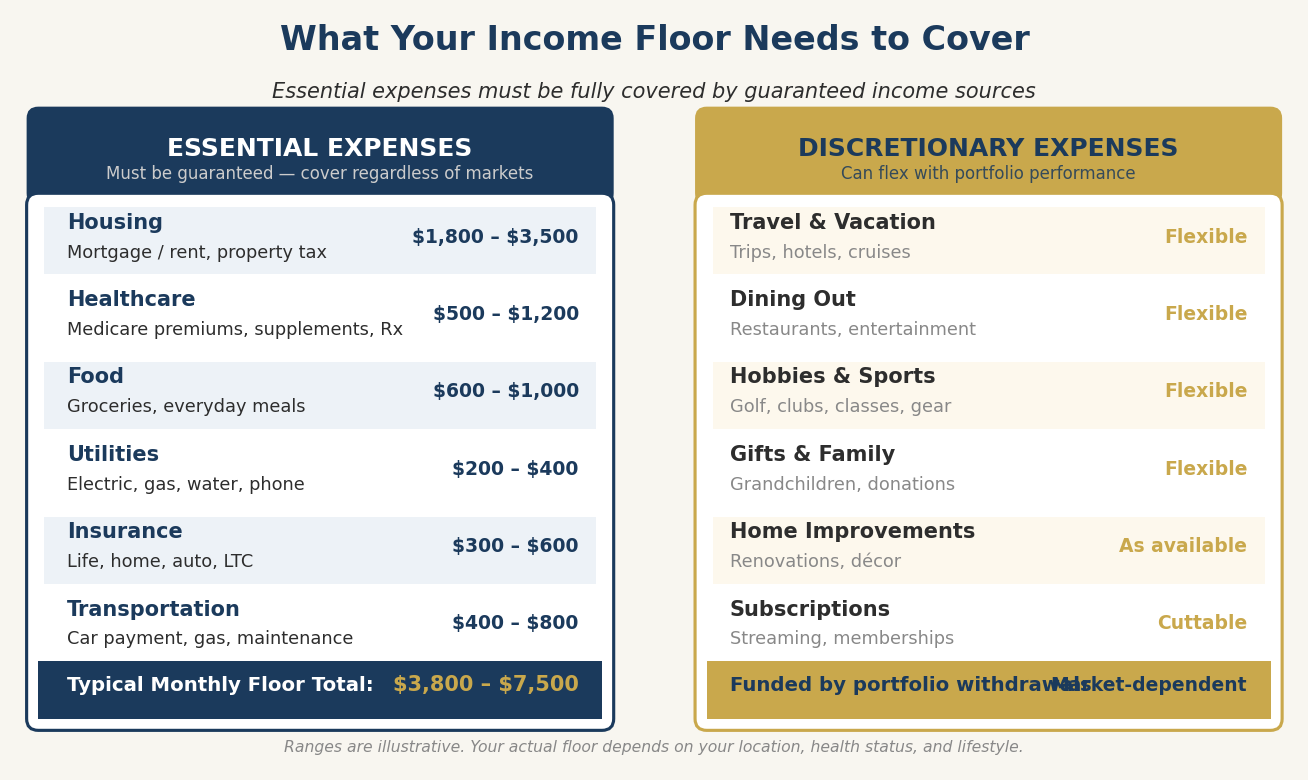
Your income floor is only as useful as the expense number it is designed to cover. Here is how I would walk through calculating your essential monthly expenses: Essential (non-negotiable) expenses:| Category | Typical Range |
|---|---|
| Housing (mortgage/rent, insurance, property tax, maintenance) | $1,200 – $2,500 |
| Food and groceries | $400 – $800 |
| Healthcare (Medicare premiums, supplements, prescriptions, dental) | $500 – $1,200 |
| Utilities (electric, water, gas, phone, internet) | $300 – $500 |
| Transportation (car payment, insurance, gas, maintenance) | $300 – $700 |
| Insurance (life, umbrella, long-term care) | $200 – $600 |
| Total essential expenses | $2,900 – $6,300 |
- Travel and entertainment
- Dining out
- Gifts and charitable giving
- Hobbies and recreation
- Home improvements
Measuring the Gap: Where Your Floor Falls Short
Once you know your essential expenses and your guaranteed income, the math is simple: Income Floor Gap = Essential Monthly Expenses – Guaranteed Monthly Income Consider this hypothetical: Richard and Diane, both 66, have the following income sources:- Richard’s Social Security (claiming at 67): $2,800/month
- Diane’s Social Security (claiming at 67): $1,400/month (spousal benefit)
- Richard’s pension from state employment: $1,200/month
- Total guaranteed monthly income: $5,400
Filling the Gap: Annuities and Other Options
If your income floor gap is significant, here are the primary tools for closing it: Option 1: Delay Social Security. If you haven’t yet claimed, each year of delay between 62 and 70 increases your benefit by 6-8%. For many people, this is the single most effective way to build a larger income floor. You can use savings to bridge the gap while your guaranteed income grows. Option 2: Add a guaranteed-income annuity. Either a fixed-indexed annuity with a lifetime-income rider or a SPIA can convert a portion of your nest egg into contractually guaranteed monthly income. The right choice depends on whether you want an account value to remain visible (FIA) or prefer the simpler one-time conversion (SPIA), and on which carrier offers the better income guarantee at the time you buy. Option 3: Build a bond or CD ladder. While not truly guaranteed for life (the payments end when the ladder matures), a bond ladder creates predictable, scheduled income for a defined period. This works well as a medium-term floor supplement if you expect other income to start later (e.g., a delayed Social Security benefit or a deferred annuity). Option 4: Reduce essential expenses. Sometimes the most effective strategy is shrinking the gap from the expense side. Downsizing your home, moving to a lower-cost area, or paying off your mortgage before retirement can dramatically reduce the income floor you need.The Income Floor and Your Investment Strategy
Here’s where the income floor concept transforms retirement investing: once your essential expenses are covered by guaranteed income, your investment portfolio serves a different purpose. Without an income floor, your portfolio must function as both a growth engine AND a monthly paycheck. This creates the fundamental tension of retirement investing — you need growth (stocks) for longevity, but you need stability (bonds/cash) for income. A market crash forces you to sell stocks at low prices to pay bills, permanently damaging your portfolio. With an income floor, your portfolio only needs to fund discretionary spending and provide long-term growth against inflation. If the market drops 30%, you can:- Temporarily reduce discretionary spending (skip the European vacation, eat out less)
- Leave your stock portfolio untouched to recover
- Continue receiving your full guaranteed income for essentials
Thomas’ Take: The income floor doesn’t just protect your money — it protects your behavior. When your grocery bill doesn’t depend on the S&P 500, you make better investment decisions. Fear-driven selling disappears because the stakes of any single market day are fundamentally lower.
A Hypothetical Income Floor in Action
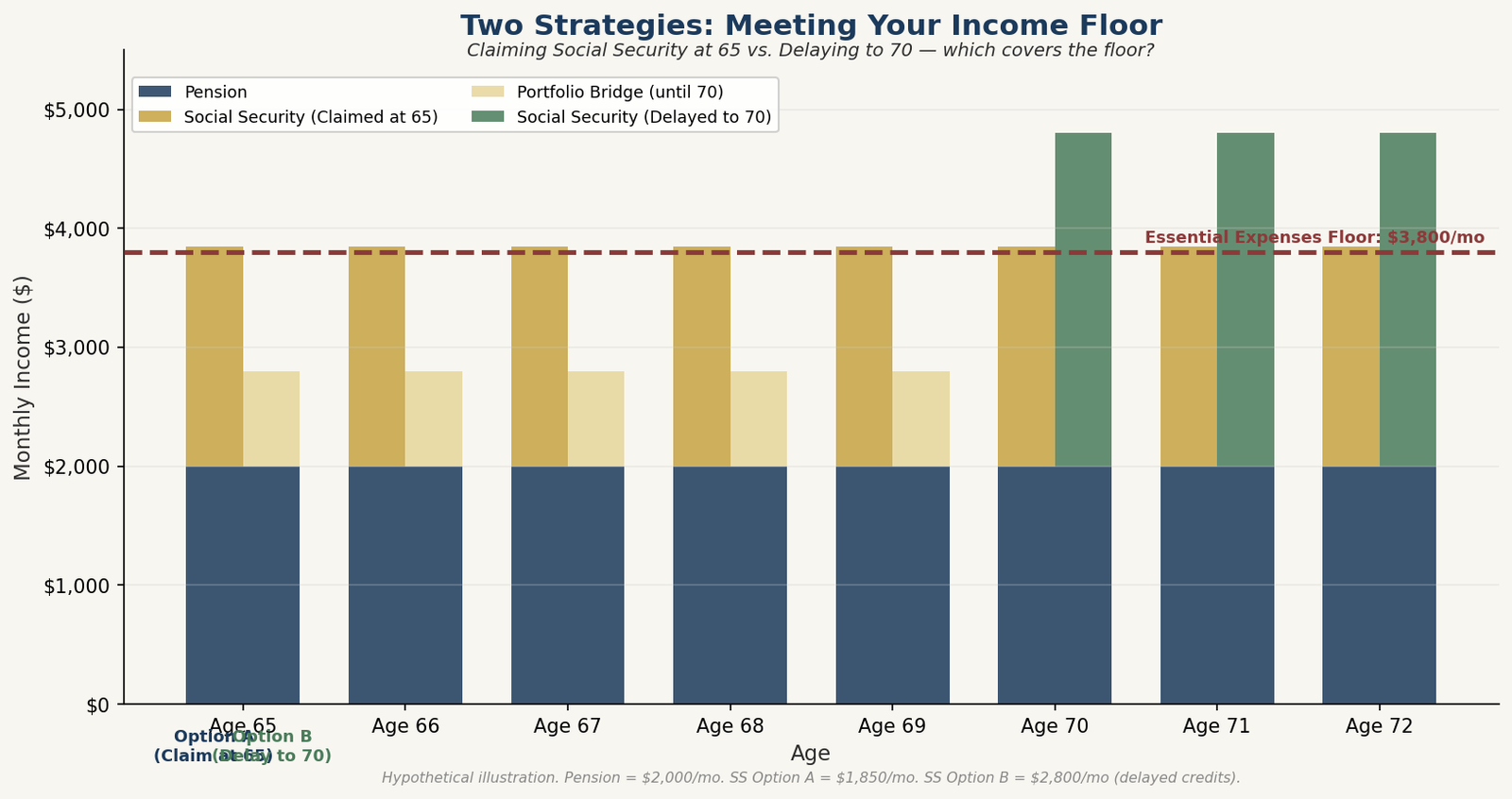
Note: This is a hypothetical scenario for educational purposes only. Patricia, 64, is planning to retire next year. Here’s her situation:- Social Security (if she claims at 65): $2,100/month
- Social Security (if she delays to 70): $3,100/month
- Pension from 25 years of teaching: $1,800/month
- Investment portfolio: $450,000 (traditional IRA: $320,000, Roth: $80,000, brokerage: $50,000)
- Essential monthly expenses: $4,500
- Income floor: $2,100 (SS) + $1,800 (pension) = $3,900/month
- Gap: $600/month ($7,200/year)
- Withdrawal rate from portfolio for essentials: 1.6%
- Income floor (ages 65-70): $1,800 (pension only)
- Gap (ages 65-70): $2,700/month funded from savings (~$162,000 over 5 years)
- Income floor (age 70+): $3,100 (SS) + $1,800 (pension) = $4,900/month
- Gap (age 70+): $0 — floor exceeds essential expenses by $400/month
FAQ
What percentage of my retirement income should be guaranteed? A common guideline is to cover 100% of essential expenses with guaranteed income. For most retirees, essential expenses represent 60-80% of total spending. There’s no universal “right” percentage — the goal is to ensure that market downturns don’t threaten your ability to cover non-negotiable costs. Can I build an income floor without a pension or annuity? Yes. Social Security alone can provide a strong floor, especially if you delay claiming and coordinate spousal benefits. Some retirees use a Roth conversion strategy to build a tax-free pool of money that functions as a quasi-guaranteed source, since Roth withdrawals aren’t affected by tax rates. A bond ladder can also create predictable income for a set period. Are annuities safe? What if the insurance company fails? Annuities are backed by the financial strength of the issuing insurance company, not the FDIC or the federal government. However, each state has a guaranty association that provides a safety net (typically covering $250,000-$300,000 per owner per company). Stick with highly rated carriers (A.M. Best rating of A or higher) and diversify across companies if purchasing large annuity amounts. How does inflation affect my income floor? Social Security has automatic COLA adjustments. Most pensions and basic annuities do not. Over a 25-year retirement, even 3% annual inflation cuts your purchasing power roughly in half. Consider this when sizing your floor — a $5,000/month floor today may only cover $2,500 in today’s dollars by age 90. Inflation-adjusted annuities or maintaining a stock allocation for growth can help offset this erosion.Build the Floor First, Then Build Everything Else on Top
The most resilient retirement plans share one thing: a strong income floor. When your essential expenses are covered by guaranteed, lifetime income, every other financial decision becomes easier — and less stressful. If you are not sure where your income floor stands, the next step is to write down your essential monthly expenses, your guaranteed monthly income, and the gap between them. That single number is the most important figure in any retirement plan I have ever worked with. For more on the broader framework, read my piece on bucket planning for retirement income.This article is published by Confluence Media Group LLC, an independent publisher of educational financial content. Thomas Clark is a Series 65 Investment Advisor Representative. The information provided is for educational and informational purposes only and is not personalized financial, tax, or legal advice. Past performance does not guarantee future results. All investing involves risk, including potential loss of principal. Consult a qualified professional before making financial decisions.
Confluence Media Group LLC is a separate entity from Confluence Capital Management, the investment advisory practice through which Thomas Clark provides advisory services. Advisory services are not offered through this publishing platform.

Thomas Clark is a Series 65 licensed investment advisor and experienced trader. He specializes in investing, retirement planning, and market analysis, helping individuals build wealth and make informed financial decisions.
