
Retirement Paycheck Strategy: Building Income from Multiple Sources
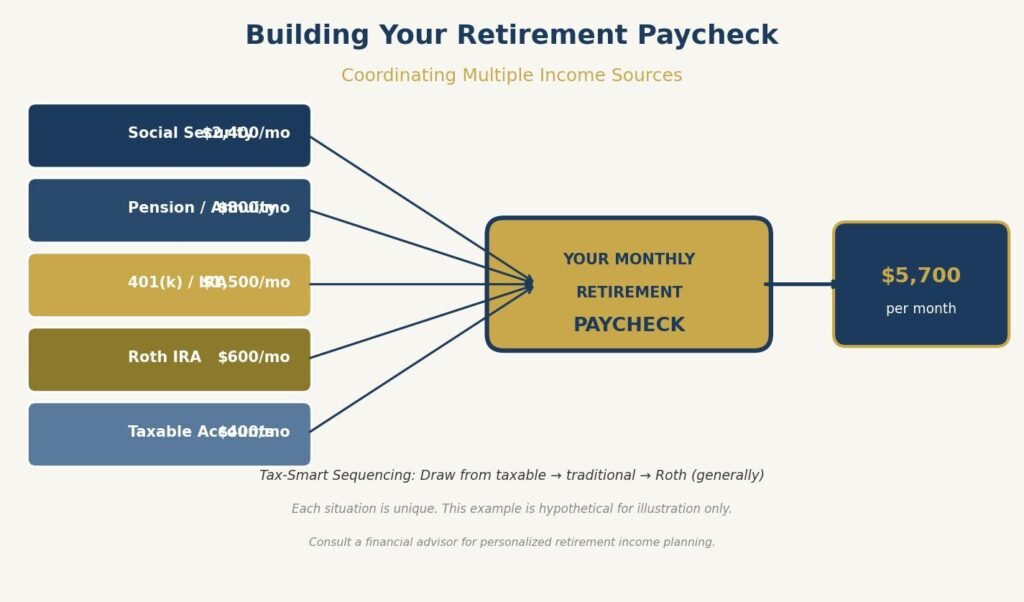
The biggest shift in retirement is not financial — it is psychological. Your retirement paycheck strategy — how you coordinate multiple income sources into a reliable monthly cash flow — starts here. For decades, a paycheck showed up every two weeks. You did not have to think about where the money came from or how the pieces fit together. Then you retire, and suddenly you are the payroll department. For more, see role of annuities in a retirement paycheck system.
Instead of one employer sending one direct deposit, you may have income arriving from five or six different sources — Social Security, a pension, an IRA, a Roth account, a taxable brokerage account, maybe rental income. They all have different tax treatments, different timing, and different rules. If you do not coordinate them deliberately, you end up either withdrawing too much from the wrong accounts or sitting on money you are afraid to touch.
The good news is that building a reliable retirement paycheck is not complicated once you have a system. In this guide, I will walk you through how to inventory your income sources, build a monthly income floor, set up a paycheck system that runs on autopilot, and sequence your withdrawals in a way that could save you thousands in taxes.
Table of Contents
- Inventory Your Income Sources
- Fixed vs. Variable Income: Why the Mix Matters
- Building Your Monthly Income Floor
- The Retirement Paycheck Strategy: Month by Month
- Tax-Smart Sequencing: Which Accounts to Draw From and When
- Hypothetical Case Study: Building a $6,500/Month Retirement Paycheck
- Adjusting Your Paycheck Over Time
- Common Coordination Mistakes
- Key Takeaways
- Frequently Asked Questions
Inventory Your Income Sources
Before you can build a paycheck, you need to know what you are working with. Most retirees have more income sources than they realize. Here is the full inventory to work through:
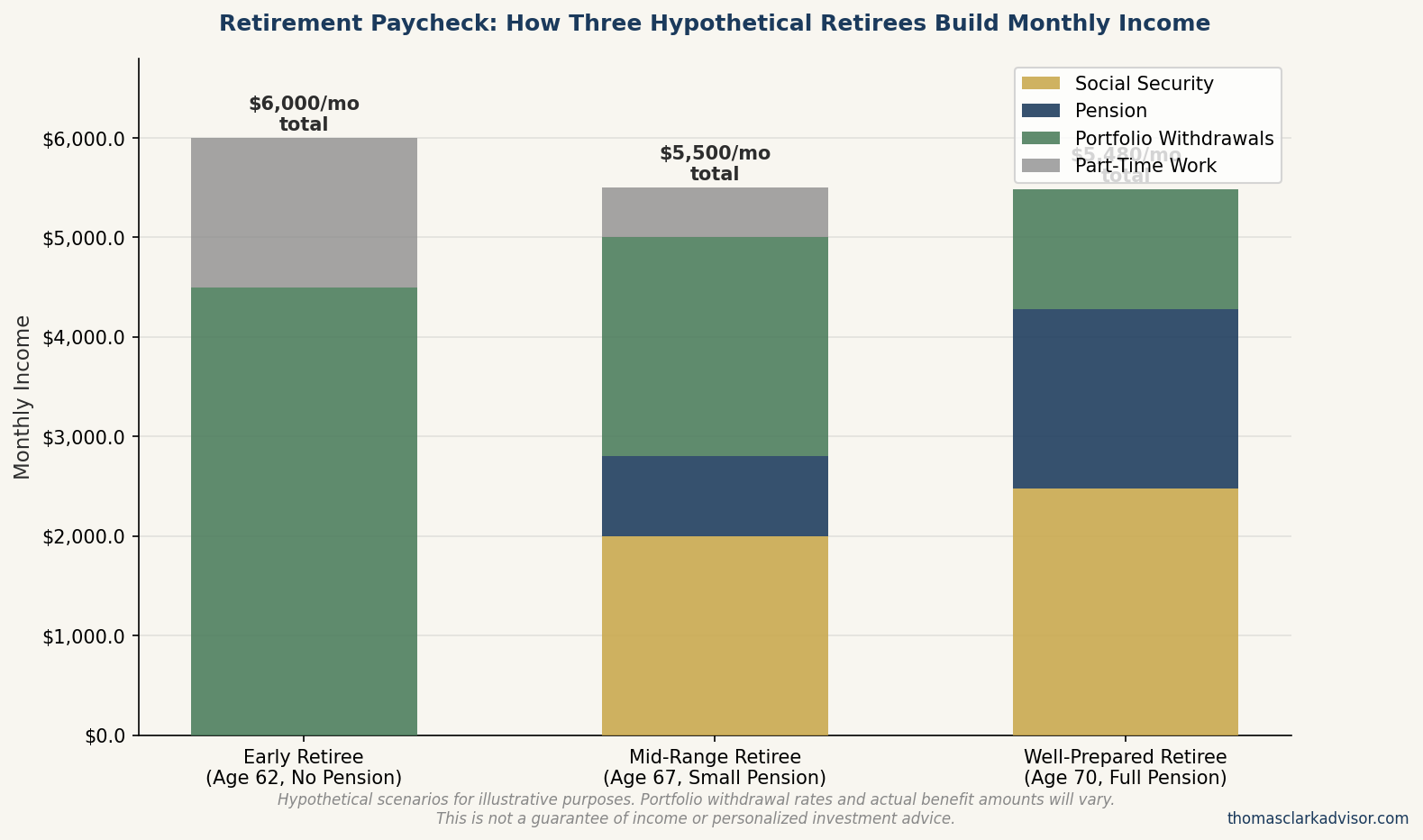
Social Security. For most retirees, this is the foundation. The Social Security Administration provides estimated benefits based on your earnings history. The average retired worker benefit in 2026 is approximately $1,976 per month, but your actual amount depends on your 35 highest-earning years and the age you claim. (For a framework on choosing the right filing age, see my guide on when to file for Social Security.)
Pension income. If you worked for a government agency, large corporation, or union employer, you may have a defined-benefit pension that pays a fixed monthly amount. According to the Bureau of Labor Statistics, roughly 15 percent of private-sector workers still have access to a defined-benefit plan. If you have one, it is often the most valuable asset in your retirement portfolio.
Traditional retirement accounts. 401(k)s, 403(b)s, traditional IRAs, and similar pre-tax accounts are where most Americans hold the bulk of their retirement savings. Withdrawals are taxed as ordinary income. Required minimum distributions (RMDs) begin at age 73 under current law, meaning the IRS will eventually require you to take money out whether you need it or not.
Roth accounts. Roth IRAs and Roth 401(k)s hold after-tax money that grows and can be withdrawn tax-free in retirement. Roth IRAs have no RMDs during the owner’s lifetime, making them the most flexible retirement account for income planning and tax management.
Taxable investment accounts. Brokerage accounts, mutual fund accounts, and other non-retirement investment accounts do not have the same withdrawal restrictions. Capital gains and dividends generate taxable income, but you have more control over the timing and amount.
Other sources. Rental income, part-time work, annuity payments, royalties, or business income may also play a role. Each has its own tax treatment and reliability profile.
Thomas’s Take: Before you map out a paycheck plan, build a one-page income source inventory. Write down each source, the estimated monthly amount, whether it is guaranteed or variable, and the tax treatment. That single page becomes the blueprint for the entire retirement paycheck strategy — and most households have never put it on paper.
Fixed vs. Variable Income: Why the Mix Matters
Not all retirement income is created equal. The distinction between fixed and variable income is critical because it determines how much of your spending is guaranteed — and how much depends on market performance or your own decisions.
Fixed (guaranteed) income includes Social Security, pensions, and income annuities. These sources pay a predictable amount on a predictable schedule. They do not fluctuate with the stock market, and in the case of Social Security, they are adjusted for inflation through annual cost-of-living adjustments. When pension income is missing or short of what essential expenses require, an income-focused fixed-indexed annuity with a guaranteed-lifetime-income rider is the tool I lean on to fill the gap — that is how the Soon bucket gets its floor.
Variable income includes withdrawals from investment accounts — 401(k)s, IRAs, Roth accounts, and taxable portfolios. The amount you can safely withdraw depends on your portfolio balance, market conditions, and how long your money needs to last. A 30 percent market decline does not change your Social Security check, but it absolutely changes the sustainability of a $5,000 monthly withdrawal from your IRA.
Why the mix matters: Retirees who cover their essential expenses — housing, food, healthcare, utilities, insurance — entirely with guaranteed income sources tend to sleep better at night. They are less likely to panic during market downturns and less likely to make costly emotional decisions with their portfolios. The variable income then funds discretionary spending — travel, dining, gifts, hobbies — where flexibility is acceptable.
Building Your Monthly Income Floor
The income floor is the foundation of your retirement paycheck. It is the amount of guaranteed, predictable money that arrives every month regardless of what the stock market does, what interest rates look like, or how the economy is performing.
Step 1: Calculate your essential monthly expenses. Add up everything you must pay every month — mortgage or rent, property taxes, insurance premiums, groceries, utilities, healthcare costs, medications, car payments, and minimum debt obligations. For most retirees, this number falls between $3,500 and $6,000 per month, though it varies significantly by location and lifestyle.
Step 2: Add up your guaranteed monthly income. Combine Social Security benefits (for both spouses if married), pension payments, and any annuity income. This is your income floor.
Step 3: Identify the gap. If your guaranteed income covers your essential expenses, you are in a strong position. Your investment accounts fund your lifestyle — travel, entertainment, generosity — and market volatility becomes much less threatening. If your guaranteed income falls short, the gap is the amount you will need to withdraw from savings every month to cover the basics.
Here is what this looks like in practice:
| Category | Monthly Amount |
|---|---|
| Essential expenses | $5,200 |
| Social Security (both spouses) | $3,800 |
| Pension | $800 |
| Income floor total | $4,600 |
| Monthly gap | $600 |
This is a hypothetical example for illustrative purposes only.
In this scenario, the couple needs only $600 per month from investment accounts to cover essentials. Their portfolio withdrawals are manageable and sustainable, even through market downturns.
Thomas’s Take: The single most important number in retirement planning is the gap between your essential expenses and your guaranteed income. Everything else — withdrawal rates, asset allocation, tax strategy — flows from that number.
The Retirement Paycheck Strategy: Month by Month
Once you know your income sources and your gap, here is how to set up a system that replicates the predictability of a working paycheck:
Create a dedicated checking account. This is your “paycheck account.” All retirement income flows into this account, and all spending comes out of it. Think of it as the central hub. This separation makes tracking effortless and prevents the common mistake of spending directly from investment accounts.
Set up automatic deposits. Social Security and pension payments can be deposited directly. For investment account withdrawals, set up systematic monthly transfers — most brokerage firms and custodians like Fidelity, Schwab, and Vanguard allow you to schedule automatic monthly distributions from IRAs and taxable accounts.
Build a cash reserve. Keep three to six months of expenses in a high-yield savings account or money market fund as a buffer. This reserve means you do not have to sell investments during a market downturn just to pay the electric bill. When the market recovers, you replenish the reserve.
Schedule a monthly “payday.” Pick a date — the first of the month works well — and schedule all transfers to arrive by that date. Your Social Security might arrive on the second Wednesday of the month, and your IRA distribution on the first. The checking account absorbs the timing differences, and you pay your bills from a single, predictable source.
Review quarterly, adjust annually. Every quarter, confirm that your system is running smoothly and your cash reserve is adequate. Once a year, review your total spending, adjust withdrawal amounts for inflation, and rebalance your investment accounts.
Tax-Smart Sequencing: Which Accounts to Draw From and When
The order in which you withdraw from different account types has a significant impact on how long your money lasts — and how much of it goes to taxes.
The conventional approach is to follow this general sequence: spend taxable accounts first, then tax-deferred accounts (traditional 401k and IRA), then Roth accounts last. The logic is that taxable accounts generate annual capital gains and dividends whether you withdraw or not, tax-deferred accounts grow without annual taxes, and Roth accounts grow tax-free forever.
The smarter approach is more dynamic. Instead of a rigid sequence, you manage your tax bracket each year by choosing which accounts to draw from based on your current year’s tax situation.
How this works in practice:
- In years when your income is low (perhaps before Social Security starts or in a year with large medical deductions), draw more from traditional IRA/401(k) accounts — or execute Roth conversions — to fill up the lower tax brackets.
- In years when your income is higher (perhaps because of RMDs, a pension, or capital gains from selling a property), lean more heavily on Roth withdrawals to avoid pushing into a higher bracket.
- Keep an eye on provisional income thresholds that determine how much of your Social Security is taxable, as well as IRMAA thresholds that affect Medicare premiums.
The tax bracket map for 2026 is particularly important for retirees. With several provisions of the Tax Cuts and Jobs Act scheduled to expire or change, understanding how the 2026 brackets affect your retirement income could save you thousands in the transition years.
Thomas’s Take: Think of your retirement accounts as three tax buckets — taxable, tax-deferred, and tax-free. The goal is not to empty one bucket before starting the next. The goal is to pour from the right bucket at the right time to keep your overall tax bill as low as possible across the whole retirement window.
Hypothetical Case Study: Building a $6,500/Month Retirement Paycheck
This is a hypothetical example for illustrative purposes only and does not represent any actual client situation.
Profile: David and Karen, both age 67, recently retired. They want $6,500 per month ($78,000 per year) to cover all expenses — essentials and discretionary spending. Here is what they are working with:
| Income Source | Type | Monthly Amount | Tax Treatment |
|---|---|---|---|
| David’s Social Security | Fixed | $2,400 | Up to 85% taxable |
| Karen’s Social Security | Fixed | $1,600 | Up to 85% taxable |
| David’s pension | Fixed | $800 | Fully taxable |
| Guaranteed income total | $4,800 | ||
| Monthly gap | $1,700 |
David and Karen’s guaranteed income covers $4,800 per month. They need $1,700 per month — or $20,400 per year — from their investment accounts.
Their savings:
| Account | Balance | Tax Treatment |
|---|---|---|
| Traditional IRAs (combined) | $620,000 | Taxable on withdrawal |
| Roth IRAs (combined) | $180,000 | Tax-free on withdrawal |
| Taxable brokerage account | $100,000 | Capital gains rates |
| Total savings | $900,000 |
The paycheck system they set up:
- Social Security and pension are direct-deposited into their joint checking account on the first of each month — $4,800 combined.
- They set up a $1,700 monthly automatic transfer from their traditional IRA to the same checking account. At this withdrawal rate, they are drawing roughly 3.3 percent of their traditional IRA annually — well within sustainable withdrawal ranges.
- They maintain a $20,000 cash reserve in a high-yield savings account (roughly three months of expenses).
- Their Roth IRAs remain untouched and continue growing tax-free — reserved for unexpected expenses, healthcare costs later in life, or years when drawing from the traditional IRA would push them into a higher tax bracket.
Tax impact: Their combined Social Security ($48,000 per year) plus pension ($9,600) plus IRA withdrawals ($20,400) puts their gross income at approximately $78,000. After the standard deduction for married filers over 65 ($32,300 in 2025, adjusted for inflation), their taxable income falls primarily in the 12 percent federal bracket. Because their provisional income exceeds $44,000, up to 85 percent of their Social Security is taxable — but the effective tax rate on their total income remains modest.
Sustainability check: At a 3.3 percent withdrawal rate from their traditional IRA, assuming moderate portfolio growth, their savings could potentially last well into their 90s. The Roth accounts provide an additional $180,000 safety net that grows tax-free. If either spouse passes away, the survivor would lose one Social Security check but could adjust withdrawals accordingly.
Adjusting Your Paycheck Over Time
A retirement paycheck is not something you set once and forget. Several forces will require adjustments over the years:
Inflation. Your expenses will increase over time, but not all of your income keeps pace. Social Security includes annual cost-of-living adjustments, but pensions typically do not. Plan to increase your investment withdrawals by 2-3 percent annually to maintain purchasing power.
Required minimum distributions. Starting at age 73, the IRS requires you to withdraw a minimum amount from traditional retirement accounts each year. These RMDs increase as a percentage of your balance as you age. In some years, your RMD may exceed what you actually need — which means extra taxable income whether you want it or not. Plan ahead by considering Roth conversions in the years before RMDs begin.
Spending changes. Research from the Employee Benefit Research Institute consistently shows that retirees tend to spend more in the early active years of retirement (travel, hobbies, home projects), less in the middle years, and then more again in the later years due to healthcare costs. Your paycheck should adapt to these phases.
Healthcare costs. Medicare premiums, supplemental insurance, prescription costs, and potential long-term care expenses will likely increase faster than general inflation. The Fidelity Retiree Health Care Cost Estimate suggests an average 65-year-old couple may need approximately $315,000 in after-tax savings for healthcare expenses throughout retirement.
Common Coordination Mistakes
Even well-prepared retirees make these errors. Avoiding them can save you significant money and stress:
Drawing everything from one account. Taking all withdrawals from a traditional IRA while ignoring taxable and Roth accounts is the most common mistake I see. It pushes you into higher tax brackets unnecessarily and leaves tax-diversification benefits on the table.
Ignoring the tax impact of each withdrawal. A $1,000 withdrawal from a traditional IRA and a $1,000 withdrawal from a Roth IRA are not the same thing. The IRA withdrawal might cost you $120-$220 in federal taxes. The Roth withdrawal costs nothing. Factor taxes into every withdrawal decision.
Not adjusting for inflation. If you withdraw the same dollar amount every year for 20 years, your purchasing power declines by roughly 35-40 percent at a 3 percent inflation rate. Build annual increases into your plan.
Forgetting about Social Security taxation. Many retirees do not realize that pulling large amounts from a traditional IRA can cause more of their Social Security to become taxable. A $10,000 IRA withdrawal does not just add $10,000 to your taxable income — it can also push an additional $8,500 of Social Security into the taxable zone through the provisional income formula. (For more on this, see my guide on Social Security spousal benefits and how income coordination affects total tax liability.)
Having no cash reserve. Without a buffer, a market downturn forces you to sell investments at low prices to generate your monthly paycheck. A three-to-six-month cash reserve eliminates this forced-selling risk.
Key Takeaways
-
Build your retirement paycheck from the bottom up. Start by calculating your essential expenses, then match them against your guaranteed income sources. The gap tells you exactly how much you need from your investment accounts each month.
-
Separate fixed from variable income. Covering essential expenses with guaranteed income (Social Security, pension, annuities) creates stability and peace of mind. Variable income from investment accounts funds your lifestyle and provides flexibility.
-
Set up a system that runs automatically. A dedicated checking account, automatic transfers, and a cash reserve replicate the simplicity of a working paycheck. Review quarterly, adjust annually.
-
Sequence your withdrawals for tax efficiency. Do not default to pulling everything from one account. Manage your tax bracket each year by choosing the right mix of taxable, tax-deferred, and tax-free withdrawals.
-
Expect your paycheck to evolve. Inflation, RMDs, spending changes, and healthcare costs will all require adjustments. Build flexibility into your plan from the start.
Frequently Asked Questions
How much of my savings can I safely withdraw each year in retirement?
The commonly cited “4 percent rule” suggests withdrawing 4 percent of your portfolio in the first year, then adjusting for inflation each year. However, this is a general guideline, not a guarantee. Your safe withdrawal rate depends on your portfolio allocation, retirement length, other income sources, and market conditions. Many advisors now recommend a more dynamic approach — withdrawing more in good years and less in down years — rather than following a rigid percentage.
Should I pay off my mortgage before retiring?
There is no one-size-fits-all answer. Paying off a mortgage eliminates a fixed expense and reduces the amount your retirement paycheck needs to cover, which can provide significant peace of mind. However, if your mortgage rate is low and the money needed to pay it off would be better used for tax-advantaged investments or maintaining liquidity, keeping the mortgage may make financial sense. Consider your overall cash flow, tax situation, and comfort level with debt.
When should I start taking Social Security if I have other income sources?
If your pension, savings, and other income can comfortably cover your expenses, delaying Social Security could be valuable. Every year you delay past full retirement age increases your benefit by 8 percent, up to age 70. This higher benefit also increases the survivor benefit for your spouse. However, if you need the income or have health concerns that suggest a shorter life expectancy, filing earlier may be the right choice. (For a detailed framework, see my guide on when to file for Social Security.)
How do I handle a market downturn if I am relying on my portfolio for income?
This is where the cash reserve and income floor strategy pay off. If your essential expenses are covered by Social Security and pension income, a market decline does not threaten your ability to pay bills. For the variable portion of your paycheck, reduce discretionary withdrawals during downturns and draw from your cash reserve instead. Avoid selling investments at depressed prices. Once the market recovers, replenish the cash reserve and resume normal withdrawal levels.
The transition from earning a paycheck to creating one is one of the most important shifts in retirement. Get it right, and your money works as a coordinated system — predictable, tax-efficient, and built to last. Get it wrong, and you spend your retirement worrying about whether the pieces will hold together.
For more on retirement income, bucket planning, and Social Security claiming, browse the retirement planning archive or sign up for the weekly newsletter at the bottom of any page.
This article is published by Confluence Media Group LLC, an independent publisher of educational financial content. Thomas Clark is a Series 65 Investment Advisor Representative. The information provided is for educational and informational purposes only and is not personalized financial, tax, or legal advice. Past performance does not guarantee future results. All investing involves risk, including potential loss of principal. Consult a qualified professional before making financial decisions.
Confluence Media Group LLC is a separate entity from Confluence Capital Management, the investment advisory practice through which Thomas Clark provides advisory services. Advisory services are not offered through this publishing platform.

Thomas Clark is a Series 65 licensed investment advisor and experienced trader. He specializes in investing, retirement planning, and market analysis, helping individuals build wealth and make informed financial decisions.
