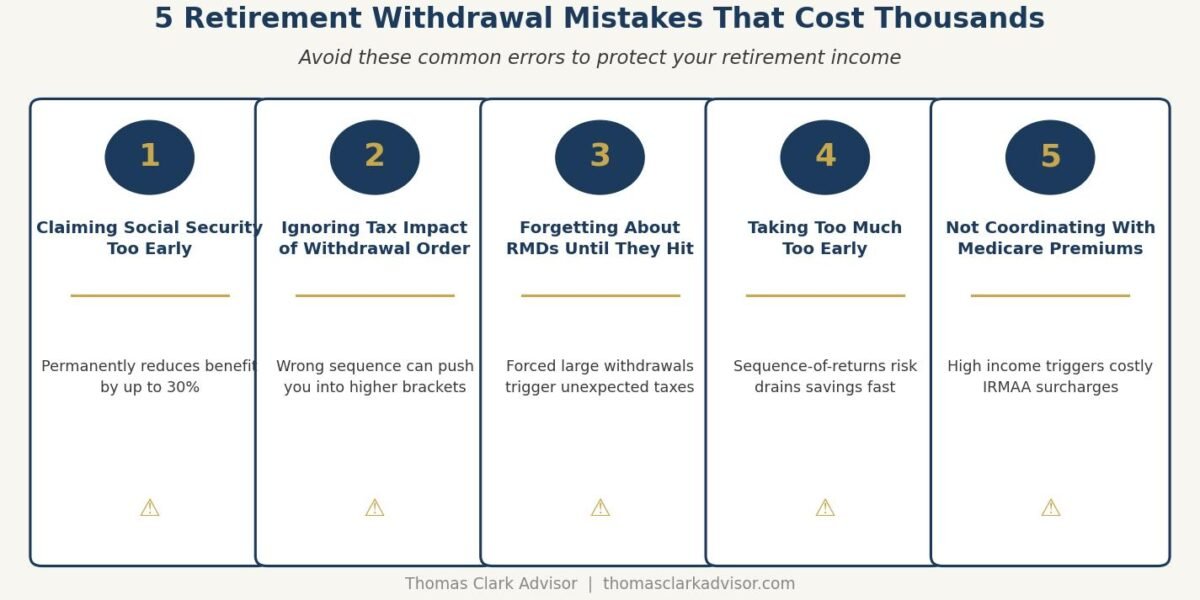
5 Retirement Withdrawal Mistakes That Cost Thousands
Featured Image: Professional infographic showing a numbered list overlay on a warm-toned photo of financial documents, with each mistake highlighted in navy (#1B3A5C) with gold (#C9A84C) accent numbers. Clean, modern layout at 1200x628px for social sharing.
You have spent decades saving for retirement. You have done the hard part — contributing to your 401(k), building up your IRAs, maybe even stashing some money in a taxable brokerage account. But here is what surprises many pre-retirees: how you take money out of those accounts may matter just as much as how you put it in.
It is common for smart, disciplined savers to make withdrawal decisions in their first few years of retirement that end up costing them tens of thousands of dollars over time — not because they spent too much, but because they pulled from the wrong accounts in the wrong order. The good news is that these mistakes are entirely avoidable once you know what to watch for.
In this article, I will walk you through five of the most common retirement withdrawal mistakes, explain why each one is so costly, and show you a more coordinated approach that could help your money last longer and keep more of it in your pocket.
Table of Contents
- Mistake 1: Drawing Social Security Too Early Without a Withdrawal Plan
- Mistake 2: Ignoring the Tax Impact of Your Withdrawal Order
- Mistake 3: Forgetting About RMDs Until They Hit
- Mistake 4: Taking Too Much Too Early
- Mistake 5: Not Coordinating Withdrawals with Medicare Premiums
- The Right Approach: Coordinated Withdrawal Planning
- Key Takeaways
- Frequently Asked Questions
Mistake 1: Drawing Social Security Too Early Without a Withdrawal Plan
This is probably the most common withdrawal mistake. Someone retires at 62 or 63 and immediately files for Social Security because it feels like the natural thing to do — they have stopped working, so they start collecting. The problem is that claiming early permanently reduces your benefit.
For every year you delay Social Security past your full retirement age (FRA) up to age 70, your benefit grows by approximately 8 percent per year through delayed retirement credits, according to the Social Security Administration. That is one of the most reliable “returns” available anywhere.
A Hypothetical Example
Consider a hypothetical retiree, Karen, with a full retirement age of 67 and a projected FRA benefit of $2,400 per month. If she claims at 62, her benefit drops to roughly $1,680 per month — a 30 percent permanent reduction. If she delays to 70, her benefit grows to approximately $2,976 per month.
Over a 20-year retirement from age 70 to 90, the difference between claiming at 62 versus 70 could exceed $40,000 in cumulative benefits — and that gap widens with cost-of-living adjustments over time. This is a hypothetical example for illustrative purposes only and does not represent any actual client situation.
The better approach for many people may be to use other savings — like taxable accounts or even strategic Roth IRA withdrawals — to bridge the gap between retirement and age 70 while letting Social Security grow. For a deeper look at how spousal benefits factor in, see my article on Social Security spousal benefits.
Thomas’s Take: Claiming Social Security is not an all-or-nothing decision tied to the day you stop working. It is a separate financial decision that deserves its own analysis.
Image: Bar chart comparing monthly Social Security benefits at ages 62, 67, and 70 for a $2,400 FRA benefit. Navy bars with gold accent labels. Alt text: “Bar chart comparing Social Security monthly benefits at claim ages 62, 67, and 70 showing significant growth from delayed claiming.”
Mistake 2: Ignoring the Tax Impact of Your Withdrawal Order
Many retirees simply pull money from whichever account feels easiest — often their traditional IRA or 401(k) because it is the largest bucket. But every dollar withdrawn from a traditional pre-tax account counts as ordinary income and is taxed accordingly. Without a plan, it is surprisingly easy to push yourself into a higher federal tax bracket.
How Tax Bracket Creep Works
Here is a simplified hypothetical. Imagine a retired married couple filing jointly with $50,000 in Social Security benefits and $30,000 in pension income. They need an additional $25,000 to cover expenses, so they withdraw it all from their traditional IRA.
That $25,000 IRA withdrawal, combined with the taxable portion of their Social Security and pension, could push their adjusted gross income well into the 22 percent bracket — meaning a portion of that withdrawal is taxed at a higher rate than necessary.
If instead they split that $25,000 between a Roth IRA (tax-free) and their traditional IRA, they could potentially keep their total taxable income in the 12 percent bracket. Over a 25-year retirement, that kind of bracket management could save tens of thousands in federal taxes alone. This is a hypothetical example for illustrative purposes only.
A strategic withdrawal sequence might look like this for many retirees:
| Account Type | Tax Treatment | When It May Make Sense to Draw |
|---|---|---|
| Taxable brokerage | Capital gains rates (often lower) | Early retirement, to fill low brackets |
| Traditional IRA/401(k) | Ordinary income | Strategically, to stay within target bracket |
| Roth IRA | Tax-free | Last (or strategically for bracket management) |
This is not a one-size-fits-all order, but the principle is clear: the sequence matters for your tax bill. For a related strategy, see how Roth conversions can reduce lifetime taxes.
Pro Tip: The years between retirement and age 73 (when required minimum distributions begin) are often called the “tax planning window.” This may be the lowest-income period of your retirement — and potentially the best time to do strategic Roth conversions or fill up lower brackets intentionally.
Mistake 3: Forgetting About RMDs Until They Hit
Required minimum distributions — RMDs — catch more retirees off guard than almost anything else. Starting at age 73 (under the SECURE 2.0 Act), you are required to withdraw a minimum amount each year from your traditional IRA, 401(k), and most other pre-tax retirement accounts. Miss that deadline, and the penalty is steep: a 25 percent excise tax on the amount you should have withdrawn (reduced from 50 percent under prior law, but still painful).
Why RMDs Create Problems
The real issue is not just the penalty risk — it is the tax surprise. If you have been letting your traditional IRA grow untouched for years, your RMDs at 73 could be substantial. A $1.2 million traditional IRA at age 73 would require a first-year RMD of roughly $45,283 based on the IRS Uniform Lifetime Table. That is $45,000 in forced ordinary income whether you need the money or not.
Combined with Social Security and any other income, that RMD could push you into a higher bracket, increase the taxable portion of your Social Security benefits, and trigger Medicare premium surcharges (more on that in Mistake 5).
The Planning Window
The years between retirement and age 73 represent a critical planning window. During these years, many retirees have lower income, which may create an opportunity to:
- Convert portions of traditional IRAs to Roth IRAs at lower tax rates
- Draw down traditional accounts strategically to reduce future RMD amounts
- Smooth out taxable income across retirement years rather than facing a sudden spike at 73
One approach some advisors explore is calculating what the projected RMDs would be at 73 and working backward to determine how much to convert or withdraw in the years leading up to that age. The goal is not to eliminate RMDs — that may not be realistic — but to reduce the shock and keep income more level over time.
Thomas’s Take: Think of RMDs as a ticking clock on your tax-planning flexibility. Every year between retirement and 73 that passes without a proactive strategy is a missed opportunity.
Free Download: Social Security Optimization Guide
Learn the strategies that could maximize your lifetime Social Security benefits.
Get Your Free Copy
Mistake 4: Taking Too Much Too Early
After decades of saving, retirement can feel like the finish line. Some retirees celebrate by spending freely in those first few years — a big trip, a new car, a home renovation. I am not saying those things are wrong. But pulling large sums from your portfolio early in retirement creates a hidden risk that most people do not think about: sequence-of-returns risk.
What Is Sequence-of-Returns Risk?
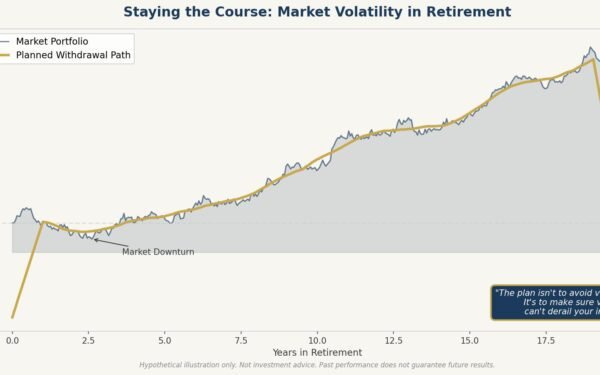
Sequence-of-returns risk means that the timing of market downturns matters enormously when you are withdrawing from your portfolio. A 20 percent market decline in year two of retirement is far more damaging than the same decline in year 15 — because early losses permanently reduce the base your portfolio can grow from, while you are simultaneously pulling money out.
Research from the Center for Retirement Research at Boston College has shown that retirees who experience poor returns in the first five years of retirement face a significantly higher risk of outliving their savings, even if long-term average returns are similar to historical norms.
A Hypothetical Illustration
Imagine two hypothetical retirees — James and Linda — both starting with $800,000 portfolios and withdrawing $40,000 per year. James experiences a 15 percent market drop in year one, while Linda experiences the same drop in year 10. After 25 years, even though they experienced the same average return, James’s portfolio may be depleted while Linda’s still has a comfortable balance. This is a hypothetical example for illustrative purposes only.
How to Manage This Risk
- Keep 1-2 years of expenses in cash or short-term bonds so you do not have to sell stocks during a downturn
- Be flexible with spending in the first 5-7 years, especially if markets decline
- Consider guardrail strategies that adjust withdrawals based on portfolio performance rather than using a fixed percentage
- Avoid front-loading large discretionary expenses if your portfolio has just taken a hit
Image: Line chart comparing two hypothetical portfolio balances over 25 years — one with an early market decline and one with a late decline — both starting at $800,000 with $40,000 annual withdrawals. Navy and gold lines on light background. Alt text: “Line chart showing how sequence-of-returns risk affects two identical portfolios differently based on timing of market declines.”
Mistake 5: Not Coordinating Withdrawals with Medicare Premiums
This is the mistake that often surprises people the most. Most retirees know that Medicare Part B and Part D have monthly premiums. What many do not realize is that those premiums are income-dependent — and a single large withdrawal in the wrong year can trigger significantly higher premiums for two full years.
How IRMAA Works
The Income-Related Monthly Adjustment Amount — IRMAA — is essentially a Medicare surcharge for higher-income beneficiaries. Medicare looks at your modified adjusted gross income (MAGI) from two years prior. If your MAGI exceeds certain thresholds, you pay higher premiums.
For 2026, the standard Medicare Part B premium is $202.90 per month. But if your income from two years ago crossed the first IRMAA threshold (roughly $109,000 for single filers or $218,000 for married filing jointly), your Part B premium could jump to $284.10 or more per month — and that is just the first tier. Higher income levels trigger even steeper surcharges, and Part D prescription drug premiums get their own IRMAA adjustment on top of that.
Why This Matters for Withdrawals
A large IRA withdrawal, a Roth conversion, or even the sale of a highly appreciated asset can spike your MAGI for that year — triggering IRMAA surcharges two years later. It is not uncommon for a one-time $50,000 IRA withdrawal to push a retiree past the IRMAA threshold, costing them an additional $1,800 or more in Medicare premiums over the following year.
The coordination lesson is straightforward: before making any large withdrawal or conversion, check where your income stands relative to IRMAA thresholds. Sometimes splitting a withdrawal across two tax years or using Roth funds instead can keep you below the line. For more on how Medicare rules interact with retirement planning, see my guide on 2026 Medicare changes.
Pro Tip: IRMAA looks at income from two years ago. If you are planning a big Roth conversion at age 63, remember that the premium impact hits at age 65 — right when many people enroll in Medicare for the first time.
The Right Approach: Coordinated Withdrawal Planning
Each of these five mistakes has something in common: they happen when withdrawal decisions are made in isolation rather than as part of a coordinated plan. The right approach treats your retirement income as a system — where Social Security timing, account withdrawal order, tax brackets, RMD projections, and Medicare costs all work together.
Here is what a coordinated withdrawal strategy generally considers:
- Map out all income sources — Social Security, pensions, rental income, part-time work — and understand their tax treatment
- Project your tax brackets year by year through retirement, including the impact of RMDs starting at 73
- Identify your “tax planning window” — typically from retirement to age 73 — and use it strategically
- Coordinate large transactions (Roth conversions, asset sales, lump-sum distributions) with IRMAA thresholds
- Maintain liquidity with a cash buffer to avoid forced selling in down markets
- Review and adjust annually — tax laws change, markets fluctuate, and life happens
This kind of planning is not something you set once and forget. It benefits from annual review and adjustment as your situation evolves.
Key Takeaways
- Claiming Social Security early without a bridge strategy could permanently reduce your benefits by 30 percent or more — delaying to 70 may increase your monthly benefit by approximately 77 percent compared to claiming at 62
- Withdrawal order matters for taxes — pulling from the wrong account at the wrong time can push you into a higher bracket and cost thousands annually
- RMDs are not optional and can create a significant income spike at 73 if you have not planned ahead during the tax planning window
- Early portfolio withdrawals during market downturns amplify sequence-of-returns risk and can permanently damage your retirement savings trajectory
- Large withdrawals can trigger Medicare IRMAA surcharges — always check income thresholds before making significant distributions
Frequently Asked Questions
What is the best order to withdraw from retirement accounts?
There is no single best order because it depends on your complete financial picture, including tax brackets, Social Security timing, and future RMD obligations. However, many financial professionals suggest considering taxable accounts first, then tax-deferred accounts, and preserving Roth accounts for last — while strategically using Roth conversions during lower-income years. The right sequence for your situation may vary.
How much can I withdraw in retirement without running out of money?
The widely referenced “4 percent rule” suggests withdrawing 4 percent of your portfolio in year one and adjusting for inflation each year after. However, this is a starting point, not a guarantee. Factors like market conditions, your asset allocation, other income sources, and spending flexibility all play a role. Many advisors now recommend more dynamic approaches that adjust withdrawals based on portfolio performance.
Can I avoid RMDs by converting to a Roth IRA?
Roth IRAs are not subject to RMDs during the owner’s lifetime, so converting traditional IRA funds to a Roth could reduce future RMD obligations. However, conversions are taxable events — you owe income tax on the amount converted in the year of conversion. The key is to convert strategically during lower-income years so that the tax cost of conversion is less than the projected tax cost of future RMDs.
Take the Next Step
Retirement withdrawal planning is one of those areas where the details genuinely matter — and where a coordinated strategy could potentially save you tens of thousands of dollars over your retirement. The five mistakes I outlined above are common, but they are also preventable with the right planning.
If you have questions about how these withdrawal strategies apply to your specific situation, I am always here to help.
Thomas Clark is a Senior Lead Wealth Advisor at Confluence Capital Management, LLC. Investment advisory services offered through Altitude Capital Management, LLC, an SEC-registered investment advisor. Content on this site is for educational and informational purposes only and does not constitute personalized investment advice. Past performance is not indicative of future results. Consult with a qualified financial professional before making any investment decisions.

Thomas Clark is a Series 65 licensed investment advisor and experienced trader. He specializes in investing, retirement planning, and market analysis, helping individuals build wealth and make informed financial decisions.