
Retiring Into a Down Market: A Hypothetical Case Study
Retiring into a down market can feel like a financial emergency. This hypothetical case study reveals the three strategies that helped one couple recover.

Jim and Linda celebrated their retirement on January 3 with a bottle of champagne and a stack of travel brochures. Between their combined 401(k) accounts, IRAs, a small pension, and Social Security, they had built a $1.2 million portfolio that their financial plan said could comfortably support $60,000 per year in withdrawals — a 5% rate — on top of their Social Security and pension income. Everything looked perfect.
By mid-March, the S&P 500 had dropped 34%.
Their $1.2 million portfolio was suddenly worth about $792,000. The retirement they had spent decades building felt like it was unraveling in real time. Optional: ‘Jim made the panicked phone call. Linda couldn’t sleep.’ — keeps the human texture without inserting an advisor character. The travel brochures went back in the drawer.
This is what retiring into a down market looks like in real time — and it is exactly the situation I want to walk through today. Because here is the part of the story most people never hear: Jim and Linda did not go back to work. They did not run out of money. They adjusted their plan, made a few strategic moves, and five years later, they were fine. This is a hypothetical example for illustrative purposes only and does not represent any actual client situation.
Table of Contents
- The Challenge: Sequence-of-Returns Risk in Action
- What Happens If They Do Nothing Different
- Strategy 1: The Spending Adjustment
- Strategy 2: The Bucket Buffer
- Strategy 3: The Social Security Bridge
- The Combined Approach: Year-by-Year Recovery
- Five Years Later: Where They Ended Up
- Building Your Own Down-Market Playbook
- Key Takeaways
- Frequently Asked Questions
The Challenge: Sequence-of-Returns Risk in Action
Most people understand that markets go up and down. What many people do not understand is that when those ups and downs happen relative to your retirement date matters enormously — often more than the average return over time.
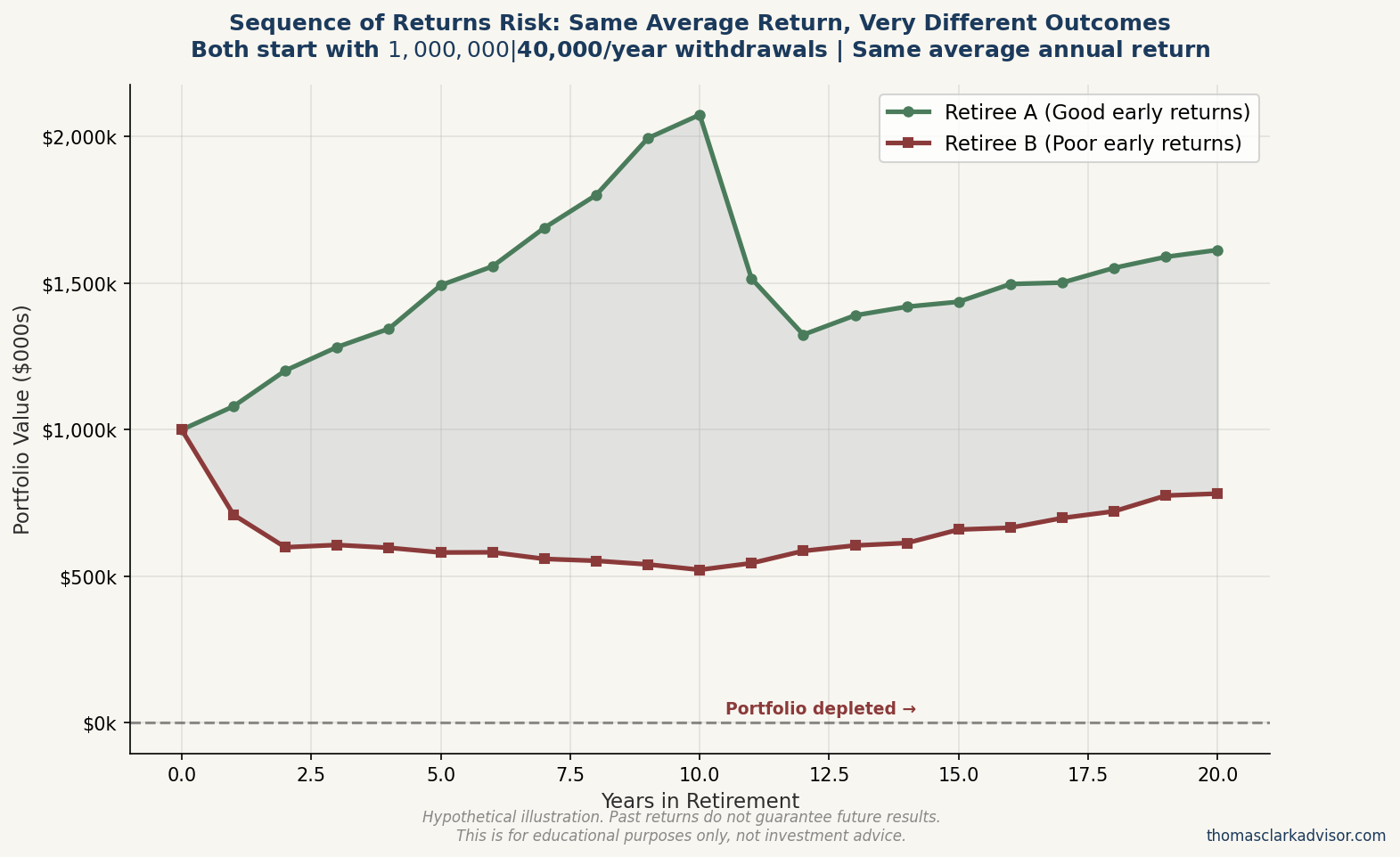
This concept is called sequence-of-returns risk, and it is one of the most significant risks to a retirement portfolio. According to research published by the National Bureau of Economic Research, the returns earned in the first five years of retirement have an outsized impact on whether a portfolio survives over a 30-year horizon.
Here is why: when you are withdrawing money from a portfolio that is simultaneously losing value, you are selling investments at depressed prices. Those shares cannot participate in the eventual recovery. It is the mathematical opposite of dollar-cost averaging during your working years — and it works against you with compounding efficiency.
To illustrate, imagine two hypothetical retirees who both earn an average 7% annual return over 20 years. Retiree A gets strong returns in the first five years and weak returns later. Retiree B gets weak returns first and strong returns later. Even with the same average, Retiree B could run out of money years earlier — because they were selling low while spending high during those critical early years.
That is exactly the trap Jim and Linda were staring down.
What Happens If They Do Nothing Different
Before looking at solutions, let us first understand how bad it could get if Jim and Linda just stuck to their original plan — withdrawing $60,000 per year from a portfolio that dropped to $792,000.
At a $60,000 annual withdrawal, they would now be pulling 7.6% per year from their depleted portfolio. Historical market data compiled by Vanguard and Morningstar suggests that withdrawal rates above 5% during a bear market dramatically increase the probability of portfolio depletion within 20 years.
Here is a simplified projection of the “do nothing” path:
| Year | Starting Balance | Withdrawal | Market Return (Hypothetical) | Ending Balance |
|---|---|---|---|---|
| 1 | $1,200,000 | $60,000 | -34% | $752,400 |
| 2 | $752,400 | $60,000 | -12% | $609,312 |
| 3 | $609,312 | $60,000 | +18% | $648,188 |
| 4 | $648,188 | $60,000 | +22% | $717,589 |
| 5 | $717,589 | $60,000 | +14% | $749,651 |
Even with a solid market recovery in years 3 through 5, Jim and Linda’s portfolio would still be down over $450,000 from their starting point — and they would be five years into retirement with a trajectory that does not look sustainable for another 20 to 25 years.
The problem is not that markets do not recover. They historically do. The problem is that withdrawing $60,000 per year during the downturn permanently removes shares that would have participated in that recovery.
Thomas’s Take: This is the scenario every pre-retiree within five years of retirement should walk through. It is not about predicting a crash — it is about having a plan that works whether the crash comes in year one or year ten. The worst time to build this plan is after the crash has already happened.
Strategy 1: The Spending Adjustment
The most immediate lever Jim and Linda could pull was their spending. Not a permanent lifestyle downgrade — a temporary, targeted reduction in discretionary expenses.
Their $60,000 annual withdrawal covered a mix of essential expenses (housing, food, insurance, utilities — roughly $42,000) and discretionary expenses (travel, dining, gifts, hobbies — roughly $18,000). By reducing discretionary spending by about 40% for 18 months, they could lower their annual withdrawal to approximately $49,200 in the first year and $52,000 in the second.
This accomplishes two things: it reduces the number of shares sold at depressed prices, and it gives the portfolio more time and more capital to participate in any recovery.
Research from the Center for Retirement Research at Boston College suggests that even modest spending flexibility — reducing withdrawals by 10% to 15% during downturns — can significantly improve the long-term survival rate of a retirement portfolio.
Jim and Linda postponed their big trip to Portugal (not cancelled — postponed), cut back on dining out, and deferred a kitchen renovation they had been considering. These were not painful sacrifices. They were tactical decisions to protect a 30-year retirement by adjusting 18 months of spending.
Strategy 2: The Bucket Buffer
If Jim and Linda had been using a bucket planning approach — the framework I lean on for exactly this scenario — they would have had a built-in shock absorber.
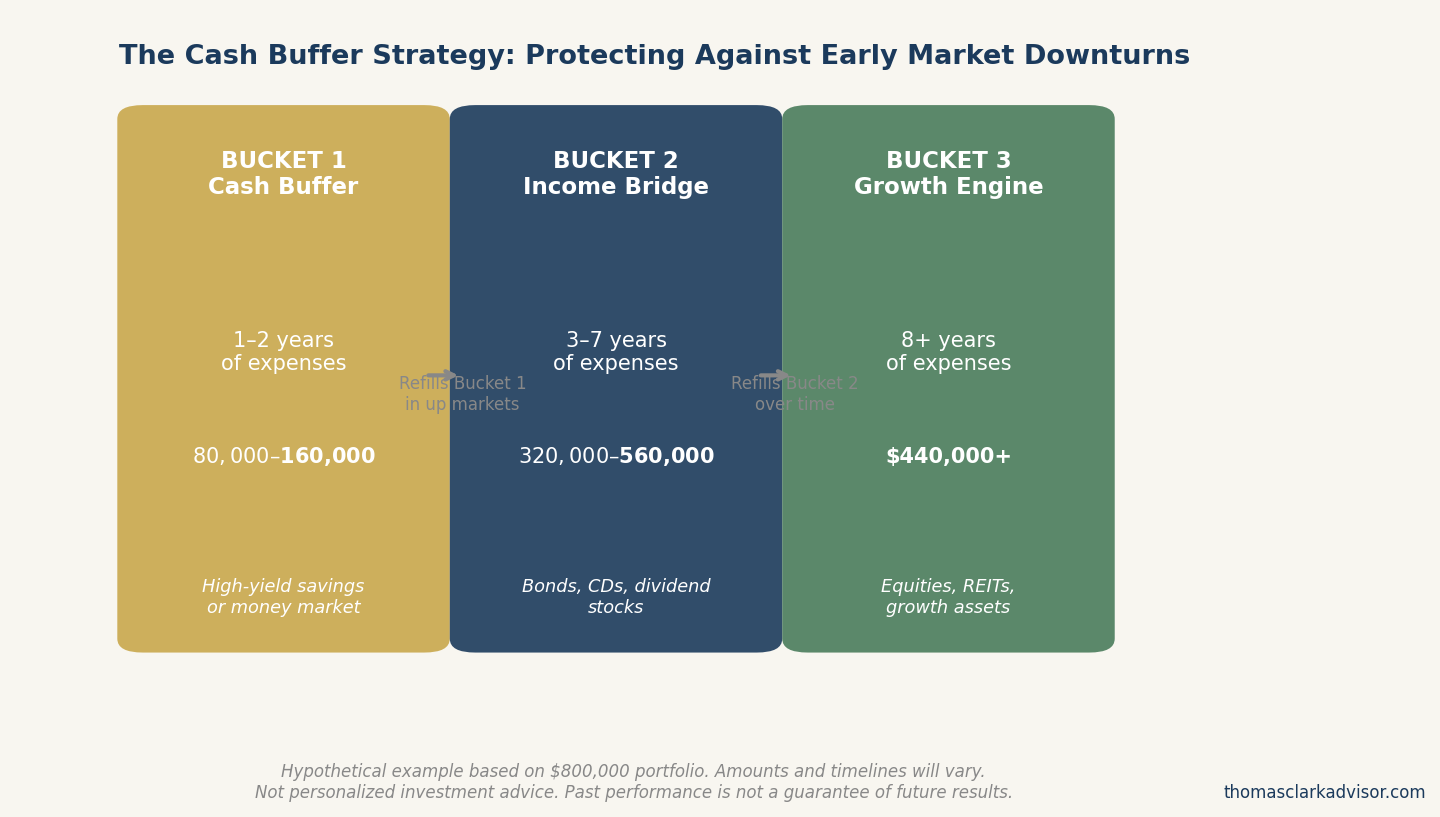
The bucket strategy divides retirement assets into three time-based segments:
- Bucket 1 (Near-term: 1-2 years): Cash and cash equivalents — money market funds, short-term CDs, high-yield savings. This covers immediate living expenses and is untouched by market volatility.
- Bucket 2 (Mid-term: 3-7 years): Bonds, fixed income, conservative balanced funds. This provides stable growth and serves as a refill source for Bucket 1.
- Bucket 3 (Long-term: 8+ years): Equities and growth investments. This is where the long-term compounding happens — and this bucket has time to recover from downturns.
In Jim and Linda’s case, if they had 18 to 24 months of living expenses ($90,000 to $120,000) sitting in Bucket 1 at the time of the crash, they would not need to sell a single share of their stock holdings during the downturn. They could draw exclusively from their cash bucket, letting Bucket 3 recover on its own timeline.
This is the fundamental value of bucket planning: it separates the money you need soon from the money that needs to grow. When the market drops 34%, you are not panicking about next month’s mortgage payment because that money was never in the stock market to begin with.
Pro Tip: I recommend keeping at least 12 to 24 months of essential expenses in your cash bucket at all times. When markets are strong, refill it from your growth bucket. When markets are down, live off the cash and leave your investments alone. The discipline of not touching Bucket 3 during a downturn is what makes this strategy work.
Strategy 3: The Social Security Bridge
Jim and Linda were both 64 when they retired, meaning they had not yet claimed Social Security. This gave them a powerful strategic option.
Their estimated benefits were approximately $2,800 per month for Jim (at full retirement age of 67) and $1,900 per month for Linda (at 67). If they delayed claiming until 70, Jim’s benefit would grow to roughly $3,472 per month and Linda’s to approximately $2,356 per month — thanks to the 8% per year delayed retirement credits between full retirement age and 70.
During a market crash, the calculus shifts. Every dollar of Social Security income that arrives each month is a dollar they do not need to withdraw from a depressed portfolio. But claiming early also permanently reduces their lifetime benefit.
Jim and Linda chose a middle path: Linda claimed at 65 (a modest reduction, roughly $1,710 per month) to bring in immediate cash flow during the downturn, while Jim delayed until 70 to maximize his benefit and — critically — to maximize the survivor benefit that Linda would receive if Jim died first.
This approach brought in $20,520 per year of guaranteed, inflation-adjusted income that required zero portfolio withdrawals. Combined with their small pension of $14,400 per year, they now had $34,920 in non-portfolio income, reducing their needed portfolio withdrawal from $60,000 to roughly $25,000 in the first year.
For a deeper understanding of claiming strategies and how they affect survivor benefits, see my article on Social Security myths that could be costing you.
The Combined Approach: Year-by-Year Recovery
When Jim and Linda combined all three strategies — spending adjustment, bucket buffer, and Social Security bridge — their situation looked dramatically different from the “do nothing” scenario:
| Year | Starting Balance | Portfolio Withdrawal | Non-Portfolio Income | Market Return (Hypothetical) | Ending Balance |
|---|---|---|---|---|---|
| 1 | $1,200,000 | $14,280 | $34,920 | -34% | $782,575 |
| 2 | $782,575 | $17,080 | $37,920 | -12% | $673,636 |
| 3 | $673,636 | $22,000 | $40,920 | +18% | $768,931 |
| 4 | $768,931 | $25,000 | $53,520* | +22% | $907,195 |
| 5 | $907,195 | $28,000 | $53,520 | +14% | $1,002,082 |
Jim begins Social Security at 70 in year 4, adding approximately $41,664 per year to their non-portfolio income.
Note: All figures are hypothetical and simplified. They do not account for taxes, inflation adjustments, or investment fees. Actual results would vary. Source assumptions: market returns are illustrative, not based on a specific index or time period.
The difference is striking. By year 5, their portfolio has recovered to over $1 million — compared to roughly $750,000 in the “do nothing” scenario. More importantly, with both Social Security benefits now flowing ($53,520 per year combined) plus their pension, their required portfolio withdrawal rate has dropped to well under 3% — a sustainable level by any historical measure.
Five Years Later: Where They Ended Up
Five years after that challenging March, Jim and Linda’s financial picture was stronger than the day they retired:
- Portfolio: Approximately $1,002,000 (versus $750,000 if they had changed nothing)
- Guaranteed income: $53,520/year Social Security + $14,400/year pension = $67,920/year
- Needed portfolio withdrawal: Approximately $25,000 to $30,000/year (a sustainable 2.5% to 3% rate)
- Travel budget: Fully restored — they took that trip to Portugal in year 3
The strategies that saved their retirement were not exotic or complicated. They required no market timing, no brilliant stock picks, and no risky bets. They required a plan, the discipline to follow it, and a few smart adjustments at the right time.
Building Your Own Down-Market Playbook
Jim and Linda’s story is hypothetical, but the strategies are widely used in retirement planning. Here is how you can build your own down-market playbook before you need it:
1. Know your essential vs. discretionary spending. If you cannot identify which expenses you could cut temporarily, you do not have a spending adjustment strategy — you just have a budget. Break your retirement spending into non-negotiable (housing, food, insurance, healthcare) and flexible (travel, dining, gifts, home improvements). For guidance on how to structure your income around these categories, see my guide on tax bracket management for retirees.
2. Build your cash bucket before you retire. Having 12 to 24 months of essential expenses in a liquid, safe account is the single best defense against sequence-of-returns risk. This is not money that is “missing out” on market gains — it is insurance against being forced to sell at the worst possible time.
3. Run your Social Security numbers both ways. Understand what your benefits look like if you claim at 62, at full retirement age, and at 70. Then model what happens if you need to claim early during a downturn versus the cost of delaying. Having both scenarios ready means you can make a fast, informed decision when markets move.
4. Stress-test your plan. Ask your financial advisor to run a Monte Carlo simulation or historical stress test showing what happens to your portfolio if the market drops 30% to 40% in your first year of retirement. If the result scares you, adjust your plan now — not later. For a broader perspective on staying grounded when markets swing, see my guide on how to think about market volatility in retirement.
5. Agree on the rules in advance. The hardest part of navigating a market crash is the emotional pressure to do something — anything. Having pre-agreed rules (“If the market drops more than 20%, we reduce discretionary spending by X% and draw from cash for Y months”) removes the emotional decision-making when you are least equipped to think clearly.
Key Takeaways
- Sequence-of-returns risk is the biggest mathematical threat to early retirement. A major market decline in the first few years of retirement can permanently damage a portfolio, even if long-term average returns are healthy.
- You do not need to predict a crash — you need a plan for one. The strategies that protected Jim and Linda were simple, predetermined adjustments, not reactive panic moves.
- A cash bucket of 12 to 24 months of essential expenses provides a critical buffer, allowing you to avoid selling growth investments at depressed prices during a downturn.
- Social Security timing is a strategic lever, not just a personal preference. Claiming decisions made during a bear market can meaningfully reduce portfolio withdrawals when it matters most.
- Temporary spending flexibility has permanent portfolio benefits. Reducing discretionary spending by even 15% to 20% during the first 18 months of a downturn can improve long-term portfolio survival dramatically.
Frequently Asked Questions
Should I delay retirement if I think the market is about to crash?
Timing the market is as difficult for retirement timing as it is for investing. Rather than trying to predict crashes, focus on building a retirement plan that works in multiple scenarios — including a bear market in year one. If your plan cannot survive a 30% to 40% decline in the first two years without running out of money, the issue is the plan, not the timing. That said, having a healthy cash bucket and flexible spending plan in place before you retire is essential preparation.
How much cash should I keep outside the stock market when I retire?
Many financial planners recommend keeping 12 to 24 months of essential living expenses in cash or cash equivalents (money market funds, short-term CDs, high-yield savings). This provides a withdrawal buffer that avoids forced selling during market downturns. The right amount depends on your total guaranteed income (Social Security, pensions, annuities) relative to your spending — the more guaranteed income you have, the less cash buffer you may need.
Does the 4% rule still work in a down market?
The 4% rule, based on the Trinity Study and updated research, was designed to survive even the worst historical periods — including retiring into crashes. However, the rule assumes a diversified portfolio and inflation-adjusted withdrawals over 30 years. Recent research from Morningstar suggests that starting withdrawal rates of 3.7% to 4% may be more appropriate given current market valuations and longer life expectancies. The key insight is that the 4% rule is a starting point, not a rigid mandate — building in spending flexibility gives you a much wider margin of safety.
Market downturns are inevitable. Retiring into one is unlucky. But running out of money because you did not have a plan — that is avoidable. Jim and Linda proved that with preparation, flexibility, and a few strategic adjustments, a retirement can survive even the worst timing.
If you want to stress-test your own retirement plan or build a down-market playbook before you need one, I am always here to help.
This article is published by Confluence Media Group LLC, an independent publisher of educational financial content. Thomas Clark is a Series 65 Investment Advisor Representative. The information provided is for educational and informational purposes only and is not personalized financial, tax, or legal advice. Past performance does not guarantee future results. All investing involves risk, including potential loss of principal. Consult a qualified professional before making financial decisions.
Confluence Media Group LLC is a separate entity from Confluence Capital Management, the investment advisory practice through which Thomas Clark provides advisory services. Advisory services are not offered through this publishing platform.

Thomas Clark is a Series 65 licensed investment advisor and experienced trader. He specializes in investing, retirement planning, and market analysis, helping individuals build wealth and make informed financial decisions.
