
Risk Tolerance vs. Risk Capacity: Why the Gap Matters
A risk questionnaire measures how you feel about losing money - but not how much loss your plan can actually afford. Here is the difference between risk tolerance and risk capacity, why capacity should set your ceiling near retirement, and how to build it.

You sit down to open an investment account, and somewhere in the setup a questionnaire asks you ten questions. How would you feel if your portfolio dropped 20% in a year? Would you sell, hold, or buy more? A few clicks later, an algorithm hands you a label — “moderate,” maybe “moderately aggressive” — and builds a portfolio around it.
Here’s the problem. That quiz measured how you feel about risk. It barely touched the question that actually decides whether your money survives a bad decade: how much risk you can afford to take. Those are two different things. The industry calls them risk tolerance and risk capacity — and when they disagree, following the wrong one is how good retirement plans quietly come apart.
Two different questions hiding inside one word
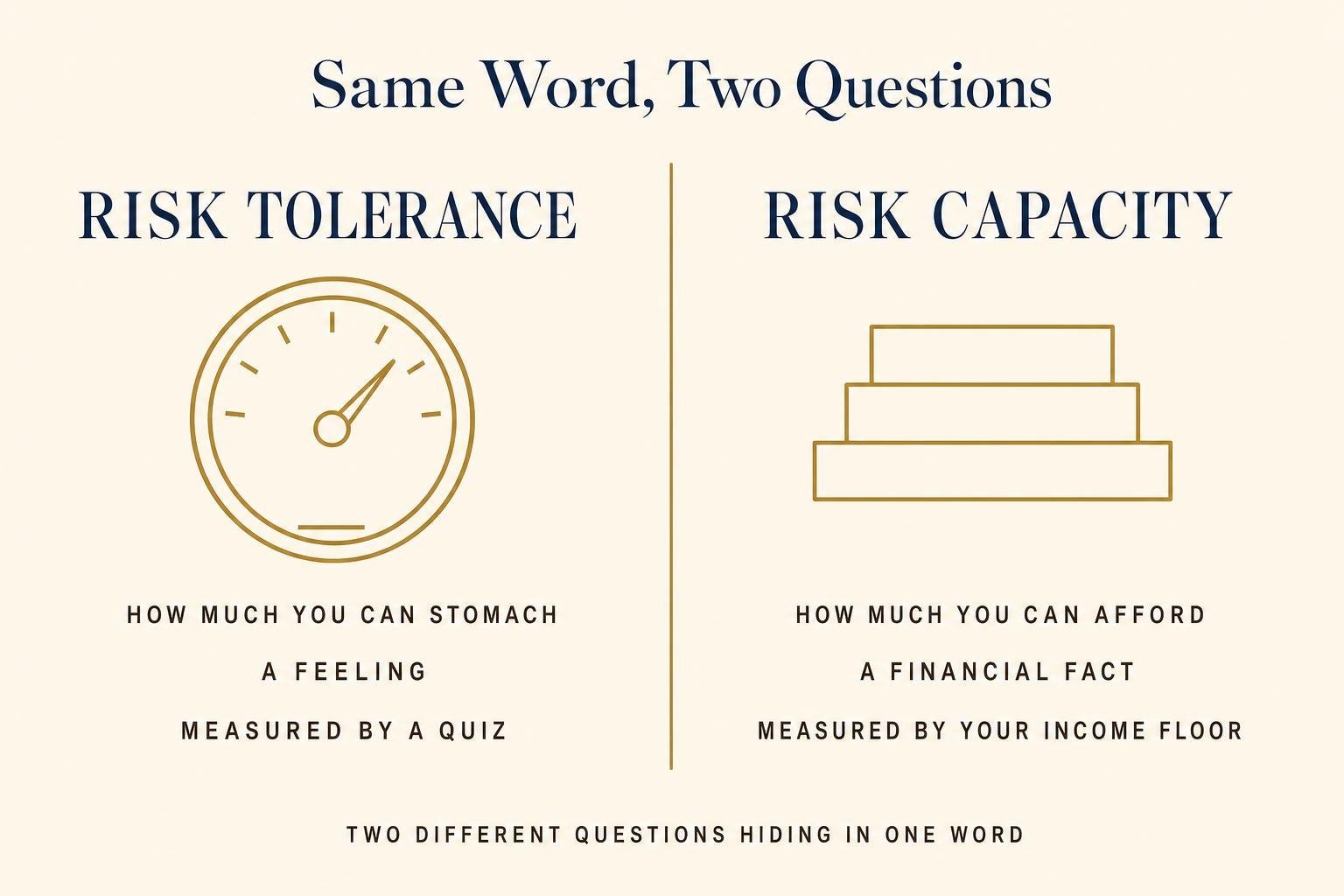
“Risk” gets used as if it were a single dial. It’s really two.
Risk tolerance is your willingness to take risk — the emotional side. The SEC defines it as your ability and willingness to lose some or all of an investment in exchange for potentially greater returns. It’s a temperament question: how much of a drop can you watch on a statement without doing something you’ll regret? A questionnaire can get at this reasonably well, because it’s asking about feelings, and you know your own feelings.
Risk capacity is your financial ability to take risk — the math side. It’s how much loss your plan can actually absorb before it stops working: before you’re forced to sell at the wrong time, cut essential spending, or run short later in life. Capacity has nothing to do with how brave you feel. It’s set by your time horizon, your income, and how much of your spending your portfolio has to cover.
A simple way to hold the two apart: tolerance is how spicy you like your food; capacity is whether your stomach can handle it. You can love heat and have no capacity for it. You can be cautious by nature and have plenty of room to spare.
Why the two so often disagree
If tolerance and capacity always pointed the same direction, you could safely measure one and ignore the other. They don’t. The two dangerous mismatches are worth naming.
High tolerance, low capacity. Picture someone 63 years old, retiring in two years, who says “I’ve always been aggressive” and holds 90% stocks. The feeling is real. The capacity isn’t there — that money starts getting spent soon, and a downturn in the first years of retirement forces selling shares at a discount to pay the bills. That’s sequence-of-returns risk, and it does the most damage in exactly the window this person is entering — the retirement red zone. Their tolerance wrote a check their plan can’t cash.
Low tolerance, high capacity. Now picture someone 45, decades from touching the money, with a stable pension on the way — sitting almost entirely in cash because a bad market year once rattled them. Their feelings say “too risky.” Their capacity says the opposite: they have the time and the income backstop to ride out any number of downturns, and the real danger is inflation quietly eroding cash that should be growing. The safe-feeling choice is the risky one.
The quiz can’t see either mismatch, because it never asked about the things that set capacity — your income floor, your time horizon to the actual withdrawals, how much of your spending has to come from the portfolio. It scored a feeling and stopped.
Why capacity usually deserves the deciding vote
Both numbers matter, but they don’t carry equal weight — and the balance shifts as you age. The SEC’s own investor education makes the point plainly: during retirement, a risk-tolerance profile may matter less than your capacity to handle market risk. That’s not a technicality. It’s the whole game once you’re living off the money.
The reason is that a loss taken while you’re drawing income isn’t the same event as a loss taken while you’re still saving. Sell shares in a down market to cover living expenses and the loss becomes permanent — those shares are gone and can’t recover. No amount of tolerance protects you from that; only capacity does. And tolerance has another weakness: it’s measured on a calm afternoon and spent in a crisis. How you answered a quiz in a quiet moment tells you little about what you’ll do the morning the market is down 15% and the headlines are ugly.
None of this means tolerance is irrelevant. A portfolio you can’t sleep next to is one you’ll abandon at the bottom, and bailing at the bottom is its own way of making a loss permanent. The point isn’t to ignore how you feel. It’s to let capacity set the ceiling — the outer limit of how much risk your plan can survive — and let tolerance fine-tune what sits underneath it.
Capacity isn’t a personality trait — it’s something you build
Here’s the part most risk quizzes get backwards. They treat capacity as if it were fixed, like eye color. It isn’t. Capacity is structural, and you can raise it.
The single biggest lever is a guaranteed income floor. When Social Security, a pension, and — if you use one — an income-focused annuity cover your essential bills, your portfolio no longer has to. That one fact multiplies your capacity. You can hold real growth through a downturn because you’re not selling it to buy groceries; the market can do whatever it wants for a year or three and your lights stay on.
This is exactly what bucket planning is built to do. The Now, Soon, Later framework is, in effect, a capacity-building machine: a Now bucket of cash so you never have to sell in a slump, a Soon bucket that pins down a guaranteed income floor, and a Later bucket of growth you can actually afford to leave alone. Build the first two well, and your capacity to hold the third through a bad year goes up — no change in temperament required. Delaying Social Security is one of the cheapest capacity boosts available to most people: a larger, inflation-adjusted floor for the rest of your life.
Consider a hypothetical case. Two neighbors, both 64, both retiring next year, both scored “moderate” on the same risk quiz. Diane has a $3,200 monthly Social Security benefit and a $1,900 pension that together cover almost all of her essential spending; her $600,000 portfolio is money she mostly won’t touch for a decade. Her friend Paul has the same $600,000, but only Social Security — he’ll need to pull $2,500 a month from the portfolio starting in January to close the gap. Same score, same age, same dollar amount. But Diane’s capacity to ride out a rough market is enormous and Paul’s is small, because Diane’s essentials don’t depend on the market and Paul’s do. If they both build the identical “moderate” portfolio the quiz suggested, the quiz has quietly done Paul a disservice: he needs a deeper cash cushion and a bigger guaranteed floor before he can afford the same exposure to stocks.
This is the kind of thing worth seeing on paper instead of guessing at. A planning tool like ProjectionLab lets you model how a bad market year actually lands on your plan — how much you’d have to sell, and how much pressure your income floor takes off — so you can size your risk to what the plan can carry rather than to a questionnaire. (ProjectionLab is a paid tool; the link is an affiliate link, which means I may earn a small commission at no extra cost to you. I only recommend tools I’d use myself.)
How to actually gauge your own capacity
You don’t need software to get a useful read. Five questions get you most of the way:
- When do you need this money? Not your age — the date you’ll start spending these specific dollars. The shorter the runway, the lower the capacity.
- How much of your essential spending is already covered by guaranteed income? This is the big one. The more of your bills that Social Security and a pension cover, the more risk the rest of the money can take.
- How much must the portfolio produce, and how soon? A portfolio that has to fund half your living expenses next year has far less capacity than one that’s pure growth for the next fifteen.
- How big is your cash cushion? Enough cash to cover a couple of years of withdrawals is what lets you not sell into a downturn. That buffer is capacity you can see.
- What else could you lean on? A paid-off house, part-time income, a spouse’s benefit, a second pension — real resources that raise the floor under everything else.
Thomas’ Take: Your risk capacity is mostly a question about your income floor, not your personality. That’s good news, because you can’t change your temperament much but you can absolutely build a floor. Cover your essentials with guaranteed income and your capacity to sit through a scary market goes up on its own.
Key takeaways
- Risk tolerance is how much market risk you’re willing to stomach; risk capacity is how much your plan can actually afford to lose. They’re different, and they often disagree.
- A standard risk questionnaire mostly measures tolerance — the less decisive of the two, especially as you near retirement.
- Near and in retirement, capacity should usually set your allocation ceiling, because selling into a downturn to fund income turns a paper loss into a permanent one.
- Capacity isn’t a fixed trait. A guaranteed income floor and a cash cushion raise it — no change in temperament required.
- Size your risk to what your plan can carry, then use tolerance to fine-tune what sits underneath.
Frequently asked questions
Can my risk capacity change over time? Yes, and it usually does. Capacity tends to shrink as you approach the years you’ll draw on the money, then can rise again once a guaranteed income floor covers your essentials. It’s worth re-checking every few years rather than deciding once and forgetting it.
Which matters more — tolerance or capacity? Both matter, but they do different jobs. Capacity sets the outer limit of how much risk your plan can survive; tolerance keeps you from holding a portfolio you’ll panic-sell at the worst moment. When the two conflict as you near retirement, capacity should usually win.
How do I raise my risk capacity? The most reliable way is to cover more of your essential spending with guaranteed income — Social Security (including delaying it for a larger benefit), a pension, or an income-focused annuity — and to keep enough cash on hand that you’re never forced to sell investments in a down market. For the full structure behind that, the basics of investment risk from FINRA and the SEC’s guide to asset allocation are both worth a read.
The risk questionnaire isn’t useless. It tells you something real about how you’ll feel when markets fall, and ignored feelings have a way of resurfacing as panic-selling at the worst moment. But a quiz alone can’t tell you how much risk your plan can survive — and that’s the number that keeps you invested through the year that actually tests you. Measure both. Let capacity set the ceiling and tolerance fine-tune the rest. And if your capacity feels thin, the fix usually isn’t a bolder portfolio or a more timid one — it’s a sturdier income floor. That’s where the Now, Soon, Later approach earns its keep.
This article is published by Confluence Media Group LLC, an independent publisher of educational financial content. Thomas Clark is a Series 65 Investment Advisor Representative. The information provided is for educational and informational purposes only and is not personalized financial, tax, or legal advice. Past performance does not guarantee future results. All investing involves risk, including potential loss of principal. Consult a qualified professional before making financial decisions.
Confluence Media Group LLC is a separate entity from Confluence Capital Management, the investment advisory practice through which Thomas Clark provides advisory services. Advisory services are not offered through this publishing platform.
About Thomas Clark
Thomas Clark is the founder of Confluence Media Group LLC and a Series 65 Investment Advisor Representative. He has spent nearly two decades working with families on retirement planning, with a focus on Social Security optimization, retirement income coordination, and the bucket planning approach to building a guaranteed income floor.
Thomas writes and publishes at thomasclarkadvisor.com and is the author of The Just in Case Binder — a 148-page printable family financial organizer for households who want to make sure the people they love know where everything is.
He lives in North Carolina with his family.
Subscribe to the weekly newsletter · Get the Just in Case Binder

Thomas Clark is a Series 65 licensed investment advisor and experienced trader. He specializes in investing, retirement planning, and market analysis, helping individuals build wealth and make informed financial decisions.
