
How a Roth Conversion Affects Your Social Security Taxation
Roth conversions and Social Security taxation interact in ways that quietly determine how much of your benefit Uncle Sam keeps. The bridge years between retirement and claiming are where the strategy gets made or missed.

Most retirees don’t think about Roth conversions and Social Security in the same sentence. They should. The two interact in ways that quietly determine how much of your benefit Uncle Sam keeps — and the window between retirement and claiming is where most of the strategy gets made or missed.
This is the third rail of retirement tax planning. Get it right, and you keep more of your Social Security in retirement. Get it wrong, and a well-intentioned conversion adds to a tax bill you didn’t see coming.
How Social Security taxation actually works
The formula sneaks up on people because it doesn’t follow the rules most other income types do. Up to 85% of your Social Security benefit can be subject to federal income tax — but only if your provisional income crosses certain thresholds.
Provisional income, sometimes called combined income, is the IRS’s way of measuring everything you earn from non-Social-Security sources, plus half of your Social Security itself. The mechanics are simple: take your adjusted gross income excluding the benefit, add any tax-exempt interest (think municipal bond interest), and then add half of your annual Social Security benefit. That sum is the number that gets measured against the thresholds.
For a married couple filing jointly, the thresholds are $32,000 and $44,000. Below $32,000, none of the benefit is taxable. Between $32,000 and $44,000, up to half is taxable. Above $44,000, up to 85% is taxable. For a single filer, the brackets are $25,000 and $34,000.
Here’s what most people don’t realize: these thresholds were set in 1983 and 1993, and they have never been indexed for inflation. The $44,000 ceiling in 1993 dollars would be roughly $95,000 today if it had been indexed. Instead, the same number applies. That’s why nearly every middle-class retiree eventually crosses into the 85% bracket — the brackets stay still while everything else moves up.
What a Roth conversion does to that calculation
A Roth conversion moves money from a pre-tax account — a traditional IRA or 401(k) — into a Roth account. You pay ordinary income tax on the converted amount in the year of the conversion. The Roth then grows tax-free, and qualified withdrawals from it never count as taxable income for the rest of your life and your spouse’s life.
Here’s where Social Security taxation gets interesting. A Roth withdrawal doesn’t count as provisional income. But a Roth conversion does. The full converted amount lands on your tax return as ordinary income that year, which is exactly the kind of income the provisional-income formula counts.
The math is straightforward. If you are already collecting Social Security and you do a $50,000 Roth conversion, you add $50,000 to provisional income. If that pushes you above the $44,000 threshold for a couple, you are now also pulling up to 85% of your Social Security benefit into taxable income on top of the conversion itself. The conversion you did to reduce future taxes can quietly inflate this year’s tax bill far more than the conversion amount alone suggests.
This is sometimes called the Social Security tax torpedo, and it’s the single most underappreciated dynamic in retirement tax planning.
The window that matters
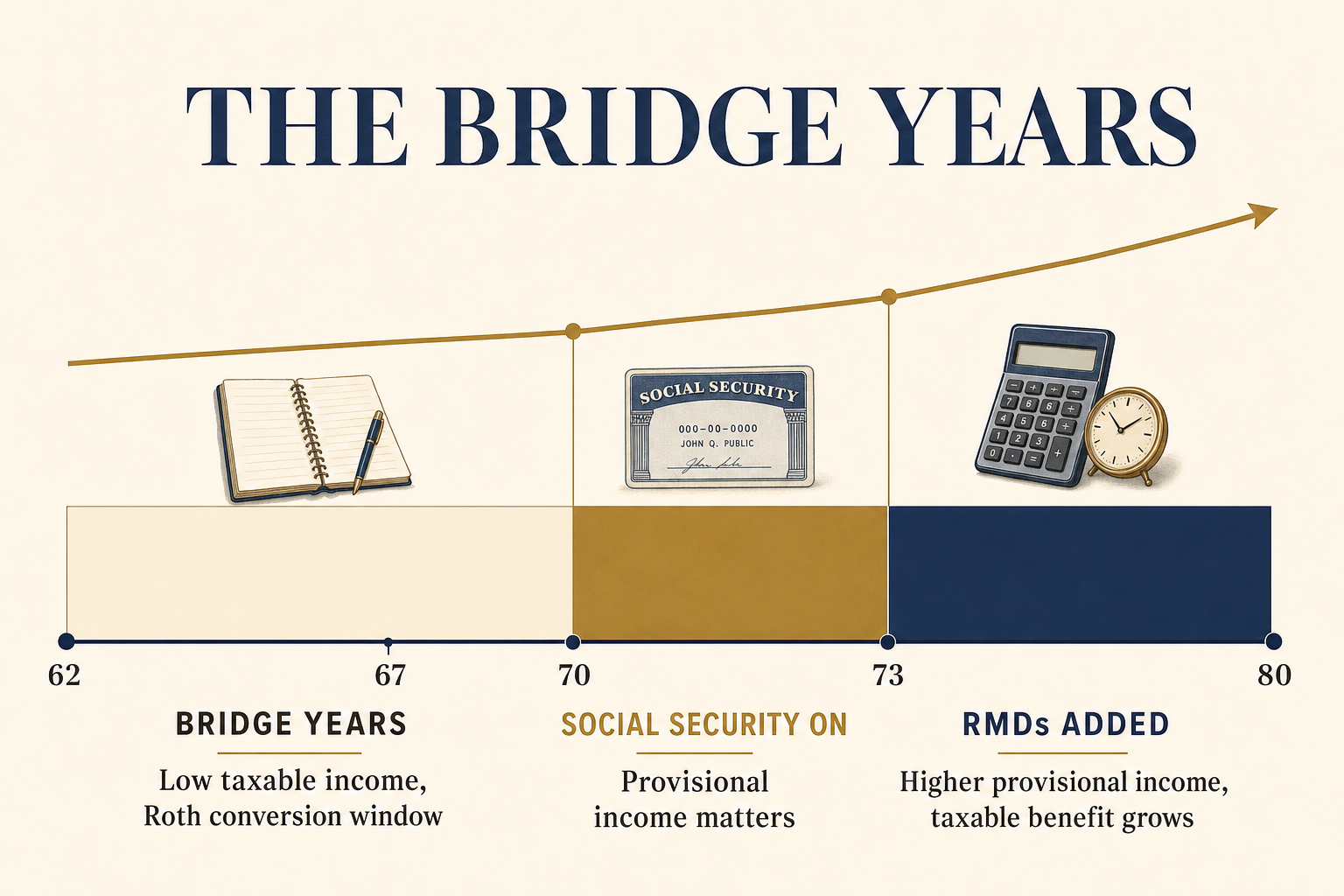
The reason the tax torpedo is solvable, not inevitable, comes down to timing. Most retirees have a window — sometimes called the bridge years — between when their wages stop and when their Social Security benefit begins. For someone who retires at 62 and delays claiming until 70, that window is eight years long. Even for someone who retires at 65 and claims at 67, it’s two years.
During that window, taxable income is at a multi-decade low. Wages are gone. Social Security hasn’t started. Required minimum distributions from traditional IRAs don’t begin until 73. If a couple is living off cash reserves and a few thousand in dividends, their AGI might sit in the $20,000–$40,000 range — well below where Social Security taxation starts to bite.
This is when Roth conversions get powerful. Convert during the bridge years, and you are paying tax at a relatively low marginal rate without dragging Social Security into the calculation, because you haven’t claimed yet. You are also shrinking the pre-tax balance that will eventually feed RMDs. Smaller future RMDs means lower future provisional income, which means a lower percentage of your eventual Social Security benefit being taxed.
Thomas’s Take: I’ve found that the years between retirement and Social Security claiming are the highest-leverage tax-planning window most people will ever have. Most retirees don’t realize this until the window has already closed.
A hypothetical scenario
Consider a hypothetical: Karim and Layla, both 64, recently retired. Their household has $1.2 million in traditional IRAs and $200,000 in a brokerage account. They are spending about $80,000 a year, partly from cash savings and partly from brokerage dividends. They plan to claim Social Security at age 70 — a combined benefit of roughly $72,000 per year in today’s dollars.
If they do nothing during the bridge years, here’s what happens. Their AGI is small now. Then Social Security starts at 70. At 73, RMDs from the traditional IRA — grown over those nine years — push another $60,000 of forced income onto their return. Combined with Social Security and any portfolio income, their provisional income easily clears $44,000, and 85% of their Social Security benefit gets pulled into taxable income permanently.
Now consider a different path. From age 64 to 70, they convert $40,000 a year from the traditional IRA to a Roth — six conversions, $240,000 total. They pay tax on the conversions at the 12% bracket (because their other taxable income is minimal), so roughly $4,800 a year in conversion tax. The $240,000 inside the Roth grows tax-free from there.
By the time Social Security starts at 70, their traditional IRA balance is smaller. RMDs at 73 are lower. Their provisional income in retirement runs $20,000–$30,000 lower than it would have. Their Social Security benefit, while still partly taxable, isn’t as deeply caught in the 85% bracket. And every Roth withdrawal from age 70 forward is invisible to the provisional-income formula.
These are illustrative numbers, not predictions. But the structure is what matters: the bridge years allow Roth conversions to happen without triggering the Social Security tax torpedo, and the shrunken pre-tax balance reduces the torpedo’s force when Social Security finally starts.
What this means for the strategy
The cleanest place to do Roth conversions is between retirement and Social Security claiming. That window is finite and worth using. If you are already claiming Social Security, conversions get more complicated — not impossible, but the tax math changes meaningfully because of the provisional-income interaction. The decision needs to weigh the marginal cost of pulling more of your benefit into the 85% bracket against the long-term benefit of shrinking the pre-tax balance.
Convert up to the top of a tax bracket, not above it. The 12% bracket runs to roughly $96,000 of taxable income for a couple. Filling that bracket is usually cheap. Pushing $30,000 above it lands you in the 22% bracket — and if you have already started Social Security, it can cross provisional-income thresholds at the same time.
There is also a quieter cost to watch: Medicare IRMAA. Once you turn 65 and enroll in Medicare, your Part B and Part D premiums are surcharged based on your modified adjusted gross income from two years prior. A single large conversion year can lift you into a higher IRMAA bracket and cost an extra $2,000–$3,000 in Medicare premiums two years later. Spreading conversions across several smaller years usually beats one big one — for tax brackets, for IRMAA, and for the Social Security taxation interaction once benefits begin.
The takeaway
The Roth conversion isn’t a tax trick. It’s a timing tool. The reason it matters for Social Security taxation isn’t that Roth withdrawals are magic — it’s that they don’t count as provisional income, which means they don’t pull more of your Social Security into the taxable column. Build a Roth balance before Social Security claiming begins, and you give your future self an income source the IRS doesn’t see when it’s calculating how much of your benefit to tax.
That’s the goal: a retirement where more of your Social Security is yours, because more of your other income is invisible to the formula. The bridge years are where that strategy is built. Most people never use them.
This article is published by Confluence Media Group LLC, an independent publisher of educational financial content. Thomas Clark is a Series 65 Investment Advisor Representative. The information provided is for educational and informational purposes only and is not personalized financial, tax, or legal advice. Past performance does not guarantee future results. All investing involves risk, including potential loss of principal. Consult a qualified professional before making financial decisions.
Confluence Media Group LLC is a separate entity from Confluence Capital Management, the investment advisory practice through which Thomas Clark provides advisory services. Advisory services are not offered through this publishing platform.
About Thomas Clark
Thomas Clark is the founder of Confluence Media Group LLC and a Series 65 Investment Advisor Representative. He has spent nearly two decades working with families on retirement planning, with a focus on Social Security optimization, retirement income coordination, and the bucket planning approach to building a guaranteed income floor.
Thomas writes and publishes at thomasclarkadvisor.com and is the author of The Just in Case Binder — a 148-page printable family financial organizer for households who want to make sure the people they love know where everything is.
He lives in North Carolina with his family.
Subscribe to the weekly newsletter · Get the Just in Case Binder

Thomas Clark is a Series 65 licensed investment advisor and experienced trader. He specializes in investing, retirement planning, and market analysis, helping individuals build wealth and make informed financial decisions.
