
Social Security Disability Benefits: What Happens When You Can’t Work Before Retirement
Social Security Disability Benefits: What Happens When You Can’t Work Before Retirement
Table of Contents
- Nobody Plans to Become Disabled at 58
- SSDI vs. SSI: Two Very Different Programs
- Eligibility: Work Credits and the 20/40 Rule
- How the SSA Defines Disability
- How Much Will You Receive? Understanding Your SSDI Benefit Amount
- The 5-Month Waiting Period
- SSDI to Retirement: The Automatic Conversion at FRA
- Medicare After 24 Months on SSDI
- Working While on SSDI: Trial Work Period and SGA Limits
- Applying for SSDI: Process, Documentation, and Dealing With Denial
- Financial Planning During Disability
- Key Takeaways
- Frequently Asked Questions
Nobody plans to become disabled at 58. You do not sit down with a retirement calculator and build in a scenario where a stroke, a degenerative spine condition, or a serious autoimmune disease ends your career a decade before you expected. And yet the Social Security Administration’s own data makes this impossible to ignore: roughly 1 in 4 workers today will experience a disability before reaching retirement age that prevents them from working for 12 months or longer.
If that happens to you — or to a spouse, a parent, or a client you care about — Social Security Disability Insurance may be the most important benefit you never expected to need. It is also one of the most misunderstood. After nearly 20 years studying how retirees and pre-retirees actually navigate Social Security, I’ve watched what happens when families don’t understand this program going in: delayed applications, missed benefits, and financial decisions made under panic rather than planning.
This guide walks through how SSDI works, what determines your benefit, and how disability before retirement intersects with the broader Social Security claiming strategy.
SSDI vs. SSI: Two Very Different Programs
The federal government runs two distinct disability programs, and people frequently confuse them. They are not interchangeable.
Social Security Disability Insurance (SSDI) is an earned benefit. It is funded by the Social Security payroll taxes you and your employers have paid throughout your working life. Your eligibility depends entirely on your work history — specifically, how many “work credits” you have accumulated. If you qualify and are approved, your benefit amount is based on your lifetime earnings record, the same way a retirement benefit is calculated.
Supplemental Security Income (SSI) is a needs-based program. It is funded by general tax revenue, not Social Security payroll taxes, and has nothing to do with your work history. SSI is designed for people who are disabled, blind, or elderly AND have very limited income and assets — the resource limit is $2,000 for an individual. SSI pays a flat monthly amount (the Federal Benefit Rate in 2026 is $943 for an individual).
The medical definition of disability is the same for both programs. But almost everything else — who qualifies, how the benefit is calculated, and how it interacts with retirement — is different. This guide focuses primarily on SSDI, because it is the program most relevant to working adults building toward retirement.
Eligibility: Work Credits and the 20/40 Rule
To qualify for SSDI, you must have earned enough work credits through your employment history. In 2026, you earn one credit for every $1,810 in wages or self-employment income, up to a maximum of four credits per year.
The general rule for most workers has two requirements:
- 40 total credits (equivalent to 10 years of full-time work)
- 20 of those credits earned in the 10 years immediately before your disability began
This “20/40 rule” is the standard for workers who become disabled at age 31 or older. The logic is that SSDI is intended to protect people who have been actively attached to the workforce — not someone who worked briefly in their 20s, left the labor force for two decades, and then becomes disabled.
Younger workers have lower thresholds. If you become disabled before age 24, you may qualify with as few as 6 credits earned in the 3 years before disability. Ages 24–30 use a sliding scale. The SSA’s full eligibility table explains the credit requirements by age.
One important practical note: if you have periods when you were not working — taking care of children, dealing with illness, or working in non-covered employment like certain state/local government jobs — those gaps can erode your recent credit history faster than you might expect. Checking your Social Security statement periodically at ssa.gov/myaccount lets you see exactly where you stand.
Pro Tip: You can create a my Social Security account at SSA.gov at any age. Your statement shows your full earnings history, your estimated disability benefit, and your estimated retirement benefit — all in one place. I recommend every client review this annually, the same way you review your credit report.
How the SSA Defines Disability
The Social Security Administration uses one of the strictest definitions of disability in the world. This is not a program for partial disability or short-term conditions.
To qualify, you must have a medically determinable physical or mental impairment that:
- Prevents you from engaging in Substantial Gainful Activity (SGA) — meaning you cannot earn more than a set monthly threshold from work
- Has lasted or is expected to last at least 12 continuous months — or is expected to result in death
The SSA also considers whether, given your condition, age, education, and past work experience, you could perform any work that exists in significant numbers in the national economy — not just your prior occupation. This is a critical distinction. You may be completely unable to continue your former job as a construction superintendent, but if the SSA determines you could do sedentary office work, you may not qualify.
The SSA maintains what is called the Blue Book — formally, the Listing of Impairments — which catalogs specific conditions and the severity thresholds that automatically qualify. If your condition meets a Blue Book listing, approval is generally faster. If it does not, the SSA uses a multi-step sequential evaluation process that considers residual functional capacity and vocational factors.

How Much Will You Receive? Understanding Your SSDI Benefit Amount
Your SSDI benefit is calculated using the same formula as your Social Security retirement benefit — specifically, it is based on your Primary Insurance Amount (PIA).
The SSA calculates your PIA by:
- Indexing your lifetime earnings to account for wage growth
- Averaging your highest 35 years of indexed earnings (or fewer years if you are younger)
- Applying a progressive benefit formula that replaces a higher percentage of earnings for lower earners
For most workers, SSDI replaces roughly 30–50% of pre-disability earnings, with the percentage being higher for lower earners. The average SSDI benefit in early 2026 is approximately $1,580 per month, though individual amounts vary significantly based on earnings history.
Because the SSDI calculation uses your actual earnings history, becoming disabled later in a career — after more high-earning years are on record — typically means a higher benefit. Conversely, someone who becomes disabled in their 30s will have fewer years of earnings factored in, resulting in a lower monthly amount.
For a deeper look at how the Social Security benefit formula works, see my post on how Social Security benefits are calculated.
Thomas’s Take: One of the things I find clients are most surprised by is that their SSDI benefit can be meaningfully different from what they might expect just from looking at their most recent salary. The averaging formula, the wage indexing, and the progressive replacement rate all interact in ways that are not intuitive. Running your actual numbers through the SSA’s online estimator — or working through them with an advisor — is worth the time before you need this information in a crisis.
The 5-Month Waiting Period
There is a built-in delay that many applicants do not know about: SSDI does not pay benefits for the first 5 full months of your disability.
This means if your disability begins on January 1, your first month of SSDI eligibility is June, and your first actual payment arrives in July (payments are made the month following the month they cover). The SSA does not pay any retroactive benefits for those first five months, regardless of how clear-cut your approval is.
Practically, this means there is a gap — often 6 to 12 months or longer, counting the application and approval timeline — during which you have no SSDI income. This is where private long-term disability (LTD) insurance becomes critically important. A well-designed LTD policy typically has an elimination period (the private equivalent of the waiting period) of 90 to 180 days and is designed to bridge exactly this kind of gap.
If you have employer-provided disability coverage, now is a good time to know what it actually covers. The details matter: own-occupation vs. any-occupation definitions, the elimination period, the benefit period, and whether the policy offsets against SSDI.
SSDI to Retirement: The Automatic Conversion at FRA
This is one of the most important — and least understood — features of SSDI, and it is directly relevant to retirement planning.
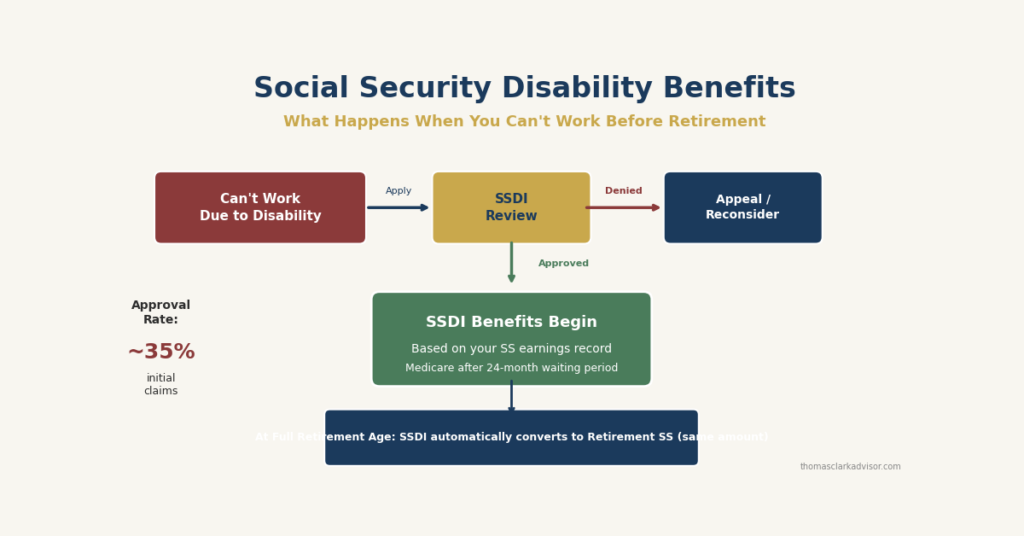
When you reach your Full Retirement Age (FRA), your SSDI benefit automatically converts to a Social Security retirement benefit. The conversion is seamless — you do not need to apply, notify anyone, or do anything. From the SSA’s perspective, you simply transition from one program to the other.
The conversion happens at the same dollar amount. There is no reduction to your benefit at the conversion. This is significant because it means disability recipients are not penalized for having been unable to work. If your SSDI benefit was $2,100/month at age 61, your retirement benefit after conversion at FRA will also be $2,100/month.
Compare this to someone who retires early and claims Social Security at 62: they face a permanent reduction of up to 30% from their full retirement benefit amount. SSDI recipients experience no such reduction — they effectively receive their full FRA benefit, even though they were receiving benefits years earlier.
This interaction with the broader Social Security claiming strategy is worth understanding in context. For a full picture of timing decisions, see my posts on when to file for Social Security and how Social Security benefits are calculated.
Medicare After 24 Months on SSDI
Once you have been receiving SSDI benefits for 24 months, you become eligible for Medicare — regardless of your age. This is a significant benefit for people who become disabled in their 40s or 50s and might otherwise face years without employer-based health coverage.
The 24-month clock starts from the date your SSDI benefits begin (your sixth month of disability, accounting for the waiting period). So the actual elapsed time from the onset of disability to Medicare eligibility is typically around 29 months.
For people with amyotrophic lateral sclerosis (ALS), Medicare eligibility begins immediately upon SSDI approval — there is no waiting period.
Understanding when Medicare kicks in is especially important for coordinating with COBRA coverage, marketplace insurance, or a spouse’s employer plan. The sequencing matters for both coverage continuity and cost. For a detailed breakdown of Medicare’s enrollment windows and how to avoid late enrollment penalties, see my guide on Medicare enrollment deadlines and penalties.
Working While on SSDI: Trial Work Period and SGA Limits
SSDI is not designed to trap you in non-employment forever. The SSA has provisions specifically intended to encourage disability recipients to attempt a return to work, without immediately losing their benefits.
Substantial Gainful Activity (SGA) is the monthly earnings threshold above which the SSA considers you able to engage in substantial work. In 2026, the SGA amount is $1,620 per month for non-blind individuals ($2,700 for blind individuals). If you earn above this amount, the SSA considers you to be engaging in SGA and will generally terminate your disability benefits. Current SGA amounts are published at SSA.gov.
The Trial Work Period (TWP) gives you a protected window to test your ability to return to work without risking your benefits. For 2026, any month in which you earn more than $1,110 counts as a Trial Work Month. You are entitled to 9 Trial Work Months within any 60-month period. During those 9 months, you receive your full SSDI benefit regardless of how much you earn.
After exhausting your Trial Work Period:
- There is a 36-month Extended Period of Eligibility (EPE) during which benefits can be reinstated quickly if earnings drop below SGA — without filing a new application
- If you stop working again after the EPE, you may be eligible for Expedited Reinstatement, allowing benefits to resume within 60 months without a full new application
The interaction between these rules and part-time or consulting income can get complicated. The SSA provides detailed guidance, and getting this right matters — both to protect your benefits during recovery and to avoid inadvertent overpayments that create repayment obligations.

Applying for SSDI: Process, Documentation, and Dealing With Denial
The application process is a significant undertaking, and going in without understanding the realities will cost you time and money.
How to apply: You can apply online at SSA.gov, by phone at 1-800-772-1213, or in person at your local Social Security office. The application itself is lengthy — expect several hours across multiple sessions. You will need detailed information about your medical conditions, treatment providers, medications, work history, and daily functional limitations.
Initial denial rates are high. Approximately 65% of initial SSDI applications are denied. This is not an anomaly — it is the norm. Do not be discouraged if you receive a denial letter. The appeals process exists precisely because many valid claims are denied at the initial level due to incomplete documentation, medical evidence that does not yet meet the SSA’s threshold, or procedural issues.
The appeals process has four levels:
- Reconsideration — a fresh review by a different SSA examiner
- Administrative Law Judge (ALJ) hearing — an in-person or video hearing; approval rates are meaningfully higher at this level
- Appeals Council review
- Federal court
Most successful appeals are resolved at the ALJ level. The wait for an ALJ hearing varies by region but can be 12 to 24 months or longer.
Get legal help. Social Security disability attorneys work on a contingency basis — they are paid only if you win, and their fee is capped by law at 25% of back pay, up to $7,200 (as of 2024; this amount is periodically adjusted). Given the complexity of the process and the stakes involved, legal representation significantly improves outcomes.
Document everything. The SSA will request medical records from your providers, but do not rely solely on them to gather what is needed. Maintain your own organized file: physician notes, imaging reports, specialist evaluations, functional assessments, hospitalizations, and any documentation of how your condition affects your daily activities and ability to work.
Financial Planning During Disability
The financial impact of a disabling condition before retirement is not limited to the loss of income. It is a cascade: income drops, expenses may rise (medical, caregiving, home modification), retirement savings contributions stop, and long-term projections shift.
Here is the framework that holds up best in a disability scenario:
Coordinate with private disability insurance. If you have employer-sponsored LTD or an individual disability policy, understand how it interacts with SSDI. Most LTD policies offset against SSDI benefits — meaning your total disability income stays the same, but the insurance company pays less once SSDI kicks in. This is not a problem; it is a design feature. But you need to report SSDI approval to your insurer promptly to avoid overpayment clawbacks.
Protect retirement accounts. If at all possible, stop drawing from retirement accounts during a disability. Withdrawals before 59½ typically trigger a 10% early withdrawal penalty in addition to ordinary income tax — though there are hardship exceptions for disability. SSDI recipients who are determined to be totally and permanently disabled may qualify for the disability exception to the early withdrawal penalty under IRS rules. Verify this with a tax professional before taking any distributions.
Social Security Survivor benefits are affected. Your earnings record — the same one that determines your SSDI benefit — also determines the survivor benefit your spouse or dependents would receive if you die. For more on how this works, see my post on Social Security survivor benefits.
Think carefully about spending. SSDI benefits are modest. The average benefit in early 2026 is roughly $1,580/month — not enough to cover most households’ fixed expenses without supplemental income, savings, or support. A cash flow plan based on realistic assumptions is essential, not optional.
Revisit your retirement projections. A disability at 55 means potentially 7–10 years without retirement contributions. Compound that over 20 or 30 years and the gap is significant. If and when your SSDI converts to a retirement benefit at FRA, you will have a lifetime income stream — but it may be lower than you projected. Understanding the revised baseline is the starting point for any rebuild.
For clients who are concerned about Social Security myths — including misconceptions about SSDI’s permanence and the solvency of the trust fund — I address many of those in my post on Social Security myths worth debunking.
Thomas’s Take: Thomas’s Take: I’ve sat with this scenario more than once — the call that comes after a diagnosis, or a surgery that did not go as planned, or a condition that has quietly been getting worse for two years. The financial part is genuinely manageable with the right framework. The most important thing I can tell you is this: don’t wait to understand this program until you need it. Learn the basics now, check your work credit balance at SSA.gov, and if you have no private LTD coverage, look at getting some. The gap between disability onset and SSDI approval is where the real financial damage happens. The financial part of it is genuinely manageable with the right framework. The most important thing I can tell you is this: do not wait to understand this program until you need it. Learn the basics now, check your work credit balance, and if you have no private LTD coverage, get some. The gap between disability onset and SSDI approval is where the real financial damage happens.
Key Takeaways
- SSDI is an earned benefit based on your payroll tax contributions and work history — not a welfare program. SSI is the needs-based alternative for those without sufficient work history.
- The 20/40 rule is the standard eligibility threshold: 40 total work credits, with 20 earned in the last 10 years before disability begins.
- The SSA’s definition of disability is strict — inability to engage in substantial gainful activity for 12+ months, considering whether you can perform any work in the national economy, not just your prior occupation.
- At Full Retirement Age, SSDI automatically converts to a retirement benefit at the same amount — with no reduction for early claiming, unlike voluntary early retirement.
- About 65% of initial SSDI applications are denied. The appeals process, particularly the ALJ hearing, is where most successful claims are ultimately won. Legal representation improves outcomes significantly.
Frequently Asked Questions
Can I receive both SSDI and a private pension or 401(k) distributions?
Yes. SSDI is not means-tested — receiving income from a pension, 401(k), IRA, or investment accounts does not reduce or eliminate your SSDI benefit. The only income that triggers SGA limits and can affect your SSDI is earned income from work. However, pension income can affect SSI (the needs-based program), and workers’ compensation or certain government pensions can reduce SSDI through the Government Pension Offset or workers’ compensation offset rules.
If I am approved for SSDI, will I receive back pay?
Yes, in most cases. SSDI can pay retroactive benefits going back to the month you became eligible (your sixth month of disability) — but only up to 12 months before the date of your application. Because the application and approval process often takes a year or more, many approved applicants receive a lump-sum back payment covering the period from eligibility to approval.
Does receiving SSDI affect my spouse’s Social Security retirement benefits?
Your SSDI claim does not reduce your spouse’s retirement benefit. Your spouse may, however, be entitled to auxiliary benefits based on your SSDI record — up to 50% of your benefit — depending on their age and circumstances. Additionally, your dependent children (under 18, or up to 19 if still in high school) may also be eligible for benefits. The combined family benefit is subject to a maximum family benefit cap.
What if my condition improves? Can I lose SSDI benefits?
Yes. The SSA conducts periodic Continuing Disability Reviews (CDRs) to determine whether you remain disabled. If your condition has improved to the point where you can engage in substantial gainful activity, your benefits can be terminated. CDRs typically occur every 3 years for conditions that are expected to improve, and every 7 years for permanent or unlikely-to-improve conditions. This is one more reason to stay organized with your medical documentation throughout your time on SSDI.
Ready to Talk Through Your Social Security Strategy?
Whether you are approaching retirement, navigating a disability, or trying to understand how all the pieces of your Social Security picture fit together — these decisions are too important to make in isolation. ## Want More Coverage Like This? The SSDI/retirement transition, Social Security claiming math, and disability planning are subjects I cover in depth across the TCA archive. If you’d like new posts delivered weekly, sign up for the TCA newsletter at the bottom of this page. The archive starts with [bucket planning the income floor], [Social Security claiming optimization], and [coordinated withdrawal sequences].
For more on retirement income, bucket planning, and Social Security claiming, browse the retirement planning archive or sign up for the weekly newsletter at the bottom of any page.
This article is published by Confluence Media Group LLC, an independent publisher of educational financial content. Thomas Clark is a Series 65 Investment Advisor Representative. The information provided is for educational and informational purposes only and is not personalized financial, tax, or legal advice. Past performance does not guarantee future results. All investing involves risk, including potential loss of principal. Consult a qualified professional before making financial decisions.
Confluence Media Group LLC is a separate entity from Confluence Capital Management, the investment advisory practice through which Thomas Clark provides advisory services. Advisory services are not offered through this publishing platform.

Thomas Clark is a Series 65 licensed investment advisor and experienced trader. He specializes in investing, retirement planning, and market analysis, helping individuals build wealth and make informed financial decisions.
