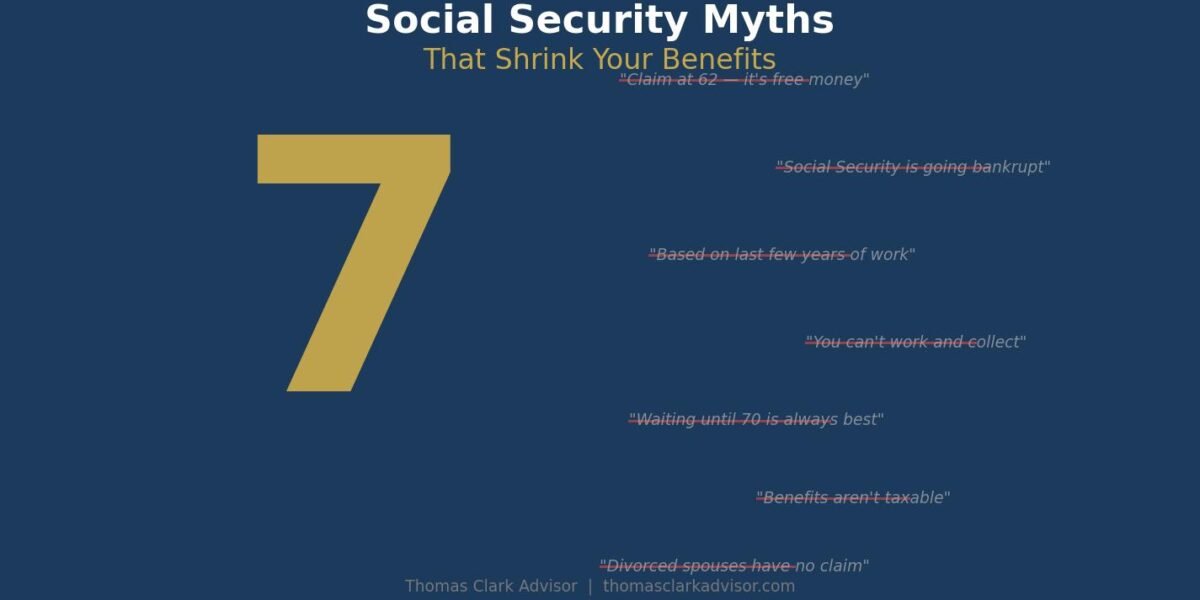
7 Social Security Myths That Shrink Your Benefits
Many people approaching retirement are convinced they have made all the right moves with Social Security. They claimed at 62, believe the program is going bankrupt anyway, and figure their benefits are based on their last few years of earnings. These Social Security myths are wrong — and together, they can cost hundreds of dollars per month in benefits that could have been received.
Social Security myths do not just cause confusion. They cause real, measurable financial harm. The Social Security Administration pays out over $1.4 trillion in benefits annually, and the decisions people make about when and how to claim are often based on folklore rather than facts.
In this article, I am going to walk through seven of the most damaging Social Security myths — the ones that consistently lead people to leave money on the table. For each one, I will show you what the data actually says and what you can do differently.
Table of Contents
- Myth 1: You Should Always Claim at 62
- Myth 2: Social Security Is Going Bankrupt
- Myth 3: Your Benefit Is Based on Your Last Few Years of Work
- Myth 4: You Cannot Work and Collect Benefits at the Same Time
- Myth 5: Divorced Spouses Have No Claim to Benefits
- Myth 6: Everyone Should Delay Until 70
- Myth 7: Social Security Benefits Are Not Taxable
- The Real Cost of Believing These Myths
- Key Takeaways
- FAQ
Myth 1: You Should Always Claim at 62
This is the single most expensive myth in retirement planning. The logic sounds reasonable on the surface: “Take the money now — a bird in the hand.” But the math tells a very different story.
When you claim Social Security at 62, your benefit is permanently reduced by up to 30% compared to what you would receive at your full retirement age (FRA), which is 67 for anyone born in 1960 or later. That reduction is not temporary. It applies to every check for the rest of your life — and it also reduces any survivor benefit your spouse may eventually receive.
Here is how the numbers work for a hypothetical worker with a full retirement age benefit of $2,400 per month:
| Claiming Age | Monthly Benefit | Annual Benefit | Cumulative by Age 85 |
|---|---|---|---|
| 62 | $1,680 | $20,160 | $463,680 |
| 67 (FRA) | $2,400 | $28,800 | $518,400 |
| 70 | $2,976 | $35,712 | $535,680 |
The breakeven point between claiming at 62 and waiting until 67 typically falls around age 78 to 79. According to the Social Security Administration’s life expectancy calculator, a 62-year-old man today can expect to live to about 83, and a 62-year-old woman to about 86. That means the majority of people who claim early end up receiving less in total lifetime benefits.
Thomas’s Take: Early claiming makes sense in some situations — serious health concerns, no other income sources, or a specific household strategy. But claiming at 62 simply because you can is one of the most costly defaults I see.
In-article image: Bar chart comparing cumulative lifetime Social Security benefits at claiming ages 62, 67, and 70, using TCA navy and gold brand colors with a clear breakeven point marked around age 78-79. Alt text: “Bar chart showing cumulative Social Security benefits at ages 62, 67, and 70, with the breakeven point highlighted near age 79.”
Myth 2: Social Security Is Going Bankrupt
This is one of the most common misconceptions: “Social Security won’t be there when I retire, so I might as well take it now.” This myth drives more premature claiming decisions than any other — and it is based on a fundamental misunderstanding of how the program works.
Social Security is funded primarily through payroll taxes (FICA). As long as people are working and paying into the system, benefits will be paid out. The Congressional Budget Office’s 2024 long-term projections estimate that the Old-Age and Survivors Insurance (OASI) trust fund could be depleted around 2033. But “trust fund depletion” does not mean “zero benefits.”
Even in the worst-case scenario — if Congress makes no changes at all — ongoing payroll tax revenue would still cover approximately 77% to 80% of scheduled benefits after the trust fund is exhausted. That is a reduction, not an elimination.
And historically, Congress has stepped in before deadlines. The last major Social Security reform in 1983 was passed just months before the trust fund was projected to run out. There is strong bipartisan motivation to address the issue: more than 67 million Americans receive Social Security benefits, according to the SSA’s statistical snapshot.
Thomas’s Take: Plan for the program as it exists today while staying informed about potential changes. Using fear of insolvency to justify early claiming almost always backfires mathematically.
Myth 3: Your Benefit Is Based on Your Last Few Years of Work
Many people believe their Social Security benefit reflects their most recent salary. If that were true, someone who took a lower-paying job in their last few years before retirement would see their benefit drop dramatically. Fortunately, that is not how the formula works.
Your Social Security benefit is calculated using your highest 35 years of indexed earnings — not your last few years. The SSA takes your annual earnings, adjusts earlier years for wage inflation (indexing), selects the top 35 years, and calculates your Average Indexed Monthly Earnings (AIME). Your Primary Insurance Amount (PIA) — your benefit at full retirement age — is then derived from the AIME using a progressive formula with specific bend points.
What this means in practice:
- If you have fewer than 35 years of earnings, zeros are averaged in for the missing years, which pulls your benefit down significantly.
- If you work beyond 35 years, a higher-earning year can replace a lower-earning year in the calculation, potentially increasing your benefit.
- Taking a pay cut late in your career generally has little impact if your earlier years were strong.
This is why I often encourage people who have gaps in their work history — perhaps from raising children or a career change — to consider whether a few additional years of work could replace those zero-earning years in the formula. Even moderate earnings can meaningfully boost the final benefit.
You can review your own earnings history on your My Social Security statement at ssa.gov to see exactly which years are being counted.
Myth 4: You Cannot Work and Collect Benefits at the Same Time
This myth keeps some people from claiming benefits they are entitled to, and causes others unnecessary anxiety about earning income after they start collecting. The truth is nuanced, but the bottom line is: yes, you can work and receive Social Security at the same time.
Here is how the earnings test actually works:
Before full retirement age (67 for most current pre-retirees):
– In 2026, if you earn more than $23,400, Social Security withholds $1 for every $2 you earn above that threshold.
– In the year you reach FRA, the threshold is higher ($62,160 in 2025 figures) and the reduction is $1 for every $3 over the limit.
At and after full retirement age:
– There is no earnings test. You can earn any amount with zero reduction in benefits.
And here is the part most people miss: the withheld benefits are not lost. Once you reach full retirement age, the SSA recalculates your benefit to credit you for the months benefits were withheld. Your monthly payment goes up to account for those “lost” checks.
Thomas’s Take: The earnings test is really more of a deferral than a penalty. If you are still working and under FRA, it may actually make sense to claim and let the earnings test work in your favor — depending on your broader financial picture. This is one area where a personalized analysis makes a real difference. I wrote more about coordinating income sources in 5 Retirement Withdrawal Mistakes That Cost Thousands.
Myth 5: Divorced Spouses Have No Claim to Benefits
This is one of the most overlooked benefits in the entire Social Security system. If you were married for at least 10 years and are currently unmarried, you may be eligible for a spousal benefit based on your ex-spouse’s earnings record — even if your ex has remarried.
The key rules for divorced spouse benefits:
- The marriage lasted at least 10 years
- You are currently unmarried
- You are at least 62 years old
- Your ex-spouse is entitled to Social Security benefits
- Your own benefit is less than what you would receive as a divorced spouse
The benefit amount can be up to 50% of your ex-spouse’s PIA at your full retirement age. And critically, claiming a divorced spouse benefit has no effect whatsoever on your ex-spouse’s benefit or their current spouse’s benefit. The SSA does not even notify your ex.
Free Download: Social Security Optimization Guide
Learn the strategies that could maximize your lifetime Social Security benefits.
Get Your Free CopyIf your ex-spouse has not yet filed for benefits but is eligible, you can still claim divorced spouse benefits as long as you have been divorced for at least two years.
Many people discover they are eligible for hundreds of dollars more per month through divorced spouse benefits they never knew existed. For anyone who was in a long-term marriage that ended in divorce, this is worth investigating. For more on how spousal benefits work generally, see my Complete Guide to Social Security Spousal Benefits.
Myth 6: Everyone Should Delay Until 70
After debunking Myth 1 about always claiming early, I need to address the opposite extreme. Delaying Social Security to age 70 maximizes your monthly benefit through delayed retirement credits — an 8% increase per year between FRA and 70. But maximizing your monthly check is not the same as maximizing your financial well-being.
Delaying until 70 may not be the right move if:
- Your health is poor. If your life expectancy is significantly below average, the breakeven math shifts in favor of earlier claiming.
- You need the income now. Withdrawing heavily from retirement accounts to “bridge” to age 70 can trigger higher tax brackets, increased IRMAA Medicare surcharges, and faster portfolio depletion.
- Your spouse has a much higher benefit. In some household strategies, it makes sense for the lower earner to claim earlier while the higher earner delays — particularly when survivor benefits are a factor.
- You have a pension or other guaranteed income. If your basic expenses are already covered, the urgency to maximize Social Security may be lower, and flexibility may matter more.
The optimal claiming age depends on your health, your spouse’s situation, your other income sources, your tax picture, and your cash flow needs. A 2019 study from United Income found that only 4% of retirees claim at the financially optimal time — which means 96% leave money on the table.
Thomas’s Take: I am a big believer in delayed claiming when the circumstances support it. But blanket advice to “always wait until 70” ignores the complexity of real life. The best strategy is the one that fits your whole financial picture.
In-article image: Decision flowchart showing key factors to consider when choosing a Social Security claiming age — health status, cash flow needs, spousal coordination, and tax implications — using navy and gold color scheme. Alt text: “Flowchart illustrating key decision factors for choosing when to claim Social Security benefits.”
Myth 7: Social Security Benefits Are Not Taxable
Many people are genuinely surprised to learn that Social Security benefits can be subject to federal income tax. This myth leads to poor tax planning and unexpected tax bills in retirement.
The taxation of Social Security is based on your “combined income” (also called provisional income), which the IRS defines as:
Combined Income = Adjusted Gross Income + Nontaxable Interest + 50% of Social Security Benefits
Here is how the federal tax thresholds work:
| Filing Status | Combined Income | Taxable Portion |
|---|---|---|
| Single | Below $25,000 | 0% taxable |
| Single | $25,000 – $34,000 | Up to 50% taxable |
| Single | Above $34,000 | Up to 85% taxable |
| Married Filing Jointly | Below $32,000 | 0% taxable |
| Married Filing Jointly | $32,000 – $44,000 | Up to 50% taxable |
| Married Filing Jointly | Above $44,000 | Up to 85% taxable |
These thresholds have not been adjusted for inflation since they were set in 1983 and 1993. As a result, more retirees are pushed into taxable territory every year. According to the SSA’s Income of the Population 55 or Older report, roughly half of all Social Security recipients now pay some federal tax on their benefits.
On top of federal taxes, 13 states tax Social Security benefits to varying degrees as of 2026, though many have been phasing out or reducing their state-level taxation.
This is why strategies like Roth conversions before claiming Social Security can be so powerful — they reduce future taxable income and can keep more of your Social Security benefits tax-free. I covered this in detail in How a Couple Saved $18,000 with Roth Conversions.
Thomas’s Take: Tax planning around Social Security is not optional — it is essential. The difference between a tax-aware claiming strategy and a naive one can easily amount to tens of thousands of dollars over a retirement.
The Real Cost of Believing These Myths
These seven myths do not exist in isolation. They compound. A person who claims early because they think Social Security is going bankrupt, does not realize the earnings test is temporary, and fails to plan for taxes on their benefits could easily leave $100,000 or more in lifetime benefits on the table.
Consider a hypothetical example: Sandra, age 61, is planning her retirement. She earns $75,000 per year and has a full retirement age benefit of $2,200 per month.
- If Sandra claims at 62 based on Myth 1, her benefit drops to about $1,540/month
- If she does not account for taxes (Myth 7), she could face an unexpected federal tax bill of $2,000 to $3,000 annually on her combined retirement income
- If she does not know about the 35-year calculation (Myth 3), she might retire with only 32 years of earnings, leaving three zero-income years in her calculation
This is a hypothetical example for illustrative purposes only and does not represent any actual client situation.
Each myth, on its own, might seem like a minor misunderstanding. Together, they represent a fundamentally flawed approach to one of the most important financial decisions in retirement. The good news is that once you understand the facts, you can make informed choices that align with your actual situation — not someone else’s misconception.
Key Takeaways
- Claiming at 62 is not automatically the smart move. The permanent reduction can cost tens of thousands over a lifetime, especially if you live past your late 70s.
- Social Security is not going bankrupt. Even worst-case projections show 77-80% of benefits funded through payroll taxes indefinitely.
- Your benefit uses your best 35 years of earnings, not your last few — so a late-career pay cut may not hurt as much as you think.
- You can work and collect benefits simultaneously. The earnings test before FRA is a temporary withholding, not a permanent loss.
- Divorced spouses may qualify for benefits on an ex-spouse’s record after a 10-year marriage, with no impact to the ex’s benefits.
FAQ
Q: What is the best age to claim Social Security?
There is no single “best” age that applies to everyone. The optimal claiming age depends on your health, spouse’s benefits, other income sources, tax situation, and cash flow needs. For many people, waiting past 62 results in significantly higher lifetime benefits, but a personalized analysis is the only way to determine what is right for your situation.
Q: Will Social Security benefits increase if I keep working after I start collecting?
Yes. If your current earnings are higher than one of the 35 years used in your benefit calculation, the SSA will automatically recalculate and increase your benefit. This happens annually and does not require any action on your part.
Q: Can I undo my Social Security claiming decision if I change my mind?
You have a 12-month window after your initial claim to withdraw your application and repay all benefits received. After that window closes, you cannot undo your claim. However, if you have reached full retirement age, you can voluntarily suspend your benefits to earn delayed retirement credits of 8% per year until age 70.
Take the Next Step
Getting Social Security right is not about following a single rule — it is about understanding how your benefits interact with your taxes, your retirement income, and your household situation. A few hours of planning today could mean thousands more in your pocket over the next 20 or 30 years.
If you have questions about how any of these myths apply to your situation, I am always here to help.
Thomas Clark is a Senior Lead Wealth Advisor at Confluence Capital Management, LLC. Investment advisory services offered through Altitude Capital Management, LLC, an SEC-registered investment advisor. Content on this site is for educational and informational purposes only and does not constitute personalized investment advice. Past performance is not indicative of future results. Consult with a qualified financial professional before making any investment decisions.

Thomas Clark is a Series 65 licensed investment advisor and experienced trader. He specializes in investing, retirement planning, and market analysis, helping individuals build wealth and make informed financial decisions.