
Social Security Solvency in 2025: What It Means for Retirees
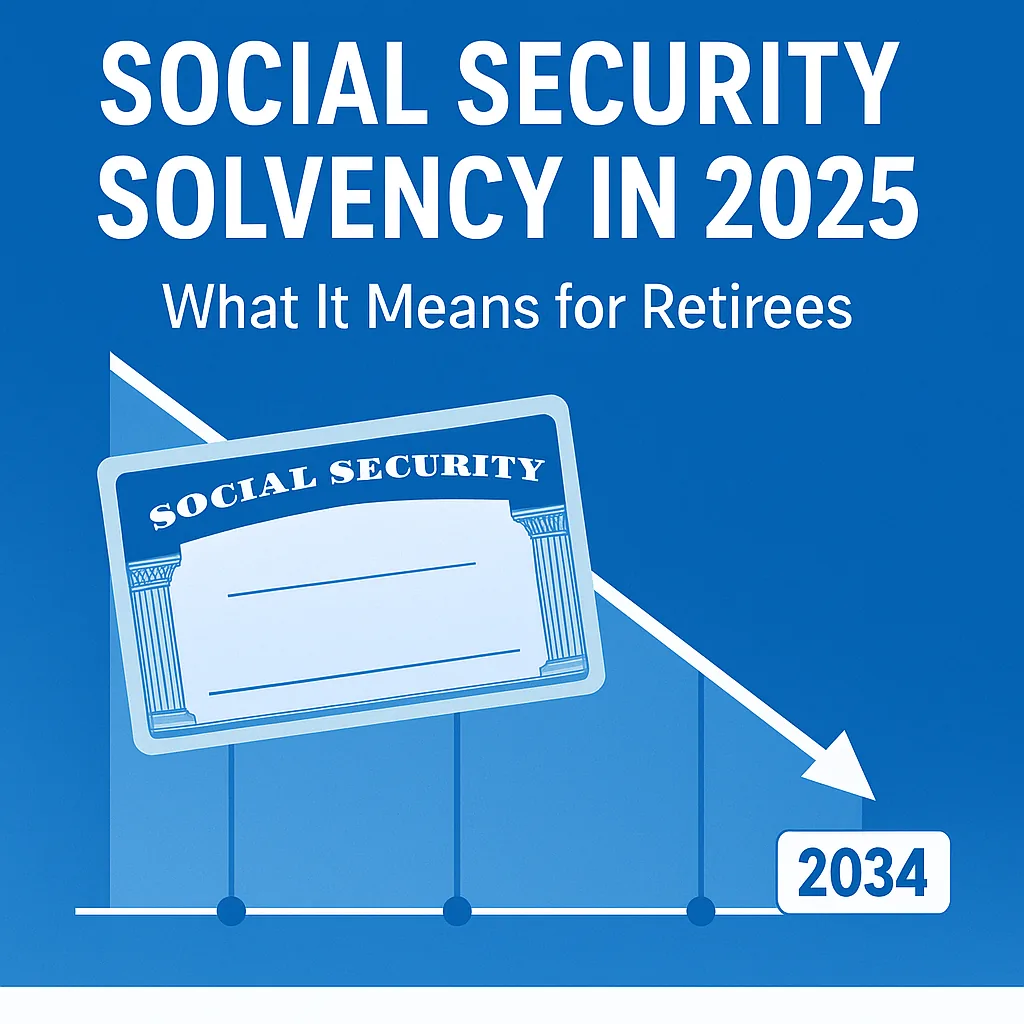
In 2034 — about eight years from now — the Social Security trust funds are projected to run short. If Congress does nothing, retirees that year would still get paid, but only about 81 cents on the dollar of what’s been promised. That’s the headline from the 2025 Trustees annual report. The smaller, more useful question is what you do with that information today.
According to the report, the Social Security trust funds are projected to run short by 2034, one year sooner than previously forecasted. At that point, incoming payroll taxes would only cover about 81% of promised benefits. Medicare isn’t far behind, with its Hospital Insurance fund expected to face shortfalls by 2033.
What “Insolvency” Actually Means
It’s important to understand that “insolvency” does not mean Social Security will vanish. Even if Congress takes no action, the system will continue paying benefits—just at a reduced rate. Current projections suggest retirees would still receive roughly 79 to 81 cents on the dollar.
Why the Shortfall Exists
Several factors have created this growing gap:
- Demographics: Americans are living longer, while birth rates remain low—meaning fewer workers are supporting more retirees.
- Policy Adjustments: The repeal of the Windfall Elimination Provision (WEP) and Government Pension Offset (GPO) increased benefit obligations.
- Rising Healthcare Costs: Medicare expenses are increasing faster than wage growth, putting additional strain on both programs.
What Congress Could Do
Lawmakers have several options on the table:
- Gradually raise the full retirement age from 67 to 68 or even 70.
- Delay the earliest eligibility age beyond 62.
- Increase payroll taxes or lift the wage cap (currently $176,100 in 2025).
- Adjust benefit formulas so higher earners receive smaller increases, while lower-income retirees remain protected.
What This Means for You
- Social Security isn’t going away. Even under the worst-case scenario, most benefits will still be paid.
- Reforms are inevitable. The sooner they’re implemented, the less drastic they’ll need to be.
- Planning is critical. Understanding how potential changes might affect your income allows you to build a more resilient retirement strategy.
My working assumption: benefits get preserved, but the rules around them shift. The full retirement age creeps up, the wage cap goes up, and the formula gets a haircut at the top. If you’re within ten years of claiming, that means two things. Don’t claim early in a panic about insolvency — the math almost never supports it. And don’t build your retirement plan as if today’s rules are locked in for the next 30 years.
This article is published by Confluence Media Group LLC, an independent publisher of educational financial content. Thomas Clark is a Series 65 Investment Advisor Representative. The information provided is for educational and informational purposes only and is not personalized financial, tax, or legal advice. Past performance does not guarantee future results. All investing involves risk, including potential loss of principal. Consult a qualified professional before making financial decisions.
Confluence Media Group LLC is a separate entity from Confluence Capital Management, the investment advisory practice through which Thomas Clark provides advisory services. Advisory services are not offered through this publishing platform.

Thomas Clark is a Series 65 licensed investment advisor and experienced trader. He specializes in investing, retirement planning, and market analysis, helping individuals build wealth and make informed financial decisions.
