By Thomas Clark, Senior Lead Wealth Advisor at Confluence Capital Management
A neighbor of mine recently stopped me at the mailbox, a little breathless. “My husband just started collecting Social Security,” she said, “and someone told me I could collect on his record — even though I barely worked. Is that true?”
It is absolutely true — and Social Security spousal benefits are one of the most valuable and least understood features in the entire retirement system. They allow a lower-earning spouse to receive up to 50% of the higher earner’s benefit, potentially adding hundreds of dollars per month to your household’s retirement income.
If you’re married, divorced, or widowed, understanding how Social Security spousal benefits work could be one of the most consequential pieces of your retirement plan. Many costly filing errors stem from common Social Security myths — knowing the facts before you file makes a real difference. In this guide, I’ll walk you through who qualifies, how the math works, when to claim, and how to coordinate timing for the biggest possible lifetime benefit.
Table of Contents
- What Are Social Security Spousal Benefits?
- Eligibility Requirements You Must Meet
- How to Calculate Your Spousal Benefit
- Spousal Benefits vs. Your Own Record
- The Impact of Claiming Age on Spousal Benefits
- Divorced Spouse Benefits Most People Miss
- Spousal Benefits and the Earnings Test
- Coordination Strategies for Married Couples
- Key Takeaways
- Frequently Asked Questions
What Are Social Security Spousal Benefits?
Social Security spousal benefits are a provision in the Social Security system that allows a married (or formerly married) individual to claim benefits based on their spouse’s earnings record rather than their own. The maximum spousal benefit is 50% of the higher-earning spouse’s primary insurance amount (PIA) — the benefit that spouse would receive at their full retirement age (FRA).
This provision exists because Social Security was designed with the recognition that many households have one spouse who earns significantly more than the other, or one spouse who may have spent years out of the workforce caregiving. The spousal benefit ensures that lower-earning or non-working spouses aren’t left with a drastically reduced or nonexistent benefit in retirement.
Here’s the key rule: your spousal benefit is based on your spouse’s PIA, not what they actually receive. If your spouse claims early and receives a reduced benefit, your spousal benefit is still calculated based on what they would have received at full retirement age. This distinction matters.
Thomas’s Take: Many couples don’t realize the spousal benefit exists until they’re already filing. Don’t be one of them. Review your household’s estimated benefits at ssa.gov/myaccount at least 5 years before retirement so you can plan around these numbers.
Eligibility Requirements You Must Meet
To receive spousal benefits, you must meet all of the following criteria:
Marriage Duration
You must be currently married to your spouse, or divorced after a marriage that lasted at least 10 years (more on that in the divorced spouse section below).
Age Requirements
- You must be at least age 62 to begin claiming spousal benefits.
- To receive the maximum 50% spousal benefit, you must wait until your own full retirement age (FRA), which is 67 for anyone born in 1960 or later.
- Claiming before your FRA permanently reduces the spousal benefit.
Your Spouse Must Be Collecting
This is the rule that catches people off guard: your spouse must have already filed for their own Social Security benefits before you can receive spousal benefits. You cannot file a spousal claim while your spouse is still in the “waiting” period, even if they’ve reached FRA.
There is an important exception for divorced spouses, which I’ll cover below.
You Must Not Have a Higher Own Benefit
The Social Security Administration will automatically compare your spousal benefit to the benefit you’ve earned based on your own work record. You receive the higher of the two — but you cannot “stack” them. If your own benefit exceeds 50% of your spouse’s PIA, you’ll receive your own benefit and the spousal benefit is irrelevant for you.
How to Calculate Your Spousal Benefit
Let me walk through this with a hypothetical example so the math is clear.
Hypothetical scenario for illustrative purposes only. Does not represent any actual client situation.
Hypothetical couple: Robert and Linda
- Robert’s PIA (full retirement age benefit): $2,800/month
- Linda’s own PIA based on her work record: $900/month
- Linda’s maximum spousal benefit (50% of Robert’s PIA): $1,400/month
Since $1,400 is greater than $900, Linda would receive the spousal benefit — an additional $500/month over what her own record would provide. Over 20 years of retirement, that’s $120,000 in additional lifetime income (before adjustments for inflation or COLA).
The Calculation, Step by Step
- Find the higher-earner’s PIA. This is available on their Social Security statement at ssa.gov.
- Calculate 50% of that PIA. This is the maximum spousal benefit.
- Compare to your own PIA. The SSA pays the higher amount.
- Apply any early claiming reduction, if you file before your FRA (see next section).
Pro Tip: Social Security doesn’t automatically tell you about spousal benefits. You need to know to ask. When you contact the SSA to apply, specifically mention that you want to claim on your spouse’s record if that produces a higher benefit.
Spousal Benefits vs. Your Own Record
The decision of whether to claim your own benefit or the spousal benefit often comes down to the income gap between spouses. Here’s a comparison across common scenarios:
Spousal Benefit Comparison Table (All figures are hypothetical examples for illustrative purposes)
| Higher Earner’s PIA | Lower Earner’s Own PIA | Max Spousal Benefit (50%) | Difference (Monthly) | Difference (20 Years) |
|---|---|---|---|---|
| $2,000 | $400 | $1,000 | +$600 | +$144,000 |
| $2,500 | $800 | $1,250 | +$450 | +$108,000 |
| $3,000 | $1,200 | $1,500 | +$300 | +$72,000 |
| $3,500 | $1,800 | $1,750 | -$50 | N/A (own benefit higher) |
As you can see, the value of the spousal benefit is most significant when the earnings gap between spouses is largest. For couples where one spouse had little or no work history, the spousal benefit can be transformational.
In-Article Image: Data visualization chart showing the spousal benefit comparison table above with TCA color palette (Navy #1B3A5C, Gold #C9A84C). Alt text: Table comparing spousal benefit amounts versus own record benefits across four hypothetical income scenarios.
The Impact of Claiming Age on Spousal Benefits
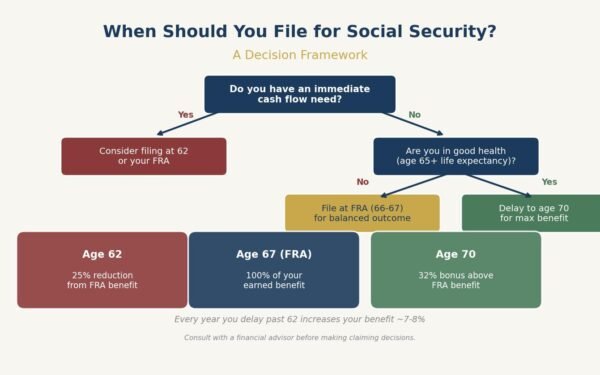
This is one of the most important nuances to understand: unlike your own retirement benefit, there is no bonus for waiting past your full retirement age to claim spousal benefits. Your spousal benefit maxes out at FRA (67 for most people reading this). There is no delayed retirement credit for spousal benefits the way there is for your own benefit (which grows 8% per year from FRA to age 70).
However, claiming early — before FRA — permanently reduces your spousal benefit. Here’s what that looks like:
Spousal Benefit Reduction by Claiming Age (Assumes FRA of 67; reductions are hypothetical illustrations of SSA methodology)
| Age at Filing | Reduction | Percentage of Maximum Spousal Benefit |
|---|---|---|
| 62 | Maximum reduction | ~32.5% of higher earner’s PIA |
| 63 | Significant reduction | ~35% of PIA |
| 64 | Moderate reduction | ~37.5% of PIA |
| 65 | Smaller reduction | ~41.7% of PIA |
| 66 | Small reduction | ~45.8% of PIA |
| 67 (FRA) | No reduction | 50% of PIA (maximum) |
The practical implication: if Linda in our earlier example claims at 62 instead of 67, her spousal benefit may be reduced from $1,400 to approximately $910 per month — a difference of $490/month, or nearly $6,000/year.
Thomas’s Take: The decision of when you claim your spousal benefit and when your spouse files for their own benefit are separate decisions that both affect your household income. These decisions should be modeled out together before filing, not made independently.
Divorced Spouse Benefits Most People Miss
Divorce does not necessarily end your entitlement to benefits on your ex-spouse’s record. These rules are widely misunderstood, and many divorced individuals leave significant money on the table.
The 10-Year Rule
If your marriage lasted 10 years or more, you may be eligible to claim a spousal benefit on your ex-spouse’s record — even if they’ve remarried. You must be:
- Currently unmarried (if you’ve remarried, divorced spouse benefits are generally not available)
- At least age 62
- Entitled to a benefit that is less than what you’d receive on your ex’s record
The Independence Advantage for Divorced Spouses
Here’s a key difference from regular spousal benefits: you do not need to wait for your ex-spouse to file. If you’ve been divorced for at least two years, you can file for divorced spousal benefits even if your ex hasn’t started collecting — as long as you’re both at least 62.
The Remarriage Rule
If you remarry, divorced spousal benefits from your previous marriage generally end. However, if that subsequent marriage also ends in divorce (or your new spouse passes away), you may regain eligibility for divorced spousal benefits on the original ex-spouse’s record.
Free Download: Social Security Optimization Guide
Learn the strategies that could maximize your lifetime Social Security benefits.
Get Your Free CopyAuthoritative source: SSA.gov — Divorced Spouse Benefits
Spousal Benefits and the Earnings Test
If you claim Social Security benefits before your full retirement age and you’re still working, the earnings test may temporarily reduce your benefit. For 2026, if you earn more than $23,400/year before FRA, Social Security withholds $1 in benefits for every $2 you earn above that threshold.
The good news: these withheld benefits aren’t lost. Once you reach FRA, the SSA recalculates your benefit to credit you for months in which benefits were withheld. Your permanent monthly benefit is adjusted upward.
The earnings test applies to spousal benefits the same way it applies to your own retirement benefit. If you’re receiving spousal benefits and still working, monitor your income carefully to avoid unexpected withholding — especially if you’re planning around a specific monthly budget.
After you reach full retirement age, the earnings test no longer applies, and you can earn any amount without affecting your benefit.
Source: SSA.gov — How Work Affects Your Benefits
Coordination Strategies for Married Couples
The spousal benefit rules interact with your own claiming age decisions in ways that can significantly affect your lifetime household income. Here are the most important coordination strategies to consider.
Strategy 1: Higher Earner Delays, Lower Earner Files Early
One common approach: the higher-earning spouse delays claiming their own benefit to age 70 (maximizing the 8%/year delayed credits), while the lower earner claims their own benefit at 62 or 63 to provide household income in the gap years.
Once the higher earner files at 70, the lower earner may switch to a spousal benefit if it’s larger than their own — though in practice, the SSA automatically pays the higher amount. The gap years while the higher earner delays can also be an ideal window for strategic Roth conversions, moving pre-tax funds into a Roth at lower tax rates before required minimum distributions begin.
Hypothetical illustration: Mark has a PIA of $3,200; his wife Susan has a PIA of $950. Susan claims at 62 and receives approximately $690/month (reduced). Mark waits until 70 and receives $3,968/month (with delayed credits). Susan’s spousal benefit at 67 would be $1,600 — significantly more than the $690 she received early. This is a planning conversation worth having well before either of them files.
Strategy 2: Both Spouses at FRA
A simpler, lower-risk strategy: both spouses claim at full retirement age. The lower earner receives either their own benefit or the 50% spousal benefit — whichever is greater — with no permanent reduction for early filing and no complexity around the earnings test.
Strategy 3: Modeling the Lifetime Totals
The “right” strategy depends on factors specific to each household: ages, health, other income sources, and expectations about longevity. Couples with a significant age gap or health disparity often benefit from more customized analysis.
A coordinated claiming strategy can produce $20,000 to $100,000+ in additional lifetime household income compared to filing without a plan. The Social Security Administration’s own research — as well as independent academic studies — supports the value of optimization.
Source: Social Security Bulletin — Optimal Social Security Claiming
Thomas’s Take: Households that develop a coordinated plan consistently do better than those where each spouse files independently on their 62nd birthday. The math is almost always worth the conversation.
Key Takeaways
- The maximum spousal benefit is 50% of your spouse’s full retirement age benefit (PIA) — but only if you wait until your own FRA to claim.
- Your spouse must be collecting Social Security before you can receive spousal benefits (divorced spouses have more flexibility here).
- Claiming before your FRA permanently reduces your spousal benefit — by up to ~35% if you file at 62.
- There is no delayed credit for spousal benefits — waiting past FRA doesn’t increase the amount, so 67 is the optimal filing age for the spousal benefit itself.
- Coordination between spouses can make a $20,000–$100,000+ lifetime difference — don’t file independently without modeling both scenarios together.
Frequently Asked Questions
Can I receive spousal benefits if I’ve never worked?
Yes. Spousal benefits are available regardless of your own work history. As long as your spouse has earned enough credits to qualify for Social Security and has filed for their benefits, you may be eligible for up to 50% of their PIA if you meet the age and marriage duration requirements.
Do spousal benefits affect my spouse’s benefit amount?
No. Your claiming a spousal benefit has no effect whatsoever on the benefit your spouse receives. Social Security doesn’t divide a single benefit between two people — it pays each benefit independently.
What happens to my spousal benefit if my spouse passes away?
If your spouse dies, you transition from spousal benefits to survivor benefits — a separate program that may allow you to receive up to 100% of your deceased spouse’s benefit (including any delayed retirement credits they earned). Survivor benefits have different rules from spousal benefits and often result in a higher monthly payment. This is another area where advance planning matters.
Can both spouses receive spousal benefits?
No. A spousal benefit is paid to the lower-earning spouse based on the higher earner’s record. The higher earner always receives their own earned benefit. Both spouses cannot simultaneously claim on each other’s records.
The Bottom Line
Social Security spousal benefits represent one of the most significant and frequently overlooked sources of retirement income available to married and divorced individuals. Whether you spent decades in the workforce or stepped away to raise a family, these provisions were designed with you in mind.
The rules are complex, and the filing decisions you make in your 60s can have six-figure implications over the course of a 20-to-30-year retirement. This is exactly the kind of planning conversation that can make a meaningful difference — and the math often surprises people in a good way.
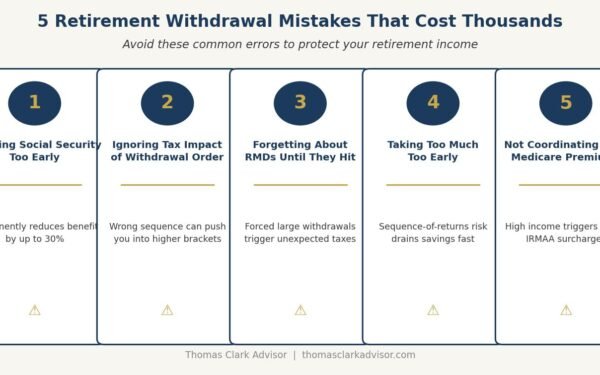
If you’re within ten years of retirement, I encourage you to request your Social Security statement at ssa.gov/myaccount and then schedule time with an advisor who can model the spousal benefit scenarios for your household specifically. As you plan your income strategy, you’ll also want to avoid the 5 most costly retirement withdrawal mistakes that can quietly erode decades of savings.
If you have questions about how Social Security spousal benefits apply to your situation, I am always here to help.

Thomas Clark is a Series 65 licensed investment advisor and experienced trader. He specializes in investing, retirement planning, and market analysis, helping individuals build wealth and make informed financial decisions.