
Social Security Survivor Benefits: The Timing Move Most Widows Miss
Surviving spouses have two distinct Social Security benefits — their own retirement benefit and a survivor benefit on the late spouse's record. Most widows claim them in the wrong order. The survivor benefit switch is a strategy that often pays out tens of thousands more over a lifetime.

Key Takeaways
- Surviving spouses have two distinct Social Security benefits — your own retirement benefit and a survivor benefit on your late spouse’s record. They can be claimed at different times.
- Survivor benefits become available at age 60 (age 50 if disabled, any age if caring for the deceased’s child under 16). Your own retirement benefit becomes available at 62.
- Survivor benefits stop growing at full retirement age. Your own retirement benefit can keep growing until 70 through delayed retirement credits.
- The strategic move is usually to claim the smaller benefit first and let the larger one grow. This is one of the few “claiming switch” strategies still available after the 2015 rules.
- The Social Security Administration is not required to run this analysis for you. The default advice “claim what you can as soon as you can” leaves real money on the table for most widows.
Two benefits, two timelines
When a working spouse passes away, the surviving spouse becomes eligible for two different Social Security benefits — and most planning conversations collapse them into one decision when they are actually separate.
The first is your own retirement benefit, based on your earnings record. You qualify for this at 62, and it grows from there until age 70.
The second is the survivor benefit, based on your late spouse’s earnings record. You qualify for this at 60, earlier in special cases, and it grows until your full retirement age — but no further.
The thing nobody tells you, and the thing the Social Security Administration has no obligation to walk you through: you do not have to take both at once. You can take one now and switch to the other later. That’s the move most widows miss.
When each benefit becomes available
Survivor benefit. Available starting at age 60, or 50 if disabled. If you remarry before age 60 you generally lose access; remarrying after 60 does not affect a survivor claim. There’s also a special rule if you’re caring for a child under 16 from the deceased: the survivor benefit is available at any age in that case.
Your own retirement benefit. Available starting at age 62. Standard rules apply — claiming early reduces it permanently, claiming after full retirement age grows it 8% per year through age 70.
These two timelines run independently. The form you sign with the Social Security office opts you into one or the other (or both, if claiming simultaneously) — but the choice is yours.
How each one grows
This is the part the standard Social Security guides usually get wrong by oversimplifying.
The survivor benefit is highest at full retirement age. It does not earn delayed retirement credits past full retirement age. Waiting from FRA to 70 to claim a survivor benefit gains you nothing.
Your own retirement benefit keeps growing past FRA at 8% per year — the delayed retirement credit — until you turn 70. So a 67-year-old primary insurance amount of $2,000 becomes roughly $2,480 if you wait until 70.
That asymmetry is the entire basis of the survivor benefit switch.
The switch strategy in practice
Consider a hypothetical. Margaret is 62. Her husband Frank passed away two years ago at 65, before he had claimed Social Security. Frank’s primary insurance amount — the benefit he would have received at full retirement age — was $2,400. Margaret’s own primary insurance amount is $1,800. Her full retirement age is 67.
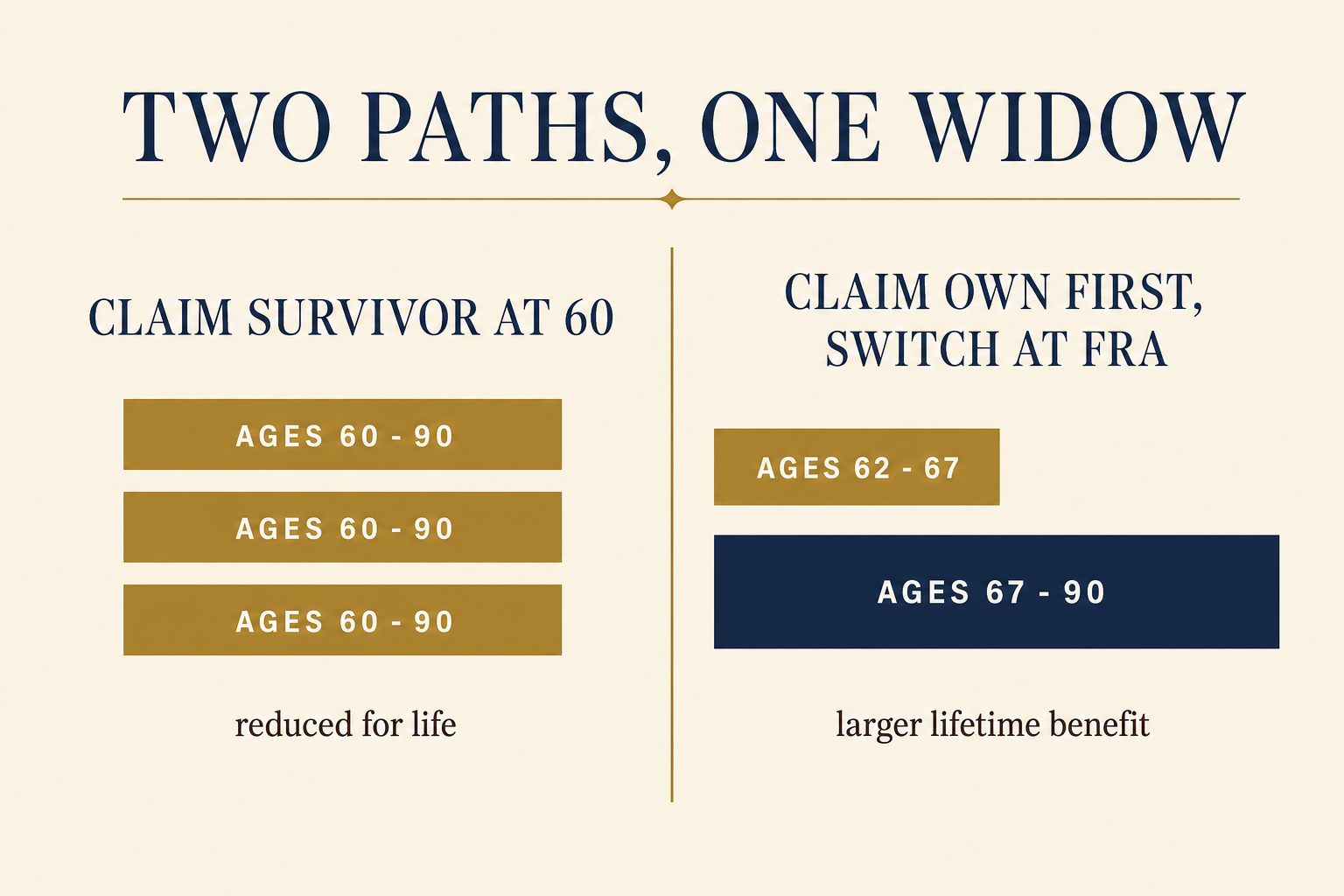
Option A — claim survivor benefit at 60, take it for life. A reduced-for-age survivor benefit at 60 is roughly 71.5% of Frank’s primary insurance amount, which works out to about $1,716 a month. Margaret would lock in that amount for the rest of her life, with annual cost-of-living adjustments.
Option B — claim survivor benefit at full retirement age. Waiting until 67 gets Margaret the full $2,400 survivor benefit. But she has gone seven years (60 to 67) without any Social Security income at all.
Option C — claim her own benefit early, switch to the survivor benefit later. At 62, Margaret files for her own retirement benefit, reduced to roughly $1,260. At 67, she switches to her late husband’s full survivor benefit of $2,400.
Option C delivers five years of Social Security income from 62 to 67, plus the maximum survivor benefit for life. The lifetime collection is meaningfully higher than Option A, and the cash starts seven years earlier than Option B.
There’s a fourth option that flips the switch the other way: claim the reduced survivor benefit at 60 and switch to her own retirement benefit at 70. If Margaret’s own benefit at 70 (roughly $2,232 with delayed retirement credits) exceeds what she’d get from the survivor benefit, that switch makes sense. In Margaret’s case it doesn’t quite work — her late husband’s record is better than hers — but for a widow whose own earnings exceeded her spouse’s, the reverse switch is often the right move.
The right answer depends on whose earnings record is higher and on the age each benefit becomes available. The wrong answer, almost always, is to file once at 60 and never look at it again.
Thomas’s Take: The default advice for surviving spouses — claim what you can as soon as you can — is wrong for most widows. The right question isn’t when to claim. It’s which benefit to claim now and which one to let grow.
What people get wrong
A few patterns come up repeatedly when families work through this decision.
Filing for both at once. You can’t actually do this. When you file the claim form, you opt into one benefit, and the agency administers the higher of the two. People often interpret “just take the bigger one” as the right move without realizing they could have started the smaller one earlier and let the bigger one grow in the background.
Waiting too long on the survivor side. Because the survivor benefit caps at full retirement age, anyone waiting until 70 to claim a survivor benefit is leaving years of money on the table. The “delayed credits grow your benefit until 70” rule applies to your own retirement benefit, not the survivor.
Assuming the local office will analyze this for you. Local Social Security representatives handle claims efficiently and accurately, but they are not required to model your switch decision. They will tell you what your benefit is at the age you’re filing — they generally will not run the comparison of starting one benefit now and switching later. That part is on you, or on a planner.
Forgetting the widow limit. If your late spouse was already collecting a reduced retirement benefit when they died, the survivor benefit is based on what they were actually receiving, not their primary insurance amount — with a floor of 82.5% of that primary insurance amount. This rule shows up frequently when the deceased claimed early.
When the reverse switch makes sense
Survivor first, own benefit later, makes sense when three things line up:
Your own earnings record is higher than your late spouse’s record. You can wait until 70 to maximize your own benefit. And you can fund the gap between a reduced survivor benefit and the eventual switch from other sources, including the survivor income itself.
Done well, this move locks in immediate income at 60, lets your own retirement benefit grow with delayed retirement credits, and ends with a 32% larger lifetime own-benefit at 70 than you’d have had at full retirement age. It’s not the right move for every widow, but for the right earnings profile it’s a quietly powerful one.
The bottom line
If you are widowed and Social Security-eligible, the questions you and a planner should be answering are clear: which benefit is bigger at full retirement age, when does the smaller benefit become available, and what does the cash flow look like in the years between starting one benefit and switching to the other.
The form you sign at the Social Security office will not ask you these questions. It will offer you a benefit and process the claim. Knowing what you’re entitled to — and what you can defer — is on you.
FAQ
Can I take a survivor benefit and my own retirement benefit at the same time?
No. You file for one or the other, and the higher of the two is paid. You can switch from one to the other later, which is the basis of the strategy in this post.
Does remarrying affect my survivor benefit?
Remarrying before age 60 generally ends your eligibility for survivor benefits on your late spouse’s record. Remarrying at or after age 60 does not affect the claim.
What if my late spouse was already collecting Social Security?
The survivor benefit is based on what they were actually receiving, with a floor of 82.5% of their primary insurance amount. This is the “widow limit.” If they claimed early at a reduced rate, the survivor benefit reflects that reduction, subject to the floor.
Can divorced spouses use this strategy?
Yes — surviving divorced spouses are generally entitled to survivor benefits on a former spouse’s record if the marriage lasted at least 10 years. The same switch logic applies. See the related post on divorced spouse benefits for the specific eligibility rules.
This article is published by Confluence Media Group LLC, an independent publisher of educational financial content. Thomas Clark is a Series 65 Investment Advisor Representative. The information provided is for educational and informational purposes only and is not personalized financial, tax, or legal advice. Past performance does not guarantee future results. All investing involves risk, including potential loss of principal. Consult a qualified professional before making financial decisions.
Confluence Media Group LLC is a separate entity from Confluence Capital Management, the investment advisory practice through which Thomas Clark provides advisory services. Advisory services are not offered through this publishing platform.
About Thomas Clark
Thomas Clark is the founder of Confluence Media Group LLC and a Series 65 Investment Advisor Representative. He has spent nearly two decades working with families on retirement planning, with a focus on Social Security optimization, retirement income coordination, and the bucket planning approach to building a guaranteed income floor.
Thomas writes and publishes at thomasclarkadvisor.com and is the author of The Just in Case Binder — a 148-page printable family financial organizer for households who want to make sure the people they love know where everything is.
He lives in North Carolina with his family.
Subscribe to the weekly newsletter · Get the Just in Case Binder

Thomas Clark is a Series 65 licensed investment advisor and experienced trader. He specializes in investing, retirement planning, and market analysis, helping individuals build wealth and make informed financial decisions.
