
Social Security WEP and GPO: How Government Pensions Affect Your Benefits
Social Security WEP and GPO: How Government Pensions Affect Your Benefits
Table of Contents
- The Shock That Hits Public Employees at Retirement
- What Is the Windfall Elimination Provision (WEP)?
- What Is the Government Pension Offset (GPO)?
- Who Was Affected: States and Workers in the Crosshairs
- How WEP Actually Calculated Your Benefit Reduction
- How GPO Actually Calculated Your Spousal and Survivor Reduction
- The Social Security Fairness Act of 2023: Both Provisions Are Repealed
- Real Numbers: Hypothetical Examples Before and After Repeal
- How to Check Whether You Are Affected and What to Do Now
- Planning Implications Going Forward
- Key Takeaways
- Frequently Asked Questions
You spent 25 years teaching. You paid into your state pension every paycheck, showed up for every parent conference, graded every late paper. You also worked summers and part-time jobs that were covered by Social Security, so you figured you had earned at least a partial benefit there too. Then you sit down with someone — maybe a retirement counselor, maybe a statement from the Social Security Administration — and you discover that your Social Security benefit is being cut nearly in half because of your state pension.
Welcome to WEP and GPO. Or rather — welcome to the long, confusing saga of two provisions that affected millions of public employees for decades and were finally repealed in early 2025.
This is a topic that has caused more confusion in retirement planning conversations than almost any other I cover. The rules were counterintuitive, the calculations were technical, and the consequences were enormous for teachers, police officers, firefighters, and other state and municipal workers. Now, with both provisions gone, there are retroactive payments coming and planning decisions to revisit.
Let me walk through exactly what these provisions were, how they worked, who they hit hardest, and what the repeal of both means for you or someone you love.
The Shock That Hits Public Employees at Retirement
For most workers, the Social Security benefit calculation feels relatively straightforward. You work, you pay FICA taxes, you accumulate credits, and the SSA calculates your Primary Insurance Amount (PIA) based on your 35 highest-earning years. I cover how that calculation works in detail in my guide on how Social Security benefits are calculated.
But for a substantial group of American workers — those who spent part or all of their career in jobs that did not participate in Social Security — the calculation looked very different. And not in their favor.
The U.S. has roughly 6 to 7 million workers in state and local government jobs that operate outside of the Social Security system. These workers pay into separate public pension systems instead of Social Security. Many of them also had other jobs — before, after, or alongside their public service — that were covered by Social Security. The result: a work history that combines SS-covered earnings with non-covered pension earnings.
Two federal provisions governed how Social Security handled those workers:
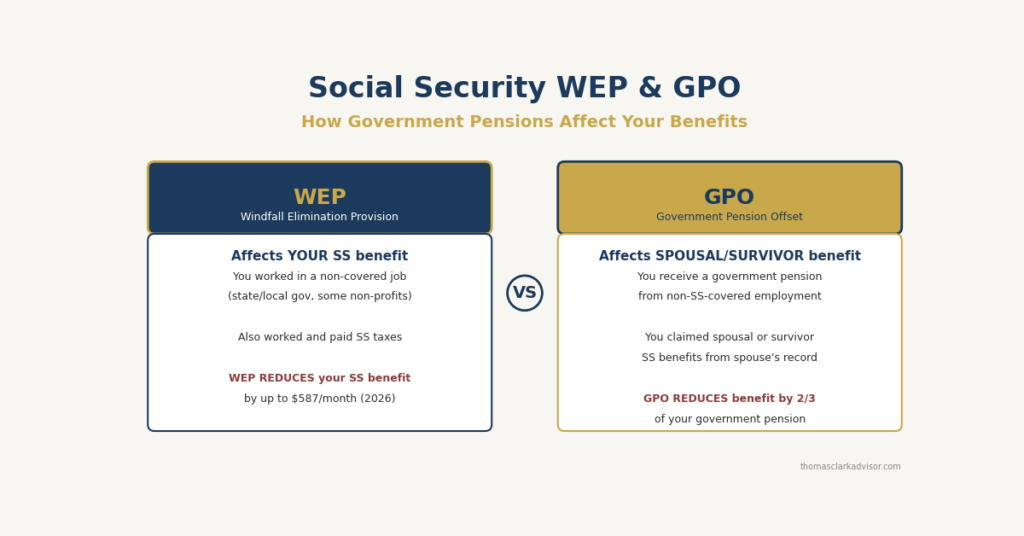
- The Windfall Elimination Provision (WEP): Reduced the worker’s own Social Security benefit.
- The Government Pension Offset (GPO): Reduced or eliminated spousal and survivor benefits based on the worker’s government pension.
Both were the subject of fierce debate for decades. Both were repealed by the Social Security Fairness Act of 2023, signed into law in January 2025.
What Is the Windfall Elimination Provision (WEP)?
The WEP, enacted in 1983, was designed to address what Congress viewed as an unintended advantage in the Social Security benefit formula. Here is the background.
Social Security’s PIA formula is deliberately weighted to replace a higher percentage of income for lower-wage earners than for higher-wage earners. That progressivity is intentional — low earners need more replacement income in retirement relative to their wages. The formula accomplishes this through “bend points”: a tiered structure where the first dollars of your average monthly earnings are replaced at 90 percent, the next tier at 32 percent, and earnings above the second bend point at 15 percent.
The problem Congress identified in 1983: workers with government pensions who had only partial SS-covered work histories would appear to be low earners in the SS system — because their non-covered years showed zero SS earnings — and therefore receive that generous 90 percent replacement rate on their first bend point. But they were not actually low earners. They had substantial pension income from their non-covered work. Congress considered this a “windfall.”
The WEP’s solution was to reduce the 90 percent factor at the first bend point — replacing it with a lower percentage, typically down to as low as 40 percent — for workers who received a pension from non-SS-covered employment.
Thomas’s Take: Whether the WEP was fair policy is a genuinely contested question, and I am not going to pretend otherwise. The argument that public employees were “gaming” the formula often overlooked the fact that many of them had no choice about which pension system their employer used, and that their non-covered pension was often modest — especially for teachers and municipal workers who earned less over their careers than the “windfall” framing implied.
What Is the Government Pension Offset (GPO)?
The GPO, also enacted in 1977 (and revised in 1983), addressed a different but related situation: spousal and survivor Social Security benefits for people receiving a government pension from non-covered work.
Under normal Social Security rules, a spouse is entitled to receive up to 50 percent of their partner’s PIA as a spousal benefit (or up to 100 percent as a survivor benefit after the partner’s death), if that amount exceeds what the spouse would receive on their own record. For those rules in full, see my Social Security spousal benefits guide and survivor benefits guide.
The GPO said: if you receive a pension from non-SS-covered government work, your spousal or survivor benefit will be reduced by two-thirds of your government pension amount.
So if your government pension was $2,400 per month, two-thirds of that — $1,600 — would be subtracted from any Social Security spousal or survivor benefit you were otherwise entitled to receive. If your spousal benefit was $1,400 per month, the $1,600 GPO reduction would eliminate it entirely, leaving you with zero.
This was not a small or theoretical reduction. For many spouses of teachers, police officers, and firefighters, the GPO did not just reduce their spousal benefit — it wiped it out completely.
Who Was Affected: States and Workers in the Crosshairs
WEP and GPO did not affect every government worker. They applied specifically to workers whose government jobs did not participate in Social Security. Roughly 15 states have significant populations of non-covered public employees. The most prominent include:
- Texas — teachers and many state employees are in non-covered pension systems
- Ohio — teachers, police, firefighters, and public employees generally
- Illinois — most public school teachers
- California — many state and local government workers, particularly those in CalSTRS and CalPERS
- Massachusetts — teachers and certain state employees
- Colorado — public school teachers and some local government workers
- Louisiana, Maine, Missouri, Nevada — among the others with significant non-covered workforces
The professions hit hardest were consistently teachers, police officers, firefighters, and other state and municipal workers whose employers opted into separate public pension systems rather than Social Security.
Image: U.S. map highlighting the approximately 15 states with the largest populations of non-Social-Security-covered government workers. States are shaded in navy (#1B3A5C) with gold (#C9A84C) labels. Cream (#F8F6F0) background. Alt text: “U.S. map showing the states most affected by the Windfall Elimination Provision and Government Pension Offset, including Texas, Ohio, Illinois, California, Massachusetts, and Colorado, where many public employees work in pension systems not covered by Social Security.”
How WEP Actually Calculated Your Benefit Reduction
Understanding the WEP calculation requires a brief detour into the PIA bend point formula, but I will keep it as practical as possible.
In 2026, the Social Security bend points are: – First bend point: $1,226/month in Average Indexed Monthly Earnings (AIME) – Second bend point: $7,391/month in AIME
The standard PIA formula applies: – 90% of AIME up to the first bend point – 32% of AIME between the two bend points – 15% of AIME above the second bend point
The WEP modified that first 90% factor downward — all the way to 40% in its maximum application. The result was a reduction in your monthly benefit, but the WEP had two important limits:
-
Maximum WEP reduction in 2026: The WEP could not reduce your Social Security benefit by more than $616 per month (this amount adjusts annually with the national average wage index).
-
The 30-year substantial earnings exception: If you had 30 or more years of “substantial” SS-covered earnings, the WEP did not apply at all. With 21 to 29 years of substantial earnings, the reduction was phased out proportionally. “Substantial” earnings means above a threshold that rises each year — in recent years, it has been roughly $27,000–$30,000 annually in SS-covered earnings.
So a teacher who worked summers, part-time, or in a private-sector job for enough years could reduce or even eliminate the WEP impact — but only if those SS-covered years met the substantial earnings threshold each year.
For the SSA’s full WEP explanation and online calculator, see the SSA WEP page.
How GPO Actually Calculated Your Spousal and Survivor Reduction
The GPO math was simpler but often more devastating:
GPO reduction = Your government pension amount × 2/3
That reduction was applied directly to whatever spousal or survivor Social Security benefit you were otherwise entitled to receive. If the reduction exceeded the benefit, the benefit went to zero — there was no floor protecting a minimum spousal or survivor payment.
Example: A retired Ohio teacher receives a $3,000/month state pension. Her husband has a Social Security benefit of $2,800/month. Under normal rules, she might be entitled to a spousal benefit of up to $1,400/month (50% of his PIA). Under the GPO: $3,000 × 2/3 = $2,000 reduction. $1,400 minus $2,000 = $0. She receives nothing from Social Security as a spouse.
Upon his death, the same calculation applied to survivor benefits. A widow or widower who might otherwise receive up to 100% of their deceased spouse’s Social Security benefit would see it wiped out by the GPO if they had a government pension of their own.
The SSA estimates that before repeal, the GPO eliminated spousal or survivor benefits for approximately 800,000 people, and reduced benefits for hundreds of thousands more.
For the SSA’s full GPO explanation, see the SSA GPO page.
The Social Security Fairness Act of 2023: Both Provisions Are Repealed
Here is the most important thing in this entire article:
The Social Security Fairness Act of 2023 was signed into law by President Biden on January 5, 2025. It repealed both the WEP and the GPO in their entirety, effective for benefits payable after December 2023.
That last phrase matters enormously: the repeal was made retroactive to December 2023, not just prospective from January 2025. Workers and spouses who were already receiving reduced benefits are entitled to retroactive payments covering the period from December 2023 through the date their corrected benefit began — which, for many people, means a lump-sum retroactive payment plus higher ongoing monthly benefits going forward.
The act was years in the making. Congress introduced various versions of WEP/GPO reform legislation for more than a decade before the Social Security Fairness Act finally passed both chambers with bipartisan support in late 2024.
What this means practically:
-
Current retirees with WEP reductions: Your monthly Social Security benefit should now be recalculated without the WEP reduction. If you were already receiving benefits when the repeal took effect, you are entitled to retroactive payments for the months from December 2023 forward at the higher rate.
-
Current retirees with GPO reductions: Your spousal or survivor benefit should now be recalculated without the GPO offset. Again, retroactive payments cover December 2023 forward.
-
Workers not yet claiming: You will file under the standard PIA formula without any WEP or GPO reduction. The full benefit you earned across your SS-covered work history is now yours.
-
Spouses not yet claiming: You will be entitled to spousal and survivor benefits under the standard rules, regardless of your government pension.
Important: The SSA has been processing these recalculations in waves since early 2025. If you believe you are affected and have not yet received updated benefit information or a retroactive payment, contact the SSA directly or review the SSA Social Security Fairness Act information page. You can also review the bill text and legislative history at Congress.gov — Social Security Fairness Act of 2023.
Pro Tip: If you received a retroactive lump-sum payment from the SSA in 2025 or 2026, it may have tax implications depending on your income in the year received. The IRS has specific rules about how to handle large retroactive Social Security payments, including the option to spread the taxable portion back across prior tax years. Talk to your CPA about this before you file — it can make a meaningful difference in your tax bill.
Real Numbers: Hypothetical Examples Before and After Repeal
These are illustrative examples. Individual results depend on actual earnings records, pension amounts, and claiming ages.
Example 1 — WEP Impact on a Texas Teacher
Before repeal: – Maria, retired Texas teacher, 28 years in the state Teacher Retirement System (non-covered) – Also worked 12 years in SS-covered private sector employment – Standard Social Security benefit: $1,400/month – WEP reduction (23 years of substantial SS-covered earnings means partial WEP applied): approximately $350/month reduction – Actual SS benefit received: $1,050/month
After repeal: – WEP reduction eliminated – Monthly benefit: $1,400/month – Retroactive payment for December 2023 through repeal processing: approximately $6,300 lump sum (18 months × $350)
Example 2 — GPO Elimination of Spousal Benefit
Before repeal: – Patricia, retired Ohio school employee, $2,700/month state pension (non-covered) – Husband’s Social Security benefit: $2,600/month – Spousal benefit she would otherwise receive: $1,300/month (50% of husband’s PIA) – GPO reduction: $2,700 × 2/3 = $1,800 – $1,300 minus $1,800 = $0. Spousal benefit eliminated entirely.
After repeal: – GPO eliminated – Monthly spousal benefit: $1,300/month (assuming she does not have a higher benefit on her own record) – Retroactive payment: approximately $23,400 lump sum (18 months × $1,300)
Example 3 — Combined WEP and GPO Affecting Both Members of a Couple
Before repeal: – James, retired Colorado firefighter, $3,200/month PERA pension (non-covered), also has $900/month Social Security benefit from prior private-sector work, reduced to $560/month after WEP – His wife Sandra, no SS-covered work history, would otherwise receive a $1,600/month survivor benefit upon his death — reduced to zero by GPO ($3,200 × 2/3 = $2,133 > $1,600)
After repeal: – James receives full $900/month SS benefit – Sandra is entitled to full survivor benefit of up to $900/month upon James’s death, with no GPO reduction
How to Check Whether You Are Affected and What to Do Now
If you think WEP or GPO affected your Social Security benefits — or those of a spouse or parent — here are the concrete steps to take:
-
Log in to your my Social Security account at SSA.gov. Your benefit statement will reflect your current payment amount. If your benefit was recalculated under the Fairness Act, you should see the updated amount and any retroactive payment information.
-
Request a benefits verification letter. This document shows your current benefit amount and can be compared to what you expected under the full PIA calculation.
-
Use the SSA’s WEP and GPO online calculators (available at SSA.gov) to estimate what your benefit should be without the provisions. This gives you a benchmark to compare against your actual payments.
-
Contact the SSA directly if you believe you are owed retroactive payments and have not received them. Call 1-800-772-1213 or visit your local SSA office.
-
Review your Social Security earnings record at my Social Security to confirm your covered and non-covered work history is accurately reflected. Errors in earnings records can affect your benefit calculation.
-
Consult a financial advisor or Social Security specialist — especially if your situation involves a combination of WEP and GPO, a survivor benefit decision, or the tax treatment of a large retroactive payment.
It is also worth revisiting decisions you may have made because of WEP and GPO. Some people delayed claiming or claimed early based on projections that assumed reduced benefits. If the picture has changed substantially, your optimal claiming strategy may have changed with it. My guide on when to file for Social Security walks through how to evaluate claiming timing, and the calculus looks different for many affected workers now that full benefits are on the table.
Planning Implications Going Forward
For workers who had built their retirement plans around reduced Social Security income, the repeal of WEP and GPO changes the math in several important ways:
Revised retirement income projections. If you were projecting Social Security income based on WEP or GPO reductions, your income floor is now higher. That may change how much you need to draw from your investment accounts, affect your Medicare premium planning (higher income can trigger IRMAA surcharges), or alter the optimal timing of pension elections.
Spousal benefit strategy. With GPO eliminated, spouses who previously expected zero Social Security spousal or survivor income now have meaningful benefits available. This changes survivor planning — including how to think about life insurance coverage, pension election options (single life vs. joint and survivor annuity), and portfolio withdrawal sequencing.
Pension election decisions. Some public employees chose single-life pension elections — sacrificing spousal survivor benefits — partly because the GPO would have eliminated the SS survivor benefit anyway, making the spousal protection seem redundant. With GPO gone, that calculus deserves a second look, especially for workers who have not yet retired and not yet elected a pension option.
Tax planning for retroactive payments. Large lump-sum retroactive payments may push your income into a higher bracket in the year received and increase the taxable portion of Social Security benefits. The IRS allows you to use the “lump-sum election method” to allocate retroactive payments back to prior tax years in some cases — your tax advisor needs to analyze this.
Claiming age strategy. Workers who previously maximized their pension income and minimized Social Security because benefits were heavily reduced by WEP may now benefit from revisiting claiming age. The break-even and lifetime maximization analysis looks different when you are working with a full rather than reduced benefit.
I cover the broader Social Security optimization framework — including how to avoid common planning mistakes — in my post on Social Security myths worth ignoring.
Thomas’s Take: The repeal of WEP and GPO is genuinely good news for millions of people, and it represents a significant fairness correction. But the planning implications are not automatic — you have to do the work to incorporate the change into your overall retirement income strategy. If WEP or GPO was a significant factor in your plan, this is a good moment to revisit the full picture with fresh numbers.
Key Takeaways
-
WEP reduced your own Social Security benefit if you had a pension from a job not covered by Social Security. The maximum reduction was $616/month in 2026, and it was eliminated entirely if you had 30+ years of substantial SS-covered earnings.
-
GPO reduced or eliminated spousal and survivor Social Security benefits for people receiving a government pension from non-covered work, by subtracting two-thirds of the pension from any spousal or survivor benefit.
-
Both WEP and GPO were repealed by the Social Security Fairness Act of 2023, signed January 5, 2025, with the repeal effective retroactively to December 2023 — meaning affected retirees are entitled to retroactive payments and higher ongoing benefits.
-
If you have not yet received updated benefits or a retroactive payment, log in to my Social Security at SSA.gov, request a benefits verification letter, and contact the SSA directly if needed.
-
The repeal changes the retirement planning math for millions of current and future retirees — spousal benefit strategies, pension election choices, claiming age decisions, and tax planning for retroactive payments all deserve a fresh look.
Frequently Asked Questions
Do I need to apply to get the higher benefit after WEP and GPO repeal?
In most cases, no. The SSA is processing recalculations automatically for people already receiving benefits. However, processing times have varied and some people have experienced delays. If you believe you are affected and have not seen a benefit adjustment or retroactive payment by mid-2025, contact the SSA directly to check the status of your recalculation.
Can I receive both my government pension and full Social Security benefits now?
Yes. With the repeal of WEP and GPO, there is no longer any federal provision that reduces your own Social Security benefit or your spousal/survivor Social Security benefit solely because of a government pension from non-covered work. You may receive both in full, subject to the normal Social Security rules that apply to everyone — including earnings test rules if you are working before full retirement age.
If I delayed claiming Social Security because of WEP, should I reconsider?
Possibly, yes. Delayed credits still apply — waiting past your full retirement age increases your benefit by 8% per year up to age 70. But if you were planning to delay specifically because your benefit was heavily reduced by WEP and not worth claiming early, that reasoning may no longer apply. Run the updated numbers or talk to a financial advisor who can model your specific situation.
Are there still any states or situations where WEP or GPO-like rules apply?
At the federal Social Security level, no — both provisions are fully repealed. However, some state pension systems have their own internal offset rules, and the interaction between a government pension and Social Security in specific employment contracts may still need to be reviewed at the state level. This is an area where a financial advisor familiar with your state’s pension system can be valuable.
Ready to Review Your Social Security Strategy?
If you are a current or former public employee — a teacher, police officer, firefighter, or state worker — and you are trying to figure out how the repeal of WEP and GPO changes your retirement picture, I am happy to walk through the numbers with you.
These changes are significant for millions of public employees and their families. The retroactive benefits, recalculated monthly amounts, and revisited claiming decisions are real money on the table. Whether it is revisiting your claiming strategy, understanding how a retroactive payment affects your taxes, or just getting a clear picture of what your retirement income actually looks like now — this is exactly the kind of planning conversation I have every week.
For more on retirement income, bucket planning, and Social Security claiming, browse the retirement planning archive or sign up for the weekly newsletter at the bottom of any page.
This article is published by Confluence Media Group LLC, an independent publisher of educational financial content. Thomas Clark is a Series 65 Investment Advisor Representative. The information provided is for educational and informational purposes only and is not personalized financial, tax, or legal advice. Past performance does not guarantee future results. All investing involves risk, including potential loss of principal. Consult a qualified professional before making financial decisions.
Confluence Media Group LLC is a separate entity from Confluence Capital Management, the investment advisory practice through which Thomas Clark provides advisory services. Advisory services are not offered through this publishing platform.

Thomas Clark is a Series 65 licensed investment advisor and experienced trader. He specializes in investing, retirement planning, and market analysis, helping individuals build wealth and make informed financial decisions.
