
Who Actually Inherits Your Money — and in What Order
Your will controls less than you think. Walk the actual order of operations — joint ownership, beneficiary forms, trusts, then the will — that decides who inherits your money.

Most people believe their will decides who gets their money. For the majority of what they own, the will doesn’t even get a vote.
That’s not a technicality. It’s the single most misunderstood thing in estate planning, and it’s why families end up shocked at a lawyer’s office months after a funeral, watching an old form hand a 401(k) to the wrong person while a carefully drafted will sits in a drawer doing nothing about it.
Your estate doesn’t pass through one document. It passes through a hierarchy of them, in a specific order, and the will sits closer to the bottom of that order than almost anyone expects. Once you understand the order of operations, you can look at everything you own and know — today, with certainty — exactly who is set to receive it.
Your will controls less than you think
A will governs one category of asset: probate assets. Those are the things you own in your own name alone, with no beneficiary attached, no joint owner, and no living trust holding the title. Probate is simply the court-supervised process of proving a will is valid and distributing whatever the will actually controls.
Here’s the part that catches people. For a typical household, the biggest assets aren’t probate assets at all. Your 401(k) and IRA pass by beneficiary form. Your life insurance pays a named beneficiary. The house is often owned jointly. The bank account may have a payable-on-death instruction. None of those even glance at your will on the way out the door.
So the will ends up governing the leftovers — the solely-owned checking account, the car, the furniture, the odds and ends nobody designated. It’s an important document, and you absolutely need one. But it’s the backstop, not the steering wheel.
The actual order of operations
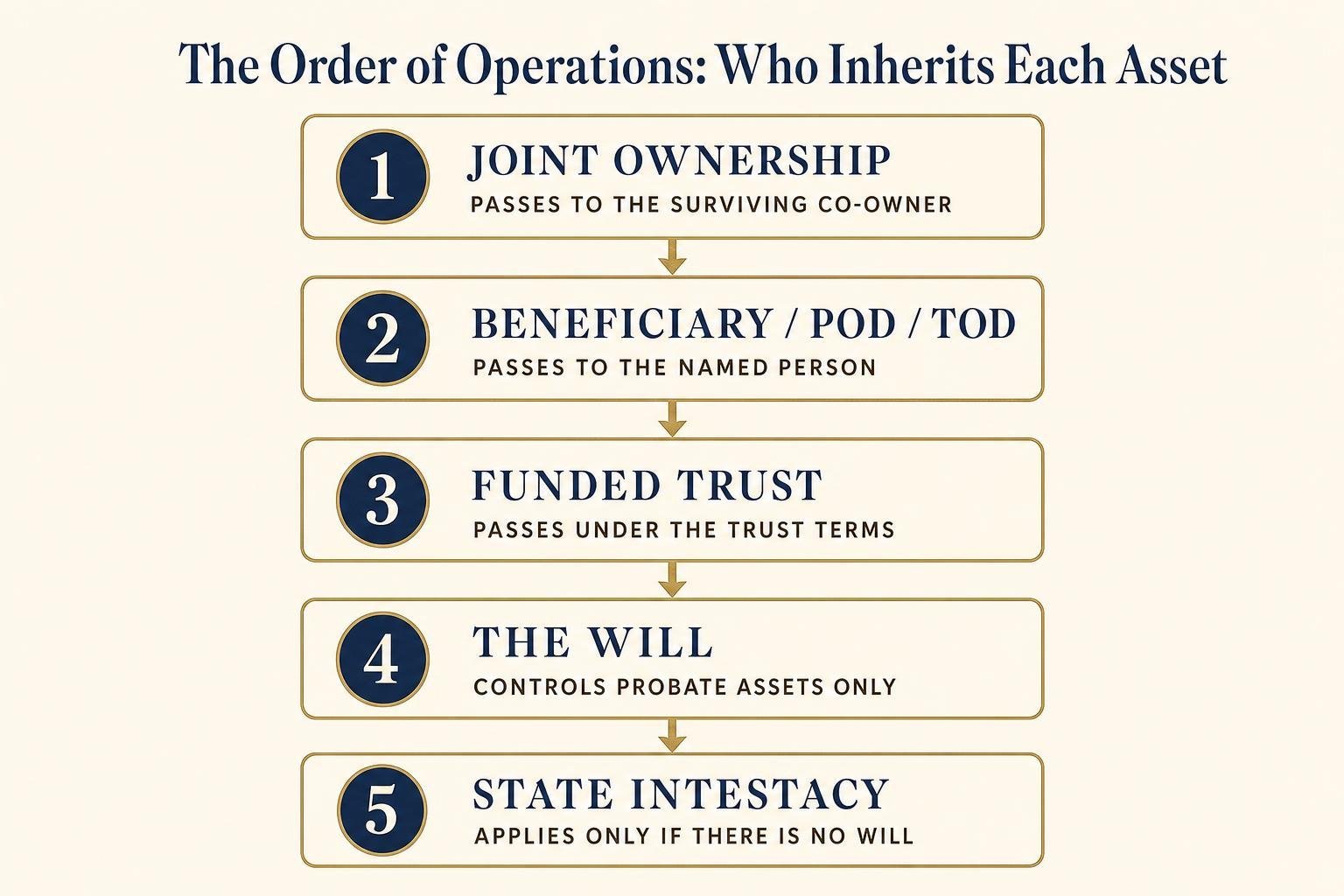
For any single asset you own, the question of who inherits it gets answered by walking down this list in order. The first rule that applies wins, and the rest never get a turn.
1. Is it jointly owned with right of survivorship? If so, it goes to the surviving co-owner the instant you die, automatically, by operation of law. “By operation of law” means it happens on its own — no court, no paperwork, no will. The most common example is a married couple’s home titled as joint tenants with right of survivorship.
2. Does it have a valid beneficiary, POD, or TOD designation? Retirement accounts, life insurance, and annuities pass by beneficiary designation. Bank accounts use a POD (payable-on-death) instruction; brokerage accounts use a TOD (transfer-on-death) registration. All three are contracts between you and the institution. The named person collects directly, outside probate, and the will has no authority over that asset.
3. Is it titled in a trust? If you’ve moved an asset into a revocable living trust, the trust document controls it — again, outside probate.
4. None of the above? Now, finally, it’s a probate asset, and your will decides where it goes.
5. No will either? Then your state’s intestacy law writes one for you, using a fixed formula — usually spouse and children first, then more distant relatives. It rarely matches what you’d have chosen.
Read that order again and notice where the will lands: fourth out of five. It only governs what the first three mechanisms left behind. That’s the whole game.
Why the forms beat the will — and why that bites people
A beneficiary designation wins because it’s a contract. When you named a beneficiary on your IRA, the custodian made a binding promise to pay that person. A will you sign twenty years later doesn’t alter that promise, because the will simply has no reach over a contractual, non-probate asset. I’ve made this case before in more detail, because it’s the mistake I see most often.
The trouble is that beneficiary forms are set once and then forgotten. People name a beneficiary when they open a 401(k) at 26 and never look at the form again. Three decades later it still names an ex-spouse, or a parent who has since passed, or no one at all. The form doesn’t know your life changed. It just executes.
This is also one of those areas where the federal rules surprise people. Employer retirement plans like a 401(k) are governed by federal law, and the beneficiary on file generally controls — a divorce decree or a will usually can’t quietly override it, and a current spouse typically has rights to the account unless they’ve formally waived them. The form is the form. The FINRA investor guidance on choosing and updating account beneficiaries is worth ten minutes precisely because so few people ever revisit these elections.
Consider a hypothetical case: Frank, 71, a retired logistics manager outside Memphis. Frank has a tidy, recently updated will leaving everything “equally to my two children.” He feels organized. But his $600,000 IRA still names his first wife from a form he signed in 1994. His house is titled jointly with his second wife. His checking account is POD to his daughter, Renee, alone. When Frank dies, his will controls almost nothing of real value: the IRA goes to his first wife, the house goes to his second wife by survivorship, and the checking account goes to Renee — leaving his son effectively disinherited despite a will that promised an even split. Every one of those outcomes is legal, and not one of them matches what Frank thought his will had settled.
Where joint ownership quietly rewrites your plan
Joint ownership is the rule most likely to surprise a family, because it sits at the very top of the order and overrides everything below it — including your beneficiary forms and your will.
The classic misstep is adding an adult child as a joint owner on a bank account “for convenience,” so they can help pay bills. It feels harmless. But a joint account with right of survivorship belongs entirely to the survivor when you die. If you have three children and you put one on the account, that child legally owns the whole balance — the other two have no claim, regardless of what your will says about splitting things evenly. Worse, while you’re alive, that money is now exposed to that child’s creditors and divorce. Convenience and ownership are not the same thing, and the title doesn’t know the difference.
What a trust does — and what it doesn’t
A revocable living trust is a powerful tool, but it only controls the assets you actually retitle into it. That step is called funding the trust, and it’s the one people skip. An unfunded trust is an empty box: the document exists, but if the house and the accounts are still in your own name, the trust governs nothing and those assets fall back down the order of operations.
Used properly, a trust lets funded assets pass outside probate, under private terms you control, with instructions that can stretch across years — useful for a minor child, a beneficiary who needs protection, or a blended family. But the trust earns its keep only after it’s funded. If you set one up, finishing the retitling work is not optional housekeeping; it’s the entire point.
The document nobody thinks about until it’s too late
Here’s the failure that has nothing to do with the legal hierarchy and everything to do with real life: your forms can all be perfect and your family still can’t find them. They don’t know the IRA exists, which bank holds the POD account, or whether there’s a trust at all. The plan is only as good as your family’s ability to locate it.
This is exactly the gap The Just in Case Binder was built to close — a printable organizer that records every account, every beneficiary designation, every deed and policy, and where each one lives, so the people you love aren’t reconstructing your financial life from a shoebox during the worst week of theirs. The legal documents decide who inherits; the binder makes sure someone can actually carry it out.
One more boundary worth naming: everything above is about what happens when you die. While you’re alive but unable to manage your own affairs, none of these mechanisms help — that’s the job of a financial power of attorney and a healthcare proxy, which is a related but separate set of documents. It’s a real risk, especially given how cognitive decline can affect financial decision-making long before the end of life.
Key takeaways
- Your will controls only probate assets — things owned in your name alone with no beneficiary, joint owner, or trust attached. For most households, that’s the leftovers.
- The order is: joint ownership, then beneficiary/POD/TOD designations, then a funded trust, then the will, then state intestacy law. The first rule that applies wins.
- Beneficiary forms beat the will because they’re contracts — and they execute exactly as written, even if the form is decades out of date.
- Adding a child as a joint owner “for convenience” can disinherit your other children and expose the money to that child’s creditors.
- A living trust controls only what you retitle into it. An unfunded trust governs nothing.
Frequently asked questions
Does my will override my 401(k) beneficiary form? No. A 401(k) passes by beneficiary designation, outside probate, and the will has no authority over it. If the form names your ex-spouse, the ex-spouse generally inherits, whatever your will says. Updating the form is the only fix.
What happens if I never name a beneficiary? The asset usually defaults into your estate and becomes a probate asset, distributed by your will — or, with no will, by state intestacy law. With retirement accounts, landing in the estate can also compress the tax timeline for whoever inherits it, so naming a person is almost always better than leaving it blank.
If everything has a beneficiary, do I still need a will? Yes. You need it for the assets you forgot to designate, to name a guardian for minor children, and as the catch-all for anything unexpected. The will is the safety net under the whole structure.
The Thomas Take
Most people put their estate-planning energy into the will because it feels like the big, serious document. But the will is the last thing consulted, not the first. The forms — the beneficiary designations, the account titles, the POD and TOD instructions — are what actually steer the bulk of your money, and they’re the part almost no one checks.
So do the unglamorous thing this weekend. Pull up every retirement account, every life insurance policy, every bank and brokerage account, and read the beneficiary or ownership line on each one out loud. Confirm it still names the person you’d choose today. That afternoon of reading does more to control where your money goes than the most expensive will you could buy — because in the order of operations, the forms go first.
This article is published by Confluence Media Group LLC, an independent publisher of educational financial content. Thomas Clark is a Series 65 Investment Advisor Representative. The information provided is for educational and informational purposes only and is not personalized financial, tax, or legal advice. Past performance does not guarantee future results. All investing involves risk, including potential loss of principal. Consult a qualified professional before making financial decisions.
Confluence Media Group LLC is a separate entity from Confluence Capital Management, the investment advisory practice through which Thomas Clark provides advisory services. Advisory services are not offered through this publishing platform.
About Thomas Clark
Thomas Clark is the founder of Confluence Media Group LLC and a Series 65 Investment Advisor Representative. He has spent nearly two decades working with families on retirement planning, with a focus on Social Security optimization, retirement income coordination, and the bucket planning approach to building a guaranteed income floor.
Thomas writes and publishes at thomasclarkadvisor.com and is the author of The Just in Case Binder — a 148-page printable family financial organizer for households who want to make sure the people they love know where everything is.
He lives in North Carolina with his family.
Subscribe to the weekly newsletter · Get the Just in Case Binder

Thomas Clark is a Series 65 licensed investment advisor and experienced trader. He specializes in investing, retirement planning, and market analysis, helping individuals build wealth and make informed financial decisions.
