
Why Most Traders Lose Money: The Three Real Reasons
Most traders don't lose money because they pick the wrong stocks. They lose to three structural forces — the cost math, the absence of a position-sizing rule, and the way the human brain is wired to handle winning and losing.
Most people believe traders lose money because they pick the wrong stocks. Better entries, a sharper strategy, the right indicator — get those right, the thinking goes, and the profits follow. I traded actively for years before I understood how wrong that story is.
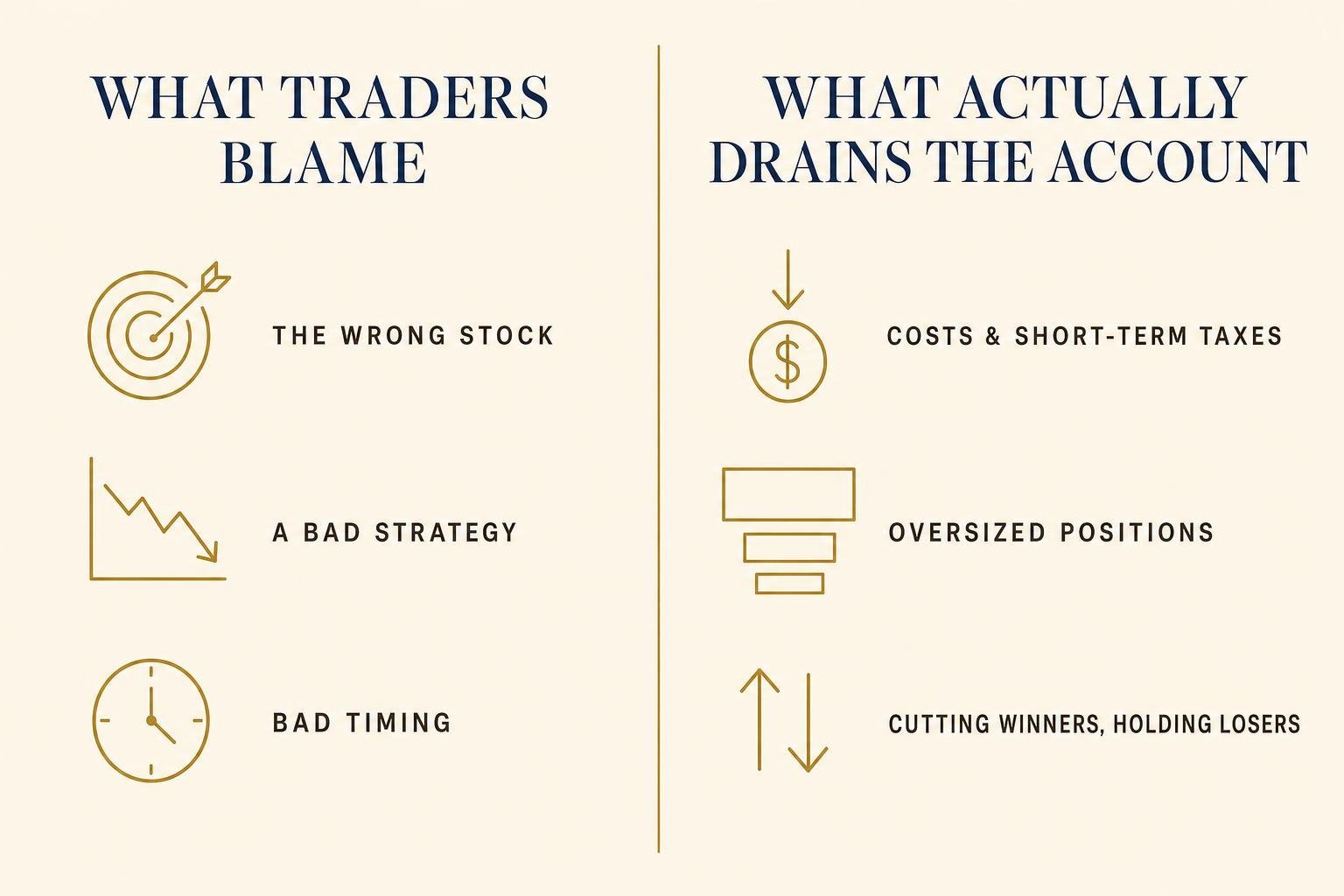
The strategy is almost never the reason an account bleeds out. You can hand a losing trader a genuinely good system and, within a year, the account is smaller. That’s not bad luck, and it’s not a bad system. It’s three structural forces that operate no matter what you trade or how clean your charts look: the cost math, the absence of a position-sizing rule, and the way the human brain is wired to handle winning and losing. Understand these three and you understand why the failure rate is what it is — and what the traders who last actually do differently.
The Strategy Is Almost Never the Problem
Start with the numbers, because they’re blunt. In a study of more than 130,000 day traders in Taiwan, researchers found that in a typical six-month period more than eight in ten lost money, and fewer than 1% earned reliable profits after fees. A separate study of roughly 20,000 Brazilian traders who stuck with it for more than 300 days found that 97% lost money. Different markets, different decades, the same result — which is why the SEC’s own investor education flatly warns that day trading is extremely risky.
If the problem were stock selection, you’d expect a fat middle to the distribution — plenty of traders roughly breaking even, a normal spread of skill. That’s not what the data shows. The losses cluster, and they cluster around forces that have nothing to do with whether you bought the right ticker. Picking direction is the part of trading everyone obsesses over. It’s also the part that matters least to whether you survive.
Reason One: The Math Runs Against You Before You Place a Trade
Every trade you make has a cost, and the cost doesn’t care whether you were right. There’s the commission — lower than it used to be, but rarely zero once you count data and platform fees — and there’s the bid-ask spread you cross going in and coming out, a small, invisible tax on every round trip. Trade often enough and that friction compounds into a serious drag on returns.
Then there’s the tax code, which is quietly hostile to short-term trading. A stock held a year or less is taxed at your ordinary income rate when you sell it at a gain, not the lower long-term capital gains rate a patient investor pays (see IRS Topic No. 409). The active trader hands a larger slice of every winning trade to the IRS and keeps a smaller one. The now-classic study of individual investors by Brad Barber and Terrance Odean put a number on the total damage: from 1991 to 1996, the households that traded the most earned about 11.4% a year while the market returned 17.9% (their paper is titled, fittingly, “Trading Is Hazardous to Your Wealth”). Same market, same stocks available to everyone. The heavy traders simply gave back six and a half points a year to costs and overactivity.
Here’s what makes the math genuinely structural rather than just annoying: losses and gains aren’t symmetric. A position that falls 20% needs a 25% gain to recover. Fall 50% and you need 100% just to get back to even. The deeper the hole, the steeper the climb, and the arithmetic never bends in your favor. This is exactly why a good read on a chart only takes you so far — as I’ve written about what technical analysis can and cannot do, a clean setup might improve your odds on a single trade, but it does nothing about the cost structure grinding underneath every trade you’ll ever place.
Reason Two: No Position-Sizing Rule Means the Streak Ends You
Ask a struggling trader how they decide how much to risk on a trade and you’ll usually get some version of “it depends on how good the setup looks.” That’s the answer that ends accounts. Sizing by conviction feels rational — bet more when you’re more sure — but conviction is exactly the thing markets punish, which means your biggest position tends to arrive right before your most confident mistake.
The structural problem is the losing streak. Even a genuinely good strategy that wins 55% of the time will, over hundreds of trades, hand you runs of six, eight, ten losers in a row. That isn’t a malfunction; it’s ordinary probability. If each of those trades risked 10% or 20% of your account because it “looked great,” the streak doesn’t dent you — it removes you from the game. You can be right about the market and still go broke waiting for it, because you were never sized to survive being wrong first.
Thomas’ Take: The one thing that separates the traders still standing in five years from the ones who aren’t isn’t entry timing. It’s that they decided, before the trade, exactly how much they were willing to lose on it. Everything else is downstream of that single rule.
I’ve made the full case for this elsewhere: position sizing is the most underrated skill in trading, precisely because it’s the one that decides whether the inevitable bad run is a bruise or an ending. Risk a small, fixed fraction of the account on each trade and a ten-loss streak is survivable. Risk whatever feels right in the moment and the same streak is a funeral.
Reason Three: Your Brain Is Wired to Do the Opposite of What Works
The third force is the hardest to fix because it isn’t a knowledge gap. It’s wiring. Decades of behavioral research, beginning with the psychologists Daniel Kahneman and Amos Tversky, found that people feel the pain of a loss roughly twice as intensely as the pleasure of an equivalent gain. That asymmetry, called loss aversion, produces a predictable and expensive pattern in the market.
Terrance Odean documented it in a study of 10,000 brokerage accounts: investors were far more willing to sell a stock that had risen than one that had fallen (his paper, “Are Investors Reluctant to Realize Their Losses?”, found a winner was roughly 50% more likely to be sold than a loser). Traders lock in small winners to enjoy the feeling of being right, and they hold losers — sometimes all the way down — to avoid the feeling of being wrong. It’s called the disposition effect, and it’s precisely backwards. The math of trading rewards cutting losers fast and letting winners run. Human wiring pushes you to cut winners fast and let losers run.
The same wiring drives the two behaviors that show up in nearly every blown-up account: overtrading after a win, when confidence swells and the next setup looks better than it is, and revenge trading after a loss, when the urge to “make it back” overrides every rule you set for yourself. None of this is a character flaw. It’s the standard-issue human operating system meeting an environment it was never built for — the same family of behavioral traps that quietly damage retirement investors, just showing up in a faster and more expensive form. Willpower doesn’t beat it. A process written down in advance does.
What the Traders Who Last Actually Do
Consider a hypothetical. Two traders, Dave and Marcus, are handed the identical strategy on the same Monday — same signals, same watchlist, same rules for entries. Six months later Dave’s account is down 30% and Marcus’s is roughly flat. They traded the same system, so the difference was never the strategy. Dave sized by feel, held his losers hoping they’d come back, and doubled up after a bad week to get even. Marcus risked a fixed 1% per trade, cut every loser at a predetermined stop, and logged each trade so he could see his own patterns. One of them was fighting all three structural forces at once. The other had built a process that neutralized them.
That’s the whole game. The traders who survive don’t own better crystal balls. They’ve accepted that the costs, the sizing, and the wiring are the real opponents, and they’ve engineered around each one. They trade less, to starve the cost drag. They size small and fixed, so no streak can end them. And they replace in-the-moment decisions with written rules — a stop on every trade, a maximum daily loss, an honest trading journal — so the wired-in impulses never get a vote.
There’s one more safeguard that matters more than any of these, and it lives outside the trading account entirely: never fund your retirement from your trading. Money you’re actively trading is risk capital, and it belongs walled off from the money that has to be there when you’re 70. I’ve made that case in full in why trading and retirement planning should never mix, and it’s the first rule I’d give any new trader. The market will teach you the three structural lessons on this page one way or another. The only choice you get is whether it teaches them with money you could afford to lose, or money you couldn’t.
Key Takeaways
- The strategy is rarely the culprit. Across markets and decades, the large majority of active and day traders lose money over time — the losses cluster around structural forces, not stock-picking skill.
- Costs are relentless. Commissions, the bid-ask spread, and the higher ordinary-income tax on short-term gains all compound against frequent trading whether or not you’re right on direction.
- Sizing decides survival. Without a small, fixed position-sizing rule, a statistically normal losing streak can end an account. Survival is a sizing decision, not a prediction.
- Your wiring works against you. Loss aversion drives the disposition effect — cutting winners and holding losers — which is exactly backwards. Only written rules, not willpower, correct it.
- Ring-fence trading capital from retirement money. Trade with what you can genuinely afford to lose, and keep it separate from the money your future depends on.
This article is published by Confluence Media Group LLC, an independent publisher of educational financial content. Thomas Clark is a Series 65 Investment Advisor Representative. The information provided is for educational and informational purposes only and is not personalized financial, tax, or legal advice. Past performance does not guarantee future results. All investing involves risk, including potential loss of principal. Consult a qualified professional before making financial decisions.
Confluence Media Group LLC is a separate entity from Confluence Capital Management, the investment advisory practice through which Thomas Clark provides advisory services. Advisory services are not offered through this publishing platform.
About Thomas Clark
Thomas Clark is the founder of Confluence Media Group LLC and a Series 65 Investment Advisor Representative. He has spent nearly two decades working with families on retirement planning, with a focus on Social Security optimization, retirement income coordination, and the bucket planning approach to building a guaranteed income floor.
Thomas writes and publishes at thomasclarkadvisor.com and is the author of The Just in Case Binder — a 148-page printable family financial organizer for households who want to make sure the people they love know where everything is.
He lives in North Carolina with his family.
Subscribe to the weekly newsletter · Get the Just in Case Binder

Thomas Clark is a Series 65 licensed investment advisor and experienced trader. He specializes in investing, retirement planning, and market analysis, helping individuals build wealth and make informed financial decisions.
