
The Father’s Day Money Conversation Most Families Quietly Avoid
Five short questions, each answerable in a couple of minutes, that together prevent the most common kind of crisis adult children stumble into when something happens to a parent. The conversation worth having this Father's Day weekend — and the structure underneath it.

Father’s Day is one of the few weekends a year when a quiet financial conversation between generations is actually socially permissible. Most families skip it anyway — because the conversation feels heavier than the moment.
There is a lighter version that does not lose any of the value. Five specific questions, each answerable in a couple of minutes, that together prevent the most common kind of crisis adult children stumble into when something happens to a parent.
The conversation isn’t easy. But it’s useful — and Sunday afternoon, with coffee, is a much better setting than the hospital waiting room three years from now.
What the actual problem looks like
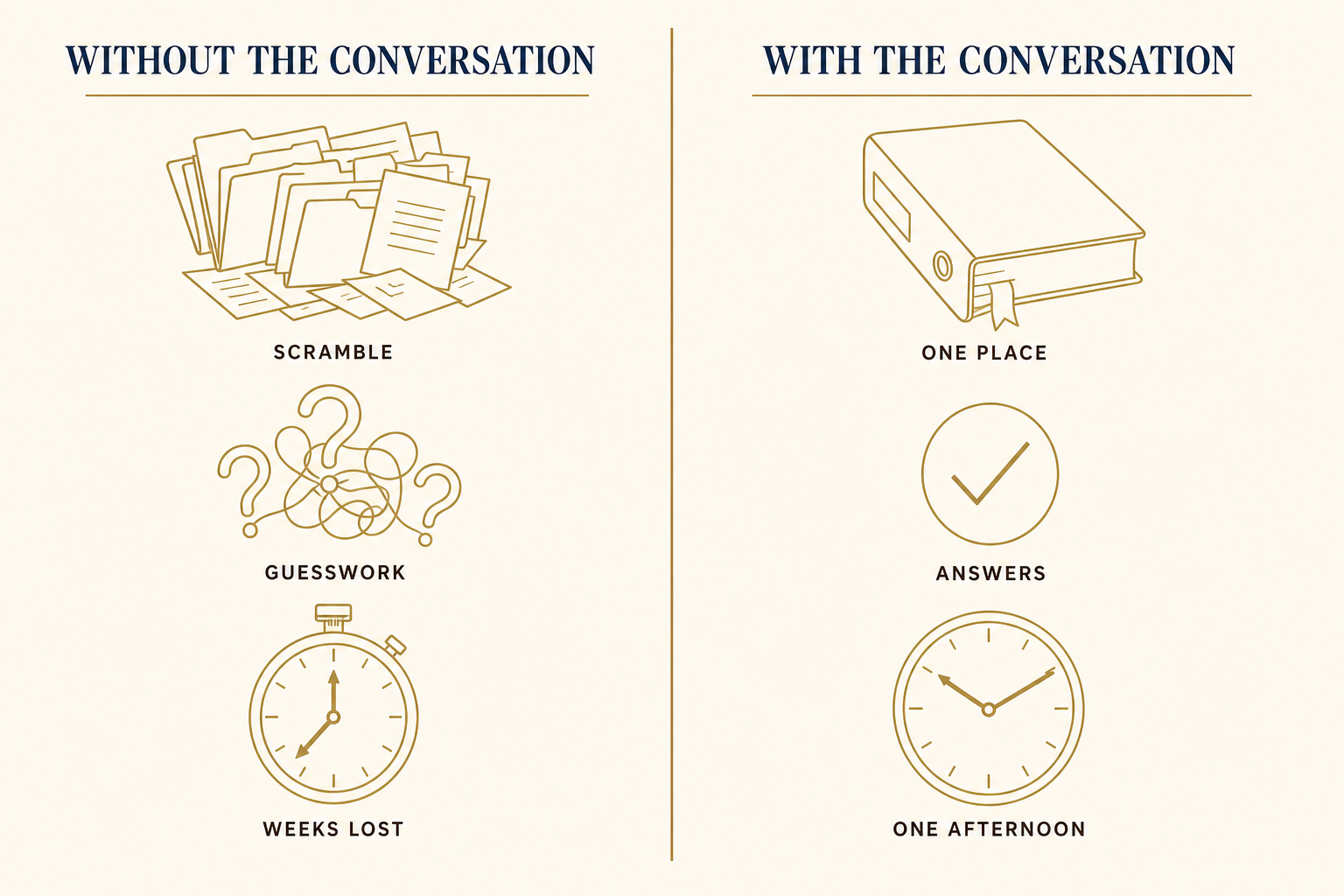
When a parent dies suddenly or becomes incapacitated, the adult children almost always go through the same sequence. They open the parent’s filing cabinet (if there is one), pull up email (if they can get into it), and start a list of every institution they can find evidence of. Then they call each one. Then they fax forms. Then they wait.
That process typically takes three to six weeks per estate when nobody planned for it, and a single afternoon when somebody did. The math isn’t subtle.
The financial cost is rarely the point. The real cost is the second-order one: decisions made under time pressure, sibling tension over who is responsible for what, and the missing documents that turn into surprises six months later — when a long-forgotten beneficiary form pays out to an ex-spouse.
None of this requires a complicated solution. It requires one conversation, ideally with a few short documents that come out of it.
Question 1 — Where do the accounts live?
This isn’t the “how much do you have” question. That part can stay private if your father wants it private. The structural question is which institutions hold what.
For each major asset, two pieces of information: the institution name and the account type. Bank checking and savings. Brokerage accounts — taxable, IRA, Roth, inherited. Employer retirement plans — 401(k), 403(b), and the pension if there is one. Life insurance policies. Annuities. The HSA, if there is one. If there is a small business, where the records live.
Write it down on one page. Don’t try to memorize it. The point isn’t to know the balances — the point is to know where to start when somebody else needs to.
Question 2 — Are the beneficiaries up to date?
This is the question that most often catches families off guard, and it’s the one with the largest downstream cost when it isn’t asked.
Beneficiary designations on retirement accounts, life insurance, and annuities override what the will says. Always. A will that leaves “everything to my children equally” cannot redirect a 401(k) that still names a 1992 ex-spouse as the primary beneficiary. The 401(k) goes to the ex.
This isn’t a hypothetical edge case. It’s one of the most common gaps in real estate plans, and it usually comes from accounts that haven’t been touched in twenty years — old employer plans, term life policies from a long-gone job, the small inherited account from a parent’s estate.
The question to ask: “When was the last time you reviewed the beneficiary forms on each of your retirement and insurance accounts?” If the answer is “I don’t remember” or “probably never,” that’s the answer. The full case for why these designations matter so much lives in why your beneficiary designations matter more than your will.
Question 3 — What’s the income plan?
If your father is pre-retirement, the structural questions are: when is he planning to claim Social Security, and what’s the pension election if there is one. Both decisions are largely irreversible once made. Both have meaningful effects on a surviving spouse’s income for the rest of her life.
If he’s already in distribution, the question shifts: what’s the income coming in each month, and from where? What happens to each income stream if he goes first? Social Security survivor benefits, pension single-life vs. joint-and-survivor election, and any guaranteed income from annuities — these all behave differently when the primary annuitant dies, and most families don’t actually know which behaves how.
This isn’t asking permission to weigh in. It’s understanding the structure of the household’s income floor — the same conversation in our mid-year retirement check-in, just from a different seat at the table.
For the claim-date question specifically, the SSA delayed retirement credits page is the right reference — each year a benefit is delayed past full retirement age adds roughly 8% to the monthly amount up to age 70, and that lift carries forward to the surviving spouse as well.
Question 4 — Where’s the master list?
If your father has a single organized document that pulls all of this together — accounts, beneficiaries, advisors, attorneys, accountant, doctor, insurance policies, digital assets, key contacts — you’re done. You’ve solved the question by asking it.
If he doesn’t, this weekend is when the outline gets started. It doesn’t have to be elaborate. A binder. A spiral notebook. A sealed envelope in the safe. The format matters less than the existence.
The two pieces that families consistently miss: digital access (the email account everything routes through, the password manager if there is one, the two-factor recovery codes) and the contact list (the attorney who drafted the will, the accountant who has the tax records, the financial professional if there is one, the insurance agent). When something happens, the family doesn’t need passwords first — they need to know which professionals to call first.
I built the Just in Case Binder specifically to be this document. It’s 148 pages of organized prompts — the kind of structure that turns “we should sit down and do this” into “this is done.” For families who’d rather build their own, the same structural outline works in any format. The point is to have one.
Question 5 — What’s the wish if Dad can’t speak for himself?
The four documents that most families know they should have but most families don’t actually have: a health care proxy (also called a medical power of attorney), a financial power of attorney, a living will or advance directive, and a HIPAA authorization that lets the named family member talk to doctors.
The hardest one to get to is the conversation underneath the documents — what your father would actually want in a worst case. End-of-life preferences. Where he wants to live if he can’t live alone. What he’d want done with the house. Whether he has feelings about a memorial service.
These aren’t questions you have to land on Father’s Day weekend. But the documents you can knock out in a single Saturday with an estate attorney, and the conversation you can start with one short opener: “If something happened and you couldn’t speak for yourself, who do you want speaking for you?” The CFPB’s Managing Someone Else’s Money guides are the right reference on the financial-POA side specifically.
This is also where any care-reserve planning fits. The conversation overlaps directly with planning long-term care without insurance, which is its own Father’s Day conversation worth having if it hasn’t happened yet — and a natural companion piece to the same weekend’s Mother’s Day conversation about where financial information lives.
What this looks like in practice
Consider a hypothetical case. Robert is 67, retired three years, lives in suburban Charlotte with his wife Karen, and has two adult children — Lisa (40) and Mark (37). His daughter Lisa has been quietly worrying for two years that she does not know what her parents have or where it lives. She doesn’t want to ask. It feels intrusive.
Father’s Day weekend. Sunday morning, after breakfast, before grandchildren arrive. Lisa says: “Dad, I want to ask you something — not because anything is wrong, but because I realized I wouldn’t know what to do if something happened. Can we sit down for twenty minutes and you walk me through what’s where?”
What unfolds: Robert walks her through the institutions. Vanguard for both IRAs. Fidelity for the brokerage account. Two checking accounts and one savings at the local credit union. A paid-off term life policy from his old employer that he forgot to cancel — and which has nothing in it anymore. A $250,000 universal life policy through New York Life that still does.
Beneficiaries: he honestly isn’t sure on the term policy and the universal life. He last looked at them in 2008. Beneficiaries on the IRAs are Karen primary, Lisa and Mark contingent in equal shares. He claimed Social Security at 64; Karen plans to claim her own at 67. There is no pension. Income coming in each month: about $4,200 from his Social Security plus Karen’s part-time bookkeeping income, plus systematic withdrawals from the IRAs.
The master list: doesn’t exist. Robert agrees to build one in the next two weeks. The POA and health care proxy: drafted in 2011 — both arguably expired in style if not in legal force, and the attorney has retired. New ones go on the to-do list.
Total time on the conversation: about thirty-five minutes. Things that came out of it that Lisa didn’t know going in: at least three. Things Robert realized he had been meaning to handle and hadn’t: at least two. Crisis prevented: hard to measure precisely, but almost certainly more than one.
The flip side — if you’re the father
If you’re the parent in this story and your adult children haven’t asked, you can lead. Most adult children won’t ask, even if they want to. It feels like overstepping. Saying “I want to walk you through where everything is so you’re not surprised one day” is one of the cleanest gifts you can give them — and Father’s Day weekend is a defensible excuse to start.
The same five questions work in either direction. The seat at the table changes; the structure doesn’t.
The point isn’t the money
The point is not making your family solve a puzzle in the middle of a grief. The amount of stress that gets removed from the worst week of someone’s life by one organized binder and one thirty-minute conversation is hard to overstate, and almost impossible to recreate after the fact.
Father’s Day weekend is a defensible excuse to start. The questions are short. The conversation is shorter than you think. And the structural relief on the other side of it lasts the rest of your father’s life.
This article is published by Confluence Media Group LLC, an independent publisher of educational financial content. Thomas Clark is a Series 65 Investment Advisor Representative. The information provided is for educational and informational purposes only and is not personalized financial, tax, or legal advice. Past performance does not guarantee future results. All investing involves risk, including potential loss of principal. Consult a qualified professional before making financial decisions.
Confluence Media Group LLC is a separate entity from Confluence Capital Management, the investment advisory practice through which Thomas Clark provides advisory services. Advisory services are not offered through this publishing platform.
About Thomas Clark
Thomas Clark is the founder of Confluence Media Group LLC and a Series 65 Investment Advisor Representative. He has spent nearly two decades working with families on retirement planning, with a focus on Social Security optimization, retirement income coordination, and the bucket planning approach to building a guaranteed income floor.
Thomas writes and publishes at thomasclarkadvisor.com and is the author of The Just in Case Binder — a 148-page printable family financial organizer for households who want to make sure the people they love know where everything is.
He lives in North Carolina with his family.
Subscribe to the weekly newsletter · Get the Just in Case Binder

Thomas Clark is a Series 65 licensed investment advisor and experienced trader. He specializes in investing, retirement planning, and market analysis, helping individuals build wealth and make informed financial decisions.
