
The Mid-Year Retirement Check-In: Six Decisions You Still Have Time to Make
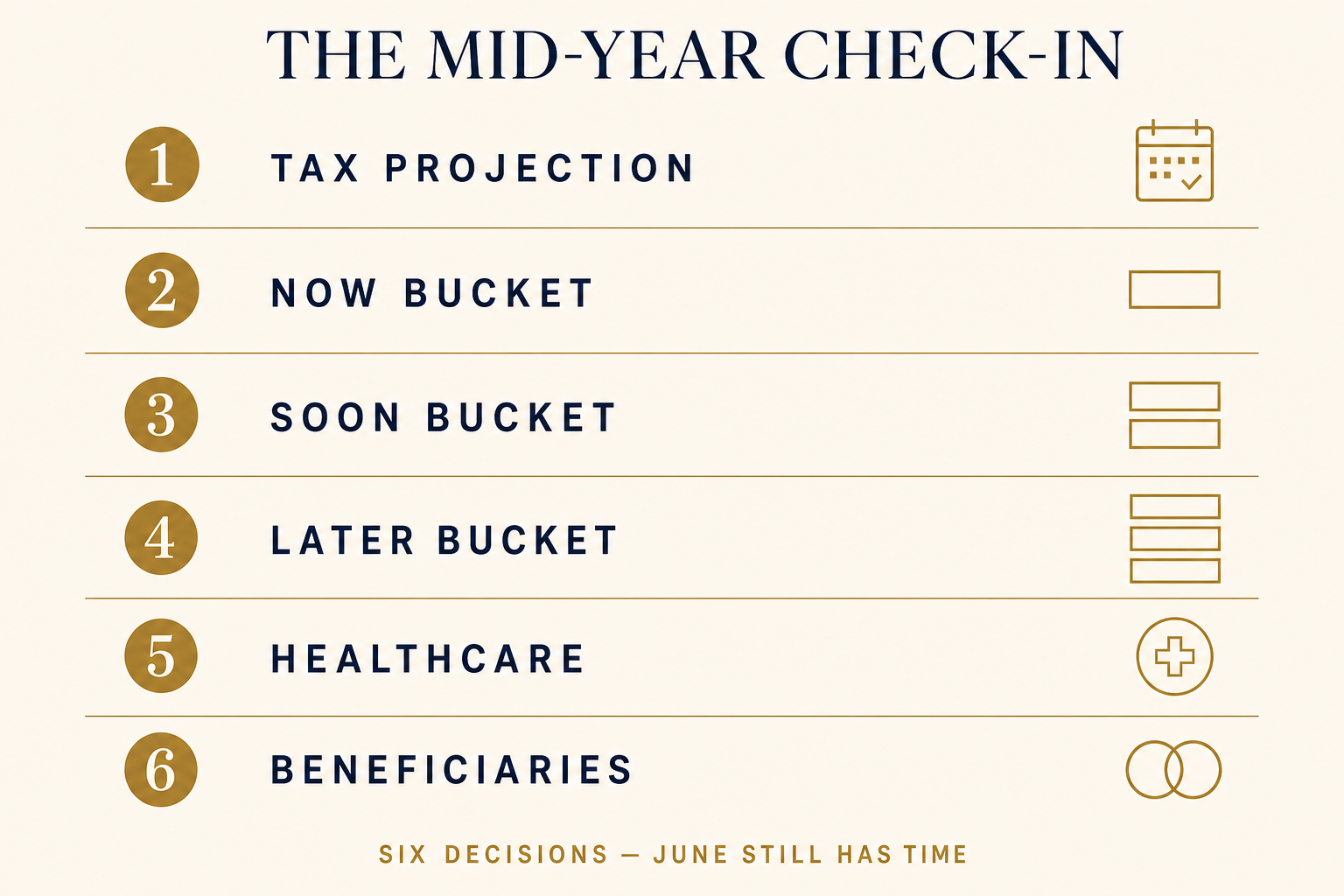
December is too late to convert with runway. November is too late to harvest into strength. June is when you still have six months of runway to act on what you find — six structural decisions worth a Saturday morning.

It’s June 17. About half the year is gone. And if you wait until December to take a real look at your retirement plan, most of what you’d want to do this year will already be off the table — or rushed.
Most retirement planning content lives at the bookends. January gets the “what’s new for the year” overview. November and December get the year-end tax-move blitz. But June is structurally the best month to actually plan, for one reason: you still have six months of runway. A move you make this week ripples through the rest of the year. A move you make on December 23 has to clear before December 31.
So this is the mid-year check-in. Six decisions. Some take an hour. Some take a conversation with a spouse. None of them take a December scramble.
1. The tax projection — and the Roth conversion window inside it
The single most useful thing you can do in June is project this year’s taxable income before December locks it in.
For someone already retired but pre-Social Security, the calculation is usually straightforward — pension, Required Minimum Distributions if applicable, capital gains, dividends, interest. For someone still working with retirement on the horizon, it’s W-2 income plus the same line items.
What you’re looking for: where does the projection land you in the federal bracket structure? If you’re in the 12% or 22% bracket with significant tax-deferred assets, you have something close to a planning gift — a Roth conversion window worth using. We covered why those windows matter in the Roth conversion window post from earlier this month.
The reason June matters more than December: a Roth conversion executed in late June gives you six months of market exposure on the converted amount before the year closes. A conversion executed on December 28 gives you three days. That matters when you’re trying to convert and let the dollars grow inside the tax-free environment.
Tools like ProjectionLab make multi-year tax projection genuinely usable for households without a CPA on retainer — you can model the conversion against bracket thresholds and see the long-term tax shape, not just this year’s hit. (ProjectionLab is an affiliate partner — disclosure at the end of this post.)
2. The Now bucket — what’s left, and what triggers a refill
In bucket planning, the Now bucket holds 18 to 24 months of essential expenses in cash and short-duration instruments. Its only job is to insulate the rest of the plan from sequence-of-returns risk during a market drawdown.
The June check is structural: where is the Now bucket today versus where it should be?
If you refilled in January and have been drawing down monthly, you’re probably six months in. That’s not yet a refill trigger — but it’s the right moment to look at the Later bucket and decide whether the current market environment is a reasonable place to harvest gains for the next top-up. The whole point of the refilling discipline is to harvest into strength, not into weakness.
If you’re already under twelve months of runway and the market is at or near recent highs, refill now. Don’t wait for the calendar.
3. The Soon bucket — Social Security, pension, and FIA payment timing
The Soon bucket holds your guaranteed income floor: Social Security, pensions, and Fixed Index Annuity income riders. Most of these are decided years in advance, but June is when several near-term elections get made.
Three checkpoints worth running:
Social Security claim date. If you’re under 70 and planning to delay, confirm you’re still on the original schedule. Delayed retirement credits accrue monthly — every month you wait between Full Retirement Age and 70 adds two-thirds of one percent to your benefit, per the SSA delayed retirement credit schedule. If circumstances changed (a layoff, a major expense, a health issue), the math may have changed too.
Pension election windows. If you have a defined-benefit pension and a retirement date in the next twelve to eighteen months, the election window for single-life versus joint-and-survivor, COLA versus no COLA, and lump sum versus annuity is typically 60 to 90 days from your separation date. Confirm the timeline now so it doesn’t surprise you.
FIA income rider activation. If you have an income rider on a Fixed Index Annuity, check the activation date you’ve planned around. The rider’s accumulated value compounds in deferral until you activate it — activating early gives up future income growth, activating late delays the income. The contract calendar wins.
This is bucket-planning maintenance — boring on paper, decisive in practice.
4. The Later bucket — drift, rebalance, and what NOT to do
By June, six months of returns have moved your Later bucket allocation. If you set a 70/30 stock-to-bond target in January and equities had a strong first half, you may be drifting toward 75/25. The reverse is also possible.
The mid-year discipline is the same regardless of market direction: if your allocation has drifted more than five percentage points from target, rebalance back. If it’s within five points, leave it alone.
What you’re not doing: making a directional bet. Mid-year is not “should I get more aggressive because the market is hot” or “should I get more defensive because of geopolitics.” It’s a mechanical adjustment back to the policy you wrote when you were thinking clearly. We covered why this matters in the sequence-of-returns piece — the Later bucket’s defense against bad-year math is structural, not tactical.
5. Healthcare — Medicare timing, IRMAA, HSA contributions
Three healthcare checkpoints, all of which are easier to handle in June than in November.
Medicare enrollment timing. If you’ll turn 65 in the next twelve months, your Initial Enrollment Period is a seven-month window starting three months before your 65th birthday. Miss it and you face the Part B late-enrollment penalty for life. The fix is to enroll on time — but knowing the window today rather than three months out is easier.
IRMAA bracket awareness. Income-Related Monthly Adjustment Amounts are based on your modified adjusted gross income from two years prior. If you’re planning a Roth conversion or a large taxable event this year, run the IRMAA projection — a single dollar of conversion income can push you into the next bracket and add $70 to $400 per month per spouse to Medicare premiums two years from now.
HSA contributions. If you’re under 65 and on a qualifying high-deductible health plan, you still have six months to reach the HSA contribution limit for the year — $4,400 self-only, $8,750 family, plus the $1,000 catch-up at 55-plus. The HSA’s triple tax advantage makes this one of the most overpowered moves available, and most people who delay the contribution end up not making it at all.
6. The boring one — beneficiary designations and the estate file
This is the one that gets skipped every year.
Beneficiary designations sit outside the will. The will is irrelevant to who receives an IRA, a 401(k), a life insurance payout, or a transfer-on-death brokerage account. The named beneficiary on the account itself wins, regardless of what the will says.
In June, pull the beneficiary forms on every account that has one. Check that they reflect today’s reality — not the reality from five years ago when one of those accounts was opened. Confirm the contingent beneficiaries too, because that’s the line that catches a primary-beneficiary failure (death, disclaimer, or a simple mismatch).
The same exercise applies to the estate file itself — where the important documents actually live. The Just in Case Binder exists for exactly this reason: the household financial map should be something the people you love can find when they need it, not something locked in your head. June is a quiet enough month to spend an hour bringing it current.
A hypothetical mid-year sweep
Consider a hypothetical case: David and Karen, 64 and 61, in suburban Charlotte. David retired from a state agency 14 months ago, drawing a $4,800-per-month pension. Karen still works part-time, earning $32,000 annually. Their portfolio sits at $850,000 across his 403(b), her IRA, and a joint brokerage. Their plan is to claim Social Security at 67 for David and at 70 for Karen.
Their mid-year sweep, in about ninety minutes:
Tax projection shows them in the 12% federal bracket with roughly $42,000 of headroom before the 22% bracket starts. That is room for a Roth conversion this year — a move that does nothing for them if they wait until December, but reshapes their 70s tax picture meaningfully if they execute now.
Now bucket is at 14 months of essentials against the 18-to-24 target. The Later bucket is up year-to-date; Karen’s IRA can fund a transfer to top up cash without crystallizing more than they want.
Soon bucket is on schedule. Karen confirms her delay plan to 70 still holds. David’s pension is steady.
Later bucket drifted from 65/35 to 71/29. They rebalance — sell the equity overweight, fund the Roth conversion target into bonds inside the new Roth, and the cash-bucket top-up at the same time.
Healthcare: David is on Medicare. Karen’s HSA-eligible plan still has $4,400 of contribution room she hadn’t planned to use. She funds it.
Beneficiaries: Karen’s IRA still names her late mother as primary beneficiary. They update it to David, with their daughter as contingent.
Total time: a Saturday morning. Total impact: a Roth conversion sized to actually bend the long-term tax shape rather than a rushed December placeholder, a Now bucket back on plan, a Later bucket back on policy, an HSA contribution that would otherwise have slipped away, and a beneficiary correction that would have caused a probate mess no one wanted.
The honest take
Most retirement plans don’t fail because the strategy was wrong. They fail because the maintenance was deferred until it was too late to act on what the maintenance revealed.
December is too late to convert with runway. November is too late to harvest into strength if the market turned in October. April is too late to fix this year’s contribution misses.
June is when you still have time. Take it.
Disclosure: This post contains an affiliate link to ProjectionLab. If you sign up through that link I may receive a referral fee at no additional cost to you. I only mention tools I would actually use to illustrate retirement math.
This article is published by Confluence Media Group LLC, an independent publisher of educational financial content. Thomas Clark is a Series 65 Investment Advisor Representative. The information provided is for educational and informational purposes only and is not personalized financial, tax, or legal advice. Past performance does not guarantee future results. All investing involves risk, including potential loss of principal. Consult a qualified professional before making financial decisions.
Confluence Media Group LLC is a separate entity from Confluence Capital Management, the investment advisory practice through which Thomas Clark provides advisory services. Advisory services are not offered through this publishing platform.
About Thomas Clark
Thomas Clark is the founder of Confluence Media Group LLC and a Series 65 Investment Advisor Representative. He has spent nearly two decades working with families on retirement planning, with a focus on Social Security optimization, retirement income coordination, and the bucket planning approach to building a guaranteed income floor.
Thomas writes and publishes at thomasclarkadvisor.com and is the author of The Just in Case Binder — a 148-page printable family financial organizer for households who want to make sure the people they love know where everything is.
He lives in North Carolina with his family.
Subscribe to the weekly newsletter · Get the Just in Case Binder

Thomas Clark is a Series 65 licensed investment advisor and experienced trader. He specializes in investing, retirement planning, and market analysis, helping individuals build wealth and make informed financial decisions.
