
Sequence of Returns Risk and Three Defenses That Actually Work
Two retirees with the same average return can end up with wildly different retirement outcomes, entirely because of when the bad years arrived. Here is why sequence of returns risk is retirement's quietest threat — and three defenses that actually work.

There’s a quiet truth about retirement that even careful planners often miss: the order in which good and bad years arrive matters more than the average return over thirty years. Two retirees can hold the same portfolio, draw the same paycheck, earn the same average return — and one of them runs out of money while the other dies with more than they started with. The math is unsentimental about it.
This is sequence of returns risk. It’s the single biggest reason retirement income planning is not just investment planning with a different label.
What sequence of returns risk actually means
In accumulation — the years you’re saving — the order of returns is mostly irrelevant. If you average 7% per year, you average 7% per year, whether the bad years come first or last. You’re not pulling money out, so a 30% drawdown just means you buy at lower prices for a few years and recover.
In distribution — the years you’re drawing income — the order is everything. When markets fall and you’re still pulling out $60,000 a year, you’re selling shares at depressed prices. You permanently retire those shares. They never participate in the recovery. The portfolio doesn’t just have to recover from the drawdown; it has to recover and offset every dollar you took out at the bottom.
That’s why a 30% bear market in year two of retirement is fundamentally different from a 30% bear market in year twenty-two. One can derail a thirty-year plan. The other you barely notice.
Why averages are a liar’s measurement here
Consider a hypothetical case to make this concrete. Imagine two retirees, both 65 with $1,000,000, both drawing $50,000 a year and adjusting for 2.5% inflation, both invested in a portfolio that averages roughly 7% over thirty years.
The only difference: Margaret hits a sequence where the first three years return -10%, -8%, and -12%. Diane hits a sequence where the first three years return +15%, +12%, and +9%. After year three, both retirees experience exactly the same returns in the same order for the remaining twenty-seven years. Over the full thirty years, they end up with the same arithmetic average return.
Margaret’s portfolio doesn’t survive thirty years. By somewhere around year eighteen, it’s gone.
Diane’s portfolio not only survives, it ends the thirty-year retirement larger than she started.
Same average. Same withdrawal. Same portfolio. Wildly different outcomes — because of when the bad years happened. That’s sequence of returns risk in a sentence.
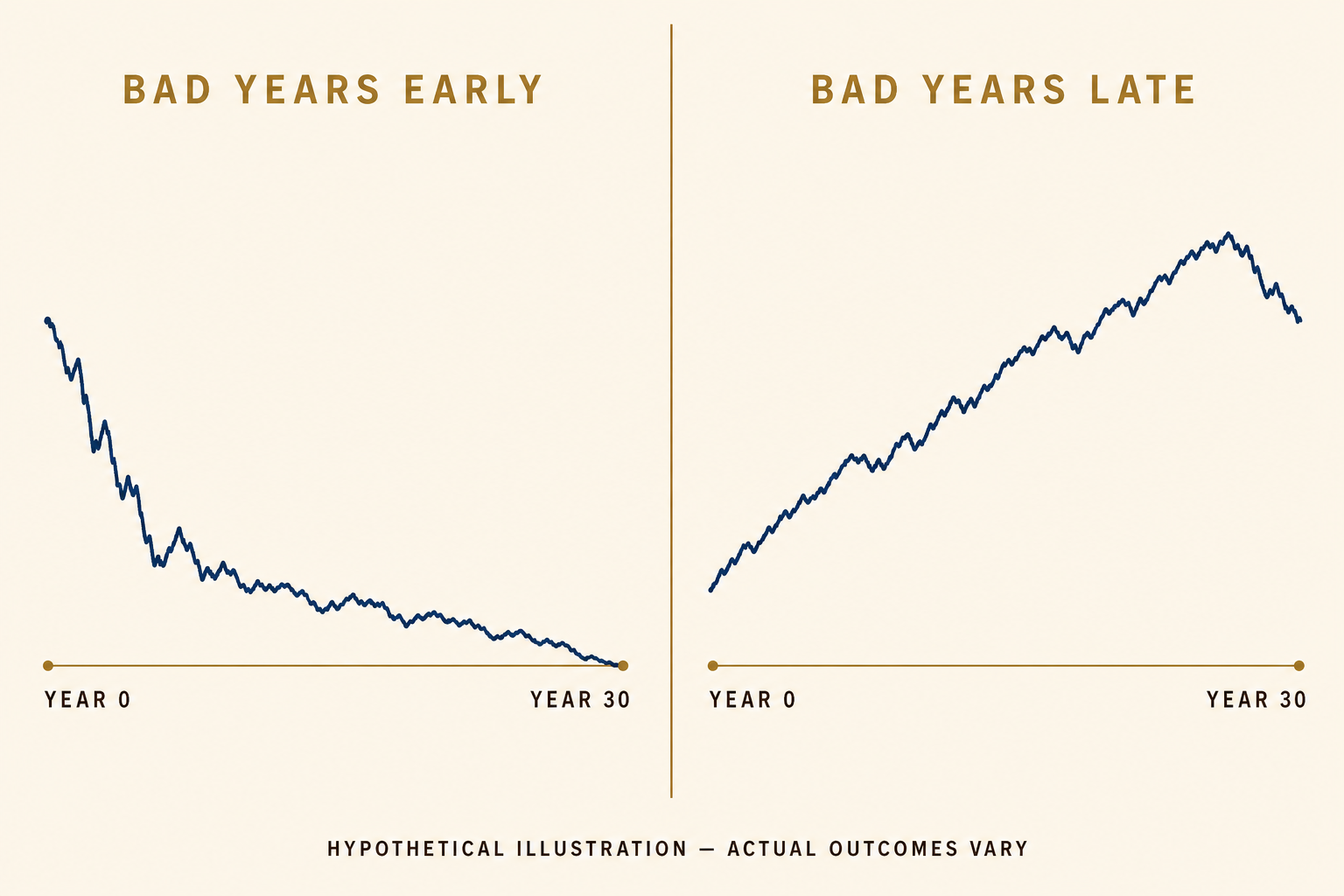
It’s also why most retirement projections that lean on average-return assumptions are quietly dishonest. The average is a story about a hypothetical retiree who never existed. You’ll live the actual sequence, not the average.
The 4% rule pretends this risk away (sort of)
Bill Bengen’s original safe-withdrawal research built sequence risk into the safe withdrawal rate calculation — that’s why the 4% rule says 4% and not 7%. The rule already assumes you’ll hit the worst historical sequence and survive. So in one sense, the rule does the job.
The problem isn’t that the rule ignores sequence risk. The problem is that the rule’s only defense is to withdraw less — to leave a giant cushion in case the bad years come early. For a retiree with $1,000,000, the 4% rule says you can spend $40,000 a year. If you’re lucky and hit a benign sequence (the bad years late, or never at the level the rule assumes), you’ll die with a massive unspent surplus — having spent your sixties more cautiously than you ever needed to.
That’s a real cost too. The 4% rule trades retirement-failure risk for retirement-underconsumption risk. Whether that’s the right trade depends entirely on what tools you put alongside it. The three defenses below are those tools.
Defense #1 — Build a guaranteed income floor (the Soon bucket)
The single most effective defense against sequence of returns risk is not a portfolio adjustment. It’s removing the portfolio from the equation for your essential expenses.
This is the heart of the Now / Soon / Later bucket planning approach. The Soon bucket is your guaranteed income floor — Social Security, any pension, and if you need to fill a gap, an income-focused Fixed Index Annuity with a lifetime income rider. The goal is to cover most or all of your planned essential expenses through guaranteed sources that pay regardless of what the market does. Sizing that floor is the work most retirees skip.
Why does this defend against sequence risk? Because when the market falls in year two, you don’t have to sell. Your grocery bill, your property taxes, your insurance premiums — those keep getting paid by Social Security and your other guaranteed income. Your market-exposed Later bucket gets to sit there and recover. You’re not selling shares at the bottom because you don’t need to sell shares at the bottom. The right Social Security claiming decision also matters here — every year of delayed retirement credits past full retirement age adds 8% to your lifetime base, which is the biggest sequence-risk insurance most people can buy without writing a check.
This is also why I’m consistently against Variable Annuities as an income solution. They combine market exposure with high fees, which defeats the entire point of guaranteed income. If you want market exposure, own the market directly in your Later bucket and stop paying somebody 2% a year to wrap it in an insurance contract. If you want guaranteed income, get guaranteed income — Social Security delay credits, pensions, and income-focused FIAs do that job at a fraction of the cost. Read the SEC investor.gov primer on annuities before you buy any of them; the contract terms matter more than the sales pitch.
Defense #2 — A dynamic withdrawal rule, not a static one
The second defense is to stop pretending you’ll withdraw the same inflation-adjusted dollar amount every year regardless of what’s happening.
Real retirees adjust. They take fewer trips when the portfolio is down 25%. They delay the new car. They eat in more. This is normal behavior — and it’s a powerful sequence-risk defense if you let it be one instead of treating it as a failure of the plan.
Dynamic withdrawal rules formalize the behavior. The simplest version: when your portfolio falls more than a threshold (say, 10% below its prior peak in real terms), you trim discretionary spending — vacations, large gifts, optional home projects — until it recovers. You don’t cut essentials, because those are coming from the Soon bucket anyway. You’re only adjusting the parts of the budget you actually have flexibility on.
This converts sequence risk from a one-way bet against you into a conversation between you and your portfolio. A bad year still hurts. But you don’t permanently damage the plan by stubbornly withdrawing as if nothing happened.
The trap to avoid: treating every down quarter as a reason to cut. Markets are volatile. If you cut spending every time the S&P 500 drops 6%, you’ll spend your retirement scared and small. Set the threshold high enough that it only triggers on real damage, not noise. A real-terms 10% drawdown from the prior peak is a reasonable starting point; tune it to your situation.
Defense #3 — Hold cash for the bad year (the Now bucket)
The third defense is the Now bucket — roughly one to two years of essential expenses held in actual cash and short-duration instruments outside the market.
The reason this matters has nothing to do with “earning a return on your cash.” It has everything to do with not being forced to sell shares in the bad year. When the market is down 30% in March of year two, you can fund the next twelve months of spending from your Now bucket and let the Later bucket recover untouched. By the time you need to refill the Now bucket, the recovery has typically started — and if it hasn’t, the dynamic withdrawal rule from Defense #2 catches the rest.
This is the discipline most retirees skip because cash “earns nothing.” The return on cash isn’t the point. The return on not selling at the bottom is the point. If holding $80,000 in cash means you don’t have to liquidate $80,000 of equities at a 30% drawdown, you’ve effectively earned a $24,000 return on that cash by avoiding the loss you would have otherwise realized. Cash isn’t a yield strategy. It’s a sequence-risk strategy. FINRA’s investor education hub has more on how short-duration cash equivalents behave in stressed markets, which is the only behavior you care about here.
What doesn’t actually help
A few popular “defenses” against sequence risk that don’t actually defend against sequence risk:
- Going more conservative with allocation after a drawdown. Reducing equities from 60% to 40% reduces future volatility, but done at the wrong time it locks in the bad outcome. The Later bucket should be aligned with your risk capacity — how long until you need the money — not panic-adjusted after a drop.
- Buying dividend stocks for “income.” Dividend income is not the same as guaranteed income. A 5% dividend yield from a stock that drops 40% has still put you down 35%. Dividend stocks are equity exposure with a label — they belong in the Later bucket, not the Soon bucket.
- Market-timing the bear. No one knows when the bear arrives. Defending against sequence risk works precisely because it works regardless of timing.
The reason none of these help is that they all assume you can react to or predict the market. A real defense against sequence risk works because you can’t predict it.
Key takeaways
- Sequence of returns risk is the single biggest reason early-retirement drawdowns are dangerous and late-retirement drawdowns mostly aren’t.
- The 4% rule’s defense is just to withdraw less, which trades failure risk for underconsumption risk.
- A guaranteed income floor (Soon bucket) means you don’t have to sell shares when the market falls.
- A dynamic withdrawal rule lets you adjust discretionary spending in bad years without permanently damaging the plan.
- A cash reserve (Now bucket) covers essential spending for one to two years so the Later bucket has time to recover.
- The retirement red zone — roughly five years before and five years after retirement — is where sequence risk is most damaging. Build the defenses before you need them.
The reason these three defenses work together — and why no one of them alone is enough — is that they cover the three distinct ways a bad sequence can break a plan: forced selling of essentials (covered by the Soon bucket), inflexible withdrawal of discretionaries (covered by the dynamic rule), and short-term cash needs in a drawdown year (covered by the Now bucket). Stack all three and the bad sequence becomes uncomfortable but survivable. That, in fact, is most of the case for bucket planning over systematic withdrawal in the first place.
You can’t make sequence of returns risk go away. The market will do what it does, in whatever order it does it. You can stop letting it set the agenda.
This article is published by Confluence Media Group LLC, an independent publisher of educational financial content. Thomas Clark is a Series 65 Investment Advisor Representative. The information provided is for educational and informational purposes only and is not personalized financial, tax, or legal advice. Past performance does not guarantee future results. All investing involves risk, including potential loss of principal. Consult a qualified professional before making financial decisions.
Confluence Media Group LLC is a separate entity from Confluence Capital Management, the investment advisory practice through which Thomas Clark provides advisory services. Advisory services are not offered through this publishing platform.
About Thomas Clark
Thomas Clark is the founder of Confluence Media Group LLC and a Series 65 Investment Advisor Representative. He has spent nearly two decades working with families on retirement planning, with a focus on Social Security optimization, retirement income coordination, and the bucket planning approach to building a guaranteed income floor.
Thomas writes and publishes at thomasclarkadvisor.com and is the author of The Just in Case Binder — a 148-page printable family financial organizer for households who want to make sure the people they love know where everything is.
He lives in North Carolina with his family.
Subscribe to the weekly newsletter · Get the Just in Case Binder

Thomas Clark is a Series 65 licensed investment advisor and experienced trader. He specializes in investing, retirement planning, and market analysis, helping individuals build wealth and make informed financial decisions.
