
How (and When) to Refill the Now Bucket: Quarterly, Annually, or Triggered?
Calendar refills work fine in accumulation, when new money flows in every paycheck. They get a lot less safe the moment you start spending the portfolio — here is the refill rule that holds up when the worst markets show up at the worst time.

If you spent thirty years saving for retirement, you probably inherited a habit: rebalance once a year, usually around New Year’s, often without really thinking about why. That habit served you well during accumulation. It quietly stops making sense the moment you start spending the portfolio instead of feeding it.
The question of when to refill your Now bucket is really the question of how you defend the rest of your retirement against the worst markets at the worst time. Get the refill rules right and a bear market becomes an inconvenience. Get them wrong and it becomes a permanent dent in the income floor you spent decades building.
The accumulation-era refill habit doesn’t transfer
In accumulation, “rebalancing” and “refilling” are essentially the same activity. New money comes in every paycheck. Once a year, you trim what’s grown above target and add to what’s lagged. Markets-up years and markets-down years both work — in a down year, you’re just buying more of the cheap asset with new contributions.
In distribution, there are no new contributions. The transaction now sells one bucket to fund living expenses. The mechanics flipped. You are no longer feeding the portfolio; the portfolio is feeding you. That changes the question from “what’s my target allocation” to “what is the cheapest thing to sell right now, and what is the cost of selling anything at all if markets are weak.”
Most calendar-refill advice was written for the accumulation question and quietly reapplied to the distribution question. It doesn’t work the same way.
Three refill schedules, three different implicit bets
The three patterns you’ll see recommended in retirement-planning content each carry an assumption most readers never notice.
Quarterly refill assumes you can mechanize the decision and that frequent small refills smooth out market timing. The math works if you stay disciplined. The behavioral failure mode is that quarterly refills during a drawdown feel like four small losses in a row, and most retirees abandon the schedule by the third quarter of a bad year. The mechanism is sound, and the human running it usually isn’t.
Annual refill picks one date a year — January 1, the retirement anniversary, the end of the fiscal year — and refills then, regardless of conditions. The assumption is that one good moment a year is enough. It usually is. The hidden cost is that if your annual date falls inside a twenty-percent drawdown, you have just locked in selling at the bottom for the next twelve months of expenses. Some years that is harmless. Some years it eats a meaningful chunk of the Later bucket.
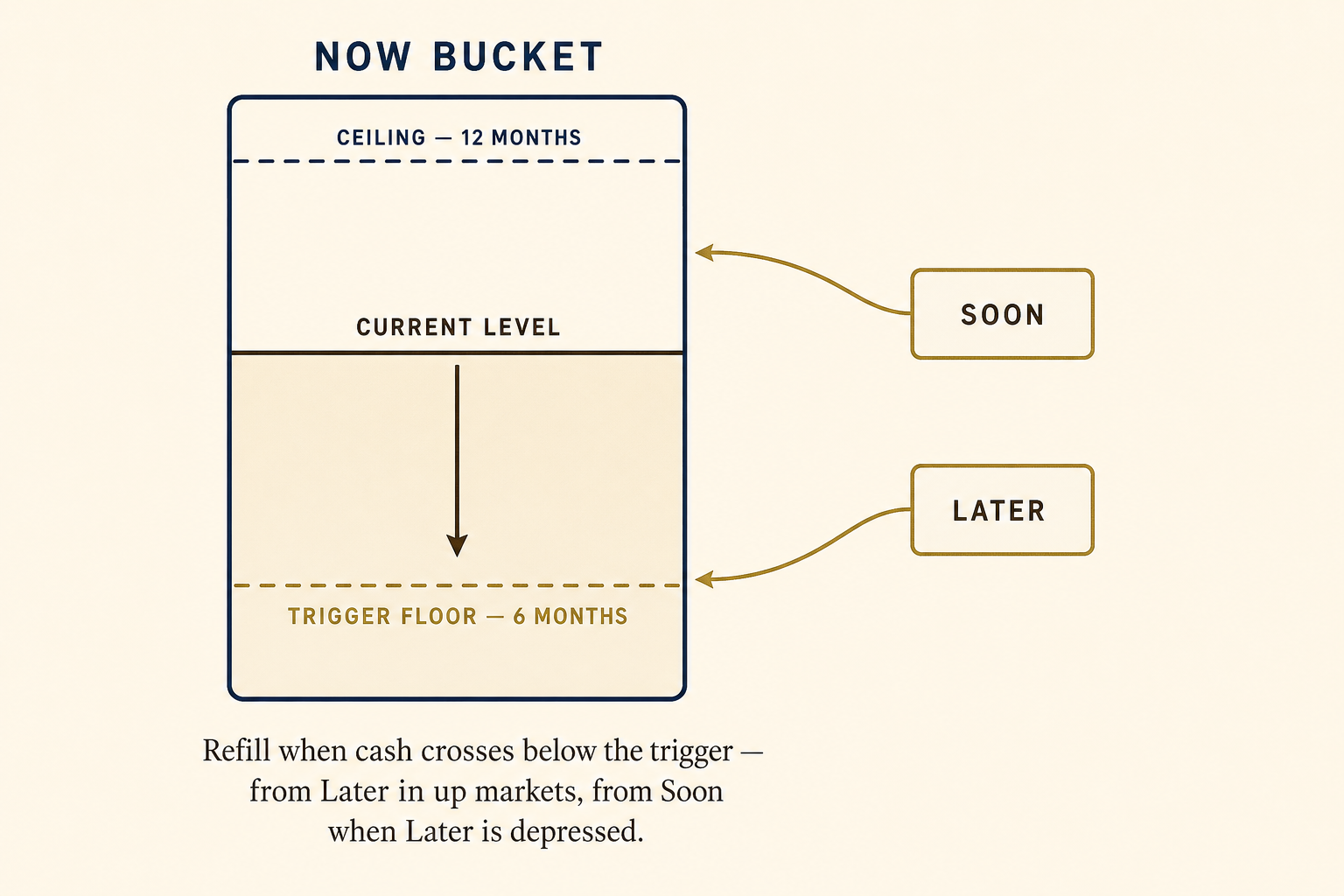
Triggered refill sets a floor on the Now bucket — usually six to twelve months of essential expenses in cash — and refills when the floor is hit. The assumption is that you will watch the bucket and act when you need to, not when the calendar says to. The trade-off is that you have to actually pay attention.
Quarterly is the most mechanical. Annual is the simplest. Triggered is the most defensive.
My view: triggered, opportunistic, and willing to wait
The Now bucket exists for one reason: so you never have to sell into a bad market to pay for groceries. Every refill rule should reinforce that purpose. A calendar that forces you to sell into a twenty-five-percent drawdown defeats the whole point of having a Now bucket in the first place.
The rule I think holds up across most retirement plans is a two-part trigger.
First, set a floor and a ceiling on your Now bucket. A common shape is twelve months of essential expenses at the top and six months at the bottom. When you cross the bottom, you refill. When you fill back above the top, you stop. The bucket lives between those two lines.
Second, when the trigger fires, look at conditions before you decide what to sell. If the Later bucket is up — markets near recent highs, dividends and interest healthy — refill from Later. If Later is down meaningfully, refill from Soon (the income-floor side of the plan) instead, or let dividends and interest in your taxable accounts carry the bucket a few extra months. The Now bucket can run a little leaner than its target floor in a bad year. It cannot do that during a good year, because a good year is exactly when you should be selling.
Notice what this is not. It is not market timing. You are not predicting the next quarter. You are deciding which inventory to sell first — the inventory whose value temporarily looks attractive, versus the inventory whose value is temporarily depressed. That is a reasonable decision for any retiree to make once or twice a year.
A hypothetical: Diane, age 68
Consider a hypothetical retiree named Diane. She has eighteen months of essential expenses in her Now bucket. Her Soon bucket carries her income floor — Social Security plus a Fixed Index Annuity income rider that together cover her core monthly needs. Her Later bucket is a diversified equity-heavy portfolio meant for growth and legacy.
Her trigger is set at six months. Three years into retirement, the Now bucket has drawn down — Social Security and the FIA rider cover most monthly bills, but a roof repair, a new car, and two trips have pulled cash below the trigger. Markets that year are up about twelve percent.
Diane refills the Now bucket from her Later bucket, trimming the equity allocation that has run a little hot back to target. She is selling something that grew. The math feels right because it is right.
A year later her trigger fires again. This time the market is down twenty percent, and yields on her cash have risen since her last refill. Diane does two things. She does not sell from Later. She lets the Now bucket dip a little further than her trigger normally allows — she has the cushion to wait. She also notices that dividends and interest in her taxable account have piled up over the year, and she routes those to cash for the next few months. By the time the bucket actually needs a meaningful refill, the market has recovered some of the ground it lost.
She did not time anything. She just refused to harvest a depressed asset when she had the flexibility not to.
The refill rule is a sequence-of-returns defense
If there is one idea worth carrying out of this post, it is that the Now bucket and its refill rules exist to solve one specific problem: the worst returns of your retirement showing up in the first decade, when you can least afford them.
A calendar refill — quarterly or annual — ignores this entirely. A triggered refill, paired with judgment about what to sell, treats it as the whole point.
You do not need to be a market technician to do this well. You need a clear floor, a clear ceiling, and the willingness to look at the Later bucket before you sell from it. The mechanics are simple. The discipline is what separates the retirees who weather a bad sequence from the ones who don’t.
This article is published by Confluence Media Group LLC, an independent publisher of educational financial content. Thomas Clark is a Series 65 Investment Advisor Representative. The information provided is for educational and informational purposes only and is not personalized financial, tax, or legal advice. Past performance does not guarantee future results. All investing involves risk, including potential loss of principal. Consult a qualified professional before making financial decisions.
Confluence Media Group LLC is a separate entity from Confluence Capital Management, the investment advisory practice through which Thomas Clark provides advisory services. Advisory services are not offered through this publishing platform.
About Thomas Clark
Thomas Clark is the founder of Confluence Media Group LLC and a Series 65 Investment Advisor Representative. He has spent nearly two decades working with families on retirement planning, with a focus on Social Security optimization, retirement income coordination, and the bucket planning approach to building a guaranteed income floor.
Thomas writes and publishes at thomasclarkadvisor.com and is the author of The Just in Case Binder — a 148-page printable family financial organizer for households who want to make sure the people they love know where everything is.
He lives in North Carolina with his family.
Subscribe to the weekly newsletter · Get the Just in Case Binder

Thomas Clark is a Series 65 licensed investment advisor and experienced trader. He specializes in investing, retirement planning, and market analysis, helping individuals build wealth and make informed financial decisions.
