
Annuities in Retirement: When They Help and When They Hurt

Annuities in Retirement: When They Help and When They Hurt
Few words in financial planning stir up more debate than “annuity.” Some advisors swear by them as the foundation of a secure retirement. Others warn clients to run the other direction. The truth about annuities in retirement is more nuanced than either camp admits — and getting it right can mean the difference between a predictable income stream and years of regret over fees, restrictions, and missed opportunities.
Here is what nearly two decades of studying retirement income mechanics makes clear: annuities are a tool, not a solution. Like any tool, they work well in specific situations and poorly in others. Variable annuities — the most expensive and most aggressively marketed category — are responsible for most of the bad reputation the word “annuity” carries. Income-focused annuities, particularly fixed-indexed annuities with guaranteed-lifetime-income riders, are a different conversation entirely. This article separates the two so you can decide whether either belongs in your plan.
Table of Contents
- What Is an Annuity? The Basics
- The Four Major Types of Annuities
- When Annuities Help: The Case for Guaranteed Income
- When Annuities Hurt: The Red Flags
- Annuity Fees: What You Are Really Paying
- Should I Buy an Annuity? A Decision Framework
- How Annuities Fit into a Broader Retirement Income Plan
- Key Takeaways
- Frequently Asked Questions
What Is an Annuity? The Basics
An annuity is a contract between you and an insurance company. You give the insurance company a lump sum of money (or a series of payments), and in return, they promise to pay you a stream of income — either immediately or at some future date, and either for a set period or for the rest of your life.
That core concept — trading a lump sum today for guaranteed payments later — is the fundamental value proposition. For retirees who worry about outliving their money, a lifetime income annuity addresses that fear directly. No matter how long you live, the payments continue.
But that simple concept has been layered with decades of product complexity, optional riders, surrender charges, sub-accounts, caps, spreads, and participation rates that can make annuity contracts nearly impenetrable. According to FINRA, annuities are among the most complex financial products sold to retail investors — and complexity tends to benefit the seller, not the buyer.
This is why understanding the different types is essential before evaluating whether any annuity makes sense for you.
The Four Major Types of Annuities
Single Premium Immediate Annuity (SPIA)
A SPIA — single premium immediate annuity — is the most straightforward annuity in the marketplace. You hand the insurance company a lump sum, and they start paying you income, usually within 30 days. Payments can be structured for one life, joint life, or a fixed period. Once the SPIA is annuitized, the lump sum is gone, but the monthly check is contractually guaranteed.
A SPIA is essentially buying a private pension. The older you are when you purchase, the higher the monthly payment — because the insurance company expects to make payments for fewer years.
SPIAs and income-rider FIAs (covered next) solve the same problem — guaranteed lifetime income — using different mechanics. A SPIA converts principal into income permanently. An income-rider FIA uses a separately calculated “income value” inside the contract to fund the lifetime payment, while the underlying account value remains accessible (subject to surrender terms) until you turn the income on.
Best for: Retirees who want absolute simplicity and a guaranteed monthly check, are comfortable giving up access to the lump sum, and do not need the optionality of an FIA with an income rider.
Fixed Annuity
A fixed annuity works like a CD issued by an insurance company. You deposit money, and it earns a guaranteed interest rate for a set period (typically 3 to 7 years). Your principal is protected, and the rate is locked in regardless of what the market does.
Fixed annuities are straightforward, low-fee products. The trade-off is that the guaranteed rate is typically modest — competitive with Treasury bonds but rarely exciting. They work well as a conservative holding within a broader portfolio but are not designed to generate retirement income on their own.
Best for: Conservative savers looking for principal protection and a guaranteed rate, as an alternative to CDs or Treasury bonds.
Fixed-Indexed Annuity (FIA)
A fixed-indexed annuity (FIA) is the annuity that fits the income-floor role inside a bucket plan, but specifically as an income tool, not a growth tool. The accumulation feature — index-linked crediting with a 0 percent floor and a capped upside — is not the reason an FIA earns a place in the plan. The reason is the optional guaranteed-lifetime-income rider, which contractually obligates the insurance company to pay a defined monthly benefit for as long as you live, regardless of what the underlying account value does.
Used this way, an FIA fills the role a private pension used to fill. It sits underneath Social Security in the income floor and helps cover the planned, recurring bills of retirement. Growth happens elsewhere — in the market-exposed Later bucket of the plan.
The trade-offs are real and need to be understood. Surrender schedules are long (7 to 10 years is typical), liquidity during that period is limited, and the income rider has an explicit annual cost. Those are acceptable trade-offs when the goal is durable, contractually guaranteed income — and unacceptable trade-offs when an FIA is sold as a way to “beat the market with no risk.” If the pitch you are getting is about accumulation rather than income, that is a sign the product is being sold for the wrong reason.
Best for: Pre-retirees and retirees who need to build or extend a guaranteed income floor — Social Security plus pension (if any) plus FIA income rider — to cover essential expenses for life.
Variable Annuity
A variable annuity is essentially a tax-deferred investment account wrapped inside an insurance contract. Your money is invested in sub-accounts (similar to mutual funds), and the value fluctuates with the market. There is no principal guarantee unless you purchase an optional rider.
Variable annuities are the most expensive type, typically carrying mortality and expense charges of 1.0 to 1.5 percent annually, plus sub-account fees of 0.5 to 1.0 percent, plus optional rider fees of 0.5 to 1.5 percent. Total all-in costs of 2.5 to 4.0 percent per year are common, according to the SEC.
Best for: Very few retirees, in my experience. The fee drag is severe, and the tax deferral benefit is rarely worth it for someone already in retirement with access to Roth IRAs and tax-loss harvesting in taxable accounts. There are occasional edge cases (extremely high earners who have maxed out all other tax-deferred space), but for most retirees, better alternatives exist.
Comparison table of four annuity types — SPIA, fixed, fixed-indexed, and variable — showing fees, protection, liquidity, and best-fit profiles.”
When Annuities Help: The Case for Guaranteed Income
There are legitimate, research-backed reasons why an annuity — specifically a SPIA or a well-structured income annuity — can improve a retirement plan:
1. Longevity protection. The single greatest risk in retirement is living longer than your money lasts. An annuity that pays for life eliminates this risk entirely for the portion of income it covers. Academic research from Professor Moshe Milevsky and others has consistently shown that partial annuitization improves retirement outcomes.
2. Behavioral stability. Retirees with guaranteed income covering their essential expenses are far less likely to make panic-driven investment decisions during market downturns. When your rent, food, and utilities are covered by Social Security and an annuity, a 30 percent market drop is scary — but not a threat to your daily life. This behavioral benefit is hard to quantify but enormously valuable.
3. Income floor construction. In a retirement paycheck strategy, a SPIA can serve as one layer of guaranteed income alongside Social Security and pensions. If Social Security covers $2,500/month of your $4,500/month essential expenses, an annuity that covers the remaining $2,000 creates a fully guaranteed floor.
4. Simplification. For retirees who do not want to manage a complex withdrawal strategy, an annuity converts the problem of “how much can I spend?” into a simple monthly check. There is real value in that simplicity for people who find investment management stressful or confusing.
When Annuities Hurt: The Red Flags
Annuities become problematic — sometimes severely so — in these scenarios:
1. Over-annuitization. Putting too much of your savings into an annuity leaves you without liquidity for emergencies, large expenses, or opportunities. Once you hand money to an insurance company for a SPIA, it is gone — you cannot get the lump sum back. A common rule of thumb: never annuitize more than 25 to 40 percent of your liquid retirement assets.
2. High-fee products sold to people who do not need them. Variable annuities with 3+ percent annual fees sold to retirees who already have adequate guaranteed income (Social Security + pension) are the most common offender. The fees drag down returns so significantly that a simple index fund in a taxable account almost always produces a better outcome.
3. Long surrender periods. If you buy a product with a 10-year surrender schedule and need the money in year 3, you will pay surrender charges of 5 to 8 percent on top of whatever fees you have already paid. These products effectively lock up your money — which is fine if you understand that going in, but disastrous if your circumstances change.
4. Buying too young. Annuity payout rates are directly linked to your age. A SPIA purchased at 60 pays significantly less per month than the same annuity purchased at 70, because the insurance company expects to make payments for a longer period. For most retirees, waiting until the mid-to-late 60s or early 70s produces much better income rates.
5. Replacing a better strategy. If your bucket planning approach already provides adequate income segmentation and you are comfortable managing it, adding an annuity may not improve your plan — it just adds complexity and reduces flexibility.
Thomas’s Take: The annuity question is never “are annuities good or bad?” It is “does this specific annuity, at this price, for this amount, solve a specific problem in my plan that cannot be solved more simply?” If the answer is yes, it might be a smart move. If the answer is “my advisor recommended it” without that specificity, proceed with extreme caution.
Annuity Fees: What You Are Really Paying
Transparency around annuity fees is one of the biggest challenges for consumers. Unlike a mutual fund where the expense ratio is clearly stated, annuity costs are spread across multiple layers:
| Fee Type | Typical Range | Applies To |
|---|---|---|
| Mortality & expense charge | 1.0% – 1.5%/year | Variable annuities |
| Sub-account management fees | 0.5% – 1.0%/year | Variable annuities |
| Administrative fees | $30 – $50/year flat | Variable annuities |
| Income rider fees | 0.5% – 1.5%/year | FIAs and variable annuities |
| Surrender charges | 5% – 8% declining over 7-10 years | FIAs, variable annuities |
| Spread/margin | 1% – 3% of index return | Fixed-indexed annuities |
Note on income rider fees: Income rider fees are paid in exchange for a guaranteed lifetime income benefit — a feature you choose to buy, not a hidden cost. Whether they are worth it depends on the income guarantee they produce relative to the fee.
A SPIA, by contrast, has no ongoing fees. The insurance company’s profit is built into the payout rate — you get a slightly lower monthly payment than the pure actuarial math would suggest, and that difference is the insurer’s compensation. This is one reason SPIAs are generally the most consumer-friendly annuity type.
For any annuity product, ask: “What is the total all-in annual cost, expressed as a percentage of my account value?” If the seller cannot or will not answer that question clearly, consider it a warning sign.
Stacked cost diagram comparing the layered annual fees of a variable annuity totaling 3.0% versus a SPIA with zero ongoing fees.”
Should I Buy an Annuity? A Decision Framework
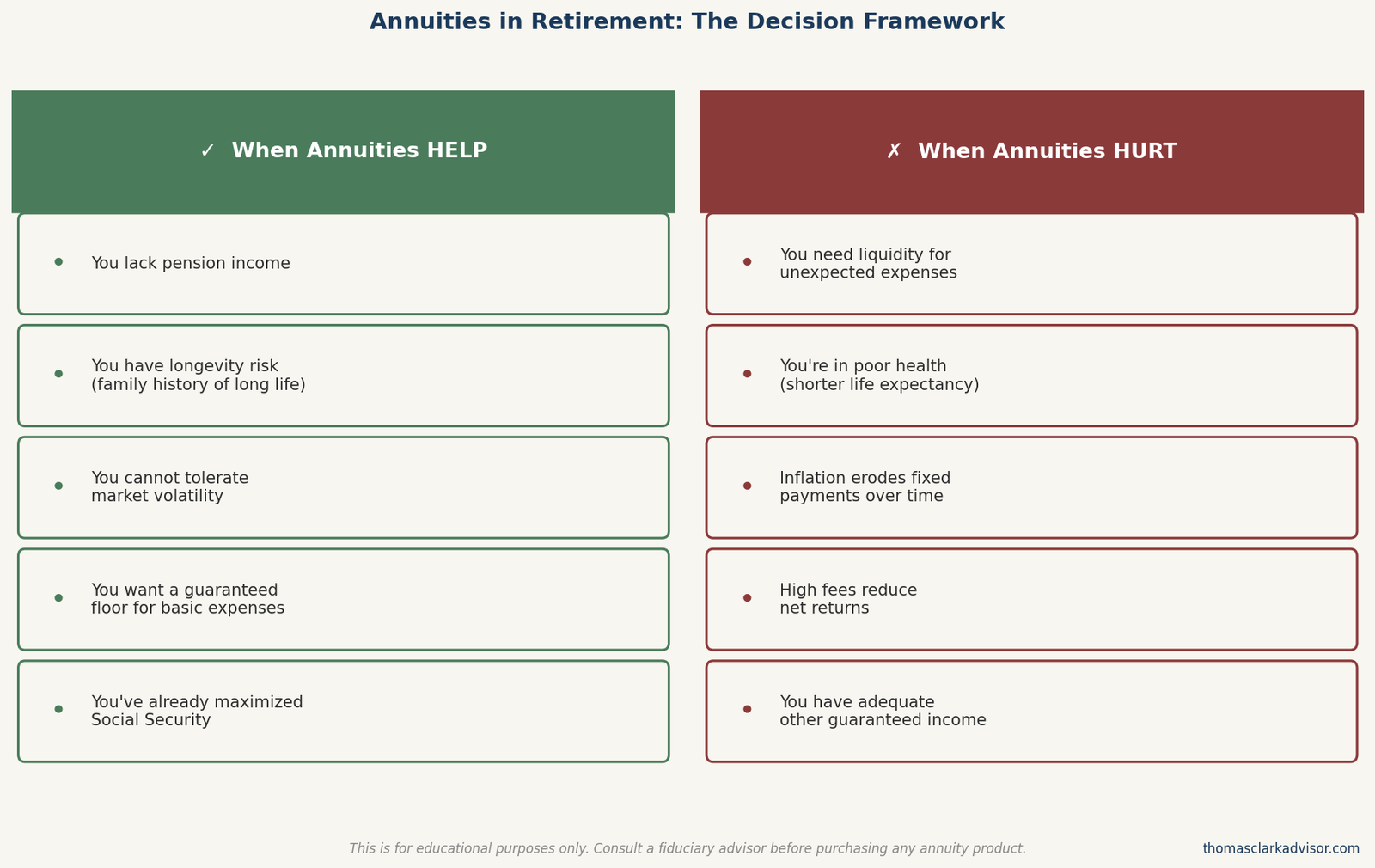
Before considering any annuity, work through these questions:
Step 1: Calculate your income gap. Add up your guaranteed income sources (Social Security, pension). Subtract your essential monthly expenses. If there is a gap, an income annuity may be worth considering. If guaranteed income already covers essentials, you likely do not need one.
Step 2: Assess your liquidity. If purchasing an annuity would leave you with less than 60 percent of your total retirement savings in liquid, accessible form, the annuity is probably too large. Emergencies, healthcare costs, and home repairs require accessible funds.
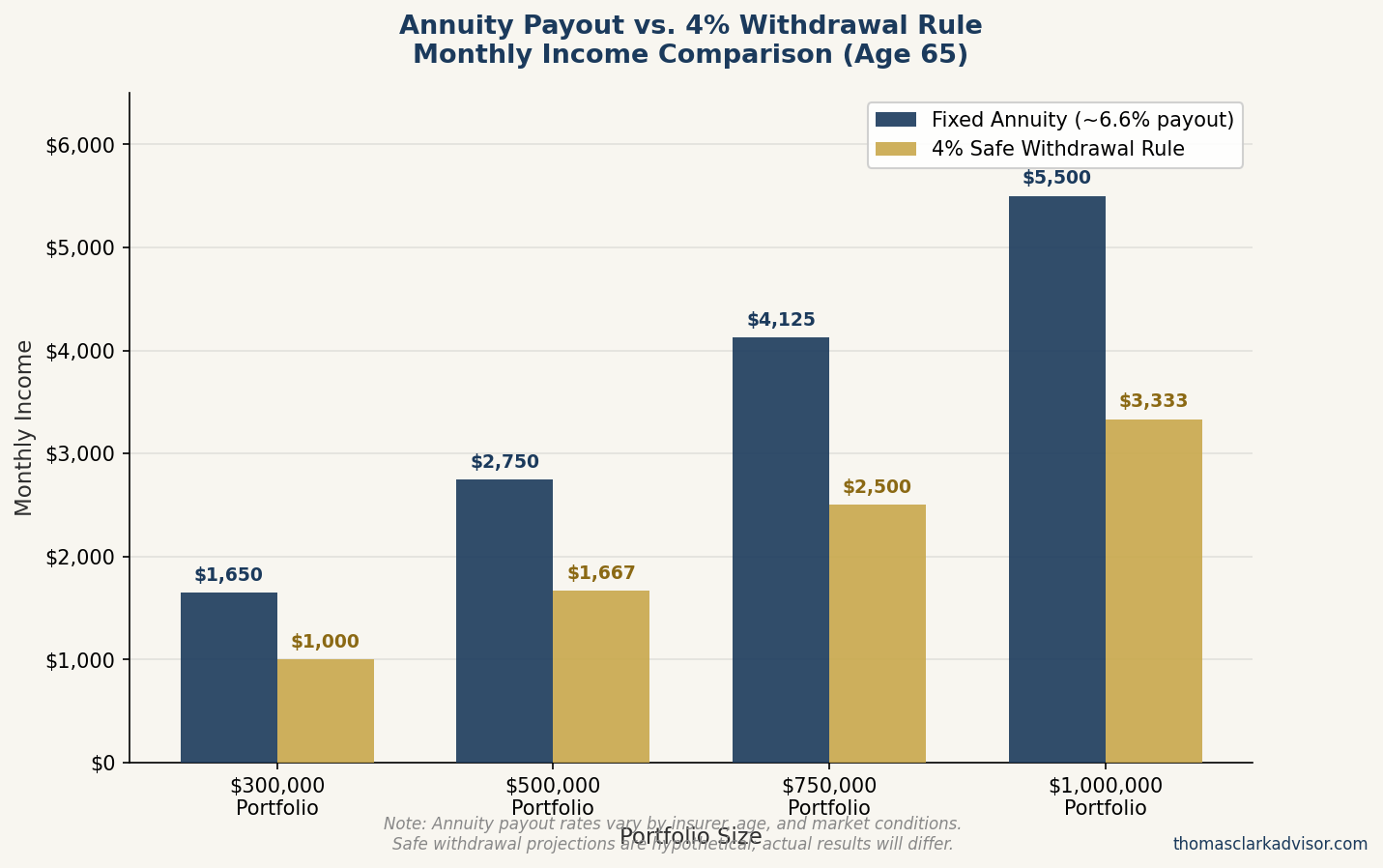
Step 3: Evaluate alternatives. Could a systematic withdrawal strategy from a diversified portfolio achieve the same goal with more flexibility? For many retirees, a well-managed 4 percent withdrawal approach (or a flexible guardrails approach) provides sufficient income without sacrificing liquidity.
Step 4: Compare products. If you decide an annuity makes sense, compare quotes from multiple insurance companies. Rates vary significantly. Use independent comparison tools rather than relying on a single agent’s recommendation. Check the insurer’s financial strength rating (A.M. Best, Moody’s, S&P).
Step 5: Understand the contract. Read the surrender schedule, fee disclosure, death benefit terms, and inflation adjustment options (if any). If you cannot understand the contract, that is not a reflection of your intelligence — it is a reflection of the product’s complexity, and complexity should make you cautious.
How Annuities Fit into a Broader Retirement Income Plan
An annuity works best when it is one piece of a coordinated income strategy — not the entire strategy. In a bucket planning approach, a SPIA can anchor the guaranteed income layer alongside Social Security:
Guaranteed floor (Bucket 1 foundation): Social Security + pension (if any) + an income-focused annuity — most often a fixed-indexed annuity with a guaranteed-lifetime-income rider, sometimes a SPIA — covers 100 percent of essential expenses. This floor provides peace of mind and behavioral stability.
Growth portfolio (Buckets 2 and 3): The remaining portfolio — invested in bonds, stocks, and diversified assets — funds discretionary spending, travel, gifts, and legacy goals. Because essential expenses are covered by guaranteed income, this portfolio can be invested more aggressively with a longer time horizon.
This combination — guaranteed floor plus growth portfolio — is what the academic literature calls the “floor-and-upside” approach. Research suggests it produces better outcomes than either full annuitization or a purely investment-based strategy for most retirees, because it addresses both the longevity risk (through the annuity) and the inflation and growth risk (through the portfolio).
The comparison between dividend stocks and annuities as income sources is worth understanding, too. Dividend stocks provide income but with no guarantee — the company can cut the dividend at any time. An annuity provides a guarantee but no growth. The right retirement plan usually includes elements of both, weighted by your personal risk tolerance and income needs.
Key Takeaways
- Annuities are a tool, not a strategy. They solve specific problems (longevity risk, income gaps) but create others (illiquidity, fees, complexity).
- SPIAs (income annuities) are the simplest and most consumer-friendly type — no ongoing fees, predictable income for life.
- Variable annuities carry the highest fees (2.5 to 4.0 percent annually) and are rarely the best choice for retirees with other tax-advantaged options.
- Never annuitize more than 25 to 40 percent of your liquid retirement assets — liquidity is essential for emergencies and flexibility.
- The decision framework is: identify the income gap, assess liquidity, evaluate alternatives, compare products, and understand the contract.
- Annuities work best as one layer in a broader income plan alongside Social Security, pensions, and a diversified investment portfolio.
Frequently Asked Questions
Should I buy an annuity in retirement?
It depends entirely on your income gap, guaranteed income sources, liquidity, and risk tolerance. If Social Security and pensions do not cover your essential expenses and you want a guaranteed income floor, a SPIA may be a strong fit. If your guaranteed income already covers essentials, an annuity likely adds cost and complexity without proportional benefit.
What is the biggest risk of buying an annuity?
Illiquidity and over-commitment. Once you purchase a SPIA, you cannot get your lump sum back. If you put too much of your savings into an annuity and face an unexpected expense, you may not have accessible funds. This is why sizing is critical — never annuitize more than you can afford to lock away permanently.
Are annuity payments taxable?
It depends on how you funded the annuity. If purchased with pre-tax money (from an IRA or 401(k)), the payments are fully taxable as ordinary income. If purchased with after-tax money, a portion of each payment is a tax-free return of your principal, and the remainder is taxable. Your insurance company will provide a 1099 showing the taxable amount.
Do annuities keep up with inflation?
Most standard annuities do not include inflation adjustments — your payment stays the same for life, meaning its purchasing power declines over time. Some annuities offer a cost-of-living adjustment (COLA) rider, but this significantly reduces the initial payment (often by 20 to 30 percent). Whether the COLA rider is worth it depends on how long you live and how high inflation runs.
The annuity conversation does not have to be confusing. Strip away the product complexity and sales pressure, and the core question is simple: do you have an income gap that a guaranteed payment would fill, and can you afford to give up access to that money? If yes, an annuity might genuinely improve your retirement. If no, your money is almost certainly better off invested in a diversified portfolio you control.
For more on retirement income, bucket planning, and Social Security claiming, browse the retirement planning archive or sign up for the weekly newsletter at the bottom of any page.
This article is published by Confluence Media Group LLC, an independent publisher of educational financial content. Thomas Clark is a Series 65 Investment Advisor Representative. The information provided is for educational and informational purposes only and is not personalized financial, tax, or legal advice. Past performance does not guarantee future results. All investing involves risk, including potential loss of principal. Consult a qualified professional before making financial decisions.
Confluence Media Group LLC is a separate entity from Confluence Capital Management, the investment advisory practice through which Thomas Clark provides advisory services. Advisory services are not offered through this publishing platform.

Thomas Clark is a Series 65 licensed investment advisor and experienced trader. He specializes in investing, retirement planning, and market analysis, helping individuals build wealth and make informed financial decisions.
