
The Pre-Medicare Gap: Bridging Healthcare Costs Between 60 and 65
Medicare starts at 65 — and for early retirees, the gap between leaving work and that birthday is the most under-discussed problem in retirement planning. Here's how to bridge it without breaking the rest of your plan.

Picture a couple at 62, both retiring early. They have a paid-off house, a healthy nest egg, and Social Security claiming options to think through. Then the first private health insurance quote arrives, and everything stops.
The pre-Medicare gap is the most under-discussed retirement planning problem in the country. Between the day you leave employer-sponsored coverage and the morning you become Medicare-eligible at 65, you are on your own. For most people that gap is real — anywhere from a few months to a full five years — and the math is more aggressive than they expect.
Key Takeaways
- The Medicare door opens at 65. If you retire before then, you are responsible for bridging your own health coverage, and the cost can reshape the entire withdrawal plan.
- You have five real options, not one. The ACA Marketplace, COBRA, a spouse’s plan, retiree medical from a former employer, and part-time work that includes benefits — most early retirees walk in thinking only about the first.
- MAGI is the lever. The Marketplace subsidy curve is steep against Modified Adjusted Gross Income. The same family at $120,000 MAGI versus $60,000 MAGI can pay several times more for the same plan.
- Aggressive Roth conversions before 65 can backfire. The lost premium tax credit is a real, calculable cost — and it often offsets the long-term Roth math during the gap years.
- The HSA is the closest thing to a free lunch. Qualified medical expenses paid from an HSA don’t show up in MAGI at all, which is exactly what you want during the bridge years.
Why the gap exists at all
Medicare starts at 65. Period. There are exceptions for certain disabilities, but for the vast majority of retirees, that birthday is the eligibility door. Employer coverage ends when employment does. COBRA can extend an employer plan for up to 18 months, but it ends well before most early retirees reach Medicare. And the longer the gap, the more expensive it gets.
Here’s where most planning conversations go off the rails. The retiree has been planning around the portfolio and Social Security, and the healthcare line on the cash-flow worksheet gets a placeholder — “we’ll figure it out.” Then the actual quote shows up. A 62-year-old couple in reasonably good health is often looking at premiums between $1,400 and $2,400 a month for two on the ACA Marketplace before any subsidies, depending on geography and plan tier. Add deductibles, and the first-year out-of-pocket exposure can easily push past $30,000.
That number changes the entire retirement plan. It moves the Now-bucket withdrawal rate, the Roth conversion strategy, the Social Security claiming age, and sometimes the retirement date itself.
The five real options
Most people walk into this conversation thinking they have one option — the ACA Marketplace — and walk out realizing they had five.
The Marketplace. ACA plans are the default route for most early retirees. The structural feature that matters most isn’t the plan itself; it’s the premium tax credit. Subsidies are calculated against Modified Adjusted Gross Income, and the curve is steep. The same family that pays $2,000 a month with a $120,000 MAGI may pay a fraction of that with a $60,000 MAGI. The Marketplace doesn’t care what’s sitting in your accounts. It cares what’s flowing through your tax return.
COBRA. For up to 18 months after you leave a job, federal law lets you keep your employer’s coverage by paying the full premium plus a small administrative fee. The numbers tend to be high because the employer was previously paying the bulk of the premium silently in your benefits package. COBRA makes sense in two cases: when a known medical event is going to happen within the year and your current plan has favorable specialist coverage, or when you only need a few months of coverage before another option begins.
A spouse’s plan. If one spouse is still working and the other is retiring early, the working spouse’s plan is almost always the cheapest answer. Add a spouse to the existing employer plan and the cost is usually a fraction of any Marketplace alternative. This is often the quietest reason that one spouse keeps working an extra two or three years.
Retiree medical from a former employer. Once common, now rare. If a previous employer offers retiree health coverage, the terms are usually generous because the contract was written before benefit costs spiraled. Most retirees no longer have access to this. Check your benefit summary documents from past employers; people forget what they are entitled to.
Part-time work that includes health benefits. A growing number of retirees take a 20–30 hour position with an employer specifically because the benefits package is the goal. Costco, Starbucks, REI, some hospital systems, and a number of municipalities offer health benefits to part-time employees. The job pays the premium and a little extra; you stay close to a healthy daily rhythm; the math often beats every other option through age 65.
Health sharing ministries get pitched in this conversation. They are not insurance, do not guarantee coverage of any claim, and carry meaningful restrictions on pre-existing conditions and lifestyle requirements. I do not include them as a sixth option.
The lever most people miss: MAGI management
The ACA premium tax credit is one of the most underappreciated tax planning levers in early retirement.
The credit phases out as Modified Adjusted Gross Income rises. A retiree drawing $40,000 from a brokerage account taxed mostly as long-term capital gains is in a very different subsidy position than one converting $80,000 from a Traditional IRA to a Roth. Both retirees may have the same lifestyle. Their healthcare costs are not the same.
This means the five years between early retirement and Medicare can be the worst possible time for aggressive Roth conversions, even when the long-term math favors them. The lost subsidy is a real cost. I’ve found that running the Roth conversion alongside the Marketplace subsidy curve — looking at the combined tax-and-premium impact — is one of the highest-value modeling exercises a pre-retiree can do.
The flip side: the Health Savings Account.
If you funded an HSA during your working years and you’re approaching the Medicare gap with a healthy balance, you have tax-free dollars sitting there waiting for exactly this. Qualified medical expenses paid from the HSA don’t show up in MAGI at all. That’s an income-floor mechanism for healthcare specifically, and it’s the closest thing to a free lunch in this entire conversation.
Thomas’s Take: The pre-Medicare gap doesn’t break retirement plans because of the sticker price. It breaks them because the price drives MAGI optimization that conflicts with every other tax move you wanted to make. Healthcare planning between 60 and 65 isn’t really a healthcare question — it’s an income-design question.
A hypothetical to make it concrete
Consider a hypothetical couple, Mark and Linda, both 62. Mark just retired. Linda left work two years ago. Their financial picture is solid — $1.4 million in a mix of Traditional IRA, Roth IRA, and brokerage accounts, a paid-off house, and combined Social Security benefits projected at $4,800 a month if they wait until Full Retirement Age.
Their planned spending in retirement is $7,500 a month. They wanted to spend the first few years doing Roth conversions to clean up the Traditional IRA before RMDs hit at 73 and before they file jointly with Linda on Social Security.
Then they priced healthcare. Two ACA Silver plans in their state cost around $1,800 a month before subsidies — roughly $21,600 a year. With deductibles and copays, realistic out-of-pocket exposure runs $26,000 a year.
If they pull $90,000 a year from the Traditional IRA to fund spending and Roth conversions, their MAGI knocks them out of any meaningful subsidy. Total annual healthcare cost: roughly $26,000.
If they instead pull primarily from the brokerage account — using long-term gains taxed at 0% in the lower brackets — and keep MAGI closer to $55,000, the subsidy can reduce premium cost dramatically. The healthcare bill might fall closer to $9,000 a year, even after copays.
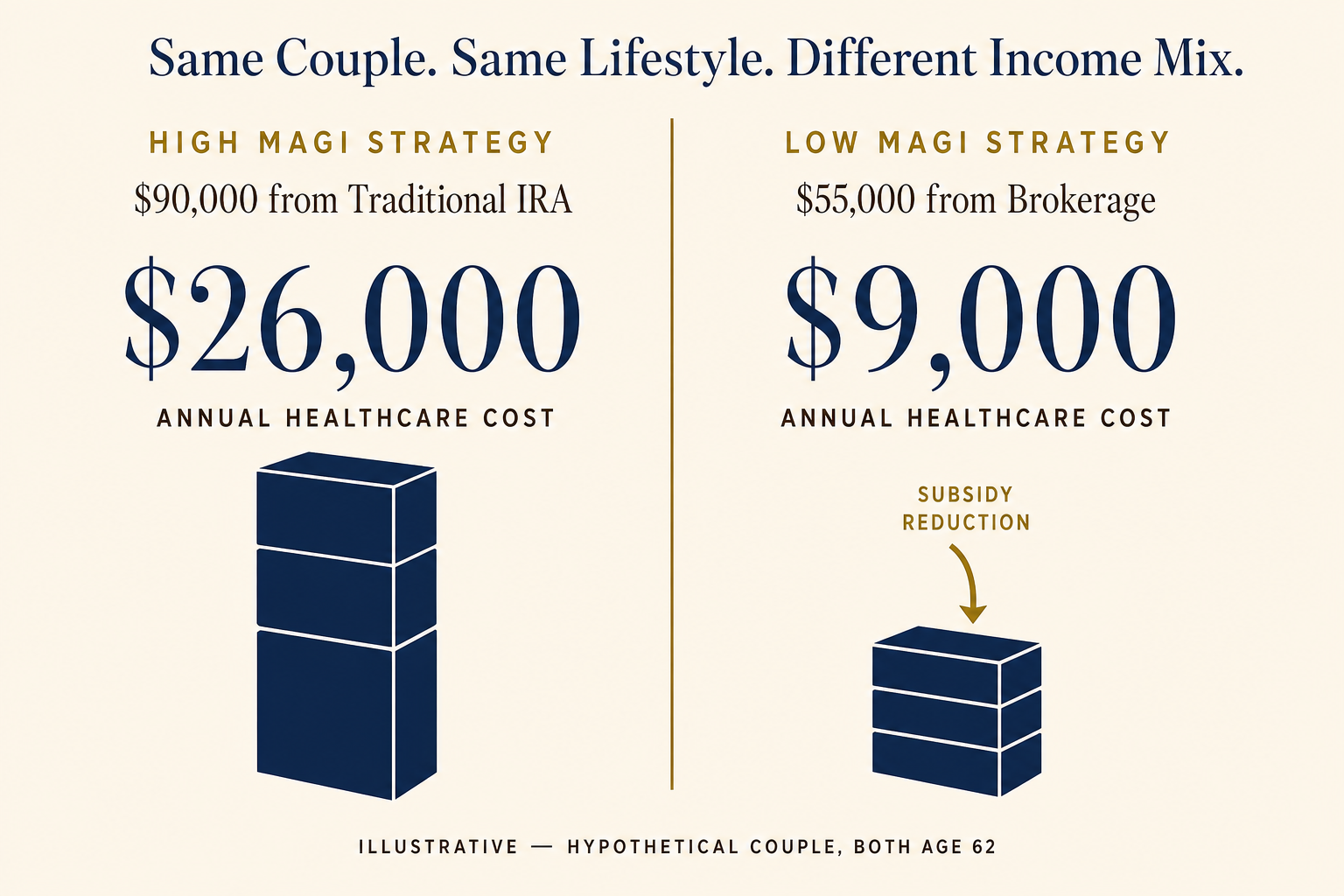
The Roth conversion math doesn’t disappear. It gets deferred. Mark and Linda may do modest conversions inside the subsidy band, then accelerate after 65 when Medicare premiums replace the ACA subsidy curve. The total tax-and-healthcare picture looks very different from the spreadsheet they walked in with.
The numbers are illustrative. The structure is the point.
Where this sits in bucket planning
This is the moment to stop treating healthcare as a line item and start treating it as a bucket question.
The Now bucket has to absorb premiums regardless of market conditions. That’s a cash flow problem, not an investment problem. The Soon bucket — your guaranteed income floor — sets the MAGI baseline for subsidy modeling. The Later bucket can absorb the cost of a paused Roth conversion strategy without harming the long-term plan.
If your essential expenses including healthcare premiums are covered by guaranteed income — Social Security, pension, or Fixed Index Annuity income rider payments — the pre-Medicare gap becomes a planning challenge rather than a planning crisis. If they’re not, the gap dictates the entire withdrawal strategy until age 65.
That’s why pre-retirees within five years of leaving work should price healthcare before finalizing the retirement date. Not as a footnote. As the number that drives every other number.
FAQ
Q: Can I just pay the penalty and go uninsured for a few years?
A: The federal individual mandate penalty was zeroed in 2019, but some states have their own. The real penalty isn’t the tax. It’s the catastrophic event that lands a 63-year-old in a hospital with no coverage. One emergency procedure can run six figures. The gap years are the worst years to self-insure.
Q: My spouse is on Medicare already. Does that help my coverage?
A: Not directly. Medicare doesn’t extend to a spouse the way employer coverage does. Each spouse is enrolled in their own plan based on their own age and work record. If you’re 62 and your spouse is 67, you still need a private bridge plan until you turn 65.
Q: What if I work for myself in early retirement?
A: A self-employed individual with earned income may be able to deduct health insurance premiums above the line, which reduces MAGI and may improve subsidy eligibility. The structure matters — an LLC with active income is different from passive partnership income. Worth a conversation with a tax professional before the year ends, not after.
Q: What about an HSA after I enroll in Medicare?
A: Once you enroll in any part of Medicare, you can no longer contribute to an HSA. You can still spend from an existing balance on qualified expenses tax-free. The contribution-stop is a small detail with a big calendar implication: if you want to maximize HSA contributions, the months before your Medicare effective date matter.
The bottom line
The pre-Medicare gap is the most predictable financial shock in early retirement. It shows up the moment you stop being covered by an employer and ends the day you turn 65. Plan it the way you plan Social Security claiming — model it, price it, and let it shape your withdrawal strategy. Treat the five years as their own micro-plan inside the broader retirement plan, with their own bucket logic and their own tax posture.
A retirement plan that gets healthcare wrong between 60 and 65 isn’t really a retirement plan. It’s a portfolio with a hole in it that takes a long time to fix.
This article is published by Confluence Media Group LLC, an independent publisher of educational financial content. Thomas Clark is a Series 65 Investment Advisor Representative. The information provided is for educational and informational purposes only and is not personalized financial, tax, or legal advice. Past performance does not guarantee future results. All investing involves risk, including potential loss of principal. Consult a qualified professional before making financial decisions.
Confluence Media Group LLC is a separate entity from Confluence Capital Management, the investment advisory practice through which Thomas Clark provides advisory services. Advisory services are not offered through this publishing platform.
About Thomas Clark
Thomas Clark is the founder of Confluence Media Group LLC and a Series 65 Investment Advisor Representative. He has spent nearly two decades working with families on retirement planning, with a focus on Social Security optimization, retirement income coordination, and the bucket planning approach to building a guaranteed income floor.
Thomas writes and publishes at thomasclarkadvisor.com and is the author of The Just in Case Binder — a 148-page printable family financial organizer for households who want to make sure the people they love know where everything is.
He lives in North Carolina with his family.
Subscribe to the weekly newsletter · Get the Just in Case Binder

Thomas Clark is a Series 65 licensed investment advisor and experienced trader. He specializes in investing, retirement planning, and market analysis, helping individuals build wealth and make informed financial decisions.
