
The Social Security Restricted Application That Most People Think Is Dead — But Still Works for Widows and Widowers
The 2015 Bipartisan Budget Act killed the version of the restricted application that retirement planners loved most. But it didn't touch the survivor-benefit version — and that one is alive, well, and almost completely unused. Here's how widows and widowers can still claim two Social Security benefits in sequence, and why almost nobody at the field office will tell you it's an option.
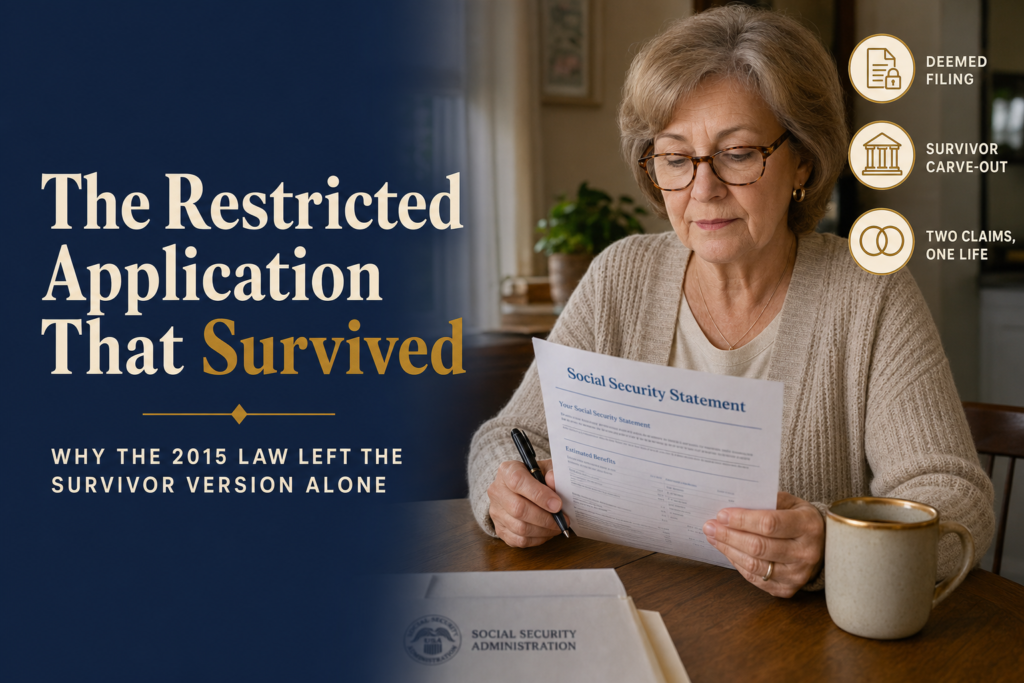
When financial blogs say “the Social Security restricted application is dead,” they’re 90% right and 100% wrong.
The 2015 Bipartisan Budget Act did kill the version that retirement planners loved most — the one where a couple paired a spousal claim with a delayed retirement claim. That door closed for anyone born after January 1, 1954, which now means everyone under age 72. The vast majority of pre-retirees reading this can stop reading articles about that strategy. It doesn’t apply to them.
But there is a different version of the restricted application that the 2015 law never touched, and almost nobody talks about it. It is the single most important claiming strategy a widow or widower has — and most surviving spouses miss it entirely, because the Social Security Administration is not in the business of pointing it out.
What the restricted application used to do
Before 2016, a spouse who reached Full Retirement Age could file a “restricted application” for spousal benefits only — leaving their own retirement benefit untouched to keep earning the 8% per year of delayed retirement credits until age 70. Four years of spousal income on the way to a 32% larger personal benefit. It was the cleanest claiming move on the board.
The 2015 Bipartisan Budget Act ended that game for anyone born after January 1, 1954. Today, when you file for any benefit at or after age 62, you are “deemed” to have filed for every benefit you’re eligible for at the same time. You take the higher of the two. The choreography is gone.
That is the version of the restricted application that died, and that is the only one most people have ever heard of.
The version that did not die
Deemed filing applies to retirement and spousal benefits. It does not apply to survivor benefits. The 2015 law was explicit on this point, and the SSA’s own program rules continue to confirm it.
That single carve-out is the entire point. A widow or widower can file a restricted application — restricting it to survivor benefits only — and let their own retirement benefit keep growing in the background. Or, depending on the numbers, they can do the opposite: claim a small retirement benefit early and switch to the larger survivor benefit later. Either way, the household gets two bites at the apple instead of one.
This is not a loophole. It is the law. It survived 2016 because survivor benefits are a different statutory animal from retirement and spousal benefits, and Congress never lumped them in.
How the survivor restricted application actually works
A surviving spouse becomes eligible for a survivor benefit as early as age 60 (age 50 if disabled). A surviving spouse can also claim their own retirement benefit as early as 62. Because deemed filing does not apply to survivor benefits, the two claims can be filed separately, in either order, with the other one suspended in place.
The two strategies that actually matter:
Path 1 — Claim survivor early, switch to your own benefit at 70. File for survivor benefits at 60 (or as early as your situation allows). Let your own retirement benefit grow at 8% per year of delayed retirement credits until age 70. At 70, switch to your own benefit, which by then is 24% larger than it would have been at Full Retirement Age and far larger than it was at 62.
Path 2 — Claim your own retirement benefit early, switch to survivor at Full Retirement Age. File for your own retirement benefit at 62. Let the survivor benefit sit. At your Full Retirement Age, switch to the survivor benefit, which maxes out at FRA — there is no delayed retirement credit on survivor benefits beyond your own FRA, so there is no reason to wait past it.
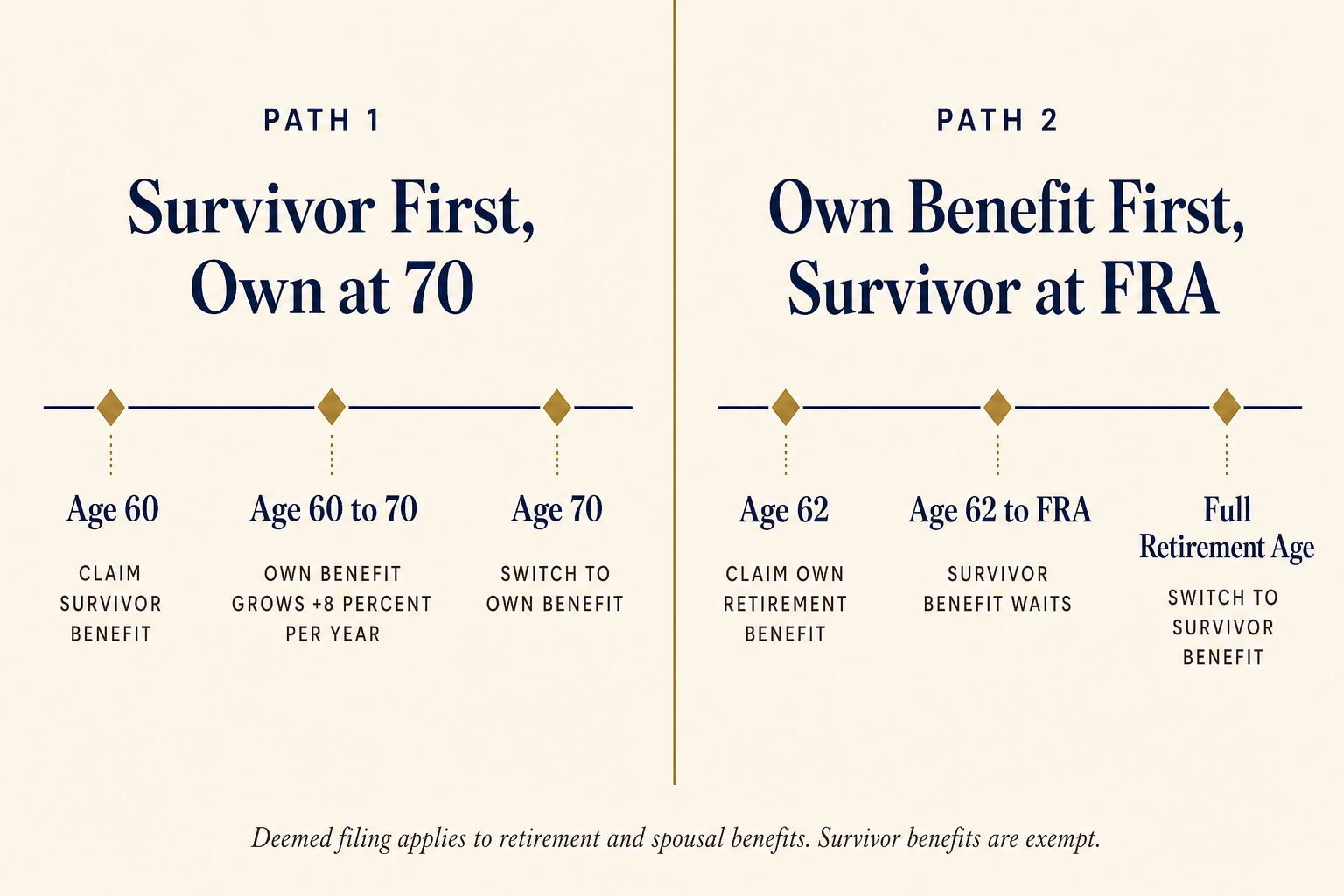
Which path is right depends on which benefit is larger, your health and longevity expectations, and how much income you need now versus later. The choice is real, and it is yours — but only if someone tells you the choice exists.
A hypothetical to make this concrete
Consider a hypothetical widow named Margaret, age 62. Her late husband had worked his full career and was earning a Social Security benefit of $3,200/month at his Full Retirement Age. Margaret worked too — her own benefit at her Full Retirement Age (67) will be $1,900/month, and at 70, it would be $2,356/month.
If Margaret walks into a local Social Security office and says “I’d like to claim my benefits,” the agent will typically run her numbers and tell her she’s entitled to the higher of the two — the survivor benefit. She files. She gets the survivor benefit. End of meeting. She leaves thinking she did the right thing.
What just happened: Margaret took her largest benefit at 62, locked it in at a permanently reduced rate (survivor benefits taken before Full Retirement Age are reduced for life), and her own retirement benefit — the one she earned over decades of working — is now functionally invisible to her. It will never be paid. The household took one bite.
Now run the alternative. Margaret files for her own reduced retirement benefit at 62 — roughly $1,330/month. Modest, but real. She delays the survivor benefit until her Full Retirement Age. At 67, she switches to the full, unreduced survivor benefit of $3,200/month.
Over those five years from 62 to 67, Margaret collects roughly $80,000 from her own benefit. Then from 67 forward, she collects $3,200/month — the full survivor amount, not the reduced one. Over a 20-year retirement, the difference between the two paths is well into six figures, in Margaret’s pocket, that the first version of the meeting would have left on the table.
The decision tree changes if Margaret’s own benefit is the larger one, or if her health makes longevity unlikely, or if she needs maximum income immediately. The point isn’t that Path 2 is always right. The point is that Path 2 exists.
Thomas’s Take: The Social Security Administration is required to pay you what you’re entitled to. It is not required to optimize your claiming sequence. The restricted application for survivor benefits is one of the most valuable strategies left in the post-2015 rulebook, and almost nobody at the field office is going to volunteer it. You have to know to ask.
Who this applies to (and who it does not)
The survivor restricted application is available to any widow or widower who is also eligible for their own retirement benefit. Birth year doesn’t matter for this version — the 2015 law’s January 1, 1954 cutoff was for the spousal-benefit version, not the survivor version.
It does not apply to divorced spouses claiming on an ex-spouse’s living record — those are spousal benefits and are subject to deemed filing. It does apply to surviving divorced spouses if the marriage lasted at least ten years and the ex-spouse is deceased. The same restricted-application logic applies because the benefit category is “survivor,” not “spousal.”
It does not apply if both benefits will pay out at roughly the same amount — there’s nothing to optimize, and the simpler claim is better. It matters most when one benefit is meaningfully larger than the other, and the gap between them is large enough that controlling the timing of each one moves real money.
What this means for bucket planning
For a widow or widower who has built a Now and Soon bucket already, the survivor restricted application is the single biggest lever for filling the Soon bucket more efficiently. Every dollar of additional lifetime Social Security income is a dollar of guaranteed, COLA-adjusted, federally backed income — the same instrument the entire Soon bucket is built around. Maximizing it shrinks the gap between essential expenses and guaranteed income, which is the bedrock metric that determines how retirement actually feels.
It also takes pressure off the Later bucket. A larger lifetime Social Security check means less withdrawal pressure on the portfolio, which means more equity exposure can stay productive instead of being asked to fund spending. The income floor and the growth allocation are connected. Tightening the floor lets the rest of the plan work the way it’s supposed to.
The one move worth making
If you’re a widow or widower, do not file for any Social Security benefit without first running the math on both paths. Not “the agent ran my numbers” — actually run them, on paper, with both timelines side by side. The fee for the calculation is zero. The cost of skipping it can be six figures.
If you’re working with a planner, ask the question directly: “Have you modeled the survivor restricted application against a straight survivor claim?” If the answer is “the restricted application was eliminated in 2015,” find a different planner. The version that was eliminated and the version you’re asking about are not the same thing, and that mistake will cost the household real money.
Most of what gets written about the restricted application treats it as a historical artifact — a strategy that used to exist and doesn’t anymore. The headline version is gone. The survivor version is alive, well, and almost completely unused. The retirees who use it will be the ones who knew to ask.
This article is published by Confluence Media Group LLC, an independent publisher of educational financial content. Thomas Clark is a Series 65 Investment Advisor Representative. The information provided is for educational and informational purposes only and is not personalized financial, tax, or legal advice. Past performance does not guarantee future results. All investing involves risk, including potential loss of principal. Consult a qualified professional before making financial decisions.
Confluence Media Group LLC is a separate entity from Confluence Capital Management, the investment advisory practice through which Thomas Clark provides advisory services. Advisory services are not offered through this publishing platform.
About Thomas Clark
Thomas Clark is the founder of Confluence Media Group LLC and a Series 65 Investment Advisor Representative. He has spent nearly two decades working with families on retirement planning, with a focus on Social Security optimization, retirement income coordination, and the bucket planning approach to building a guaranteed income floor.
Thomas writes and publishes at thomasclarkadvisor.com and is the author of The Just in Case Binder — a 148-page printable family financial organizer for households who want to make sure the people they love know where everything is.
He lives in North Carolina with his family.
Subscribe to the weekly newsletter · Get the Just in Case Binder

Thomas Clark is a Series 65 licensed investment advisor and experienced trader. He specializes in investing, retirement planning, and market analysis, helping individuals build wealth and make informed financial decisions.
