
Election Years and the Stock Market: What 80 Years of Data Actually Show
Eighty years of S&P 500 data say election-year volatility is mostly noise — and the twelve months after a midterm have historically been the strongest stretch of the four-year cycle. Here's what the pattern actually looks like, and why a built income floor makes the conversation a non-conversation.
It’s a midterm year. Between now and November, you’re going to read fifty articles telling you the stock market is about to do something dramatic because of the election. Most of them will be wrong. A few will be right by accident.
What’s striking is that we actually have eighty years of clean S&P 500 data on this exact question, and it tells a story almost nobody bothers to repeat.
The four-year pattern actually exists. It just isn’t what most people think.
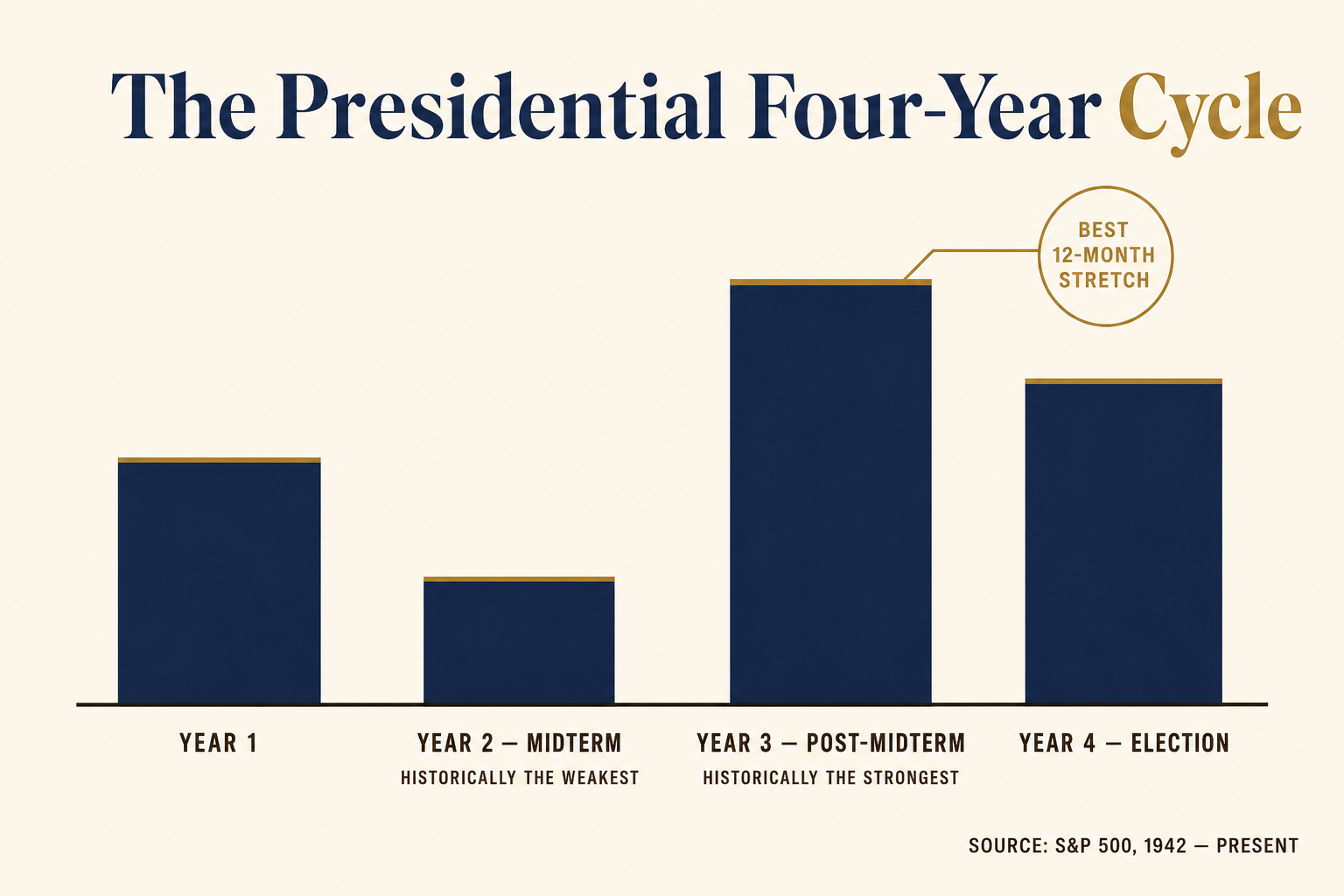
The presidential cycle theory says equity returns follow a predictable rhythm tied to the four-year political calendar — weakest in years one and two, strongest in years three and four. People have been arguing about it since the 1960s, and over an eighty-year sample, the pattern shows up clearly enough to take seriously.
Year three of a presidential term — the year leading up to a midterm — has historically been the strongest, averaging roughly 14% on the S&P 500. Year two — the midterm year itself, which is what we’re sitting in right now — has historically been the weakest, averaging closer to 6%. Year four, the presidential election year, lands in the middle.
That’s the part that gets repeated. Here’s the part that doesn’t: the twelve months after a midterm election are the single best stretch of the four-year cycle. Going back to 1942, the S&P 500 has been positive in every single one of those post-midterm twelve-month windows. Every one. The average return in that stretch is more than 18%.
So when somebody warns you in May of a midterm year that “the market always gets ugly into the election,” they may be partly right. And when somebody warns you in October that “this is the worst possible time to be in stocks,” they’re roughly twelve months away from the most reliable upward stretch in the entire dataset.
What the eighty-year picture actually shows
Set aside the four-year cycle for a moment and just look at election years in aggregate. Since 1928, the S&P 500 has finished positive in something like nineteen of the twenty-four presidential election years. That’s roughly a 79% hit rate — almost identical to the long-run base rate of positive years. Election years are not unusually bad. They’re not unusually good. They’re mostly just years.
Volatility tells a slightly more interesting story. Election years do tend to show a small bump in realized volatility, but it’s narrower than the headlines suggest. The bump concentrates in a six-to-eight-week window between Labor Day and Election Day. Before September, election-year volatility looks about like any other year. After Election Day, the volatility resolves quickly — usually within two weeks of the result being clear, regardless of which side won.
That last part matters. The narrative says “markets hate uncertainty until they know who won.” The data says “markets hate uncertainty until they know who won — and then they immediately go back to caring about earnings, rates, and inflation, which is what they cared about the whole time.”
The trap: trying to trade on who’s ahead
The version of election-year analysis that has cost investors the most money is the one that says: if my preferred party wins, the market will do well; if the other side wins, it’ll crash. This belief is bipartisan and almost completely uncorrelated with what stocks actually do.
The S&P 500 has produced positive long-run returns under every modern administration of both parties. Bull markets and bear markets have started and ended under presidents of every political stripe. The biggest single driver of equity returns over any administration has been the Federal Reserve’s reaction to whatever cyclical conditions happened to land on that president’s desk — not the policy preferences of the White House.
The retirees who got hurt most in the 2008–2010 window weren’t the ones who guessed wrong about the election. They were the ones who got out of equities entirely because they were sure the country was over, and then watched a decade-long bull market happen without them. The retirees who got hurt most in 2016–2018 made the same mistake from the opposite political direction.
If your portfolio decisions are downstream of CNN or Fox News, your portfolio decisions are downstream of the wrong inputs.
What this actually means for a retiree
Here’s where the bucket framework earns its keep.
The Now bucket — your current liquidity, the two-to-three years of cash that funds your living expenses — doesn’t care about election-year volatility. It’s not invested in the equity market. Whether the S&P 500 is up 8% or down 8% between now and November, your grocery money is sitting in a money market fund earning a yield that’s set by the front end of the Treasury curve, which the election doesn’t move.
The Soon bucket — your guaranteed income floor from Social Security, pensions, and Fixed Index Annuity income riders — doesn’t care either. Social Security is paid out of the trust fund and general revenues. Pension checks come from the plan. Annuity income riders have contractual rates already set. Election-year volatility does not show up in any of those payment streams. That is the entire point of building an income floor.
The Later bucket — your equity-tilted growth allocation — does own stocks, so it does experience whatever volatility the next six months produce. But the Later bucket is, by construction, money you don’t need to touch for a decade or more. A 12% drawdown between September and November on money you’re not going to spend until 2036 is a noise event, not a problem.
This is why pre-retirees and retirees who use a bucket framework tend to sleep better through political volatility than people who run a single undifferentiated portfolio. The framework pre-decides where each dollar lives, so when CNN runs a “MARKETS IN TURMOIL” chyron, you’ve already answered the question of which money is at risk and how long it has to recover.
Consider a hypothetical
Take a hypothetical retiree named Margaret. She’s 68, retired four years ago, has Social Security coming in at $2,800 a month, a small pension that adds another $1,400, and a $900,000 portfolio split roughly Now/Soon/Later: $80,000 in cash and short Treasuries, $300,000 in a Fixed Index Annuity with a lifetime income rider that hasn’t been activated yet, and $520,000 in a diversified equity-and-bond portfolio.
Between now and the midterm in November, the S&P 500 will do something. Maybe it’ll be up 6%. Maybe it’ll be down 9%. Maybe it’ll be flat with a dramatic month in October that everyone forgets about by Thanksgiving.
In all three scenarios, Margaret’s grocery bill is paid out of the Now bucket. Her base income is paid by Social Security and the pension. Her Later bucket fluctuates, sometimes a lot, but she doesn’t sell anything to live. The vote happens. The country continues. Twelve months later, the post-midterm pattern either repeats or it doesn’t — and either way, Margaret’s income for 2027 is already determined by the structural pieces she put in place years ago.
That’s what a built income floor buys you. Not certainty about markets. Certainty about your own cash flow regardless of what markets do.
The one move worth making in an election year
If you’re going to do anything in response to election-year volatility, do this: confirm your Now bucket is actually full. Two to three years of essential expenses, in cash and short-duration instruments. If it isn’t, top it up while equities are still near recent highs, not after a drawdown forces you to sell at a worse price.
That’s it. That’s the move. It’s not exciting. It doesn’t depend on guessing the election. And it’s the move that has historically separated the retirees who experienced 2008, 2020, and every other rough stretch as “an interesting year for the news” from the retirees who experienced them as a permanent dent in their plan.
Eighty years of data say the market is going to do roughly market things between now and November. The only real risk worth managing in an election year is the risk of letting the election convince you to do something you wouldn’t have done in a calmer year. The bucket framework’s main job is to make that conversation a non-conversation.
This article is published by Confluence Media Group LLC, an independent publisher of educational financial content. Thomas Clark is a Series 65 Investment Advisor Representative. The information provided is for educational and informational purposes only and is not personalized financial, tax, or legal advice. Past performance does not guarantee future results. All investing involves risk, including potential loss of principal. Consult a qualified professional before making financial decisions.
Confluence Media Group LLC is a separate entity from Confluence Capital Management, the investment advisory practice through which Thomas Clark provides advisory services. Advisory services are not offered through this publishing platform.
About Thomas Clark
Thomas Clark is the founder of Confluence Media Group LLC and a Series 65 Investment Advisor Representative. He has spent nearly two decades working with families on retirement planning, with a focus on Social Security optimization, retirement income coordination, and the bucket planning approach to building a guaranteed income floor.
Thomas writes and publishes at thomasclarkadvisor.com and is the author of The Just in Case Binder — a 148-page printable family financial organizer for households who want to make sure the people they love know where everything is.
He lives in North Carolina with his family.
Subscribe to the weekly newsletter · Get the Just in Case Binder

Thomas Clark is a Series 65 licensed investment advisor and experienced trader. He specializes in investing, retirement planning, and market analysis, helping individuals build wealth and make informed financial decisions.
