
Reading the Yield Curve: What the Bond Market Is Telling Retirees
Most retirees track the stock market. That's the wrong dashboard. The bond market — and the shape of the yield curve — is where retirement income actually gets decided.

Picture two numbers on a screen. One is the yield on a 10-year U.S. Treasury bond. The other is the yield on a 2-year. The difference between them — usually quoted as the “10-2 spread” — is the single most-watched indicator in financial markets. It shapes how banks lend, how mortgages price, and whether the analysts say a recession is on the way.
For retirees, the bond market does something else. It tells you what your money can actually earn, and how long you can lock that earning rate in.
Most retirees track the stock market. That’s the wrong dashboard. The bond market is where retirement income actually lives, and the shape of the yield curve is the single best one-glance summary of where that income stands today.
Why the bond market matters more to retirees than the stock market
The income floor in a well-designed retirement plan doesn’t come from stocks. It comes from Social Security, pensions, and — for many households — fixed-income vehicles like bonds, CDs, and Fixed-Indexed Annuities with guaranteed-lifetime-income riders. Stocks belong in the Later bucket, where their job is long-term growth, not next month’s grocery bill.
So when the headline news is the Dow or the S&P, that matters for the Later bucket. But it’s not where retirement income gets decided. Retirement income is priced off bonds. CD rates follow bond yields. Annuity payouts follow bond yields. Even the “safe” portion of a balanced portfolio earns whatever the bond market is paying that day.
That makes the bond market the foreground for a retiree and the stock market the noise. For an accumulator with thirty years ahead, that ratio runs the other way.
The three shapes of the curve
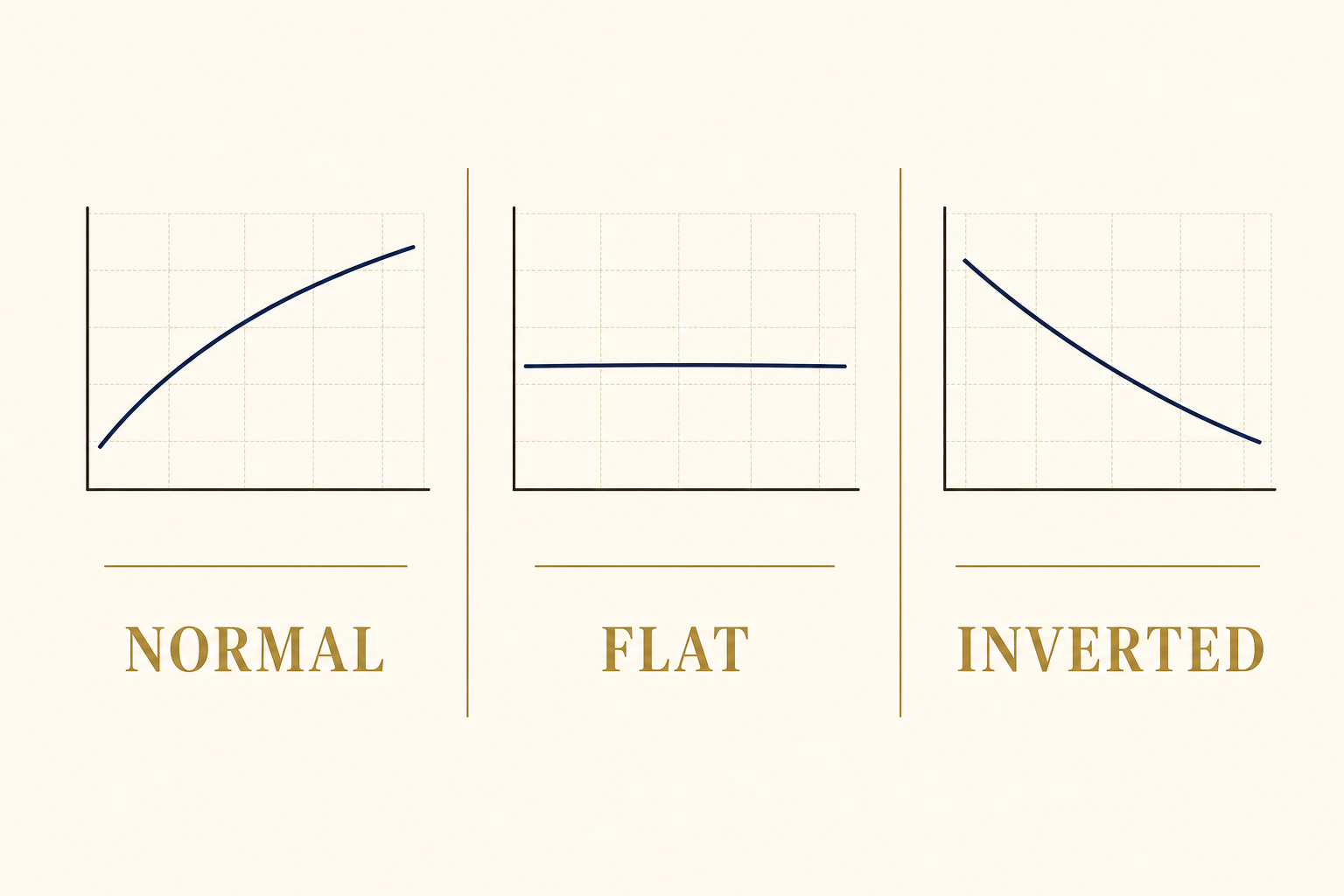
The yield curve plots Treasury yields across maturities — from a 1-month bill out to a 30-year bond. Most of the time, it slopes upward: short-term bonds pay less than long-term bonds, because investors want to be compensated for locking up their money longer. That’s a normal curve, and most decades look like it.
Two other shapes show up.
A flat curve means short-term and long-term yields are about the same. A 1-year Treasury and a 10-year Treasury pay nearly identical interest. The market is essentially saying it can’t tell whether rates will be higher or lower in the future.
An inverted curve means short-term yields are higher than long-term yields. The 2-year pays more than the 10-year. This is the unusual shape — historically, an inverted curve has preceded most U.S. recessions by 6 to 18 months. It also creates a strange-looking world for anyone deciding where to put their cash.
What each shape is telling a retiree
A normal curve is the easy environment. Longer-term bonds and annuities pay more than short-term ones. Building an income floor is straightforward — you lock in higher yields for longer durations, and you get paid for the duration risk you’re taking. This is when long-dated CDs, intermediate Treasury bonds, and lifetime-income annuities all line up nicely.
A flat curve is awkward. You’re not getting paid much extra for going longer, but you’re still taking the risk that rates rise after you commit. The honest answer is that flat curves are usually a waiting game. Short-term yields are reasonable, and there’s little hurry to extend duration.
An inverted curve is the unusual one — and it’s where retirees actually have a hidden advantage. Short-term yields are temporarily high. A 6-month T-bill or a 1-year CD might pay more than a 10-year bond. For a Now bucket — current-year and next-year living expenses — that’s a gift. You earn outsized yields on the cash you have to keep liquid anyway.
Here’s where it gets interesting. Inverted curves don’t last. The market is telling you the short-term rates are temporarily elevated and will come back down. That makes the inverted-curve period the worst time to lock in long-term bonds, and the best time to keep your Now bucket fully deployed in short-duration instruments. The instinct to “lock in high rates for 30 years” when the 30-year is paying less than a 6-month bill has the math exactly backward.
When the curve shape becomes an opportunity
The shape matters most at the edges of two specific decisions retirees face.
The first is annuity timing. Income annuities — Fixed-Indexed Annuities with guaranteed-lifetime-income riders, single-premium immediate annuities — price their payouts off the long end of the curve. When 10-year and 20-year yields are high, lifetime-income payouts are high too. When those yields are low, the same dollar of premium buys a smaller monthly check, for the rest of your life. Many retirees set up their Soon bucket without ever looking at where the curve is the day they sign the paperwork. That’s leaving real income on the table over a 25-year retirement.
The second is CD-and-bond ladder construction. A normal curve favors a longer ladder; an inverted curve favors a shorter one. The ladder you build in a 5% short-rate environment looks nothing like the ladder you’d build in a 2% short-rate environment. Both can be right — for their environment.
Consider a hypothetical. Margaret, 64, has $400,000 in conservative savings she plans to convert into income over the next ten years. The yield curve she sees the day she sets up her plan determines the shape of her ladder, the duration of any annuity she buys, and the cash yield on her Now bucket for the next two years. Same $400,000, three different rate environments, three meaningfully different incomes. The curve isn’t background information for Margaret. It’s a planning input.
How the curve maps onto bucket planning
The Now bucket cares about short-term yields. When the curve is inverted, the Now bucket is unusually productive — keep it short and ride the high cash rates while they last.
The Soon bucket cares about whether locking in long-term income is attractive today. When 10-year and 20-year yields are generous, the Soon bucket is the bucket to build. When they’re low, the right move is often to wait, or to build the Soon bucket gradually over several years to average across rate environments.
The Later bucket largely doesn’t care about the curve at all. Stocks are about corporate earnings and growth over decades, not about this quarter’s bond yields. The Later bucket runs on a different clock.
Thomas’s Take: I watch the bond market more than the stock market. Equity volatility makes the news, but bond yields decide what your retirement income actually looks like. If I had to pick one chart for a 60-year-old to glance at once a week, it wouldn’t be the S&P 500. It would be the 10-2 spread.
The mistake most retirees make is treating the bond market as background noise — something the financial press talks about while they focus on the daily Dow. For an accumulator, that’s mostly fine. For a retiree drawing income, the bond market is the foreground, and the stock market is the noise.
The point isn’t to trade the curve. The point is to recognize that the curve shape is the rate environment your income floor will be built in, and to act when the environment is working with you instead of against you. Lock in long when rates are generous. Keep cash short when short rates are unusually high. Let the curve do some of the work for you.
When the income floor is sized correctly — and built in a rate environment that’s helping rather than fighting you — the stock market becomes what it should be for a retiree: a long-term growth engine you can mostly leave alone, not a daily anxiety.
This article is published by Confluence Media Group LLC, an independent publisher of educational financial content. Thomas Clark is a Series 65 Investment Advisor Representative. The information provided is for educational and informational purposes only and is not personalized financial, tax, or legal advice. Past performance does not guarantee future results. All investing involves risk, including potential loss of principal. Consult a qualified professional before making financial decisions.
Confluence Media Group LLC is a separate entity from Confluence Capital Management, the investment advisory practice through which Thomas Clark provides advisory services. Advisory services are not offered through this publishing platform.
About Thomas Clark
Thomas Clark is the founder of Confluence Media Group LLC and a Series 65 Investment Advisor Representative. He has spent nearly two decades working with families on retirement planning, with a focus on Social Security optimization, retirement income coordination, and the bucket planning approach to building a guaranteed income floor.
Thomas writes and publishes at thomasclarkadvisor.com and is the author of The Just in Case Binder — a 148-page printable family financial organizer for households who want to make sure the people they love know where everything is.
He lives in North Carolina with his family.
Subscribe to the weekly newsletter · Get the Just in Case Binder

Thomas Clark is a Series 65 licensed investment advisor and experienced trader. He specializes in investing, retirement planning, and market analysis, helping individuals build wealth and make informed financial decisions.
