
Why Headline Inflation Doesn’t Match Your Grocery Bill
The official inflation number is built around a working-age household. For retirees, the gap between the headline and the lived experience at the grocery store and the pharmacy counter is wide enough to plan around.
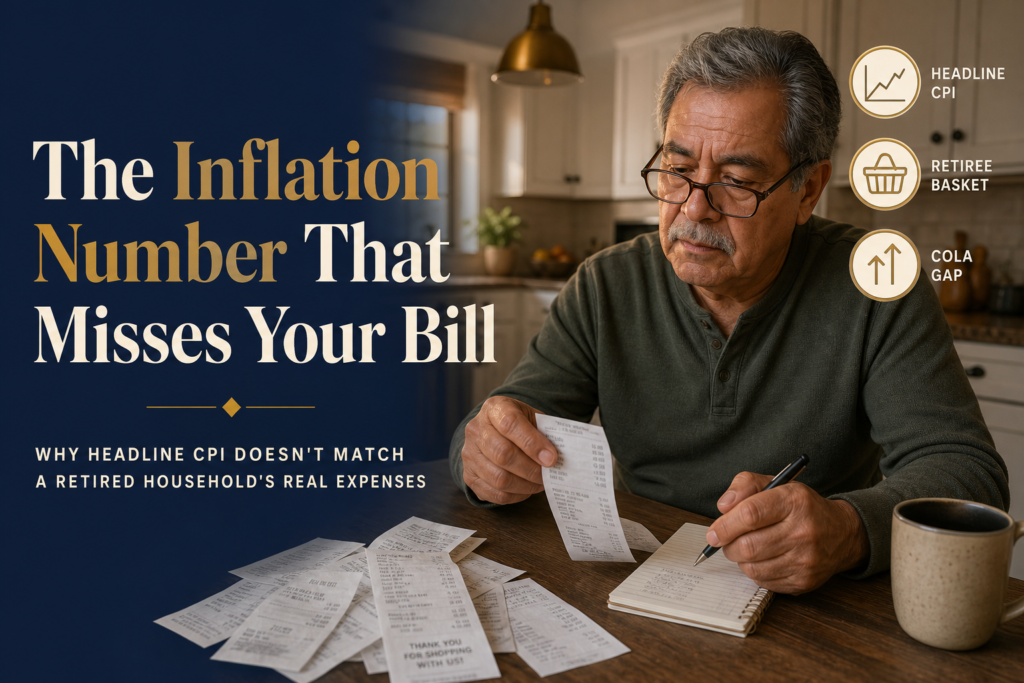
If you’ve been retired for more than a few years, you’ve probably had this experience: a financial headline announces that inflation has “cooled” to 2.8%, and you read it standing next to a grocery cart that cost you noticeably more than the same trip did last spring. Your pharmacy bill went up. Your homeowners insurance went up. Your Medicare Part D plan switched tiers. And somewhere in there a policymaker said inflation was “moderating.”
It isn’t that the headline number is wrong. It’s that the headline number isn’t measuring you.
The Consumer Price Index that hits the front page each month — and that anchors Social Security’s annual cost-of-living adjustment — is an average. Like most averages, it hides almost everything interesting. For people in the distribution phase of retirement, the gap between the headline and the lived experience is wide enough to matter for how you plan.
What the headline number actually measures
The figure you usually see — “inflation came in at 2.8%” — is the year-over-year change in the Consumer Price Index for All Urban Consumers (CPI-U). It’s calculated by the Bureau of Labor Statistics from a fixed basket of goods and services weighted to reflect average urban household spending. The basket contains hundreds of categories, each with its own weight: food at home is one slice, gasoline is another, and owner’s equivalent rent of a primary residence is the largest single piece.
CPI-U represents about 93% of the U.S. population, but the average it implies is built around a working-age household. The implicit profile is younger and employed: a family that drives to a job, raises kids, pays down a mortgage, and has employer-subsidized health insurance.
If that’s not your household, the basket isn’t your basket.
Where the retiree experience diverges
A few specific weights drive most of the gap.
Healthcare. CPI-U gives medical care roughly an 8% weight overall. The Bureau of Labor Statistics also maintains a separate, experimental index called the Consumer Price Index for the Elderly (CPI-E), which tracks spending patterns for households where the reference person is 62 or older. CPI-E gives medical care a weight closer to 12%. That’s a meaningful difference — and over long stretches, CPI-E has tended to run modestly higher than CPI-W, the index that actually drives Social Security’s COLA.
Housing. A retiree who owns a home outright doesn’t feel “shelter inflation” the way a renter or a recent buyer does. But that retiree still feels property taxes, homeowners insurance, and maintenance. CPI’s “shelter” line, dominated by owner’s equivalent rent, doesn’t track those line items the way they show up in an actual retiree’s bank account.
Food at home vs. food away from home. Working households spend a sizable share of their food dollars eating out. Retirees, on average, shift toward groceries. Food at home and food away from home don’t move in lockstep — and during the post-pandemic period, food at home rose faster than the dining-out line for stretches at a time.
Geographic averaging. CPI is a national figure. If you live in a state where insurance premiums have surged because of climate-related risk, or where property taxes have lurched higher because of rapid home-price appreciation, the national average is going to feel detached from your monthly statement of bills.
None of this is conspiratorial. The BLS is transparent about how the index is built, who it’s representative of, and what its limitations are. The disconnect comes from the fact that a single national number gets used as if it were every household’s number.
Why the COLA gap matters
Social Security’s annual cost-of-living adjustment is tied to CPI-W — the Consumer Price Index for Urban Wage Earners and Clerical Workers — which is closer in spirit to CPI-U than to CPI-E. CPI-W is built from the spending patterns of working households, not retired ones.
That means the COLA is anchored to the inflation experience of working Americans, even though Social Security is paid almost entirely to retired ones.
Several proposals over the years have suggested switching the COLA to CPI-E for exactly that reason. None have passed. So the practical reality is that the same gap I described above flows directly into the year-over-year change in your Social Security benefit: if your personal inflation runs higher than CPI-W, your real purchasing power from Social Security drifts down a little each year, even with the COLA.
The long-run gap between CPI-W and CPI-E is small but persistent. Small and persistent is the dangerous kind — it compounds.
A hypothetical: the gap at the kitchen table
Consider a hypothetical case: Maria, 68, retired, lives in central Florida. Her household budget runs about $5,400 a month. Roughly $900 goes to healthcare (premiums, Part D, supplemental, out-of-pocket), $1,100 goes to housing carrying costs (property taxes, insurance, HOA, maintenance), $850 goes to food at home, and the rest to transportation, utilities, and discretionary spending.
Suppose headline CPI-U for the year prints at 2.9%. If Maria’s healthcare costs went up 6%, her property insurance went up 11%, her food at home went up 4%, and her gasoline actually came down 3%, her personal weighted inflation rate works out closer to 5% than to the 2.9% headline.
Her Social Security check, indexed to CPI-W, goes up roughly with the national average — call it 2.6% to 3%. Her budget went up 5%. The gap is the slow leak in her retirement plan.
This is a hypothetical illustration, and the actual numbers shift year to year. The point isn’t the specific spread. It’s that the headline number can be doing exactly what economists say it’s doing — moderating — while a retired household’s specific basket continues to march upward at a different rate.
What this means for how you plan
A few practical implications.
Plan your inflation assumption on your basket, not on the headline. When you build a long-range retirement income plan, the question to ask isn’t “what will CPI run at?” It’s “what will my healthcare, insurance, taxes, and grocery line items run at?” Healthcare especially deserves its own assumption — it has historically compounded faster than the broader CPI.
The Soon bucket is where this shows up first. The bucket planning framework treats your guaranteed income floor — Social Security, any pensions, and Fixed Index Annuity income riders — as the layer that funds your essentials. If your essentials inflate faster than your floor adjusts, the floor erodes. That’s the argument for sizing the Soon bucket with some cushion rather than to the dollar, and for revisiting it every couple of years.
Withdrawal-rate rules of thumb are still rules of thumb. The 4% rule and its descendants are anchored to historical CPI — not to your basket. That’s one more reason the 4% rule isn’t a planning system on its own and works better as a stress-test floor than as a withdrawal recipe.
Track your own number. If you run a household budget, you already have what you need. Take last year’s total spending and divide by the year before’s. That’s your personal inflation rate. It will tell you more about your retirement than any single CPI print.
Thomas’ Take: I don’t expect the headline number to align with retired households. It isn’t built to. The useful exercise isn’t waiting for the government to publish an index that matches your life — it’s running your own number once a year and adjusting your plan accordingly. The retirement plans that hold up over twenty and thirty years are the ones where the planner kept measuring the right things, not the most-reported things.
The bottom line
The CPI you read about each month is a real measurement of a real basket — it’s just a basket built for a household that probably isn’t yours. For retirees, the gap between the headline and the lived experience is wide enough to plan around, and small enough that most people don’t notice it eroding their plan until several years in. Build your retirement income plan on your basket. Revisit it. The number on the news will keep doing its job. Your job is to make sure it isn’t the only one you’re watching.
This article is published by Confluence Media Group LLC, an independent publisher of educational financial content. Thomas Clark is a Series 65 Investment Advisor Representative. The information provided is for educational and informational purposes only and is not personalized financial, tax, or legal advice. Past performance does not guarantee future results. All investing involves risk, including potential loss of principal. Consult a qualified professional before making financial decisions.
Confluence Media Group LLC is a separate entity from Confluence Capital Management, the investment advisory practice through which Thomas Clark provides advisory services. Advisory services are not offered through this publishing platform.
About Thomas Clark
Thomas Clark is the founder of Confluence Media Group LLC and a Series 65 Investment Advisor Representative. He has spent nearly two decades working with families on retirement planning, with a focus on Social Security optimization, retirement income coordination, and the bucket planning approach to building a guaranteed income floor.
Thomas writes and publishes at thomasclarkadvisor.com and is the author of The Just in Case Binder — a 148-page printable family financial organizer for households who want to make sure the people they love know where everything is.
He lives in North Carolina with his family.
Subscribe to the weekly newsletter · Get the Just in Case Binder

Thomas Clark is a Series 65 licensed investment advisor and experienced trader. He specializes in investing, retirement planning, and market analysis, helping individuals build wealth and make informed financial decisions.
