
Sizing Your Soon Bucket: How to Set Your Retirement Income Floor Target
Most retirement plans size the income bucket by guessing a portfolio percentage. The right way is to start with essential expenses, subtract guaranteed income, and let the gap define the bucket — not the other way around.

Key Takeaways
- Start with essential expenses, not assets. The number that drives your retirement plan is the floor under your life — mortgage, taxes, groceries, utilities, insurance — not the size of your portfolio.
- Subtract the guaranteed income you already have. Social Security and any pension already cover part of the floor for life. The shortfall is the real number you’re solving for.
- The Soon bucket is sized by the gap, not by a percentage of assets. A $1,000-a-month gap is a different planning problem than a $4,000-a-month gap, regardless of total net worth.
- Lifetime guaranteed income tools fill the gap. Single-premium immediate annuities and fixed-indexed annuities with income riders can produce lifetime income. Variable annuities are not part of how I build an income floor.
- A correctly sized Soon bucket changes everything else. The Later bucket can take more risk, the Now bucket stays lean, and the household sleeps better through volatility.
Open the budget you actually live on. Strip out the gym membership, the trip to Italy, the gifts at Christmas. What’s left — the mortgage, the property tax, the groceries, the utilities, the insurance premiums — is the number that should drive your entire retirement plan.
That number is your essential expense floor. The job of your Soon bucket is to cover it for life with income you don’t have to worry about.
Most retirement conversations start at the wrong end. They start with how much you’ve saved, then back into how much you can spend. I do it the other way around. I start with how much you have to spend, then figure out how much guaranteed income covers it, then figure out what’s left for the Later bucket to grow.
A two-paragraph refresh on the Soon bucket
The bucket framework has three layers: Now (one to two years of cash for current expenses), Soon (lifetime guaranteed income that covers your essential floor), and Later (long-horizon growth aligned with your risk tolerance and legacy goals). Each layer has a specific job, and no layer is asked to do something it’s not suited for.
The Soon bucket is not a portfolio. It’s not a target-date fund. It’s not a “conservative” allocation inside your IRA. It’s the layer of your plan that produces income — month after month, for as long as you and your spouse are alive — without depending on what the market did last quarter. That’s a structural job. You can’t substitute a bond fund for it.
Start with essential expenses, not your portfolio
The number you’re sizing the Soon bucket against is essential expenses — the floor under your life. Mortgage or rent. Property taxes. Groceries. Utilities. Insurance premiums (health, auto, home, long-term care if you have it). Transportation costs. Out-of-pocket medical baselines.
What essential expenses are not: the discretionary travel budget, restaurant outings, the new kitchen renovation, holiday gifts. Those things are real and they belong in your plan, but they belong in the Later bucket — funded by what your investment portfolio produces, in the years it produces enough.
The reason for the separation is psychological as much as financial. When the Later bucket has a bad year, you can choose to skip the trip. You cannot choose to skip the property tax. The Soon bucket is what makes the difference between “we’re tightening up this year” and “we have a problem.”
A useful exercise: open your last twelve months of bank and credit-card statements and sort every transaction into “essential” or “discretionary.” Most retirees who do this for the first time discover their essential floor is somewhere between $4,000 and $7,500 per month. Yours might be higher or lower. The point is to know the number.
Subtract the guaranteed income you already have
Once you know your essential floor, the next step is subtracting the guaranteed lifetime income already coming in. For most households this is two things: Social Security and any pension. Both are real, both are inflation-adjusted in some way (Social Security through annual COLAs; some pensions partially), and both pay for life.
Here’s where the planning math actually starts to matter.
Consider a hypothetical couple — Margaret and Frank, both 64, planning to retire next year. Their essential expenses come to $6,200 a month. Margaret’s Social Security at her Full Retirement Age (67) will be $2,800 a month. Frank’s will be $2,100. Neither has a pension. They have $640,000 across his 401(k) and her IRA.
If both delay to age 70, their combined Social Security at that age — using the standard delayed retirement credit — would land near $6,070 a month in today’s dollars. That’s almost their entire essential floor.
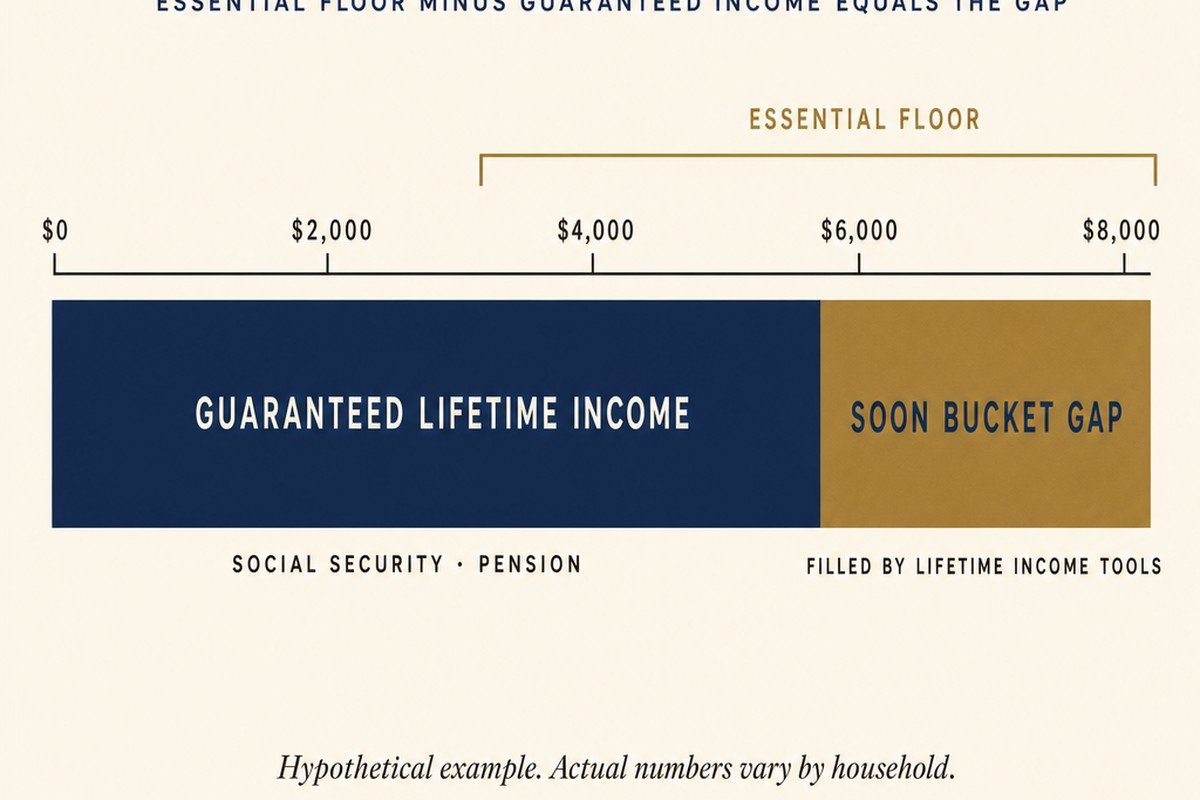
If they claim at 67 instead, they bring in around $4,900 a month combined — leaving a gap of roughly $1,300 a month, or $15,600 a year, that something else has to cover for the rest of their lives.
That $1,300-a-month gap is what the Soon bucket has to produce. It is not optional. It is the difference between essential expenses being covered and not being covered.
The gap is the Soon bucket’s job
This is the key reframe most retirees don’t make on their own: the Soon bucket isn’t sized by a percentage of your portfolio. It’s sized by the gap between essential expenses and guaranteed income.
If your essential floor is fully covered by Social Security and a pension, your Soon bucket gap is zero — and the entire portfolio can be allocated to the Later bucket and the Now cash reserve. Some retirees are in this position and don’t realize it.
If your essential floor exceeds guaranteed income by $1,000 a month, you need an additional $12,000 a year of guaranteed income for life. That’s the target.
If the gap is $4,000 a month, you need $48,000 a year of additional guaranteed income for life — and the planning conversation looks much different.
The size of the gap, not the size of the portfolio, determines whether your retirement is built on a stable floor or on a hope that the market keeps cooperating.
Thomas’s Take: I’ve found that the single greatest predictor of retirement happiness isn’t net worth — it’s the gap between essential expenses and guaranteed income. Close that gap, and almost everything else becomes manageable.
Sizing the principal you need to fill the gap
Once you know the annual gap your Soon bucket has to produce, the next question is how much principal that takes.
There are two reasonable categories of guaranteed-lifetime-income tools that can fill a Soon-bucket gap: a fixed-indexed annuity (FIA) with a guaranteed lifetime income rider, and a single-premium immediate annuity (SPIA). Both pay for life. Neither is a market product. Neither is what most retirees mean when they say “annuity” in casual conversation — and importantly, neither is a variable annuity. Variable annuities combine market risk with high fees and are not part of how I build an income floor.
The principal required to produce a $1,000-a-month lifetime income gap for a couple in their late sixties is meaningful — typically in the six figures, with the exact number depending heavily on the interest-rate environment, the ages of both spouses, joint-life versus single-life options, and how the rider is structured. That’s a calculation that has to be run against your specific situation and the carrier’s current rate, not a general number from an article.
The point of this article is not to tell you what to buy. The point is to tell you what you’re solving for: an income floor that covers essential expenses for both lives, regardless of what the market does in any given decade.
Why this changes how the rest of the plan looks
Once the Soon bucket is sized correctly, three things become true at once.
The Later bucket can take more risk than most retirees think it can — because it’s no longer responsible for paying the mortgage. Its job is inflation protection over decades and legacy goals, not next month’s rent.
The Now bucket — the one to two years of cash — doesn’t need to be huge. It’s a buffer against sequence-of-returns timing on the Later bucket, not a long-term holding tank.
And the household sleeps differently. When the grocery bill doesn’t depend on the S&P 500, you make better investment decisions. You’re less likely to panic-sell in a drawdown and less likely to chase yield at a market top.
The order matters. You don’t size the Soon bucket by deciding how much annuity you “want.” You size it by what the gap actually is, and then you fill it.
Frequently Asked Questions
Q: What if my essential expenses change after I retire?
They will, by some amount, every year. Inflation pushes them up; paying off a mortgage drops them. Size the Soon bucket against a realistic ten-year average of essentials, not your first month of retirement. Then revisit annually.
Q: Does Social Security alone cover the Soon bucket for some households?
Yes. For households with modest essential expenses and two earners’ Social Security, the gap can be zero. In that case the Soon bucket is “done” — no additional income product needed. This is a real outcome and worth checking before assuming you need anything else.
Q: Are long-term care costs part of essential expenses?
The premium is. The actual care, if and when it happens, is usually a separate planning bucket — sometimes funded by long-term care insurance, sometimes by setting aside the Later bucket’s largest position, sometimes by home equity. It is not what the Soon bucket is for.
Q: Should I fill the entire gap with one product?
Not necessarily. Laddering — filling part of the gap now and part later, especially if Social Security is being delayed — is often more efficient than committing all the principal at once.
Q: How does this relate to the 4% rule?
It replaces it. The 4% rule is a withdrawal heuristic that asks the portfolio to cover both essentials and discretionary spending using a fixed percentage. The Soon-bucket approach separates the two jobs — guaranteed income covers essentials, the portfolio covers discretionary growth — and removes sequence-of-returns risk from the essential-expense floor.
The close
Most retirement plans fail in slow motion. They don’t fail because the market crashes; they fail because the plan was never structured to survive a crash. A Soon bucket sized to your real essential floor — built with guaranteed lifetime income, not a market product — is what makes the rest of the plan resilient.
You don’t get there by saving more. You get there by structuring what you’ve saved into layers, each doing the job it’s actually suited for. Start with the floor.
This article is published by Confluence Media Group LLC, an independent publisher of educational financial content. Thomas Clark is a Series 65 Investment Advisor Representative. The information provided is for educational and informational purposes only and is not personalized financial, tax, or legal advice. Past performance does not guarantee future results. All investing involves risk, including potential loss of principal. Consult a qualified professional before making financial decisions.
Confluence Media Group LLC is a separate entity from Confluence Capital Management, the investment advisory practice through which Thomas Clark provides advisory services. Advisory services are not offered through this publishing platform.
About Thomas Clark
Thomas Clark is the founder of Confluence Media Group LLC and a Series 65 Investment Advisor Representative. He has spent nearly two decades working with families on retirement planning, with a focus on Social Security optimization, retirement income coordination, and the bucket planning approach to building a guaranteed income floor.
Thomas writes and publishes at thomasclarkadvisor.com and is the author of The Just in Case Binder — a 148-page printable family financial organizer for households who want to make sure the people they love know where everything is.
He lives in North Carolina with his family.
Subscribe to the weekly newsletter · Get the Just in Case Binder

Thomas Clark is a Series 65 licensed investment advisor and experienced trader. He specializes in investing, retirement planning, and market analysis, helping individuals build wealth and make informed financial decisions.
