
Now, Soon, Later: The Bucket Planning Framework Built for Bad Markets
The biggest fear in retirement isn't running out of money — it's the bad year that comes early. Bucket planning structures the money so a market drop can't reach the parts of your life that needed protecting.

The biggest fear in retirement isn’t running out of money. It’s the bad year that comes early — the one that hits while you’re still mostly invested and just starting to draw. Bucket planning is built for that bad year. Most other strategies aren’t.
The “X percent rule” advice you’ve read everywhere starts with a single number and a single portfolio. It tells you what to withdraw, then trusts the math to hold. It doesn’t tell you what to actually do on a Tuesday morning when the market has dropped twelve percent and your next car payment is due Friday.
Bucket planning answers the Tuesday question. You don’t sell the dropped portfolio to make the car payment, because that money isn’t in the dropped portfolio. It’s already in your Now bucket. Same paycheck, different month, different decade.
This is the framework, in plain English.
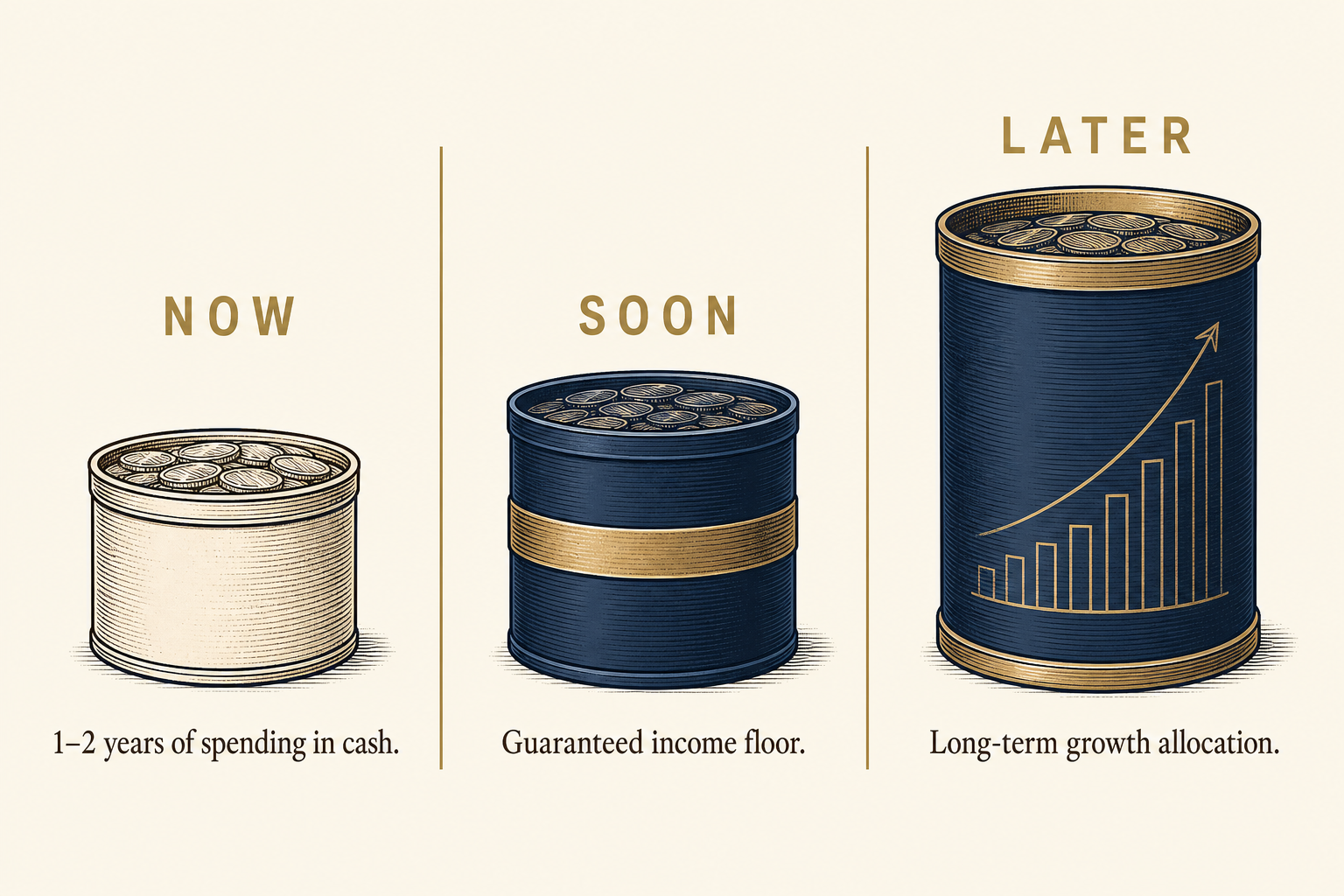
The three buckets
The whole approach divides your retirement money into three time horizons, each with a different job.
The Now bucket holds short-term spending money. Think one to two years of living expenses, give or take, sitting in cash and short-term cash-equivalents. High-yield savings, money market, short Treasury — wherever the rate is decent and the principal doesn’t move. The job here is liquidity, not growth.
The Soon bucket is the income floor. This is the part of retirement that pays the rent regardless of what stocks did this year. Social Security goes here. A pension, if you have one, goes here. A Fixed Index Annuity sized for income — not for growth, only for income — can go here too. The defining feature of the Soon bucket is that the cash flow is guaranteed by the structure of the instrument, not by hopes about what the market will do.
The Later bucket is everything else — your stock allocation, your equity index funds, your growth assets. The job here is to grow, and the time horizon is long enough that a rough year doesn’t force you to sell into the rough year.
That last sentence is the whole point. The Later bucket only works as a growth engine if you don’t have to sell out of it during a bad market. The Now and Soon buckets exist so you don’t have to.
Why the rule-based approaches break down
Most generic retirement advice tells you to set a withdrawal percentage and rebalance annually. The math behind those rules is usually backed by historical simulations that average across good and bad sequences. The trouble is you don’t get to live an average sequence. You get to live one — yours.
If your one sequence happens to start with a bad three-year stretch in your first five years of retirement, the systematic withdrawal approach asks you to sell shares while they’re cheap. That’s “sequence of returns risk” in plain language. Selling cheap shares in year two is what permanently shrinks the portfolio for year twelve.
Bucket planning sidesteps the question entirely. In the bad three years, you spend out of Now (which never dropped) and live on Soon (which is contractually guaranteed). The Later bucket gets to be sick in private, the way it’s supposed to.
Most advisors won’t put it this bluntly, so I will: for the typical pre-retiree without a giant pension, the bucket strategy is built for the exact scenarios people actually worry about. The rule-based approach optimizes for an averaged-across-centuries spreadsheet. The bucket approach is structured for the single sequence a household actually lives — and especially for the version of that sequence where the bad years arrive early. There is a tradeoff: the cash and income-floor layers don’t compound the way an all-equity sleeve can, which is the price of insulating spending from market timing. For most pre-retirees, that’s a price worth paying.
A hypothetical retiree, to make the numbers feel real
Consider a hypothetical couple, Bob and Linda, both 67, just retired. Their household budget is around $90,000 a year. Social Security between the two of them covers $48,000. They have $850,000 in combined IRAs and brokerage. No pension.
Their Soon bucket is mostly Social Security at $48,000 a year — guaranteed for life, COLA-adjusted. They also choose to use a portion of the IRA — say $200,000 — to set up a Fixed Index Annuity with an income rider that produces another $12,000 a year of guaranteed income. (FIAs are useful for income, not for growth — Bob and Linda use them only as the income floor, not as a market substitute.) Now their Soon bucket throws off about $60,000 a year of guaranteed income, covering two-thirds of the household budget.
Their Now bucket holds $60,000 — roughly two years of the spending gap above the income floor — sitting in a high-yield savings account.
Their Later bucket is the remaining $590,000, invested for growth at whatever allocation matches their actual risk tolerance.
When markets drop 20% in their year-three retirement, Bob and Linda spend out of Now. The Now bucket gets refilled in calmer years from Later. The Later bucket has time to recover. The Soon bucket pays the rent the whole time, because that’s its only job.
This is a hypothetical for illustration, not a recommendation. Your numbers, your tax situation, your risk tolerance, your spouse — all different. The framework is the transferable part.
What changes when you have buckets
Three things change, and I think they’re worth naming directly.
First, you stop watching the market the way you used to. The Later bucket can drop 25% and your spending doesn’t move. You still see the number on the statement, but the statement no longer tells you whether you can buy groceries. That’s a different relationship with the same portfolio.
Second, the conversations you have with your spouse change. There’s a difference between “we have $850,000 invested” and “we have $60,000 in checking, $60,000 a year coming in guaranteed for life, and $590,000 working long-term.” The second sentence is harder to panic about.
Third, the timeline of decisions opens up. The Roth conversion question, the Social Security claiming question, the question of whether to pay off the mortgage early — all of those become easier when there’s a clear bucket each dollar belongs to. You’re not deciding in the abstract anymore. You’re deciding which bucket gets the money and why.
Where to start
Bucket planning isn’t a magic trick. It doesn’t make markets go up. It doesn’t promise a return. What it does is structure the money so that the bad market can’t reach the parts of your life that needed protecting.
If the standard advice has always felt too brittle to you — too dependent on the next ten years not being weird — start with the Now and Soon buckets first. Get the income floor real. Get two years of spending in cash. Then the Later bucket can be exactly what it was always supposed to be: a long-term growth allocation that’s allowed to have bad quarters because you don’t depend on the quarters.
That’s the whole framework. The rest is implementation.
This article is published by Confluence Media Group LLC, an independent publisher of educational financial content. Thomas Clark is a Series 65 Investment Advisor Representative. The information provided is for educational and informational purposes only and is not personalized financial, tax, or legal advice. Past performance does not guarantee future results. All investing involves risk, including potential loss of principal. Consult a qualified professional before making financial decisions.
Confluence Media Group LLC is a separate entity from Confluence Capital Management, the investment advisory practice through which Thomas Clark provides advisory services. Advisory services are not offered through this publishing platform.
About Thomas Clark
Thomas Clark is the founder of Confluence Media Group LLC and a Series 65 Investment Advisor Representative. He has spent nearly two decades working with families on retirement planning, with a focus on Social Security optimization, retirement income coordination, and the bucket planning approach to building a guaranteed income floor.
Thomas writes and publishes at thomasclarkadvisor.com and is the author of The Just in Case Binder — a 148-page printable family financial organizer for households who want to make sure the people they love know where everything is.
He lives in North Carolina with his family.
Subscribe to the weekly newsletter · Get the Just in Case Binder

Thomas Clark is a Series 65 licensed investment advisor and experienced trader. He specializes in investing, retirement planning, and market analysis, helping individuals build wealth and make informed financial decisions.
