
The HSA Triple Tax Advantage: The Most Underused Retirement Account You Already Have
The Health Savings Account is the only retirement vehicle in the federal code that is tax-free on the way in, while it grows, and on the way out. Used correctly, it is the most powerful retirement account most people already have — and almost nobody uses right.

Most people I talk to about Health Savings Accounts call them health checking accounts. They contribute the family minimum, swipe the debit card for copays, and treat the balance like it is supposed to drop back to zero by December.
If that sounds like you, you are using a Ferrari to deliver pizzas. The HSA is the single most tax-advantaged account in the federal code — better than your 401(k), better than your Roth IRA, better than anything else with your name on it. Once you understand the triple tax advantage, the question stops being “should I use my HSA for medical bills?” and becomes “how fast can I max this out, and how do I avoid touching it until I am 65?”
That is the short version. Now the long one.
What the triple tax advantage actually is
Every other tax-advantaged account gives you one or two tax breaks. The HSA gives you three.
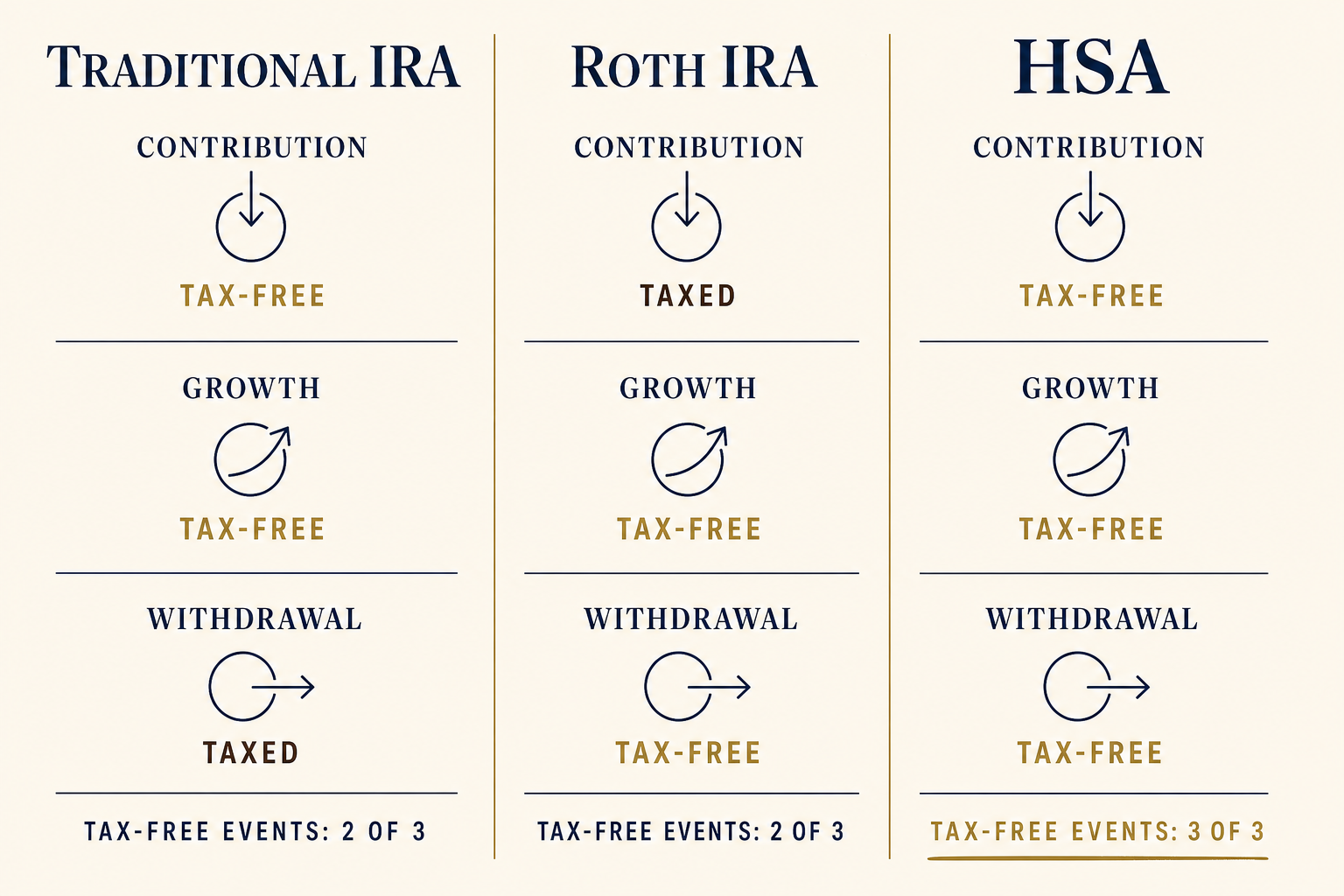
Going in. Contributions are pre-tax — they reduce your taxable income the year you make them, just like a traditional 401(k) or IRA contribution. If you are in the 22 percent federal bracket and you contribute $8,750 (the 2026 family limit), you have cut your federal tax bill by $1,925 before the money has done a thing.
Growing inside. The balance can be invested in mutual funds or ETFs once you cross your provider’s investment threshold (usually $1,000 or $2,000 in cash). Those investments grow without dividends taxed, without capital gains taxed, without any of the friction that exists inside a taxable brokerage account.
Coming out — for qualified medical expenses. Withdrawals for qualified medical expenses are tax-free. Not “tax-deferred until later.” Tax-free. Forever.
Nothing else in the tax code does all three. A Roth IRA gives you two: tax-free growth and tax-free withdrawals, but you fund it with after-tax dollars. A 401(k) gives you two on the other side: pre-tax going in and tax-deferred growth, but you owe ordinary income tax on every dollar you pull out. The HSA gives you all three. Congress has left this hole open for more than two decades, and most people walk past it.
Pro Tip: “Tax-free” only applies to qualified medical expenses, which is a longer list than most people realize. Prescription glasses, hearing aids, dental work, Medicare premiums after 65, long-term care insurance (with limits), and yes, the bandages and contact solution at the pharmacy all qualify. The IRS publishes the canonical list in Publication 502.
The eligibility rules, briefly
This part is short on purpose. To contribute to an HSA in 2026 you need to be enrolled in a High Deductible Health Plan (HDHP) and not enrolled in any disqualifying secondary coverage, including most general-purpose Flexible Spending Accounts (FSAs) and any part of Medicare.
For 2026, an HDHP means a minimum deductible of $1,700 for self-only coverage or $3,400 for family coverage, with out-of-pocket maximums no higher than $8,500 self-only or $17,000 family. Annual HSA contribution limits are $4,400 self-only and $8,750 family, plus a $1,000 catch-up if you are 55 or older. The IRS posts each year’s indexed numbers in a revenue procedure before open enrollment season — the 2026 figures come from Rev. Proc. 2025-19.
If your employer offers an HDHP option during open enrollment and lets you fund an HSA alongside it, that is the unlock. If you are already on a non-HDHP plan and your family is generally healthy, the HDHP-plus-HSA path often saves more money over a decade than the lower-deductible plan does. I am not going to tell you which plan to pick — that is a function of your expected medical use, your family’s situation, and the actual premium differences. But the choice is worth taking a Saturday morning to model.
The shoebox method — the move that makes the HSA actually work
Here is where most people miss the whole point.
The IRS does not require you to reimburse a qualified medical expense in the same year you incur it. There is no statute of limitations on the reimbursement. As long as you keep the receipt and the expense was incurred after the HSA was established, you can pay a $400 dental bill out of pocket today, let the $400 sit invested in your HSA for thirty years compounding tax-free, and reimburse yourself in retirement.
Think about what that means. The HSA, used correctly, is the only account where every dollar of contribution can grow tax-free for decades AND come out tax-free. The Roth IRA is its closest cousin, and the Roth gives up the up-front deduction.
The mechanic looks like this.
Consider a hypothetical case. Janet, 45, is enrolled in her employer’s HDHP. She maxes the family HSA at $8,750 in 2026 and keeps doing so every year for twenty years. Her family runs into about $2,500 of qualified medical expenses annually — copays, glasses, dental work, the kids’ braces. She pays each one from her checking account, drops the receipt in a labeled folder, and leaves the HSA untouched.
Twenty years later, Janet is 65. Her HSA, invested in a low-cost balanced fund and earning a hypothetical 7 percent average annual return, sits at roughly $375,000. She has $50,000 of receipts in the folder. She can — at any time, in any tax year — pull $50,000 from the HSA tax-free as reimbursement for those old receipts. That money funds the first year of a kitchen renovation, a trip, or her property tax bill. The remaining $325,000 stays inside the HSA, still growing.
The growth on Janet’s $8,750 annual contributions was never taxed. The withdrawal she just made was never taxed. The contribution itself was never taxed going in. Three tax-free strokes in a row, separated by twenty years of compounding. (For a deeper look at why the compounding piece matters more than the headline rate, see my earlier post on how compound interest actually works.)
That is the trick. The HSA wins by being left alone, not by being spent.
Editorial note: ProjectionLab — a retirement planning tool I use for modeling tax-advantaged account decisions like the HSA-versus-Roth question — has a free tier that handles HSA growth projections cleanly. If you want to run Janet’s math against your own household numbers, that is where I would start. (Affiliate disclosure: I earn a small commission if you upgrade to a paid plan. The free tier handles most household scenarios without paying anything.)
What happens at 65 — the back-up plan no one talks about
Here is the part of the HSA most articles bury at the bottom and most people never learn.
At age 65, your HSA stops being just a medical account. The qualified-expense rules still apply for tax-free withdrawals, but non-medical withdrawals are now treated exactly like traditional IRA distributions — taxable as ordinary income, with no 20 percent penalty.
Read that again. After 65, the HSA behaves like a traditional IRA for non-medical use and like a Roth IRA for medical use. You get to pick which set of rules applies based on what you withdraw for.
In retirement, qualified medical expenses include Medicare Part B premiums, Part D premiums, Medicare Advantage premiums, and long-term care insurance premiums (subject to age-based limits). Those are not small numbers. A couple on Medicare is often looking at $5,000 to $10,000 of premiums per year between them before any actual medical care. That is $5,000 to $10,000 of tax-free HSA withdrawals available every year of retirement, just by paying the premiums you were going to pay anyway. The Medicare side of this is part of why I treat the pre-65 window as such a high-leverage planning year — see bridging the pre-Medicare gap for the full picture.
If the HSA still has a balance after all qualified medical expenses are covered for the year, the remainder behaves as a traditional IRA — withdraw for whatever you want, pay ordinary income tax on it, no penalty.
Thomas’s Take: This is why I think of the HSA as the third leg of the bucket-planning stool nobody planned for. The Now bucket is cash, the Soon bucket is guaranteed income, the Later bucket is market growth. The HSA fits across Soon and Later — it is a parked tax-free pool that pays for the largest single category of retirement spending (healthcare) without ever touching the rest of the architecture. The point of the buckets is that each dollar has a job. The HSA is the rare dollar that does three.
The traps to avoid
Three things will undo the math if you let them.
Medicare enrollment. The day you enroll in any part of Medicare — including Part A, which most people are auto-enrolled in at 65 if they are already taking Social Security — you can no longer contribute to an HSA. Existing balances are fine; future contributions stop. If you are still working past 65 and on an employer HDHP, you can delay Medicare to keep contributing, but you have to actively decline Part A and understand the trade-offs. Most people do not realize they have the choice. The SSA Medicare enrollment page walks through the timing.
Disqualifying secondary coverage. A general-purpose FSA for you or your spouse disqualifies you. So does most non-HDHP coverage, including being claimed as a dependent on someone else’s tax return. The rules have a few carve-outs — limited-purpose FSAs for vision and dental are fine — but the default assumption is that any other first-dollar coverage breaks your HSA eligibility.
Spending the HSA as you go. This is the soft trap. There is nothing illegal about using HSA dollars to pay medical bills the same year you incur them, and most providers route the debit card transaction automatically. The cost is invisible: every dollar you withdraw early is a dollar that did not get three decades of tax-free compounding. The math is unforgiving in the long run.
A short FAQ
What if my employer does not offer an HDHP? You can open an HSA at any qualifying institution (Fidelity has a no-fee account; Lively is another popular option) as long as you are enrolled in a qualifying HDHP somewhere. The HSA itself does not have to live with your employer.
What if I switch employers mid-year? Your HSA balance is portable — it moves with you. The contribution limits are pro-rated based on how many months you had qualifying HDHP coverage.
What about my spouse? Family coverage allows one HSA per family or two HSAs split however you like, as long as combined contributions do not exceed the family limit. Once either spouse hits 55, that spouse’s catch-up has to live in that spouse’s own HSA — it cannot be combined.
What happens to the HSA if I die? If your spouse is the beneficiary, the account becomes their HSA — clean transfer, no tax event. If anyone else is the beneficiary, the account loses HSA status and becomes taxable income to them in the year of death. Naming beneficiaries on this account matters more than most people think; this is part of the broader case for treating beneficiary designations as their own planning step, not a footnote.
The bottom line
The HSA is the most overpowered retirement account in the federal code, and it sits behind a door most people walk past because the word “health” is on the sign. If you are under 65, enrolled in an HDHP, and not maxing the contribution — or you are maxing it and then immediately spending it down — you are leaving money on the table that is hard to leave anywhere else.
The fix is small. Contribute the max. Pay current medical expenses out of pocket. Save the receipts. Invest the balance. Let it sit for thirty years. When you get to retirement, you will have a tax-free pool that quietly handles a category of spending — healthcare — that derails more retirement plans than market crashes do.
The Now / Soon / Later architecture wins because it gives each dollar a job. The HSA, used right, is the only dollar in the plan that does three jobs at once.
This article is published by Confluence Media Group LLC, an independent publisher of educational financial content. Thomas Clark is a Series 65 Investment Advisor Representative. The information provided is for educational and informational purposes only and is not personalized financial, tax, or legal advice. Past performance does not guarantee future results. All investing involves risk, including potential loss of principal. Consult a qualified professional before making financial decisions.
Confluence Media Group LLC is a separate entity from Confluence Capital Management, the investment advisory practice through which Thomas Clark provides advisory services. Advisory services are not offered through this publishing platform.
About Thomas Clark
Thomas Clark is the founder of Confluence Media Group LLC and a Series 65 Investment Advisor Representative. He has spent nearly two decades working with families on retirement planning, with a focus on Social Security optimization, retirement income coordination, and the bucket planning approach to building a guaranteed income floor.
Thomas writes and publishes at thomasclarkadvisor.com and is the author of The Just in Case Binder — a 148-page printable family financial organizer for households who want to make sure the people they love know where everything is.
He lives in North Carolina with his family.
Subscribe to the weekly newsletter · Get the Just in Case Binder

Thomas Clark is a Series 65 licensed investment advisor and experienced trader. He specializes in investing, retirement planning, and market analysis, helping individuals build wealth and make informed financial decisions.
