

This is the most common Medicare question I hear: Should I go with a Medicare Supplement plan or Medicare Advantage? The answer depends on how you use healthcare. For more, see how to choose the right Medicare Part D plan.
This question lands in my inbox almost every week — from people approaching 65, and from people who have already enrolled and are wondering whether they made the right choice. The truth is, neither option is universally better. Both have real strengths and real drawbacks. But choosing the wrong one can cost you thousands of dollars a year, or worse, limit your access to the doctors and hospitals you need.
In this article, I will break down exactly how each option works, compare them side by side, walk through three hypothetical scenarios, and give you a decision framework so you can make the choice that fits your situation — not someone else’s.
Table of Contents
- Medicare Supplement (Medigap) Explained
- Medicare Advantage Explained
- Medicare Supplement vs Medicare Advantage: Side-by-Side Comparison
- The Cost Comparison: It Is Not Just About Premiums
- Hypothetical Scenario 1: The Healthy Traveler
- Hypothetical Scenario 2: The Budget-Conscious Homebody
- Hypothetical Scenario 3: The Chronic Condition Manager
- The Switching Trap: Why Your Initial Choice Matters
- Decision Framework: Five Key Questions to Ask Yourself
- Key Takeaways
- Frequently Asked Questions
Medicare Supplement (Medigap) Explained
A Medicare Supplement plan — commonly called Medigap — works alongside Original Medicare (Parts A and B). You keep Original Medicare as your primary coverage, and the Supplement plan fills in the gaps: deductibles, copays, coinsurance, and excess charges that Original Medicare does not cover.
Medigap plans are standardized by the federal government. That means Plan G from one insurance company covers the exact same benefits as Plan G from another company. The only difference between carriers is the premium and, potentially, the customer service experience. This standardization makes comparison shopping straightforward — you are comparing price, not coverage.
The most popular Medigap plans today are Plan G and Plan N. Plan G covers nearly everything Original Medicare does not, leaving you responsible only for the Part B annual deductible ($257 in 2026). Plan N has lower premiums but adds small copays for office visits and emergency room trips that do not result in admission.
One critical point: Medigap plans do not include prescription drug coverage. If you choose a Supplement plan, you will need a separate Medicare Part D drug plan to cover medications.
Medicare Advantage Explained
Medicare Advantage (Part C) is a completely different structure. Instead of supplementing Original Medicare, it replaces it. A private insurance company administers your coverage under contract with Medicare, bundling Part A (hospital), Part B (medical), and usually Part D (prescriptions) into a single plan.
Medicare Advantage plans come in several network types:
- HMO (Health Maintenance Organization): You must use in-network providers and typically need a referral from your primary care physician to see specialists.
- PPO (Preferred Provider Organization): You can see out-of-network providers, but you will pay more. No referral requirement for specialists.
- PFFS (Private Fee-for-Service): Less common. Providers are paid on a per-service basis at rates set by the plan.
Many Medicare Advantage plans offer additional benefits that Original Medicare does not cover — dental, vision, hearing, gym memberships, and over-the-counter allowances. These extras are a significant draw, and they are one reason Advantage plans have grown rapidly. According to the Kaiser Family Foundation, more than half of all Medicare beneficiaries are now enrolled in Advantage plans.
The trade-off is the network. With Medicare Advantage, you are generally limited to the plan’s provider network for full coverage, and plan structures can change year to year.
Medicare Supplement vs Medicare Advantage: Side-by-Side Comparison
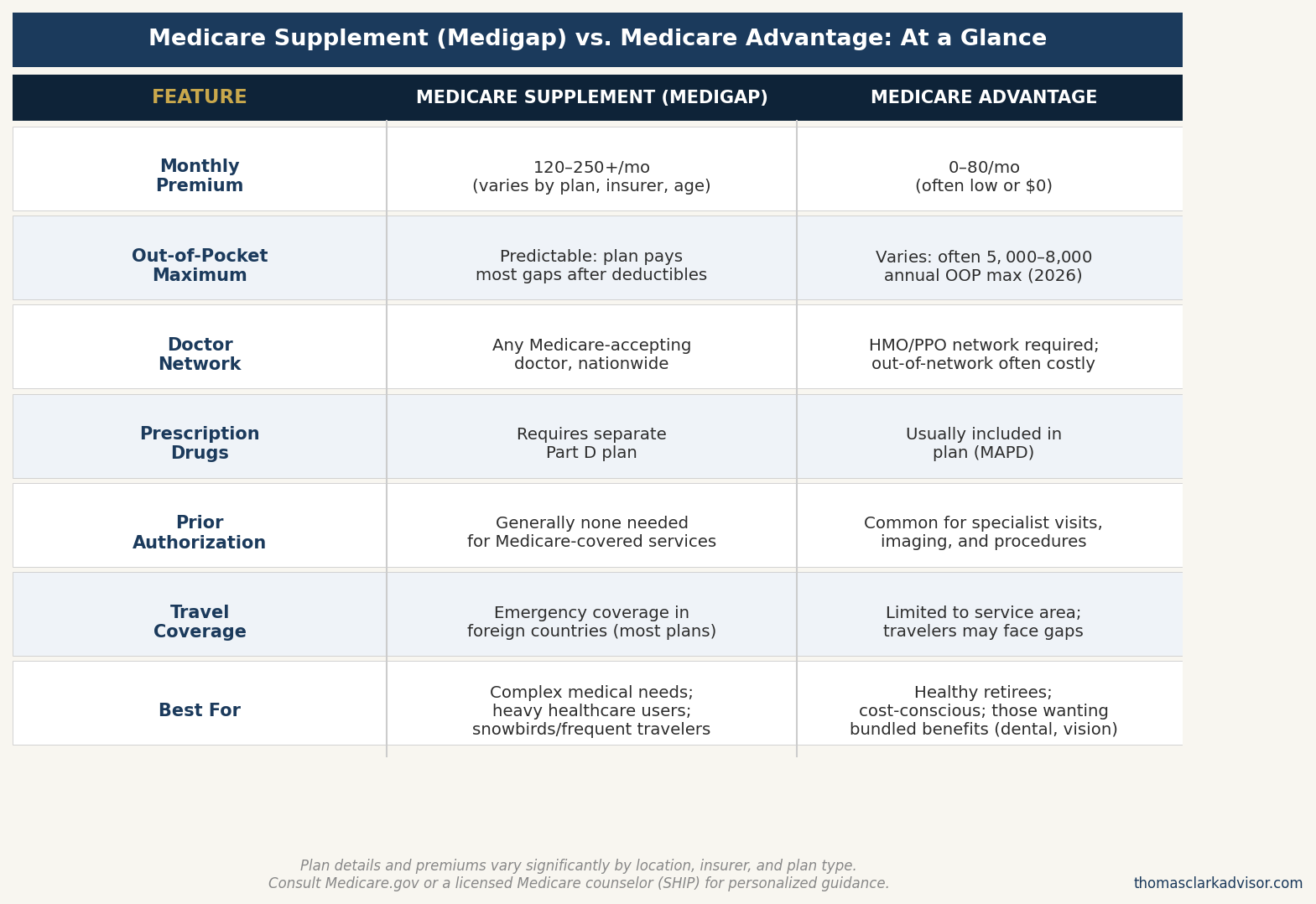
| Feature | Medicare Supplement (Medigap) | Medicare Advantage |
|---|---|---|
| Monthly Premiums | Higher ($100-$300+/month depending on plan and location) | Lower ($0-$50/month for many plans) |
| Out-of-Pocket Maximum | Effectively very low (Plan G: only the Part B deductible) | Required by law (typically $3,000-$8,000/year) |
| Provider Choice | Any doctor or hospital that accepts Medicare, nationwide | Limited to plan network (HMO/PPO) |
| Referrals Needed | No | Yes (HMO plans) |
| Prescription Drug Coverage | No — separate Part D plan required | Usually included |
| Travel Coverage | Most plans cover foreign travel emergency care | Limited or no out-of-area coverage |
| Extra Benefits (dental, vision, hearing) | Not included | Often included |
| Predictability | Very predictable — minimal out-of-pocket costs | Less predictable — copays and coinsurance vary by service |
The Cost Comparison: It Is Not Just About Premiums
This is where most people get tripped up. They see a $0 premium Medicare Advantage plan next to a $180 per month Supplement plan and the decision seems obvious. But premiums are only one piece of the total cost picture.
For a light healthcare user — someone who sees a primary care doctor a few times a year, takes one or two generic medications, and has no major procedures — a Medicare Advantage plan’s low premiums often result in lower total annual costs. You might pay a $20 copay here and there, but your total out-of-pocket spending stays well below what you would pay in Supplement premiums.
For a heavy healthcare user — someone managing chronic conditions, seeing multiple specialists, or facing a surgery or hospitalization — the math can flip. A Medicare Advantage plan’s copays and coinsurance for specialist visits, imaging, and hospital stays can add up quickly, potentially reaching the plan’s out-of-pocket maximum of $5,000 to $8,000 in a bad year. Meanwhile, a Supplement Plan G holder would pay only the $257 Part B deductible and nothing else for covered services, regardless of how much care they need.
Here is a simplified annual cost comparison:
| Light User | Heavy User | |
|---|---|---|
| Medigap Plan G (premium + Part D + deductible) | ~$3,400/year | ~$3,400/year |
| Medicare Advantage PPO (premium + copays + drugs) | ~$1,200/year | ~$6,500/year |
These figures are hypothetical and approximate. Actual costs vary by location, plan, and individual healthcare usage. This comparison is for illustrative purposes only.
The takeaway: Supplement plans have higher fixed costs but almost no variable costs. Advantage plans have lower fixed costs but potentially high variable costs. Your expected healthcare usage determines which structure saves you more.
Hypothetical Scenario 1: The Healthy Traveler
This is a hypothetical example for illustrative purposes only and does not represent any actual client situation.
Profile: Linda, age 66, recently retired. She is in excellent health, takes no prescription medications, and plans to travel extensively — including three to four international trips per year and long stays visiting grandchildren in other states.
Best fit: Medicare Supplement Plan G.
Linda needs the freedom to see any doctor anywhere in the country without worrying about network restrictions. When she travels to Florida for two months in the winter, she does not want to find out her Medicare Advantage HMO only covers emergency care outside her home area. Her Medigap plan works anywhere a provider accepts Medicare — which is the vast majority of doctors and hospitals nationwide. The foreign travel emergency benefit also provides a safety net for her international trips.
Yes, Linda pays higher monthly premiums. But her healthcare usage is minimal, so her total annual cost is predictable and manageable. And the peace of mind of unrestricted access is worth the premium difference for her lifestyle.
Hypothetical Scenario 2: The Budget-Conscious Homebody
This is a hypothetical example for illustrative purposes only and does not represent any actual client situation.
Profile: James, age 65, lives in a mid-sized city and rarely travels. He has mild hypertension managed with a single generic medication. He sees his primary care doctor quarterly and a cardiologist once a year. Budget is a top priority — he is living on Social Security and modest savings.
Best fit: Medicare Advantage PPO.
James’s healthcare needs are predictable and local. A well-rated Medicare Advantage PPO in his area offers a $0 monthly premium, includes Part D drug coverage, and provides dental and vision benefits he would otherwise pay out of pocket. His total annual cost — copays for a few doctor visits and a cheap generic medication — comes to roughly $600 to $900. Compare that to $3,000 or more per year for a Supplement plan plus standalone Part D.
For James, the savings are real and meaningful. He stays in his home area, his doctors are all in-network, and he benefits from the extra coverages that Supplement plans do not offer.
Hypothetical Scenario 3: The Chronic Condition Manager
This is a hypothetical example for illustrative purposes only and does not represent any actual client situation.
Profile: Patricia, age 70, manages Type 2 diabetes, osteoarthritis, and early-stage kidney disease. She sees four specialists regularly, requires lab work every quarter, takes five medications (two brand-name), and may need a knee replacement within the next two years.
Best fit: Medicare Supplement Plan G.
Free Download: Social Security Optimization Guide
Learn the strategies that could maximize your lifetime Social Security benefits.
Get Your Free CopyPatricia’s healthcare usage is high and somewhat unpredictable. Under a Medicare Advantage plan, the copays for specialist visits ($40-$50 each), imaging ($200-$300 per scan), lab work ($20-$50 per panel), and a potential inpatient surgery ($1,000-$3,000 copay) would add up quickly — possibly hitting the plan’s $6,000 to $8,000 out-of-pocket maximum. And that resets every calendar year.
With Supplement Plan G, Patricia pays her monthly premium and the $257 Part B deductible — and nothing else for Medicare-covered services. She can also see any specialist without a referral and without worrying about whether they are in-network. For someone who uses the healthcare system heavily, the Supplement plan’s higher premium is effectively insurance against unpredictable costs. Her total annual spending is capped and predictable, which matters enormously when you are managing chronic conditions on a fixed income.
Thomas’s Take: Medicare Advantage is a bet that you will stay relatively healthy and local. Medigap is a bet that you want predictability no matter what happens. Neither bet is wrong — but you need to understand which one you are making. Neither bet is wrong — but you need to understand which one you are making.
The Switching Trap: Why Your Initial Choice Matters
Here is the part of the Medicare decision that most people do not learn until it is too late: your initial enrollment choice can lock you in for life.
When you first become eligible for Medicare at age 65, you get a six-month Medigap Open Enrollment Period. During this window, insurance companies must sell you any Supplement plan they offer at the standard rate, regardless of your health. No medical underwriting. No denial for pre-existing conditions.
Once that window closes, if you want to switch from Medicare Advantage to a Supplement plan later, the insurance company can — and usually will — require medical underwriting. That means they can charge you more, exclude coverage for pre-existing conditions, or deny your application entirely.
This creates a real problem. Many people choose Medicare Advantage at 65 because they are healthy, the premiums are low, and the extra benefits are attractive. Ten years later, when their health has changed and they want the broader access and predictability of a Supplement plan, they find they cannot get one — or cannot afford one — because of underwriting.
A few states (Connecticut, Massachusetts, New York, and others) have guaranteed-issue protections that allow switching without underwriting in certain situations. But in most states, the initial choice carries long-term consequences.
Decision Framework: Five Key Questions to Ask Yourself
If you are trying to decide between Medicare Supplement and Medicare Advantage, work through these five questions:
-
How much healthcare do you use? If you see multiple specialists, take several medications, or have upcoming procedures, a Supplement plan’s predictability may save you money and stress. If you are generally healthy with minimal usage, Advantage may cost less.
-
Do you travel frequently? If you spend significant time outside your home area — snowbirds, frequent travelers, people visiting family in other states — a Supplement plan’s nationwide access is a major advantage.
-
How important is provider choice? If you want to see any doctor who accepts Medicare without referrals or network restrictions, that is a Supplement plan. If you are happy with local in-network providers, Advantage works.
-
What is your budget tolerance? Can you absorb $150 to $250 per month in predictable premiums? Or do you need the lowest possible monthly cost, even if it means variable out-of-pocket expenses when you use care?
-
Are you comfortable with this choice long-term? Given the switching trap, consider not just your health today but where you might be in ten or fifteen years. Starting with a Supplement plan keeps both doors open. Starting with Advantage may close the Supplement door later.
Key Takeaways
-
Medicare Supplement and Medicare Advantage are fundamentally different structures. Supplement works alongside Original Medicare and fills in cost gaps. Advantage replaces Original Medicare with a private plan that bundles coverage but uses a provider network.
-
Premiums do not tell the whole cost story. Supplement plans have higher fixed costs but almost no variable costs. Advantage plans have lower premiums but can generate significant out-of-pocket expenses in a bad health year.
-
Your healthcare usage pattern determines the better value. Light, local users tend to save with Advantage. Heavy users, travelers, and people who want unrestricted provider access tend to do better with Supplement plans.
-
The initial enrollment decision carries long-term weight. The six-month Medigap Open Enrollment Period at 65 is the one guaranteed window to buy a Supplement plan without medical underwriting. After that, switching from Advantage to Supplement may be difficult or impossible.
-
Neither option is universally better. The right choice depends on your health, travel habits, provider preferences, budget, and risk tolerance. Anyone who tells you one is always better than the other is oversimplifying.
Frequently Asked Questions
Can I switch from Medicare Advantage back to a Medicare Supplement plan?
You can switch during the Medicare Advantage Open Enrollment Period (January 1 through March 31) or during the Annual Enrollment Period (October 15 through December 7). However, in most states, you will face medical underwriting when applying for a Supplement plan after your initial Medigap Open Enrollment Period has passed. This means the insurance company can evaluate your health and may charge higher premiums, add exclusions, or deny coverage. A few states offer guaranteed-issue rights in certain situations, so check your state’s rules.
Is Medicare Advantage really free?
No. Even when an Advantage plan has a $0 monthly premium, you still pay your Part B premium to Medicare (typically $185 or more per month in 2026). You also pay copays, coinsurance, and deductibles when you use healthcare services. The $0 premium means the plan itself charges nothing extra on top of your Part B premium — it does not mean Medicare coverage is free.
Do I need a separate Part D plan with Medicare Advantage?
In most cases, no. The majority of Medicare Advantage plans include Part D prescription drug coverage. In fact, if you have an Advantage plan that includes drug coverage, you generally cannot enroll in a standalone Part D plan — doing so would disenroll you from your Advantage plan. Always verify drug coverage before enrolling.
Which plan is better if I have a chronic condition?
There is no universal answer, but Medicare Supplement plans tend to offer more predictable costs for people with chronic conditions. When you see multiple specialists, require frequent lab work, or face potential hospitalizations, the copays and coinsurance under Medicare Advantage can accumulate quickly. A Supplement plan like Plan G caps your exposure at the Part B deductible regardless of how much care you need. That said, some Advantage plans offer strong chronic condition management programs — so compare total expected costs and care coordination features for your specific conditions.
Medicare is one of the most consequential financial decisions you will make in retirement, and it is one you will live with for decades. Take the time to understand both options, run the numbers based on your actual healthcare usage, and think long-term. The cheapest plan today is not always the cheapest plan over the next twenty years.
For more on retirement income, bucket planning, and Social Security claiming, browse the retirement planning archive or sign up for the weekly newsletter at the bottom of any page.
This article is published by Confluence Media Group LLC, an independent publisher of educational financial content. Thomas Clark is a Series 65 Investment Advisor Representative. The information provided is for educational and informational purposes only and is not personalized financial, tax, or legal advice. Past performance does not guarantee future results. All investing involves risk, including potential loss of principal. Consult a qualified professional before making financial decisions.
Confluence Media Group LLC is a separate entity from Confluence Capital Management, the investment advisory practice through which Thomas Clark provides advisory services. Advisory services are not offered through this publishing platform.

Thomas Clark is a Series 65 licensed investment advisor and experienced trader. He specializes in investing, retirement planning, and market analysis, helping individuals build wealth and make informed financial decisions.