
Understanding Medicare Part D: How to Choose the Right Drug Plan
Understanding Medicare Part D: How to Choose the Right Drug Plan
You have spent months figuring out Medicare Part A and Part B. You have chosen between Medicare Supplement and Medicare Advantage. And then someone asks: “But what about your Medicare Part D drug plan?” For most new Medicare beneficiaries, Part D is the part that feels the most confusing — and the most consequential if you get it wrong.
Here is why Part D matters: the right plan can cover your prescriptions for $20 to $50 per month in premiums. The wrong plan — or no plan at all — can cost you thousands in out-of-pocket drug expenses and permanent late enrollment penalties. And unlike Parts A and B, where the government determines your coverage, Part D requires you to actively choose a plan from dozens of competing options, each with different premiums, formularies, pharmacy networks, and cost-sharing structures.
One of the most common Part D mistakes is choosing a plan based on premium alone. A plan with a $0 premium can cost you far more than a plan with a $40 premium if your specific medications are not on the formulary or are placed in a high cost-sharing tier. Let me walk you through how Part D actually works and how to choose a plan that fits your prescriptions and your budget.
Table of Contents
- What Medicare Part D Covers
- The Four Phases of Part D Coverage
- What Is a Formulary and Why It Matters More Than Premium
- How to Compare and Choose a Part D Plan
- The Coverage Gap: What Changed After the Inflation Reduction Act
- Part D Enrollment: When to Sign Up and What Happens If You Miss It
- Extra Help: The Low-Income Subsidy Most People Miss
- Key Takeaways
- Frequently Asked Questions
What Medicare Part D Covers
Medicare Part D covers outpatient prescription drugs — the medications you pick up at a pharmacy or receive through mail order. It is offered through private insurance companies that contract with Medicare, which means you have choices: standalone Part D plans (paired with Original Medicare and a Supplement) or Medicare Advantage plans that include drug coverage (MA-PD plans).
Part D covers most FDA-approved prescription drugs, but every plan has its own formulary — the list of drugs it covers and the cost-sharing tier for each drug. This is the critical point: just because a drug is “covered by Part D” does not mean your specific plan covers it, or covers it at a price you can afford.
Part D does NOT cover:
– Drugs not approved by the FDA
– Drugs for weight loss or cosmetic purposes (in most cases)
– Over-the-counter medications
– Drugs covered under Medicare Part B (certain injectable drugs administered in a medical setting)
Every Part D plan must cover at least two drugs in each therapeutic category and all drugs in six “protected” classes (antidepressants, antipsychotics, anticonvulsants, immunosuppressants, antiretrovirals, and antineoplastics). But beyond those minimums, plan formularies vary dramatically.
The Four Phases of Part D Coverage
Understanding the Part D cost structure requires understanding its four coverage phases. You move through these phases based on your cumulative drug spending during the calendar year:
Phase 1: Annual Deductible
Most Part D plans have an annual deductible of up to $590 (2026 maximum). You pay 100 percent of your drug costs until you reach this amount. Some plans have $0 deductibles or waive the deductible for generic drugs — this is worth checking, especially if you take inexpensive generics.
Phase 2: Initial Coverage Period
After meeting the deductible, you enter the initial coverage period. Here, you pay a copay or coinsurance for each prescription, and the plan pays the rest. Typical cost-sharing:
– Tier 1 (preferred generic): $1 – $10 copay
– Tier 2 (generic): $5 – $20 copay
– Tier 3 (preferred brand): $30 – $50 copay
– Tier 4 (non-preferred brand): 30% – 40% coinsurance
– Tier 5 (specialty): 25% – 33% coinsurance
This phase continues until the combined amount paid by you and the plan reaches $5,030 in total drug costs (2026 threshold).
Phase 3: Coverage Gap (Donut Hole)
Historically, the coverage gap — colloquially known as the “donut hole” — was the most feared phase of Part D. After the Inflation Reduction Act changes, the landscape has shifted significantly (more on this below).
Phase 4: Catastrophic Coverage
Once your out-of-pocket spending reaches the annual cap (currently $2,000 per year after the Inflation Reduction Act changes), you enter catastrophic coverage. In this phase, you pay $0 for all covered drugs for the rest of the year.
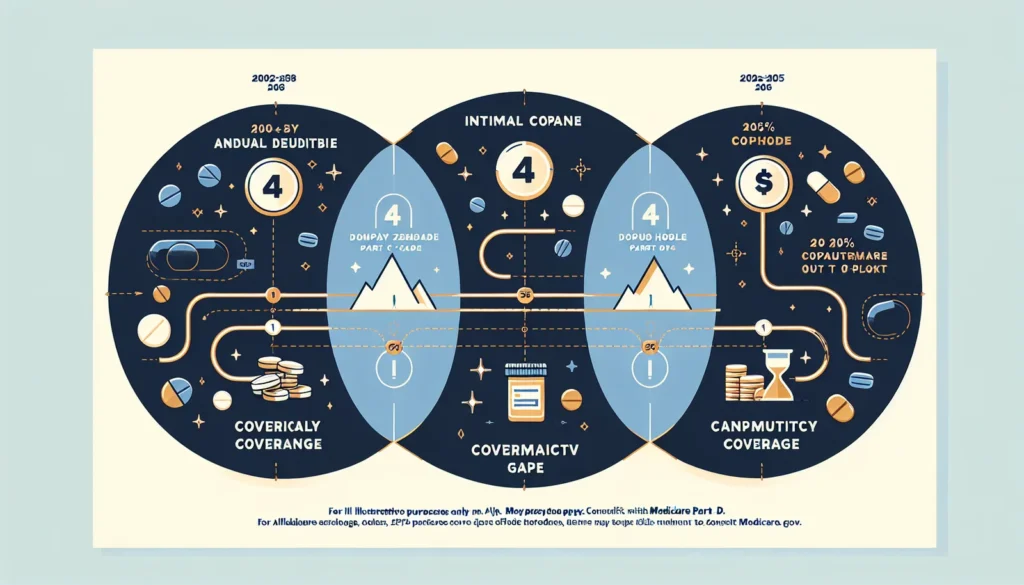
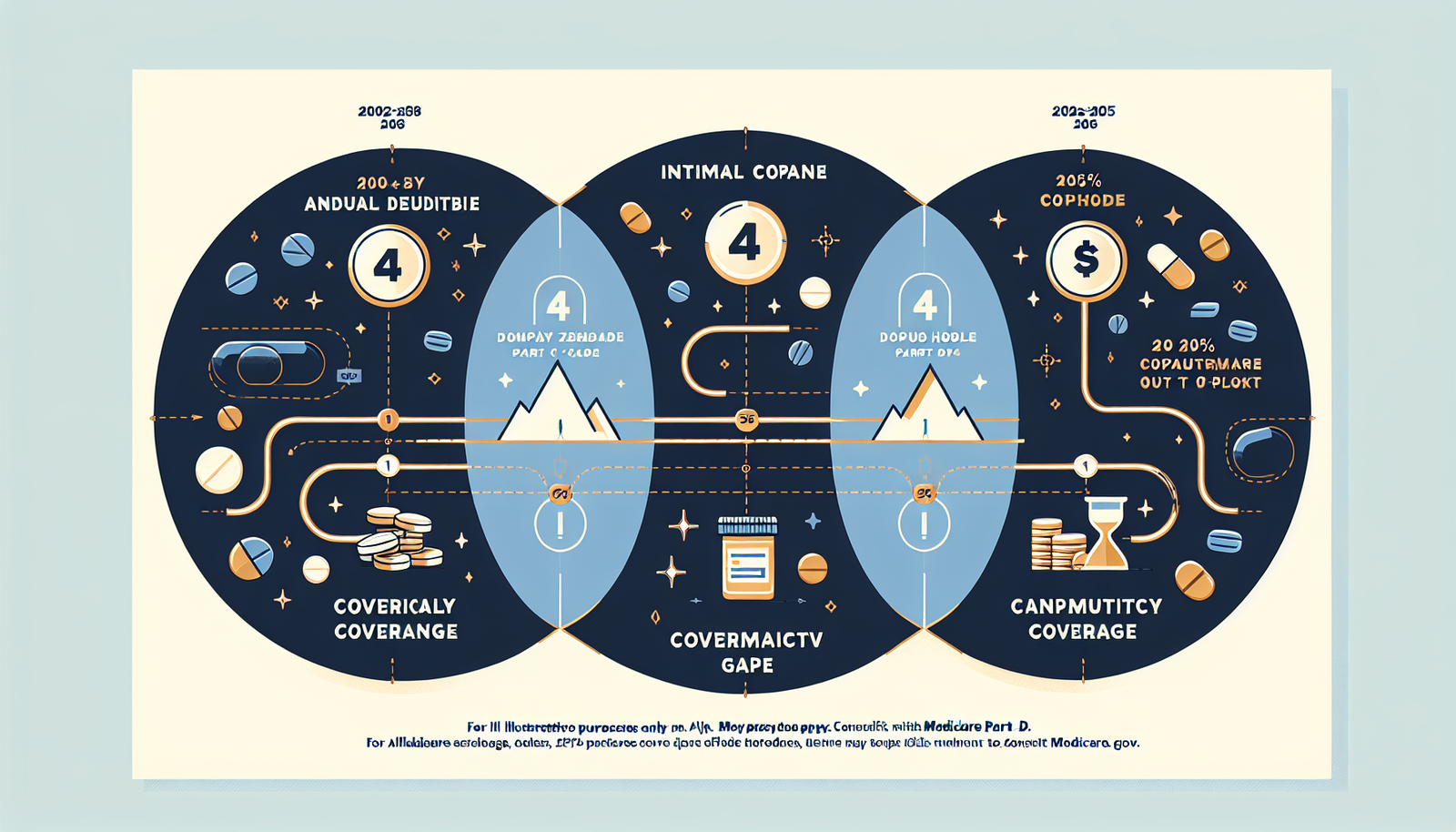
Horizontal progression diagram showing the four phases of Medicare Part D coverage with dollar thresholds: deductible, initial coverage, coverage gap, and catastrophic coverage.”
What Is a Formulary and Why It Matters More Than Premium
A formulary is the list of prescription drugs a Part D plan covers, organized into cost-sharing tiers. This is the single most important factor in choosing a Part D plan — more important than premium, more important than the insurance company’s name, more important than what your neighbor chose.
Here is why: a drug on Tier 2 (generic) might cost you $8 per month. The same drug on Tier 4 (non-preferred brand) in a different plan might cost you $120 per month. A drug that is not on the formulary at all requires a coverage exception request — which may be denied.
The tier placement is not just about whether a drug is generic or brand-name. It is about the plan’s negotiated pricing with manufacturers and pharmacy networks. Two Part D plans can place the same drug on different tiers, resulting in dramatically different costs to you.
How to check a formulary:
1. Go to Medicare Plan Finder on Medicare.gov
2. Enter your zip code and the drugs you take (name, dosage, frequency)
3. The tool will show you estimated annual costs for every available plan — including premiums, deductibles, and drug-specific copays
This 15-minute exercise can save you hundreds or thousands of dollars per year. reviewing your plan during every annual enrollment period is well worth the effort, even if you are happy with your current plan — because formularies and tier placements change annually.
Thomas’s Take: Plenty of retirees end up paying $200 per month more than they need to because they picked a Part D plan on a friend’s recommendation instead of running their own drug list through the formulary. Your neighbor’s best plan can be your worst plan. The only thing that matters is how your specific drugs are covered in your specific plan.
How to Compare and Choose a Part D Plan
Here is the step-by-step process I’d walk through every fall before the Annual Enrollment Period closes:
Step 1: List every prescription you take. Include the drug name, dosage, and how often you take it. Do not forget medications you take seasonally or intermittently.
Step 2: Use Medicare Plan Finder. Enter your drugs at medicare.gov/plan-compare. The tool calculates your estimated total annual cost for every plan available in your area — not just the premium, but premiums + deductible + copays combined.
Step 3: Check the pharmacy network. Each plan has a preferred pharmacy list. Using a preferred pharmacy can cut copays significantly. If you have a pharmacy you prefer (or need for convenience), make sure it is in-network for the plan you are considering.
Step 4: Look at total annual cost, not just premium. A plan with a $0 premium and $590 deductible plus high copays may cost more overall than a plan with a $40 premium, $0 deductible, and lower copays. Only the total annual cost tells you the real price.
Step 5: Check for coverage restrictions. Some plans require prior authorization, step therapy (trying a cheaper drug first), or quantity limits for certain medications. If you take a drug that requires these extra steps, factor in the hassle and the risk of denial.
Step 6: Consider mail-order options. Many plans offer 90-day supplies through mail order at lower cost than 30-day retail fills. If you take maintenance medications, mail order can produce meaningful savings.
The Coverage Gap: What Changed After the Inflation Reduction Act
The Inflation Reduction Act (IRA), signed in 2022, fundamentally changed the Part D cost structure for beneficiaries:
The $2,000 annual out-of-pocket cap. Starting in 2025, total out-of-pocket spending on Part D drugs is capped at $2,000 per year. Once you hit this cap, you pay nothing for covered drugs for the rest of the year. This is a dramatic improvement from the pre-IRA structure, where catastrophic coverage still required 5 percent coinsurance with no cap — meaning retirees on expensive specialty drugs could face five-figure annual costs.
Medicare Drug Price Negotiation. The IRA authorized Medicare to negotiate prices directly with manufacturers for certain high-cost drugs. The first negotiated prices took effect in 2026 for 10 drugs, with additional drugs added in future years. If you take one of the negotiated drugs, your costs may have decreased significantly.
Insulin cap. Monthly insulin costs are capped at $35 for Part D beneficiaries — regardless of the type of insulin or the plan. This was one of the most impactful provisions for diabetic retirees who were paying hundreds per month.
What the donut hole looks like now: With the $2,000 annual cap, the practical impact of the coverage gap has been largely eliminated for most beneficiaries. You still move through the phases structurally, but your out-of-pocket spending stops at $2,000 regardless of which phase you are in. For retirees on expensive medications who previously feared the donut hole, this is a transformative change.
Before and after comparison of Medicare Part D out-of-pocket costs showing how the Inflation Reduction Act’s $2,000 annual cap reduces spending for retirees on expensive medications.”
Part D Enrollment: When to Sign Up and What Happens If You Miss It
Initial Enrollment Period
Your initial enrollment period for Part D is the same seven-month window as Medicare Parts A and B: three months before the month you turn 65, the month you turn 65, and three months after. If you are enrolling in Medicare at 65 while still working, your Part D timing may differ — employer drug coverage generally qualifies as “creditable coverage” that prevents a late enrollment penalty.
Annual Enrollment Period (AEP)
Every year from October 15 through December 7, you can switch Part D plans, add Part D coverage, or drop it. Changes take effect January 1. This is the most important window for Part D — even if you are happy with your current plan, formularies and premiums change annually. Review your plan every fall.
The Late Enrollment Penalty
If you go 63 or more consecutive days without Part D or other creditable prescription drug coverage, you will pay a late enrollment penalty when you eventually sign up. The penalty is calculated as 1 percent of the national base premium ($34.70 in 2026) multiplied by the number of months you were without coverage.
Example: If you went 24 months without creditable coverage, your penalty would be roughly $8.33 per month (24 x 1% x $34.70) — added to your Part D premium for as long as you have Part D. Over a 20-year retirement, that adds up to nearly $2,000 in permanent penalty payments.
The penalty is permanent and cumulative. There is no way to remove it once incurred (with very limited exceptions). This is why enrolling in Part D when you turn 65 is generally worth considering, even if you currently take no prescriptions — the penalty for waiting is not worth the few dollars saved in premiums.
Special Enrollment Periods
You can enroll or switch outside of AEP if you experience a qualifying event: moving to a new coverage area, losing employer coverage, qualifying for Extra Help (low-income subsidy), or entering/leaving a nursing facility.
Extra Help: The Low-Income Subsidy Most People Miss
Medicare’s “Extra Help” program (also called the Low-Income Subsidy or LIS) pays for Part D premiums, deductibles, and copays for beneficiaries with limited income and resources. For 2026, individuals with income below roughly $22,500 and assets below $17,220 (excluding home and car) may qualify for full or partial Extra Help.
What surprises many people is how generous the benefit is:
– Full Extra Help: $0 premium, $0 deductible, $1.55 to $4.50 copays for all drugs
– Partial Extra Help: Reduced premiums, reduced deductible, and reduced copays (sliding scale)
According to the Social Security Administration, millions of eligible beneficiaries are not enrolled because they do not know about the program or assume they will not qualify. If you or a family member has limited income and takes multiple prescriptions, checking eligibility takes minutes and can save thousands per year.
Key Takeaways
- Part D is not one-size-fits-all. The right plan depends entirely on your specific prescriptions — check every plan’s formulary against your drug list using Medicare Plan Finder.
- Formulary and tier placement matter more than premium. A $0 premium plan can cost hundreds more than a $40 premium plan if your drugs are on higher tiers.
- The Inflation Reduction Act capped annual out-of-pocket costs at $2,000 — a transformative change for retirees on expensive medications. Insulin is capped at $35/month.
- Review your plan every year during AEP (October 15 – December 7). Formularies, premiums, and pharmacy networks change annually.
- Never go without Part D coverage. The late enrollment penalty is permanent — 1% of the base premium per month of uncovered time, added to your premium for life.
- Check Extra Help eligibility if income and assets are limited. The savings can be substantial and the program is widely underutilized.
Frequently Asked Questions
Do I need Part D if I do not take any prescriptions?
Yes — enrolling in a low-cost Part D plan is generally a prudent step even if you currently take no medications. The late enrollment penalty for delayed enrollment is permanent and will cost far more over time than a basic plan’s premiums. Additionally, prescription needs often change as you age, and you want coverage in place when you need it.
Can I switch Part D plans if my medications change?
You can switch plans during the Annual Enrollment Period (October 15 – December 7) each year. Outside of AEP, you can only switch during a Special Enrollment Period triggered by qualifying events. This is why choosing a plan with broad formulary coverage is prudent, even if a narrower plan is cheaper for your current prescriptions.
Does Medicare Advantage include Part D drug coverage?
Many Medicare Advantage plans include drug coverage (called MA-PD plans), but not all do. If your MA plan includes drug coverage, you do not need a separate Part D plan. If it does not, you may need to enroll in a standalone Part D plan — but check compatibility, as some combinations are not allowed.
How does Part D interact with IRMAA?
If your modified adjusted gross income exceeds certain thresholds ($106,000 individual / $212,000 married in 2026), you pay an IRMAA surcharge on your Part D premium in addition to the plan premium itself. This surcharge ranges from $13.70 to $81.00 per month and is determined by the same two-year income lookback used for Part B IRMAA.
Medicare Part D does not have to be overwhelming. The key is to approach it as a personal decision based on your prescriptions — not a generic choice based on brand name or premium price. Fifteen minutes with the Medicare Plan Finder once a year is one of the highest-return investments of time you can make in retirement.
If you are turning 65 and navigating Medicare for the first time — or just want a fresh look at your current Part D plan during the next AEP — fifteen minutes with the Plan Finder, drug list in hand, is the single highest-return move you can make. Getting this right can save you real money every year for as long as you are on Medicare.
This article is published by Confluence Media Group LLC, an independent publisher of educational financial content. Thomas Clark is a Series 65 Investment Advisor Representative. The information provided is for educational and informational purposes only and is not personalized financial, tax, or legal advice. Past performance does not guarantee future results. All investing involves risk, including potential loss of principal. Consult a qualified professional before making financial decisions.
Confluence Media Group LLC is a separate entity from Confluence Capital Management, the investment advisory practice through which Thomas Clark provides advisory services. Advisory services are not offered through this publishing platform.

Thomas Clark is a Series 65 licensed investment advisor and experienced trader. He specializes in investing, retirement planning, and market analysis, helping individuals build wealth and make informed financial decisions.
