Qualified Charitable Distributions: The Tax-Smart Way to Give in Retirement
Qualified Charitable Distributions: The Tax-Smart Way to Give in Retirement
If you are 70 and a half or older, give to charity, and have a traditional IRA, there is a tax strategy sitting in your account that you may not know about — and it could save you thousands of dollars every year. It is called a qualified charitable distribution (QCD), and it is one of the most efficient tax moves available to retirees who are charitably inclined.
Here is the basic idea: instead of taking money out of your IRA, paying income tax on it, and then writing a check to your favorite charity, you send the money directly from your IRA to the charity. The distribution satisfies your required minimum distribution, the charity gets the full amount, and the income never appears on your tax return. Not as a deduction — it is simply excluded from your taxable income entirely.
I have walked plenty of pre-retirees and retirees through QCDs over the years, and the reaction is almost always the same: “Why didn’t I know about this sooner?” The reason is that QCDs are not widely marketed — there is no financial product to sell and no commission to earn. But for retirees who already give to charity, this strategy is close to a free lunch. Let me show you exactly how it works.
Table of Contents
- What Is a Qualified Charitable Distribution?
- QCD Rules: Eligibility and Limits
- QCD vs. Standard Deduction: Why QCDs Win for Most Retirees
- How QCDs Reduce Your Tax Bill Beyond the Obvious
- Step-by-Step: How to Execute a QCD
- Common QCD Mistakes to Avoid
- QCDs and Your Broader Retirement Tax Strategy
- Key Takeaways
- Frequently Asked Questions
What Is a Qualified Charitable Distribution?
A qualified charitable distribution is a direct transfer of funds from your traditional IRA to a qualified charity. The key word is “direct” — the money goes straight from the IRA custodian to the charity without passing through your hands. This direct transfer is what makes it excludable from your gross income.
Under current tax law, individuals age 70 and a half or older can make QCDs of up to $111,000 per year for 2026 (the limit is indexed for inflation under the SECURE Act 2.0). If you are married and both spouses have IRAs, each spouse can make QCDs up to the annual limit from their own accounts — potentially $222,000 per couple.
The QCD counts toward your required minimum distribution for the year. So if your RMD is $40,000 and you make $15,000 in QCDs, you only need to take $25,000 in additional taxable distributions to satisfy the RMD requirement.
The distribution is reported on your 1099-R like any other IRA withdrawal, but you (or your tax preparer) exclude it from taxable income on your tax return. The IRS treats it as if the distribution never happened from an income perspective — which is precisely what makes it so powerful.
QCD Rules: Eligibility and Limits
The rules for QCDs are specific, and breaking any of them disqualifies the distribution:
Age requirement: You must be 70 and a half or older on the date of the distribution. Not 70 — 70 and a half. If your birthday is July 15, you reach 70.5 on January 15 of the following year.
Account types: QCDs can only be made from traditional IRAs (including inherited traditional IRAs and inactive SEP and SIMPLE IRAs). They cannot be made from 401(k)s, 403(b)s, or active employer plans. If you have money in an old 401(k), rolling it into a traditional IRA first makes it eligible for QCDs.
Annual limit: $111,000 per individual for 2026, up from $108,000 in 2025. This limit is adjusted annually for inflation.
Eligible recipients: The charity must be a 501(c)(3) organization. Private foundations, donor-advised funds, and supporting organizations do NOT qualify. This is one of the most common mistakes — many retirees use donor-advised funds for their charitable giving, but QCDs cannot go to a DAF.
Direct transfer: The funds must go directly from the IRA to the charity. If the money hits your personal bank account first — even if you immediately write a check to the charity — it is not a QCD. It is a taxable distribution followed by a charitable donation.
No benefit received: You cannot receive anything of value in return for the QCD (such as event tickets, meals, or goods). The gift must be a pure donation.
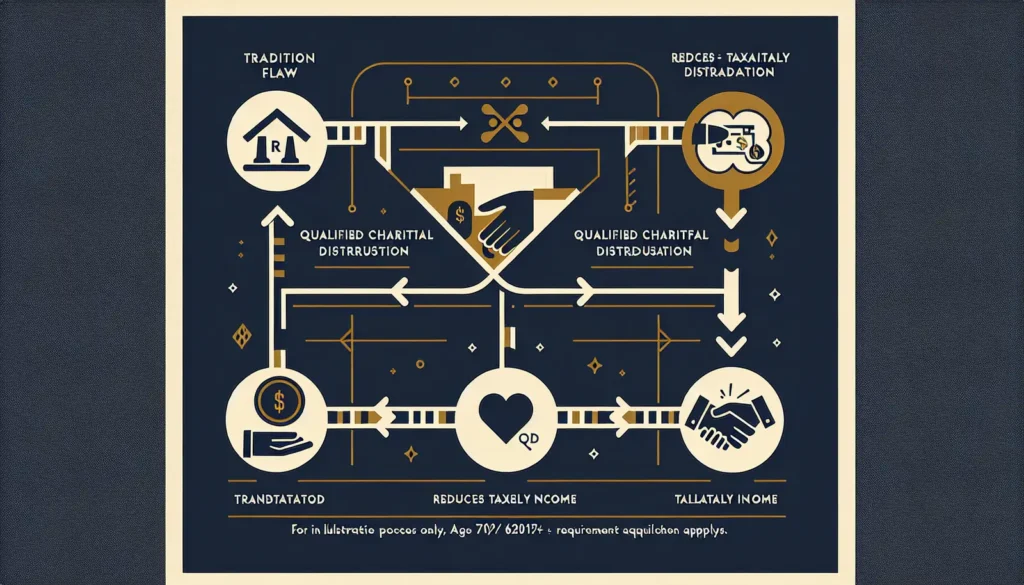
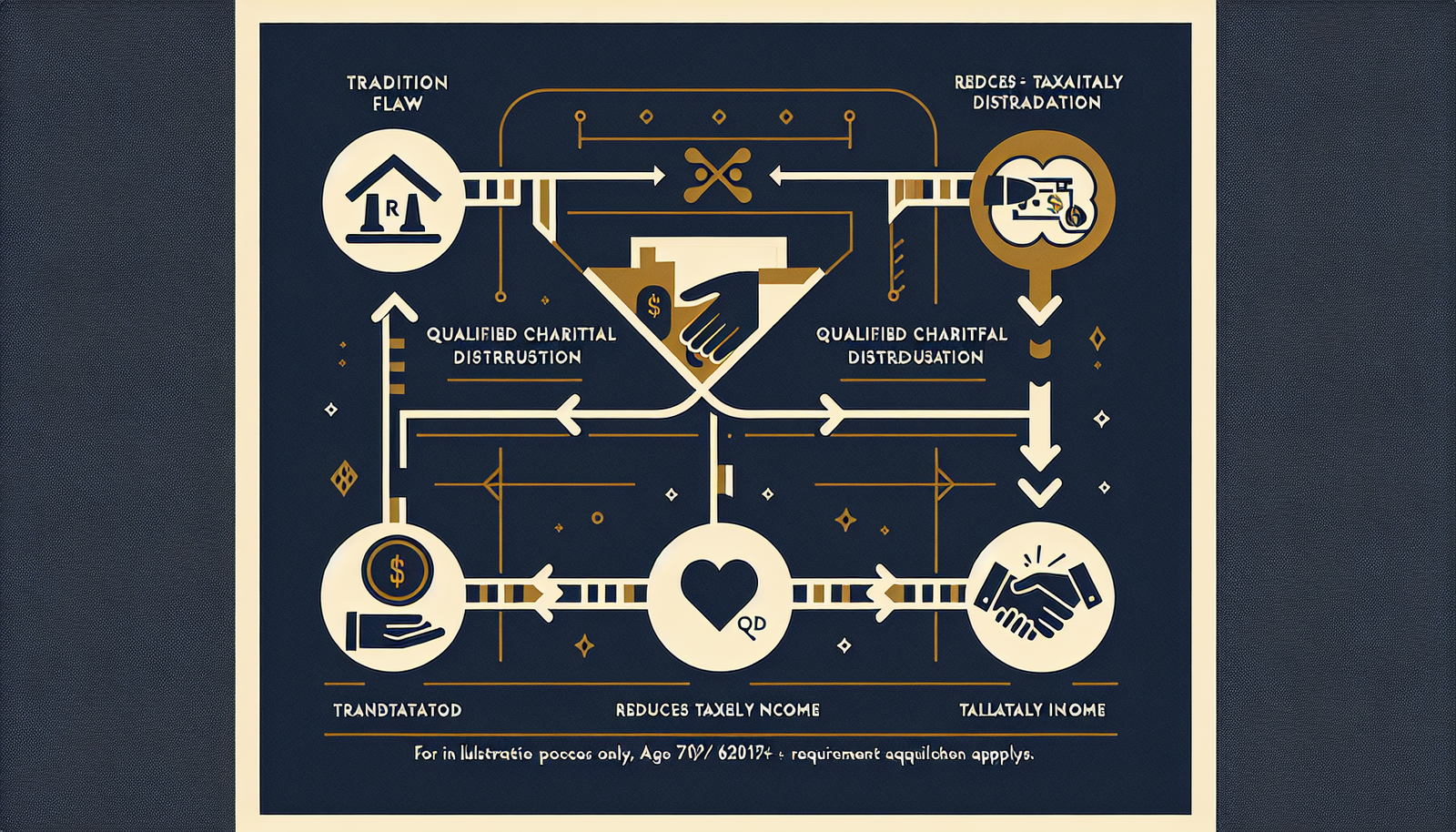
Comparison diagram showing how a standard IRA withdrawal adds to AGI while a qualified charitable distribution bypasses AGI entirely.”
QCD vs. Standard Deduction: Why QCDs Win for Most Retirees
Before the Tax Cuts and Jobs Act of 2017 (TCJA), many retirees itemized their deductions and claimed charitable giving on Schedule A. In that world, the tax benefit of a QCD and a standard charitable deduction were roughly similar — you either excluded the income (QCD) or deducted it (itemized).
But the TCJA nearly doubled the standard deduction, and it remains elevated in 2026. For married couples over 65, the standard deduction is approximately $32,300. For single filers over 65, it is roughly $16,550. This means the vast majority of retirees now take the standard deduction rather than itemizing — and if you take the standard deduction, you get zero tax benefit from your charitable donations.
This is where QCDs become essential. A QCD provides a tax benefit regardless of whether you itemize. Because the QCD is excluded from income (not deducted), it works on top of the standard deduction.
Example: This is a hypothetical scenario for illustrative purposes only.
Margaret, age 74, has a $45,000 RMD and gives $10,000 per year to her church. Without a QCD, she takes the full $45,000 RMD (all taxable), takes the standard deduction, and gets no additional tax benefit from her $10,000 donation.
With a QCD, she sends $10,000 directly from her IRA to the church. Her taxable IRA income drops to $35,000. She still takes the standard deduction. The $10,000 QCD effectively gave her a $10,000 “deduction” she would not have received otherwise. At the 22 percent bracket, that is $2,200 in federal tax savings — every year.
Over a 15-year period, that adds up to $33,000 in tax savings, and the church received the exact same amount it would have received either way.
How QCDs Reduce Your Tax Bill Beyond the Obvious
The income exclusion is the direct benefit, but the cascading effects of lower AGI are where QCDs really shine:
Reduced Social Security taxation. QCD income is excluded from AGI, which means it does not increase your provisional income. For retirees near the provisional income thresholds where Social Security becomes taxable, a QCD can prevent thousands in Social Security from being pulled into the tax net.
Lower IRMAA exposure. Medicare Part B and Part D premiums are based on your modified AGI from two years prior. A $15,000 QCD today reduces your MAGI by $15,000 — which in two years could keep you below an IRMAA threshold and avoid $1,776 to $4,888 in additional Medicare premiums (per person).
Lower state taxes. In states that tax retirement income (North Carolina does not tax Social Security but does tax IRA distributions), a QCD reduces state taxable income as well.
Reduced Net Investment Income Tax exposure. For high-income retirees, lower AGI can reduce or eliminate the 3.8 percent surtax on net investment income.
Preserves other deductions and credits. Many tax benefits phase out at higher AGI levels. A lower AGI from QCDs can help maintain eligibility for medical expense deductions (7.5 percent of AGI floor), education credits for grandchildren, and other income-tested provisions.
Thomas’s Take: I think of QCDs as a “triple play” — you reduce your income tax, reduce your Social Security tax exposure, and potentially reduce your Medicare premiums, all while giving the exact same amount to charity you would have given anyway. It is rare to find a strategy with this many compounding benefits and essentially zero downside for people who are already charitable.
Step-by-Step: How to Execute a QCD
Step 1: Confirm you are age 70.5 or older and have a traditional IRA (not a 401(k) or Roth).
Step 2: Contact your IRA custodian (Schwab, Fidelity, Vanguard, etc.) and request a QCD distribution. Most custodians have a specific QCD form or online process. Specify the charity name, address, and EIN (tax ID number).
Step 3: The custodian sends a check directly to the charity — either a physical check or an electronic transfer. Some custodians mail the check to you, made payable to the charity, for you to forward. This still qualifies as a QCD as long as it is made payable to the charity, not to you.
Step 4: Get a written acknowledgment from the charity confirming the donation amount and that no goods or services were provided in exchange.
Step 5: At tax time, your 1099-R will show the full distribution amount (including the QCD). Work with your tax preparer to correctly report the QCD exclusion on your return. On Form 1040, the total IRA distribution is reported on Line 4a, but only the taxable portion (excluding QCDs) goes on Line 4b.
Timing tip: Complete QCDs before taking your regular RMD for the year. The IRS applies the “first dollars out” rule — the first distributions from your IRA in a year are treated as satisfying your RMD. If you take your full RMD in January and then try to do a QCD in March, the QCD will not count toward your RMD (because it was already satisfied). Plan your QCDs early in the year.
Common QCD Mistakes to Avoid
Mistake 1: Sending the QCD to a donor-advised fund. This is the single most common error in QCD practice. DAFs, private foundations, and supporting organizations are not eligible recipients for QCDs. If you use a DAF for the rest of your charitable giving, you must route QCDs directly to the end charity for them to qualify.
Mistake 2: Depositing the funds in your bank account first. Even momentarily. If the check is made payable to you instead of the charity, it is a taxable distribution. Make absolutely sure the custodian issues payment to the charity.
Mistake 3: Doing a QCD from a Roth IRA. Roth IRA distributions are already tax-free, so a QCD from a Roth provides no additional tax benefit. Always use traditional IRA funds for QCDs — that is where the tax exclusion creates value.
Mistake 4: Forgetting to report it correctly at tax time. Your 1099-R will not identify the QCD separately. If your tax preparer does not know about the QCD, they will report the full distribution as taxable income. Keep your QCD acknowledgment letter and inform your preparer.
Mistake 5: Making a QCD before age 70.5. The age requirement is 70 and a half, not 70. A distribution made even one day before you reach 70.5 does not qualify. Calculate your exact 70.5 date carefully.
QCD eligibility checklist showing qualifying criteria with green checkmarks and disqualifying factors with red X marks.”
QCDs and Your Broader Retirement Tax Strategy
QCDs do not exist in isolation — they are most powerful when coordinated with your other retirement tax strategies:
QCDs + Roth conversions: These are complementary tools. A Roth conversion strategy reduces your traditional IRA balance over time, which reduces future RMDs. QCDs use current RMDs to fund charitable giving tax-efficiently. Together, they systematically reduce the tax drag of traditional IRA accounts from both directions.
QCDs + Social Security planning: Because QCDs reduce AGI, they directly reduce the provisional income that determines how much of your Social Security is taxable. For a retiree near the taxation thresholds, a $10,000 QCD could prevent $8,500 of Social Security from being taxed — an additional $1,870 in savings at the 22 percent bracket, on top of the $2,200 saved on the QCD itself.
QCDs + IRMAA management: If your MAGI is near an IRMAA cliff, a QCD in the right year can drop you below the threshold and save $1,000 to $5,000 in Medicare premiums — per person — two years later.
QCDs + the widow’s tax trap: For surviving spouses facing the widow’s tax trap — where switching to single-filer status dramatically increases taxes — QCDs become even more valuable. The lower thresholds for single filers mean that every dollar of AGI reduction has a larger impact. A surviving spouse who aggressively uses QCDs can meaningfully reduce the tax shock of losing a spouse.
The retirees who get the most out of QCDs are those who integrate them into a comprehensive annual tax planning review — looking at all income sources, all thresholds (tax brackets, Social Security taxation, IRMAA), and all available strategies in coordination. This is not something you figure out once and forget — it is an annual optimization.
Key Takeaways
- A QCD sends IRA funds directly to charity and excludes the amount from your taxable income — not as a deduction, but as an income exclusion that works regardless of whether you itemize.
- The 2026 annual limit is $111,000 per person ($222,000 for married couples with separate IRAs). QCDs count toward your RMD.
- QCDs beat standard charitable deductions for most retirees because the TCJA’s elevated standard deduction means most people no longer itemize — and non-itemizers get zero tax benefit from donations without QCDs.
- Cascading benefits include reduced Social Security taxation, lower IRMAA exposure, reduced state taxes, and preserved income-tested deductions and credits.
- Critical rules: Must be age 70.5+, must go directly to a 501(c)(3), cannot go to a donor-advised fund, and funds must never pass through your personal account.
- Coordinate QCDs with Roth conversions and IRMAA planning for maximum tax efficiency across your full retirement income strategy.
Frequently Asked Questions
Does a QCD count toward my required minimum distribution?
Yes. The QCD amount counts dollar-for-dollar toward satisfying your RMD for the year. If your RMD is $30,000 and you make $12,000 in QCDs, you need to take only $18,000 in additional taxable distributions.
Can I make a QCD to a donor-advised fund?
No. Donor-advised funds, private foundations, and supporting organizations are explicitly excluded from QCD eligibility under IRS rules. The QCD must go directly to a qualifying 501(c)(3) public charity.
Does a QCD reduce my provisional income for Social Security taxation?
Yes. Because the QCD is excluded from AGI, it does not appear in the provisional income formula. This can prevent additional Social Security benefits from being taxed — a powerful secondary benefit beyond the direct income exclusion.
Can I make a QCD if I do not have a required minimum distribution yet?
Yes. You can make QCDs starting at age 70.5, even if your RMDs have not begun yet (which is now age 73 under the SECURE Act 2.0). This gives you two and a half years of QCD eligibility before RMDs start — a useful window for reducing your traditional IRA balance tax-efficiently while supporting charities you care about.
A qualified charitable distribution will not change your life. But for retirees who give to charity — whether $1,000 or $50,000 per year — it is one of the rare strategies where you pay less in taxes without changing your behavior at all. You give the same amount to the same charities. The only difference is the path the money takes — and that path saves you real money, every year, for as long as you keep giving.
For more on retirement income, bucket planning, and Social Security claiming, browse the retirement planning archive or sign up for the weekly newsletter at the bottom of any page.
This article is published by Confluence Media Group LLC, an independent publisher of educational financial content. Thomas Clark is a Series 65 Investment Advisor Representative. The information provided is for educational and informational purposes only and is not personalized financial, tax, or legal advice. Past performance does not guarantee future results. All investing involves risk, including potential loss of principal. Consult a qualified professional before making financial decisions.
Confluence Media Group LLC is a separate entity from Confluence Capital Management, the investment advisory practice through which Thomas Clark provides advisory services. Advisory services are not offered through this publishing platform.

Thomas Clark is a Series 65 licensed investment advisor and experienced trader. He specializes in investing, retirement planning, and market analysis, helping individuals build wealth and make informed financial decisions.
