
Social Security and Taxes: How Much of Your Benefit Is Taxable?
Social Security and Taxes: How Much of Your Benefit Is Taxable?
Here’s a number that surprises almost every pre-retiree the first time they hear it: up to 85 percent of your Social Security benefit can go right back to the IRS in taxes. Not 85 percent of your income — 85 percent of the Social Security benefit you worked your entire career to earn. For retirees who assumed Social Security was tax-free, this is one of the most unwelcome discoveries in retirement planning.
The question “is Social Security taxable?” has a frustratingly complicated answer: it depends. It depends on how much other income you have, what type of income it is, and even whether you file taxes as an individual or a married couple. The mechanism that determines all of this is called provisional income — a calculation the IRS uses specifically to figure out how much of your Social Security benefit gets taxed. Most retirees have never heard of provisional income until it costs them thousands of dollars.
I want to change that. In this guide, I will break down exactly how Social Security taxation works, show you the math with real numbers, and walk through the strategies that can reduce or eliminate the tax bite. This is one of the most impactful pieces of retirement planning you can do — and the earlier you understand it, the more options you have.
Table of Contents
- Is Social Security Taxable? The Short Answer
- How Provisional Income Determines Your Social Security Taxes
- The Two Threshold Levels: 50 Percent and 85 Percent
- A Real-Numbers Example: How the Math Works
- The Income Sources That Push You Over the Line
- Five Strategies to Reduce Social Security Taxes
- The Widow’s Tax Trap and Social Security
- Key Takeaways
- Frequently Asked Questions
Is Social Security Taxable? The Short Answer
Yes — for most retirees, at least a portion of Social Security benefits is taxable at the federal level. According to the Social Security Administration, roughly 40 percent of people who receive Social Security pay federal income taxes on their benefits. But among retirees with any meaningful retirement savings, the percentage is much higher — because almost any additional income source can push your benefits into taxable territory.
The key concept you need to understand is that Social Security is not taxed in a straightforward way. You do not simply add your Social Security to your other income and pay tax on the total. Instead, the IRS uses a special formula — provisional income — to determine what percentage of your benefit is taxable: 0 percent, up to 50 percent, or up to 85 percent.
Importantly, no more than 85 percent of your Social Security benefit will ever be taxable. The remaining 15 percent is always tax-free. But for most retirees with income above the thresholds, that 85 percent ceiling is exactly where they land.
How Provisional Income Determines Your Social Security Taxes
Provisional income for Social Security is calculated as:
Adjusted Gross Income (AGI) + Tax-Exempt Interest + 50% of Social Security Benefits = Provisional Income
Let me break that down:
- AGI includes all your taxable income: pension payments, IRA and 401(k) withdrawals, wages, rental income, capital gains, dividends, and interest. Roth IRA withdrawals are NOT included.
- Tax-exempt interest is the interest from municipal bonds. Even though muni bond interest is not taxed as income, the IRS includes it in the provisional income calculation. This catches many retirees off guard.
- 50 percent of Social Security benefits — not the full amount, just half — is added to the total.
The resulting number is your provisional income, and it determines how much of your Social Security benefit the IRS gets to tax.
Notice what is NOT in this formula: Roth IRA distributions, return of basis from non-deductible IRA contributions, and Health Savings Account withdrawals for qualified expenses. These income sources are invisible to the provisional income calculation — which is one of the most compelling reasons to build Roth assets before you start collecting Social Security.
The Two Threshold Levels: 50 Percent and 85 Percent
The IRS applies two threshold levels based on filing status:
| Filing Status | Provisional Income | Taxable Portion of SS |
|---|---|---|
| Single, Head of Household | Below $25,000 | 0% |
| Single, Head of Household | $25,000 – $34,000 | Up to 50% |
| Single, Head of Household | Above $34,000 | Up to 85% |
| Married Filing Jointly | Below $32,000 | 0% |
| Married Filing Jointly | $32,000 – $44,000 | Up to 50% |
| Married Filing Jointly | Above $44,000 | Up to 85% |
Source: IRS Publication 915
These thresholds have never been adjusted for inflation since they were established in 1983 and 1993. In today’s dollars, they are remarkably low. A married couple receiving $30,000 in Social Security and taking just $30,000 from a traditional IRA already has a provisional income of $45,000 ($30,000 IRA + $15,000 half of SS) — pushing them above the $44,000 threshold where up to 85 percent of their benefits become taxable.
This is why I tell clients that the Social Security tax thresholds are effectively a flat rate for most retirees with any meaningful savings. If you have a pension, a 401(k), or an IRA, you are almost certainly going to have 85 percent of your Social Security taxed. The question becomes not whether you will pay tax on Social Security, but how much you can do to reduce the other income that triggers it.
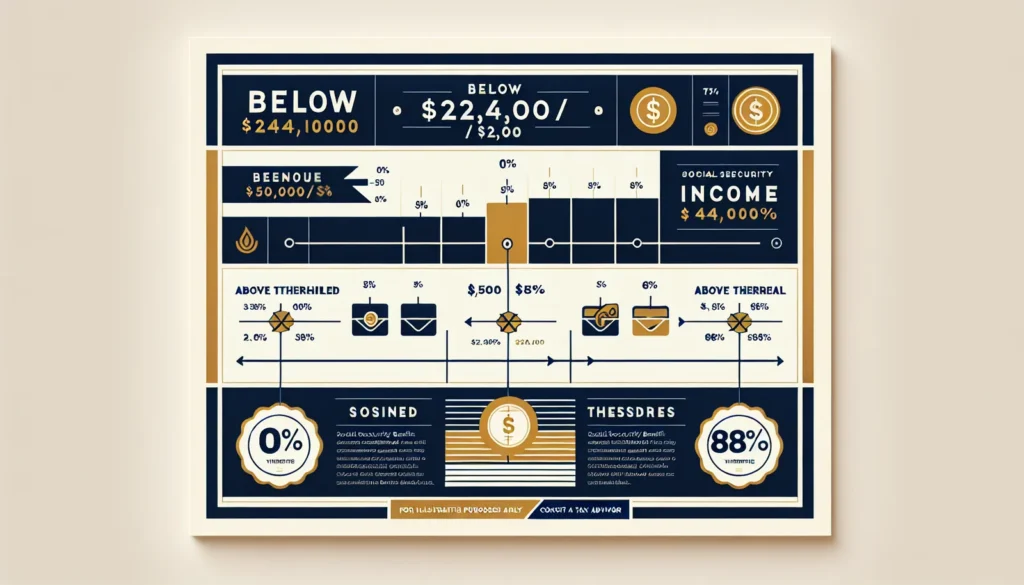
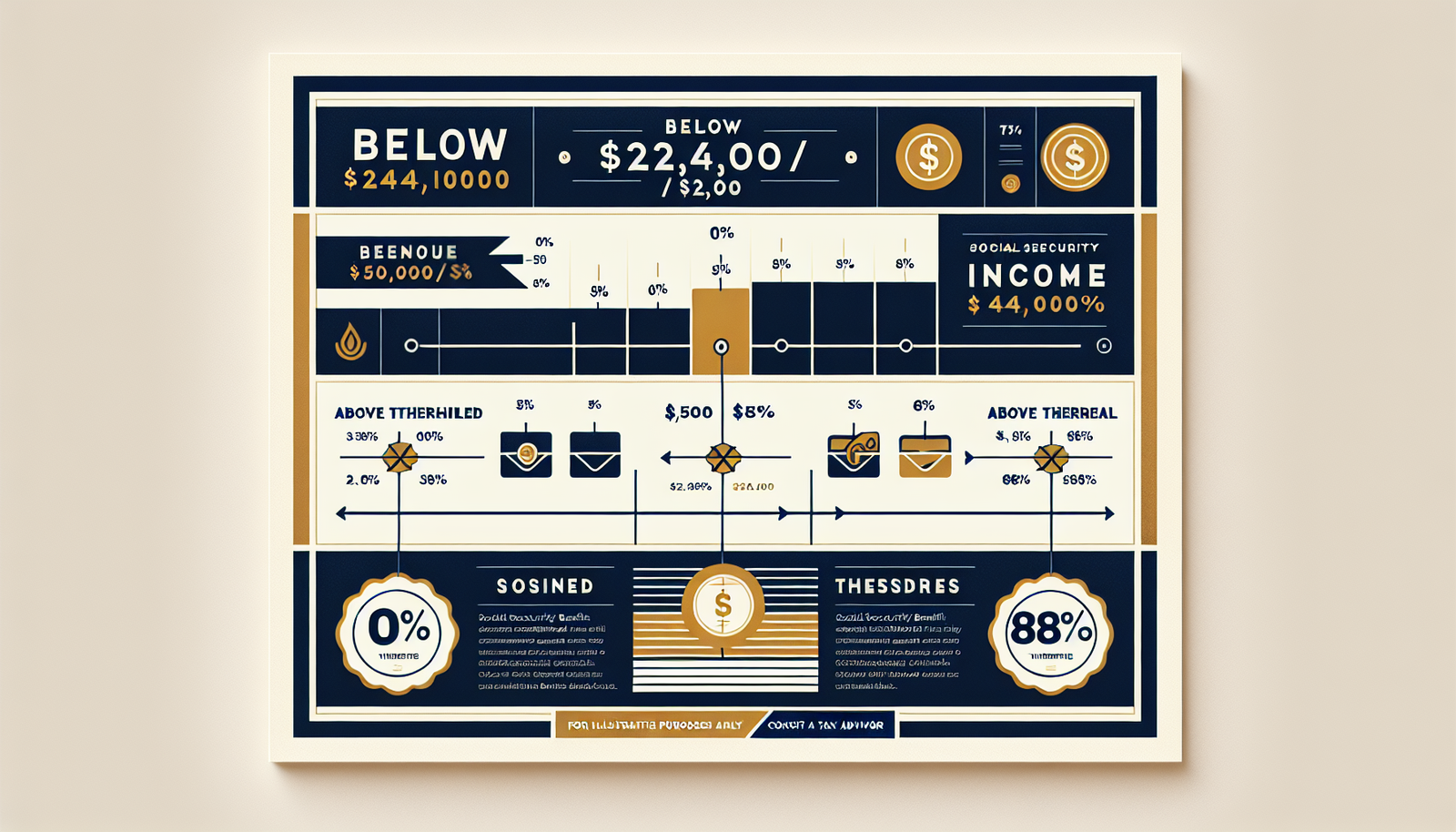
Flowchart showing how provisional income is calculated from AGI, tax-exempt interest, and half of Social Security benefits, with threshold zones determining the taxable percentage.”
A Real-Numbers Example: How the Math Works
This is a hypothetical scenario for illustrative purposes only and does not represent any actual client situation or guarantee of future results.
Meet Robert and Linda, a married couple both age 68. Their income sources:
- Social Security (combined): $42,000 per year
- Traditional IRA withdrawals: $35,000 per year
- Pension (Robert): $18,000 per year
- Municipal bond interest: $5,000 per year
Provisional income calculation:
– AGI: $35,000 (IRA) + $18,000 (pension) = $53,000
– Tax-exempt interest: $5,000
– 50% of Social Security: $21,000
– Total provisional income: $79,000
This is well above the $44,000 married threshold, so up to 85 percent of their Social Security is taxable. That means $35,700 of their $42,000 Social Security benefit ($42,000 x 0.85) gets added to their taxable income.
Their total taxable income: $53,000 (AGI) + $35,700 (taxable SS) = $88,700, before the standard deduction.
Now imagine Robert and Linda had moved $200,000 from their traditional IRA to a Roth IRA five years before retirement, using Roth conversions before Social Security started. If they now take $20,000 from the Roth (tax-free, not included in AGI) and only $15,000 from the traditional IRA:
Revised provisional income:
– AGI: $15,000 (IRA) + $18,000 (pension) = $33,000
– Tax-exempt interest: $5,000
– 50% of Social Security: $21,000
– Total provisional income: $59,000
Still above the threshold — but the taxable Social Security does not change (still 85 percent at this level). However, the lower IRA withdrawal reduces their AGI directly, and their total taxable income drops to: $33,000 + $35,700 = $68,700. That is $20,000 less in taxable income, saving them roughly $4,400 in federal taxes at the 22 percent bracket — every single year for the rest of their lives.
Over a 25-year retirement, that is over $110,000 in tax savings from a decision made before they claimed Social Security.
The Income Sources That Push You Over the Line
Understanding which income sources affect provisional income helps you control the tax impact:
High-impact sources (count dollar-for-dollar toward provisional income):
– Traditional IRA and 401(k) withdrawals, including required minimum distributions
– Pension income
– Part-time wages or self-employment income
– Capital gains from selling investments or property
– Rental income
– Municipal bond interest (the hidden trap)
Zero-impact sources (do not affect provisional income):
– Roth IRA withdrawals (qualified)
– Return of basis from non-deductible IRA contributions
– HSA withdrawals for qualified medical expenses
– Loans (home equity, etc.)
This is why when you file for Social Security affects your provisional income. The larger your benefit (from delaying to 70), the more half of that benefit contributes to provisional income. But the trade-off is usually worth it — the additional guaranteed income from delaying almost always outweighs the marginal increase in provisional income.
Five Strategies to Reduce Social Security Taxes
1. Roth Conversions Before You Claim Social Security
The single most effective strategy. Convert traditional IRA funds to Roth during the years between retirement and Social Security claiming (or between retirement and age 73 when RMDs begin). The conversion is taxable in the year you do it, but every dollar converted is permanently removed from the provisional income calculation for the rest of your life.
The ideal conversion window is when your income is temporarily lower — after you stop working but before Social Security and RMDs begin. For many retirees, the 10 and 12 percent tax brackets are wide open during this period, making conversions remarkably cheap relative to the long-term savings.
2. Draw from Roth Accounts Strategically
If you have Roth assets, use them as your “invisible” income source. Need an extra $10,000 for a vacation or home repair? Take it from the Roth rather than the traditional IRA. That $10,000 will not increase provisional income, will not push more Social Security into taxable territory, and will not affect your tax bracket.
3. Manage Capital Gains Timing
A large capital gain in a single year can spike your provisional income and dramatically increase the tax on your Social Security. If you plan to sell a appreciated asset, consider spreading the sale across multiple tax years or timing it for a year when other income is lower. Tax-loss harvesting can also offset gains.
4. Consider the Qualified Charitable Distribution
For retirees age 70.5 and older, qualified charitable distributions (QCDs) from an IRA satisfy your required minimum distribution without adding to AGI — and therefore without affecting provisional income. If you were going to donate to charity anyway, routing the gift through a QCD instead of writing a check removes that income from the Social Security tax calculation entirely.
5. Be Cautious with Municipal Bonds
Municipal bonds are popular with retirees because the interest is federal-tax-free. But that interest IS included in provisional income. A retiree with $15,000 in muni bond interest might assume it is “free” income — but it could be adding $15,000 to their provisional income, pushing thousands more in Social Security benefits into taxable territory. In some cases, taxable bonds in a lower bracket produce a better after-tax result than muni bonds that trigger Social Security taxes.
Thomas’s Take: The provisional income formula is one of the most poorly understood mechanics in retirement taxation. Plenty of retirees unknowingly pay $3,000 to $5,000 more per year in taxes because they don’t realize how their income sources interact with Social Security. The fix is rarely dramatic — it is usually about shifting where income comes from, not reducing your lifestyle.
The Widow’s Tax Trap and Social Security
One scenario where Social Security taxes become particularly painful is when a spouse dies. The surviving spouse moves from married filing jointly to single filing status, which means the provisional income thresholds drop from $32,000/$44,000 to $25,000/$34,000 — while often retaining much of the same income.
This is known as the widow’s tax trap, and it can cause a dramatic increase in taxes on Social Security benefits. A surviving spouse who was well below the threshold as a married couple may find that 85 percent of their Social Security is now fully taxable as a single filer, even with less total income.
Planning for this possibility — through Roth conversions, beneficiary designations, and income source diversification — is one of the most important things married couples can do to protect the surviving spouse’s financial security.
Key Takeaways
- Up to 85 percent of Social Security benefits can be taxed as ordinary income — not 100 percent, but far more than most retirees expect.
- Provisional income (AGI + tax-exempt interest + 50% of SS benefits) determines how much is taxable. The thresholds ($25,000/$34,000 single; $32,000/$44,000 married) have never been adjusted for inflation.
- Roth IRA withdrawals do not count toward provisional income — making Roth conversions before claiming Social Security one of the most powerful tax strategies available.
- Municipal bond interest counts toward provisional income despite being federally tax-free — a common surprise for retirees.
- The widow’s tax trap can dramatically increase Social Security taxes for a surviving spouse due to lower single-filer thresholds.
- Planning the timing and source of retirement income can reduce Social Security taxes by thousands of dollars per year over a multi-decade retirement.
Frequently Asked Questions
At what income level is Social Security not taxed at all?
If your provisional income is below $25,000 (single) or $32,000 (married filing jointly), none of your Social Security benefits are taxable. However, these thresholds are so low that most retirees with any pension, IRA, or 401(k) income will exceed them.
Do all states tax Social Security benefits?
No. Most states do not tax Social Security. As of 2026, only a handful of states tax Social Security benefits, and several of those offer partial exemptions. North Carolina, where I’m based, does not tax Social Security benefits at the state level.
Does delaying Social Security to age 70 increase my taxes?
Delaying increases your benefit by about 8 percent per year past full retirement age, which means a larger benefit — and potentially more of it subject to taxation. However, the additional guaranteed income almost always outweighs the marginal tax increase, especially when combined with Roth conversion planning during the delay years.
Can I reduce provisional income by taking Social Security early?
Taking Social Security at 62 reduces your benefit amount, which means the “50% of Social Security” component of provisional income is lower. But the permanently reduced benefit over your lifetime typically costs far more than any tax savings. Reducing provisional income through Roth conversions and income source management is almost always the better approach.
Social Security taxes are not something that happens to you — they are something you can plan for, manage, and in many cases significantly reduce. The retirees who pay the least in Social Security taxes are not the ones with the smallest benefits. They are the ones who planned how their income sources would interact with the provisional income formula years before they filed.
The retirees who pay the least in Social Security taxes are not the ones with the smallest benefits. They are the ones who planned how their income sources would interact with the provisional income formula years before they filed. For the framework that ties Roth conversions, claiming age, and the income floor together, see Bucket Planning for Retirement Income.
This article is published by Confluence Media Group LLC, an independent publisher of educational financial content. Thomas Clark is a Series 65 Investment Advisor Representative. The information provided is for educational and informational purposes only and is not personalized financial, tax, or legal advice. Past performance does not guarantee future results. All investing involves risk, including potential loss of principal. Consult a qualified professional before making financial decisions.
Confluence Media Group LLC is a separate entity from Confluence Capital Management, the investment advisory practice through which Thomas Clark provides advisory services. Advisory services are not offered through this publishing platform.

Thomas Clark is a Series 65 licensed investment advisor and experienced trader. He specializes in investing, retirement planning, and market analysis, helping individuals build wealth and make informed financial decisions.
