
How the Social Security Earnings Test Works After Early Retirement
Key Takeaways
- In 2026, you can earn up to $24,480 per year while collecting Social Security before the earnings test reduces your benefits — if you’re under full retirement age all year.
- For every $2 you earn above the limit, $1 is temporarily withheld from your Social Security check. In the year you reach FRA, the formula changes to $1 for every $3 over $65,160.
- The withheld money is NOT gone forever — once you reach full retirement age, the SSA recalculates your benefit upward to credit you for the months benefits were withheld.
- Only earned income counts — investment income, pensions, rental income, and retirement account withdrawals do not trigger the earnings test.
- Once you reach full retirement age, the earnings test disappears completely — you can earn unlimited income with no benefit reduction.
Table of Contents
- What Is the Social Security Earnings Test?
- The 2026 Earnings Test Limits
- How the Reduction Actually Works
- The Year You Reach Full Retirement Age: A Different Rule
- The Part Most People Miss: You Get the Money Back
- What Counts as “Earnings” (and What Doesn’t)
- Self-Employment and the Earnings Test
- Should You Work While Collecting Social Security?
- FAQ
What Is the Social Security Earnings Test?
Picture this: you retire at 63, start collecting Social Security, and pick up a part-time consulting gig. A few months later, your Social Security check shrinks. Nobody warned you.
This happens often enough that the Social Security earnings test deserves its own explainer. It is one of the most misunderstood rules in the entire program — and the misunderstanding causes real anxiety and real financial mistakes.
Here’s the basic concept: if you claim Social Security benefits before your full retirement age (FRA) and continue to earn income from work, the Social Security Administration may temporarily reduce your benefits once your earnings exceed a certain threshold.
The key word in that sentence is “temporarily.” The earnings test is not a tax. It’s not a permanent penalty. It’s a temporary withholding that gets repaid to you later — but almost nobody knows that part. More on that in a moment.
The 2026 Earnings Test Limits
For 2026, the Social Security Administration has set two earnings limits:
| Situation | 2026 Annual Limit | Reduction |
|---|---|---|
| Under FRA for the entire year | $24,480 | $1 withheld for every $2 earned above limit |
| Year you reach FRA (months before your birthday) | $65,160 | $1 withheld for every $3 earned above limit |
| At or above FRA | No limit | No reduction |
Let’s make this concrete. Consider this hypothetical: Maria is 63 years old and collecting Social Security early at $1,800 per month ($21,600 per year). She also works part-time as a bookkeeper, earning $36,480 per year.
Maria’s earnings exceed the $24,480 limit by $12,000. The SSA withholds $1 for every $2 over the limit, so $6,000 is withheld from her Social Security benefits during the year. That means approximately 3.3 months of benefits will be skipped or reduced.
Instead of receiving $21,600 in Social Security for the year, Maria receives $15,600. The $6,000 difference isn’t lost — it’s temporarily withheld.
Pro Tip: The earnings test only applies to wages from employment or net earnings from self-employment. It does NOT apply to income from investments, pensions, annuities, interest, capital gains, rental property, or retirement account withdrawals. A retiree with $200,000 in investment income is unaffected by the earnings test.
How the Reduction Actually Works
The SSA doesn’t reduce every check evenly. Instead, they typically withhold entire monthly checks until the reduction amount is satisfied, then resume paying full benefits.
Using Maria’s example: with $6,000 to withhold, the SSA would likely stop her $1,800 monthly checks for approximately 3 months, then resume full payments for the remaining 9 months of the year.
The timing can feel jarring. If you don’t expect it, receiving no Social Security check for January, February, and March can throw off your budget — even though you’ll receive full checks from April through December.
If you know your earnings will exceed the limit, you can contact the SSA in advance to arrange for reduced monthly checks throughout the year instead of full withholding for several months. This smooths out your cash flow and avoids the surprise of missing checks.
The Year You Reach Full Retirement Age: A Different Rule
The year you reach full retirement age, a more generous formula kicks in. The SSA only counts earnings in the months before the month you reach FRA, and the limit jumps to $65,160 with a softer $1-for-$3 reduction.
Here’s a hypothetical: Tom turns 67 (his FRA) in September 2026. From January through August, he earns $72,000 from his consulting practice — $6,840 over the $65,160 limit. The SSA withholds $2,280 ($1 for every $3 over the limit). Starting in September, when Tom reaches FRA, the earnings test no longer applies. He can earn $1 million in the last four months of the year and keep every penny of his Social Security benefit.
This special earnings limit rule is particularly useful for people who work seasonally or have bonus-heavy compensation in certain months. If you can structure your earnings to fall in months after you reach FRA, you can avoid the earnings test entirely in your FRA year.
The Part Most People Miss: You Get the Money Back
This is the most important section of this article. Please read it twice.
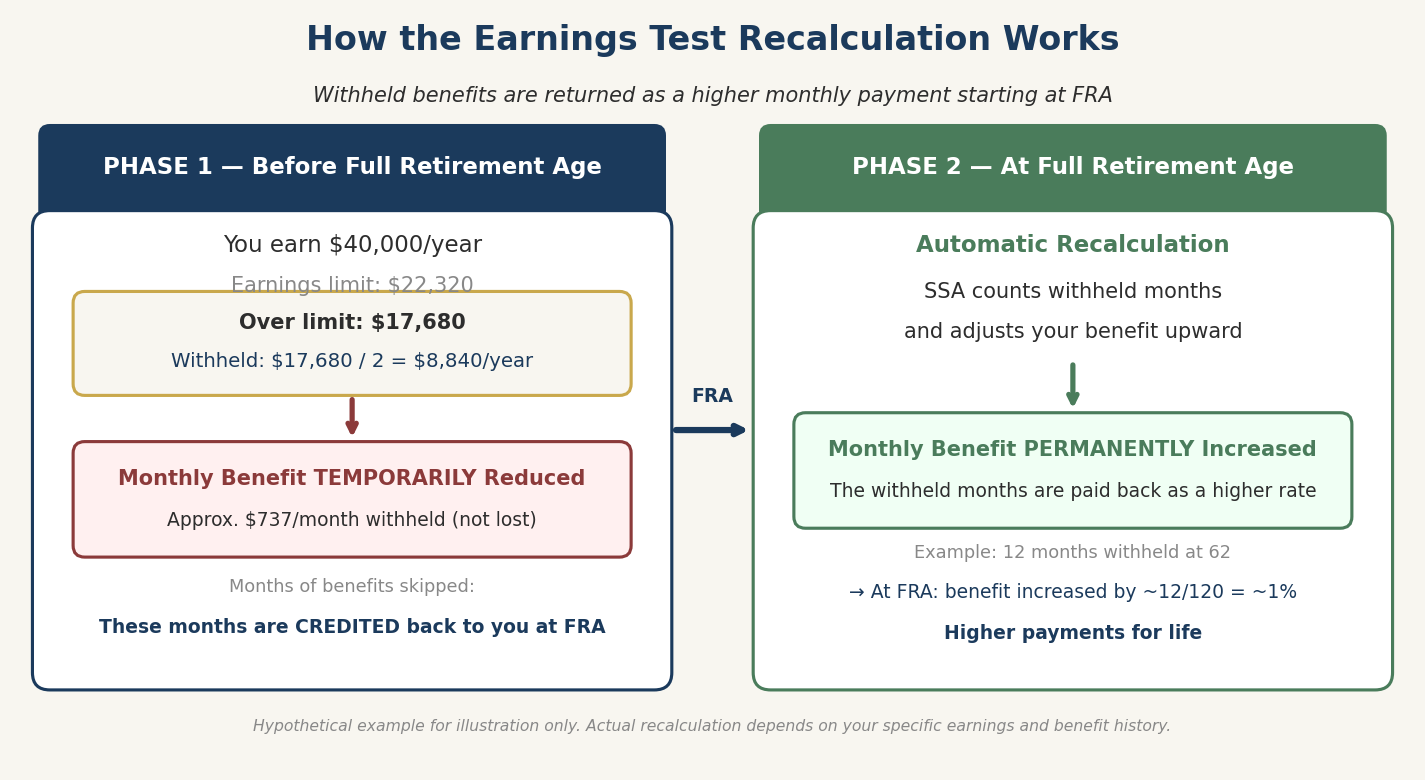
The Social Security earnings test does not permanently reduce your lifetime benefits. Once you reach full retirement age, the SSA recalculates your monthly benefit to account for every month that benefits were withheld.
Here’s how it works: if you had 12 months of benefits withheld due to the earnings test over several years, the SSA recalculates your benefit at FRA as if you had claimed 12 months later than you actually did. Since claiming later means a higher monthly benefit, your check goes up — permanently.
Using Maria’s hypothetical: if she had a total of 18 months withheld between ages 63 and 67, the SSA would recalculate her benefit at age 67 as if she had first claimed at approximately age 64.5 instead of 63. That higher recalculated benefit continues for the rest of her life.
Is the recalculation a perfect dollar-for-dollar recovery? Not exactly — the math depends on your specific benefit amount, how long you live, and the timing of the withholding. But for most people, the recalculation recovers the majority of what was withheld if they live to average life expectancy or beyond.
Thomas’ Take: The earnings test is one of the most misunderstood rules in Social Security, and the misunderstanding leads people to either stop working or not claim benefits — both of which can be costly mistakes. The money comes back. Knowing this should change how you think about working in early retirement.
What Counts as “Earnings” (and What Doesn’t)
This distinction trips up a lot of retirees. The earnings test only applies to specific types of income:
Income that DOES count toward the earnings test:
- Wages from an employer (W-2 income)
- Net earnings from self-employment
- Bonuses, commissions, and vacation pay
- Severance pay (in some cases)
Income that does NOT count:
- Investment income (dividends, interest, capital gains)
- Pension payments
- Annuity income
- Rental income from properties you own
- Retirement account withdrawals (IRA, 401k, Roth distributions)
- Government benefits (other than Social Security)
- Inheritance
This is a critical planning point. A retiree who earns $100,000 from rental properties and withdraws $50,000 from their IRA is completely unaffected by the earnings test. But a retiree who earns $30,000 from a part-time job could see benefits withheld.
The type of income matters — not the amount.
Self-Employment and the Earnings Test
Self-employment adds complexity. The SSA counts net earnings from self-employment — your profit after business expenses, not gross revenue.
If you’re a consultant earning $60,000 in revenue but your net self-employment income after expenses is $22,000, you’re under the $24,480 limit and the earnings test doesn’t apply.
The SSA also has a special rule for the first year of retirement: regardless of your annual earnings, you can receive a full Social Security benefit for any month your earnings are $2,040 or less (in 2026). This monthly test applies only in the first year you’re retired and collecting benefits.
This monthly test helps people who retire mid-year after earning a high salary. Even if your total 2026 earnings are $150,000 because you worked full-time through June, you can still receive full Social Security benefits for July through December if your monthly earnings in those months are each under $2,040.
Should You Work While Collecting Social Security?
The answer for most people is: yes, if you want to, and the earnings test shouldn’t be the reason you stop.
Here’s my decision framework:
Working is usually fine if:
- Your earnings are under the $24,480 threshold (no impact at all)
- You understand that withheld benefits are recalculated and returned at FRA
- You enjoy the work and it provides purpose, social connection, or supplemental income
- The additional earnings help you delay drawing from retirement accounts, preserving that money for later
Consider the full picture if:
- Your earnings significantly exceed the threshold — run the numbers on how much will be withheld
- Additional earned income pushes more of your Social Security into taxable territory (up to 85% can be taxed)
- The extra income triggers IRMAA surcharges on your Medicare premiums
- You’d rather delay claiming Social Security to get a permanently higher benefit instead of dealing with the earnings test
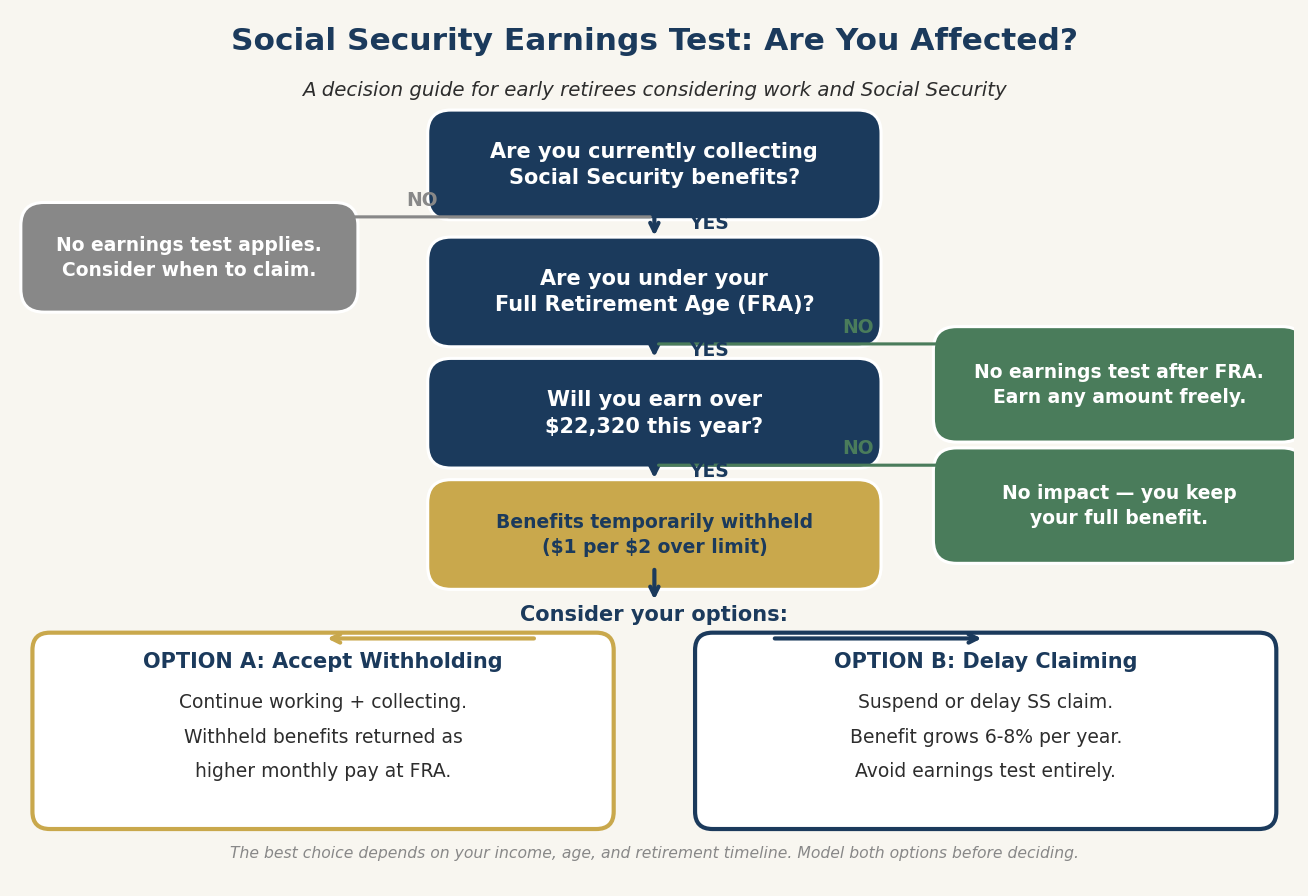
Pro Tip: If you’re under FRA and planning to work, consider whether delaying your Social Security claim altogether might be the better move. Each year you wait between 62 and 70, your benefit grows by 6-8%. You could work, live on your earnings, and let your Social Security benefit grow — avoiding the earnings test entirely while building a larger guaranteed income for later.
FAQ
Does the Social Security earnings test apply to my spouse’s income? No. The earnings test applies only to the individual collecting benefits, based on their own earnings. Your spouse’s income — whether from work, investments, or any other source — has no effect on your earnings test calculation. However, if your spouse is also collecting Social Security early and working, they face their own separate earnings test.
What if I go over the earnings limit by just a small amount? Even going $1 over triggers the reduction. If you earn $24,481 (just $1 over the 2026 limit), you’ll have $1 withheld from your benefits (technically $0.50, rounded). The reduction is proportional — small overages mean small withholdings. But if you’re close to the limit, it may be worth tracking your earnings carefully to stay just under.
Does the earnings test apply to spousal benefits? Yes. If you’re collecting spousal benefits before your full retirement age and you earn income from work, the same earnings test rules apply. Your earnings can reduce your spousal benefit, and the same recalculation at FRA applies.
Can I repay my Social Security benefits and start over if I regret claiming early? Within the first 12 months of claiming, you can withdraw your application and repay all benefits received (including any benefits paid on your record to a spouse or dependents). After 12 months, that option expires. This is essentially a one-time “do-over” that lets you claim again later at a higher benefit.
Is income from a 401(k) or IRA withdrawal subject to the earnings test? No. Retirement account withdrawals — whether from a traditional IRA, Roth IRA, 401(k), or any other qualified retirement plan — are not counted as “earnings” for the Social Security earnings test. Only wages from employment and self-employment income count.
The Earnings Test Isn’t a Penalty — It’s a Timing Adjustment
The Social Security earnings test sounds punitive, but it isn’t. It’s a temporary reduction that gets recalculated and largely returned to you once you reach full retirement age. Understanding this changes the entire decision calculus for early retirees who want to keep working.
The real question isn’t “will my benefits be reduced?” — it’s “given my full financial picture, what’s the smartest way to coordinate my work income, Social Security, and retirement account withdrawals?”
For more on retirement income, bucket planning, and Social Security claiming, browse the retirement planning archive or sign up for the weekly newsletter at the bottom of any page.
This article is published by Confluence Media Group LLC, an independent publisher of educational financial content. Thomas Clark is a Series 65 Investment Advisor Representative. The information provided is for educational and informational purposes only and is not personalized financial, tax, or legal advice. Past performance does not guarantee future results. All investing involves risk, including potential loss of principal. Consult a qualified professional before making financial decisions.
Confluence Media Group LLC is a separate entity from Confluence Capital Management, the investment advisory practice through which Thomas Clark provides advisory services. Advisory services are not offered through this publishing platform.

Thomas Clark is a Series 65 licensed investment advisor and experienced trader. He specializes in investing, retirement planning, and market analysis, helping individuals build wealth and make informed financial decisions.
