
The Trading Journal: What to Track and Why Most Skip It
Most traders can tell you what they made last month but not why. A trading journal closes that gap. Here's what to actually track, and why the traders who need one most are the ones who skip it.
Ask a trader what they made or lost last month and you’ll get an answer to the dollar. Ask them why, and the room goes quiet. Most can point to a number. Almost none can point to a reason.
That gap — between the profit-and-loss line and the actual cause behind it — is the whole reason to keep a trading journal. And it’s also why the traders who need one most are the ones who never keep it. A journal forces you to look at something a P&L statement lets you avoid: whether you’re any good, or whether you just had a good month. Active trading is hard enough that both the SEC and FINRA warn plainly about how few frequent traders come out ahead. A journal is how you get an honest read on which side of those odds you’re actually on.
A trading journal is not a P&L statement
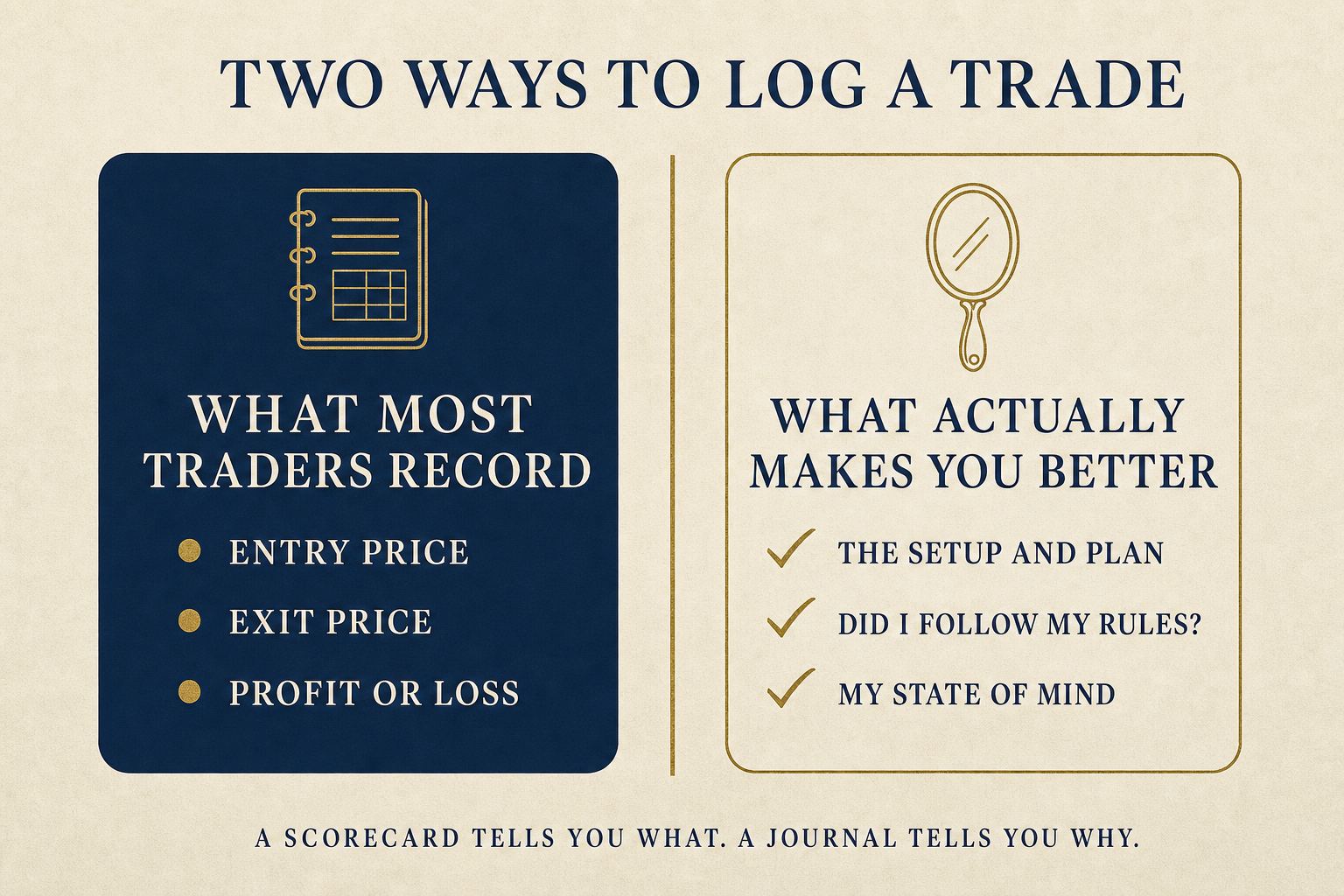
Here’s the first mistake, and it’s nearly universal. Most people think a trading journal is a log of entries, exits, and profit. Bought here, sold there, made or lost this much. They track it faithfully for a few weeks, notice it isn’t telling them anything useful, and quit.
They quit because a list of prices and profits is a scorecard, not a journal. A scorecard tells you what happened. A journal tells you why it happened — the decision you made and the state you were in when you made it. Only one of those two things can be improved. You can’t get better at the market. You can only get better at your own decisions, and you can’t fix a decision you never wrote down.
The market gives you an outcome. The outcome is a blend of your process and plain luck, and on any single trade you cannot tell which is which. A journal is the tool that pulls those two apart over time. That’s its entire job.
Why most traders skip it
If journaling is that valuable, why does almost no one do it? Three honest reasons.
The first is that it’s boring. Placing a trade is exciting; writing three careful sentences about why you placed it is not. The reward for the trade is immediate and the reward for the journal is weeks away, so the journal loses every time willpower is low — which is exactly when you need it.
The second reason is the real one. A journal separates skill from luck, and most traders would rather not know the answer. It’s a lot more comfortable to believe your winning month was skill and your losing month was the market being irrational. Write it all down honestly and you often find the opposite: your best trade broke your own rules and happened to work, and your worst stretch was entirely self-inflicted. That’s a hard mirror to look into. Most people put it down.
The third reason is mechanical. The people who do try usually track the wrong things — prices and P&L, the scorecard again — so the journal never pays them back and they conclude it doesn’t work. It works. They were just writing down the parts that don’t matter.
What to actually track
A useful entry takes about ninety seconds and captures the decision, not just the result. Five fields do almost all the work:
- The setup and thesis. Before you enter: what is the pattern or edge you think you’re trading, in one sentence? If you can’t name it, that’s information — you’re about to take an impulse trade.
- The plan. Your entry, your stop, your target, and your position size — written before the trade, not after. Record your risk as one unit (“R”), the dollar amount you’ll lose if the stop hits. Sizing every trade to a fixed R is the discipline that keeps one bad day from ending your account; it’s worth its own deeper look at position sizing.
- Your state. How you felt going in. Rested or tired, focused or distracted, calm or trying to make back a loss. This is the field nobody records and the field that explains the most.
- The outcome — in R, not just dollars. Did the trade make or lose one R, two R, half an R? Measuring in R instead of dollars strips out account size and lets you compare a trade from last month to one from today on equal footing.
- Did you follow your plan? Yes or no. This single field matters more than the profit or loss. A losing trade you took exactly as planned is a good trade. A winning trade you took on impulse is a bad trade that paid you — which is the most dangerous kind.
Add a marked-up screenshot of the chart if you can. That’s the entire system. Not software — a spreadsheet or a paper notebook you’ll actually fill in beats the most expensive platform you won’t.
The review is where the edge lives
A journal you never reread is a diary. The payoff isn’t in the writing; it’s in the review. Read the week’s entries every weekend and sort each trade into one of four boxes, judged on process and outcome together.
Good process with a good outcome: repeat it. Good process with a bad outcome: accept it. That’s variance, and punishing yourself for a well-taken losing trade only teaches you to abandon the rules that work. Bad process with a bad outcome is the easy fix, because the pain and the cause line up. And then the box that quietly wrecks trading accounts: bad process, good outcome. You broke your rules and got paid for it. Your brain files the reward as skill, and you’ll do it again, bigger, until the day the coin lands the other way. Grading the decision instead of the result is the only thing that inoculates you against that trap. If you want the psychology behind why we do this, I’ve written about the behavioral traps that push us to cut winners and hold losers, exactly backwards.
What a review actually turns up
Consider a hypothetical case. Nathan, 44, is a part-time swing trader in suburban Denver with a $60,000 account he keeps deliberately separate from his retirement money. For a year he tracked only his P&L, and his read on himself was that his strategy was fine but he had bad luck — a run of losers that just wouldn’t quit.
He starts journaling the decision and his state of mind for eight weeks. When he reviews it, the story falls apart in the best way. Grouped together, the trades he took exactly as planned were close to a wash — the strategy wasn’t broken. Nearly all of the damage came from a single cluster of losers that shared one tag in his notes: entered within an hour of a losing trade, sized larger than his plan allowed. He wasn’t unlucky. He was revenge-trading, and only the journal could see it because only the journal recorded his state.
The fix was one rule: no new position for sixty minutes after a loss. He couldn’t have written that rule a year earlier, because a year earlier he didn’t know he needed it. The P&L never told him. This is the same lesson behind why most traders lose money — it’s rarely the strategy, and almost always the structure and the behavior around it.
Thomas’s Take: A journal isn’t there to make you feel good about your trading. It’s there to tell you the truth about it — and the truth is almost always that your process, not the market, decided how you did. The market was going to do what it did with or without you.
The discipline travels
Two things make a trading journal worth the effort long after the novelty wears off. The first is keeping your trading capital walled off from the money you’re actually going to retire on — a line I think matters enough that I’ve argued trading and retirement planning should never mix. The journal is what keeps the trading account honest so the retirement plan never has to bail it out.
The second is that the core habit — write the rule before you act, then judge the decision instead of the outcome — is not really a trading skill. It’s the same discipline that separates a plan from a reaction anywhere in your financial life. It’s what keeps a long-term investor from tearing up a good strategy after one bad quarter, the same way a defined process keeps technical analysis from turning into a story you tell yourself after the fact. You don’t have to place a single trade to use it. You just have to be willing to write down what you decided, and why, before you know how it turned out.
Key Takeaways
- A journal is a mirror, not a scorecard. A P&L tells you what happened; a journal tells you why. Only the “why” can be improved.
- Track the decision and the state, not just the price. Setup, plan, position size in R, how you felt, and whether you followed your rules.
- The most important field is “did I follow my plan?” A losing trade taken by the rules beats a winning trade taken on impulse.
- The review is the point. Sort every trade by process and outcome; the “bad process, good outcome” trades are the ones that quietly do the damage.
- The habit outlives the trading. Judging decisions by process instead of last month’s result keeps any financial plan on track.
Frequently Asked Questions
Do I need special journaling software? No. A spreadsheet or a paper notebook you’ll actually use beats the fanciest platform you won’t. The tool is never the bottleneck — the honesty is. Start simple and only add software once the habit is real.
How many trades before a journal tells me anything? Enough to see a pattern rather than a coincidence — usually a few dozen trades over several weeks. One trade is a story; thirty trades, sorted and reviewed, start to show you what you actually do rather than what you think you do.
Isn’t the cost of all this trading the real problem anyway? Costs are a genuine drag, and they’re worth respecting — commissions, spreads, and the fact that short-term trading gains are taxed at ordinary income rates rather than the lower long-term capital-gains rates (IRS Topic No. 409). But costs are a fixed headwind you can measure. Your own decisions are the variable you can actually change, and the journal is how you find them.
The market doesn’t owe you an explanation for last month. Your journal does. Keep the scorecard if you like — you’ll need it at tax time — but if you want to get better instead of just keeping track, write down the decision and the state of mind behind it, then read it back with the nerve to grade the choice, not the result. That’s the whole practice, and almost nobody does it. Which is exactly why it’s an edge.
This article is published by Confluence Media Group LLC, an independent publisher of educational financial content. Thomas Clark is a Series 65 Investment Advisor Representative. The information provided is for educational and informational purposes only and is not personalized financial, tax, or legal advice. Past performance does not guarantee future results. All investing involves risk, including potential loss of principal. Consult a qualified professional before making financial decisions.
Confluence Media Group LLC is a separate entity from Confluence Capital Management, the investment advisory practice through which Thomas Clark provides advisory services. Advisory services are not offered through this publishing platform.
About Thomas Clark
Thomas Clark is the founder of Confluence Media Group LLC and a Series 65 Investment Advisor Representative. He has spent nearly two decades working with families on retirement planning, with a focus on Social Security optimization, retirement income coordination, and the bucket planning approach to building a guaranteed income floor.
Thomas writes and publishes at thomasclarkadvisor.com and is the author of The Just in Case Binder — a 148-page printable family financial organizer for households who want to make sure the people they love know where everything is.
He lives in North Carolina with his family.
Subscribe to the weekly newsletter · Get the Just in Case Binder

Thomas Clark is a Series 65 licensed investment advisor and experienced trader. He specializes in investing, retirement planning, and market analysis, helping individuals build wealth and make informed financial decisions.
