Retirement & Wealth Planning

Bucket Planning Without a Pension: Building the Income Floor From Scratch

Editorial still-life: three small empty wooden trays lined up left to right at slightly increasing heights, a folded cream paper with a navy-ink architectural foundation diagram, brass building cube blocks, paperweight, leather notebook with navy fountain pen, brass-rimmed cream mug on a warm walnut desk in soft morning light.

Most retirees today aren’t building bucket planning on top of a pension. They’re building the income floor from scratch.

The defined-benefit pension is no longer the standard backstop it once was. According to the U.S. Bureau of Labor Statistics, only about 15% of private-sector workers had access to a traditional pension in 2024 — and far fewer actually retire with one large enough to cover essential expenses. For everyone else, the foundation of bucket planning — that guaranteed income floor in the Soon bucket — has to be built deliberately, piece by piece, from the tools that are actually available.

The good news is those tools exist. The harder part is knowing what to use, in what order, and how big each piece needs to be. That’s what this post is about.

What a pension actually does — and why you can replicate it

A pension is a structural shortcut. Every month, regardless of what the S&P 500 did or how rates moved, a check arrives. That single mechanic — guaranteed monthly income, indifferent to markets — is the foundation that makes bucket planning work. When essential bills are covered by an income floor, the rest of the portfolio is free to act like a long-term growth engine rather than a short-term ATM.

If you don’t have a pension, you don’t get to skip that mechanic. You just have to build it from other materials.

The income-floor target stays the same: cover the essentials — housing, utilities, groceries, insurance, healthcare — from guaranteed sources. The Later bucket then carries the growth weight. Sizing the Soon bucket is the same exercise either way. What changes without a pension is the construction order and the materials list.

Foundation block #1: Social Security as your synthetic pension

For most retirees without a pension, Social Security is the closest thing to one they will ever have. It pays monthly. It adjusts for inflation. It continues for life. And — crucially — its size is partly a decision you control.

The benefit at age 70 is roughly 76% higher than the benefit at 62, per the Social Security Administration’s delayed retirement credit schedule. Every year of delay between full retirement age and 70 adds 8% to the monthly check, and every cost-of-living adjustment then compounds on the higher base.

For a worker whose benefit at full retirement age would be $2,800 per month, claiming at 70 instead lifts that figure to roughly $3,472. Across a 25-year retirement, the lifetime difference is well into six figures — and the surviving spouse, if there is one, inherits the larger number for the rest of their life.

This is why I treat delayed Social Security as the single most powerful pension-substitute decision a pre-retiree without a pension can make. It isn’t free — claiming later means using portfolio assets to bridge the gap — but the trade is buying a larger inflation-adjusted, lifetime-guaranteed income stream in exchange for spending down some of the Later bucket early. That’s exactly the trade bucket planning is built to support.

Foundation block #2: Fixed Index Annuities, used for income

Social Security alone usually doesn’t cover the full essentials line — especially for households with no pension, paid-off mortgages aside. The gap between the Social Security check and the essentials number is where Fixed Index Annuities with guaranteed income riders earn their place in the Soon bucket.

I’ll be specific about the framing here because this is where most retirement content goes wrong. A Fixed Index Annuity, used for income, is a tool to convert a lump sum into a guaranteed monthly check for life. That’s the job. It is not a market substitute. It is not a growth play. The income rider’s payout is contractually defined, and the lifetime guarantee is what you’re buying — full stop.

This is also why variable annuities don’t appear in how I build an income floor. They combine market risk with high fees, which defeats the entire purpose of a guaranteed-income structure. If the income floor is supposed to be the part of the plan that doesn’t move when markets do, layering market exposure and rider costs onto it is the wrong tool for the job. FIAs with income riders preserve the structural promise; variable annuities undermine it.

The sizing math for an FIA income piece is straightforward. Subtract the Social Security benefit (at the age you plan to claim) from the essentials target. The remaining gap is what the income rider needs to cover. Income annuities are typically quoted as a percentage of the deposit, with the percentage varying by issue age and deferral period. A reasonable planning tool to model the trade-off is ProjectionLab, which lets you stress-test different Soon-bucket sizes and FIA deposit amounts against the same long-term portfolio assumptions. (ProjectionLab affiliate disclosure: I may earn a commission if you subscribe through that link. The recommendation is editorial — I use ProjectionLab because it handles guaranteed-income inputs better than most consumer tools.)

Foundation block #3: The Now bucket, doing slightly more work

Without a pension, the Now bucket — short-term cash, money markets, short-duration Treasurys — carries one additional job. It’s not just covering the next 12 to 24 months of spending; it’s also the bridge that lets you delay Social Security and lets the FIA’s deferral period accrue without panic.

For a household claiming Social Security at 70 and starting an FIA income rider at the same age, the Now bucket may need to fund five or more years of essentials before either of those guaranteed streams turns on. That’s a different size than what someone with a pension would carry, because the pension recipient already has guaranteed income flowing during those bridge years.

The rule of thumb I use: when there’s no pension, the Now bucket should hold at least the gap between expected guaranteed income today and expected guaranteed income at your full claim age, multiplied by the years until that claim age. Refilling that bucket then becomes more deliberate, because it’s doing double duty.

A hypothetical: David and Karen, no pension between them

Consider a hypothetical case. David, 63, just retired from a marketing role in suburban Charlotte. Karen, 61, is winding down a freelance design business. Neither has a pension. They have $850,000 across a 401(k) and a Roth IRA, $90,000 in taxable savings, and a paid-off house. Their essentials run roughly $5,400 a month — housing carrying costs, utilities, groceries, insurance, healthcare.

Their Social Security statements show David’s benefit at full retirement age (67) at $2,900 per month and Karen’s at $1,700. If they both claim at 67, combined Social Security covers $4,600 — leaving a $800-per-month gap to fill.

Now look at the alternative. David delays to 70, claiming approximately $3,596 per month. Karen claims at 67. Combined Social Security at that point covers $5,296 — almost the entire essentials line, with only a $100-or-so gap.

To bridge the seven years from now until David’s age 70, the Now bucket needs to carry roughly $5,400 × 12 × 7 = $453,600, minus Karen’s eventual Social Security starting at her 67. After accounting for Karen’s benefit kicking in at year six, the bridge requirement settles around $360,000 — uncomfortably close to half the portfolio.

That’s where the FIA layer becomes interesting. A guaranteed-income FIA purchased today with a $150,000 deposit, deferring for seven years to David’s age 70, might provide a contractually defined lifetime income stream that, combined with delayed Social Security, fully covers essentials with margin to spare. The Now bucket size drops because guaranteed-income arrival is closer and larger. The Later bucket — the remaining roughly $550,000 — stays fully invested for the long horizon, doing the job it’s supposed to do.

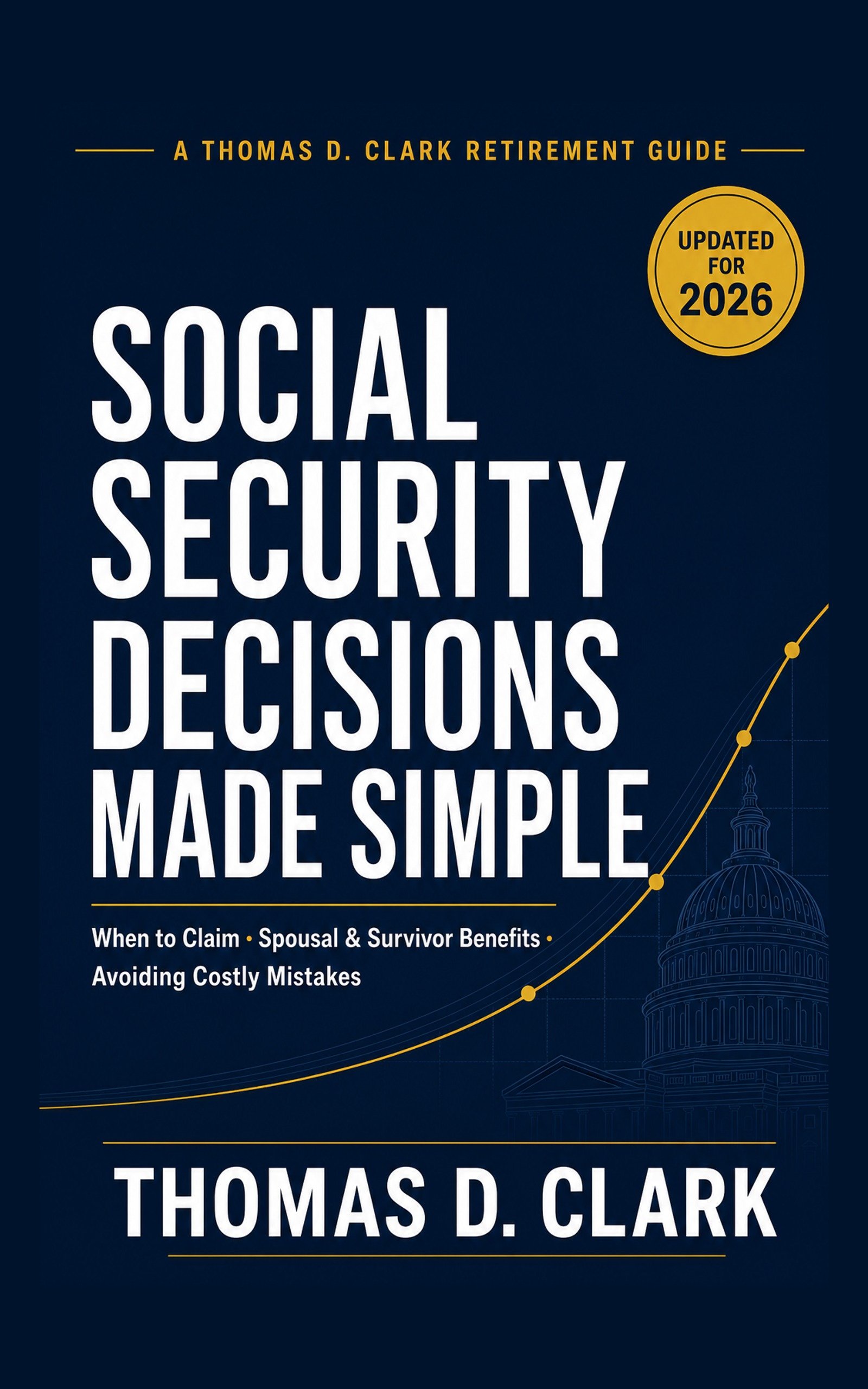
Free Download: Social Security Optimization Guide

Learn the strategies that could maximize your lifetime Social Security benefits.

Get Your Free Copy

That’s bucket planning without a pension. Not as elegant as inheriting a defined-benefit check at retirement, but structurally the same idea: cover essentials with guaranteed income, let the rest grow.

The four questions to answer before you start building

Building an income floor from scratch is a decision-rich project, not a one-shot purchase. Before placing any of the building blocks above, work through these four questions.

What’s the actual essentials number? Pull twelve months of spending and separate non-negotiable from discretionary. The income-floor target covers the first column, not the second. People consistently overstate this number because they include items that would adjust if income tightened.

When does Social Security maximize the household’s lifetime benefit? For most couples, this is a coordination question, not just an individual one. The higher earner delaying often does more for the surviving spouse than for the claimant. Run the math with the survivor scenario explicitly modeled, not just the joint-lifetime number.

How much of the gap should be filled with a guaranteed-income tool, and how much should be left to dynamic Later-bucket withdrawals? The answer depends on essentials size, household risk tolerance, and how confident you are in the Later bucket’s ability to absorb a bad sequence. A larger guaranteed floor reduces sequence-of-returns vulnerability; a smaller one preserves more upside and inheritability. There is no single right ratio.

What’s the bridge plan between today and the day guaranteed income arrives? This is the Now-bucket sizing question, but it’s also a portfolio-construction question — the bridge dollars probably shouldn’t be in the same allocation as the long-horizon Later bucket.

Key takeaways

  • A pension is a structural shortcut to a guaranteed income floor. Without one, the floor still gets built — it just takes more deliberate engineering.
  • Delayed Social Security is the most powerful pension-substitute decision most pre-retirees have access to. The lifetime difference between claiming at 62 and 70 is roughly 76% per the SSA’s delayed retirement credit schedule.
  • Fixed Index Annuities with income riders fit the Soon bucket when used for guaranteed income. Variable annuities don’t belong in the floor — they reintroduce the market risk the floor is supposed to remove.
  • The Now bucket has to do more work without a pension. It funds the bridge years between today and the day Social Security and any FIA income riders turn on.
  • A hypothetical household with $850,000 and no pension can still build a credible income floor by combining delayed Social Security, a measured FIA deposit, and a deliberately sized Now bucket — leaving the bulk of the portfolio invested for the Later bucket’s long horizon.

FAQ

Q: Doesn’t an FIA income rider cost a lot in fees?

Income riders carry an explicit annual fee, usually deducted from the contract’s accumulation value rather than from the lifetime income payment. The relevant comparison isn’t “fee versus no fee” — it’s “fee versus the cost of trying to manufacture the same guaranteed lifetime income from a portfolio alone.” For households that need a hard income floor, the rider fee is the price of removing sequence risk from that portion of the plan. Whether that’s worth it depends on the household’s essentials gap and risk tolerance, which is exactly what the four questions above are designed to surface.

Q: Why not just use a 4% systematic withdrawal instead of building this floor?

The 4% rule is a portfolio sustainability heuristic, not an income guarantee. It assumes you can keep selling assets in a down year — which is precisely when selling does the most damage. A bucket structure separates the “what to spend” question from the “what to sell” question, and a guaranteed income floor takes the worst version of sequence risk off the table entirely. Without a pension, building that floor manually is more work than inheriting one — but the protection is the same.

Q: What if I have a small pension that doesn’t cover essentials?

A partial pension is still a head start. It reduces the FIA and Social Security work that would otherwise be needed to close the gap. The companion post on bucket planning with a pension covers the math for that case; the structural logic is the same, just with one of the building blocks already in place.


This article is published by Confluence Media Group LLC, an independent publisher of educational financial content. Thomas Clark is a Series 65 Investment Advisor Representative. The information provided is for educational and informational purposes only and is not personalized financial, tax, or legal advice. Past performance does not guarantee future results. All investing involves risk, including potential loss of principal. Consult a qualified professional before making financial decisions.

Confluence Media Group LLC is a separate entity from Confluence Capital Management, the investment advisory practice through which Thomas Clark provides advisory services. Advisory services are not offered through this publishing platform.


About Thomas Clark

Thomas Clark is the founder of Confluence Media Group LLC and a Series 65 Investment Advisor Representative. He has spent nearly two decades working with families on retirement planning, with a focus on Social Security optimization, retirement income coordination, and the bucket planning approach to building a guaranteed income floor.

Thomas writes and publishes at thomasclarkadvisor.com and is the author of The Just in Case Binder — a 148-page printable family financial organizer for households who want to make sure the people they love know where everything is.

He lives in North Carolina with his family.

Subscribe to the weekly newsletter · Get the Just in Case Binder

Thomas Clark

Thomas Clark

Senior Lead Wealth Advisor | Fiduciary

Thomas Clark is a fiduciary financial advisor at Confluence Capital Management with nearly 20 years of experience. He specializes in retirement income planning and Social Security optimization.

More About Thomas