
Geopolitics and Your Retirement Portfolio: When It Actually Matters
Most geopolitical news doesn't move retirement portfolios — and the bucket architecture already absorbs the noise. Here's how to tell when geopolitics actually matters, and the two adjustments that are usually appropriate when it does.

Over the last three months, I’ve gotten the same question in three different forms.
“Should I sell because of what’s happening with Iran?” “Are defense stocks the move right now?” “How worried should I be about oil at $110?”
The honest answer is the one most market headlines don’t want you to hear: for a properly built retirement portfolio, almost none of this matters in the way the news is presenting it. The pieces that do matter look very different from the pieces the network anchors are pointing at.
This is a rule worth holding tightly through any geopolitical event, because the next one is always coming. So let’s walk through it carefully — what geopolitical news actually does to a retirement portfolio, when the noise becomes signal, and what the Now/Soon/Later architecture already absorbs without you doing anything.
The default answer is “do nothing”
The data on this is unromantic but consistent. Pull up a chart of the S&P 500 across the last forty years and overlay every major geopolitical event — the 1990 Gulf War, 9/11, the 2003 Iraq invasion, the 2014 Crimea annexation, the 2022 Ukraine invasion, the 2025–26 Iran escalations. The pattern is almost always the same shape: a sharp drop in the first one to three weeks, partial recovery within a month, and the original cause becoming hard to detect in the price chart by month six.
That’s not an opinion. Research from the Federal Reserve Bank of San Francisco and others has shown that median S&P drawdowns across post-WWII geopolitical shocks tend to land in the mid-single digits, with recoveries measured in weeks rather than quarters. Some events are worse — 2022’s Ukraine shock layered on top of an existing inflation and rate-hike cycle, and took longer to absorb. Some barely register — the 2014 Crimea event was a sub-2% drawdown that recovered within a week.
The reason this happens is structural. Geopolitical shocks are surprises by definition, so prices reset quickly once the surprise is priced in. They don’t change corporate earnings six quarters out the way a recession does, and they don’t change the discount rate the way the Fed does. They just change today’s mood.
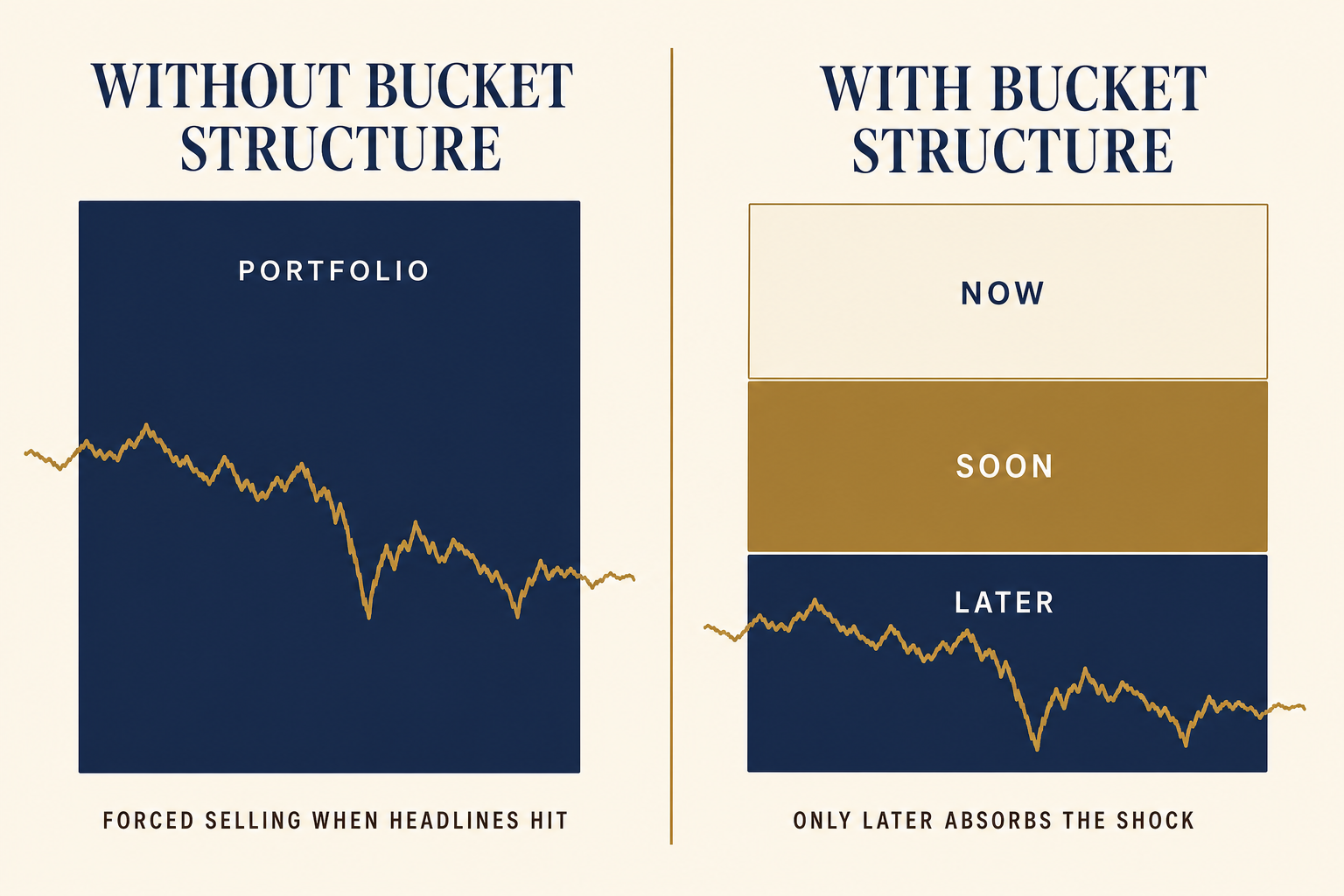
For a retiree drawing from a properly structured bucket plan, the mood doesn’t get to your kitchen table. The Now bucket is in cash and short-duration instruments. The Soon bucket is delivering guaranteed income from Social Security, a pension if you have one, or income-rider annuity payments. The Later bucket is the only part of the portfolio that even sees the headline drawdown — and the Later bucket has a job description that includes weathering exactly this kind of event.
The discipline isn’t sophisticated. It’s: don’t sell the Later bucket to pay this month’s groceries. The bucket architecture means you never had to.
The three cases when geopolitics actually matters
Default-to-do-nothing isn’t the whole answer, though, because some events do rewrite the rules. They’re rarer than the headlines suggest, but they exist, and they share a common shape.
Case one: a sustained supply-chain disruption that changes the structural cost of something a retiree actually buys. The 1973 oil embargo did this. The post-2022 European energy rerouting did this. The current Strait of Hormuz situation could — that one narrow passage handles roughly 20% of global oil shipments, according to the U.S. Energy Information Administration, and a multi-quarter disruption would mean structurally higher gasoline, electricity, and shipping-driven goods prices for as long as the routing remains broken. That isn’t a stock-market problem. That’s a retiree-budget problem. The portfolio doesn’t need to change. The Now-bucket cash buffer and the inflation assumption in the plan might.
Case two: a regime-level change in trade or sanctions that closes off a major end market. This is what the U.S.–China decoupling has been doing slowly for several years. It changes which companies have which revenue, which supply chains are commercially viable, and which sectors carry which risks. A retiree with a broadly diversified equity index is mostly insulated from this — the index reweights as the underlying companies’ fundamentals shift. A retiree with concentrated single-stock or single-country exposure isn’t insulated, and that concentration is the real problem the geopolitics surfaced.
Case three: a currency or reserve-status shift. This is rare and slow, but it’s the kind of thing that genuinely matters. The end of the gold standard. The rise of the euro. The slow internationalization of the renminbi. These shifts change the long-term real return profile of holding U.S. dollars, U.S. Treasuries, and U.S.-domiciled assets. Most retirees aren’t doing anything about this on a one-week horizon and shouldn’t be. But it’s a real risk to track at the level of “where is the income floor denominated, and is some of it diversified outside of one currency regime.”
Notice what’s not on the list. Headlines about troop movements. Daily oil-price ticks. Defense-stock rallies that journalists chase a day late. Cable-news countdowns to the next vote, summit, or strike. None of these are decision-grade information for a retirement portfolio. They’re entertainment.
What bucket planning already absorbs
The reason I keep pulling the answer back to bucket structure is because the architecture is the response. You don’t react to geopolitics — you’ve already pre-reacted to it, by building a plan that survives a few quarters of market disruption without forcing you to sell anything.
Consider a hypothetical case: Helen, 68, in Asheville. She has roughly $740,000 across a 403(b) and a small Roth, Social Security paying $2,800 a month after she claimed at 70, and a modest TIAA pension covering another $1,400. Her essentials run about $5,000 a month. The Now bucket holds about 18 months of expenses in a money market and a short-term Treasury ladder. The Soon bucket is the Social Security and pension income, with a small income-rider annuity layered on top. The Later bucket is the rest, sitting in a 65/35 stock/bond mix.
Iran escalates. Brent goes to $115. The S&P drops 12% in three weeks. Helen calls and asks if she should do anything.
The honest answer is: no, and that’s the point. Her grocery money this month comes out of the Now bucket and is unrelated to the S&P. Her gas bill rising 30% comes out of the Now bucket too, and her plan already had a 3% inflation assumption that gives her room to absorb a temporary supply-cost spike. Her Social Security check arrives on the same date as always, and the COLA next January will catch up to whatever the inflation print delivers. The Later bucket is down on paper. She doesn’t have to look at it. Six to twelve months from now, if the original drawdown still hasn’t recovered, the Later bucket will be the source of the year’s annual refill to the Now bucket — at which point she’ll do a clear-eyed sell with a 12-month time horizon, not a panicked sell with a 12-hour one.
Same family, same dollars, same news. Without the bucket architecture, the call sounds different. “Should I sell now? Should I move to cash? Should I buy defense stocks?” Those are the questions you have to answer when your monthly grocery money is structurally linked to whatever the S&P did this week. They’re the wrong questions, but they’re forced questions if the plan is built that way.
Two real moves that are usually appropriate
I don’t want to give the impression that the right answer to every geopolitical event is to stare at the ceiling. There are two adjustments that often do make sense.
The first is reviewing your Now bucket size. If the world looks like it’s entering a multi-quarter disruption — sustained supply-chain stress, a slow-rolling sanctions regime, persistent oil-price elevation — extending the Now bucket from a typical 18 months to something closer to 24 or 30 is a defensible structural move. It costs you a little in opportunity cost on the cash. It buys you more runway for the Later bucket to recover on its own timeline. That’s a one-time structural adjustment, not a market call. The framing I keep returning to is the same one I wrote up in the post on refilling the Now bucket — the rule is set in advance, not reactively.
The second is rebalancing the Later bucket inside its own allocation, not out of it. If a sustained event has driven energy or defense stocks sharply higher relative to the rest of the equity market, that’s a moment when the rebalance threshold inside the Later bucket might tell you to trim winners and add to laggards. You’re not making a geopolitical bet — you’re enforcing the allocation policy you already wrote down before the event began. That’s the rebalancing version of “build the defense before you need it,” and it’s the same logic that runs underneath the sequence of returns defenses I’ve written about for the bad-year case.
What I’d avoid: sector-specific bets driven by the news cycle. Buying defense stocks because a brokerage upgraded them is the textbook example of the trade journalists describe one week and the market priced in three weeks earlier. The retail investor who reads the upgrade is, structurally, the exit liquidity for the institutional positions that were built before the headlines. I made the same case from a different angle in the recent piece on whether sector rotation belongs in a retirement portfolio — the timing problem is the same problem, dressed in different clothes.
Run your own numbers against the bad scenario
One adjustment I genuinely recommend is stress-testing your own bucket plan against a geopolitical-drawdown scenario before you’re inside one. What happens to your withdrawal sustainability if the Later bucket drops 25%? If essentials inflation runs 5% for two years on top? If oil-driven category inflation cuts your discretionary travel line in half for eighteen months while your healthcare line keeps compounding?
These are answerable questions, but only with a modeling tool that lets you run real scenarios against your actual numbers. ProjectionLab is the one I use for this kind of scenario work — it lets you model the bucket architecture, layer in a market shock, and watch what happens to the withdrawal sustainability across thirty years rather than reacting to a single bad week. Disclosure: that’s an affiliate link. I receive a small commission if you subscribe, at no extra cost to you. I only recommend tools I actually use.
The frame I keep coming back to
Markets are not the world. They’re the priced expectations of corporate cash flows over years and decades, run through a discount rate and the mood of the marginal buyer this week. Geopolitical events change the mood of the marginal buyer this week. They occasionally change the priced expectations of corporate cash flows over the next few years. They rarely change the underlying real economy in a way that requires a retirement portfolio to be rebuilt.
The bucket architecture pre-answers nearly all of this. You built a guaranteed income floor that doesn’t ask the S&P’s permission to pay your essentials. You built a Now bucket that absorbs eighteen months of disruption without forcing a single sale. You built a Later bucket whose job description includes the bad quarters, and the post on the Now/Soon/Later framework walks through that division of labor in detail if you want to revisit the foundation piece.
When a geopolitical event hits, the first thing to check is not the news. It’s the plan. If the plan is sound, the news is information about the world — not instructions to your portfolio.
This article is published by Confluence Media Group LLC, an independent publisher of educational financial content. Thomas Clark is a Series 65 Investment Advisor Representative. The information provided is for educational and informational purposes only and is not personalized financial, tax, or legal advice. Past performance does not guarantee future results. All investing involves risk, including potential loss of principal. Consult a qualified professional before making financial decisions.
Confluence Media Group LLC is a separate entity from Confluence Capital Management, the investment advisory practice through which Thomas Clark provides advisory services. Advisory services are not offered through this publishing platform.
About Thomas Clark
Thomas Clark is the founder of Confluence Media Group LLC and a Series 65 Investment Advisor Representative. He has spent nearly two decades working with families on retirement planning, with a focus on Social Security optimization, retirement income coordination, and the bucket planning approach to building a guaranteed income floor.
Thomas writes and publishes at thomasclarkadvisor.com and is the author of The Just in Case Binder — a 148-page printable family financial organizer for households who want to make sure the people they love know where everything is.
He lives in North Carolina with his family.
Subscribe to the weekly newsletter · Get the Just in Case Binder

Thomas Clark is a Series 65 licensed investment advisor and experienced trader. He specializes in investing, retirement planning, and market analysis, helping individuals build wealth and make informed financial decisions.
