
Bucket Planning vs. the Three-Fund Portfolio
The three-fund portfolio tells you what to own. Bucket planning tells you what to sell, and when. Here is why you don't have to choose between them.

Spend ten minutes in an online investing forum and someone will tell you the three-fund portfolio is all any investor ever needs. Spend ten minutes at a retirement workshop and you’ll hear that you need buckets — Now, Soon, and Later — to survive the move into retirement. Each camp is convinced the other is overcomplicating things. They’re both right, and they’re mostly arguing past each other.
Here’s the reframe that ends the argument. The three-fund portfolio and bucket planning answer two completely different questions. One tells you how to invest a dollar. The other tells you how to structure a dollar you’re about to spend. Confuse the two and you’ll either over-engineer your savings in your thirties or walk into retirement with a portfolio that has no plan for a bad year.
What the three-fund portfolio actually is
The three-fund portfolio is exactly what it sounds like: a total U.S. stock index fund, a total international stock index fund, and a total U.S. bond index fund. That’s the whole thing. You pick a stock-to-bond ratio you can live with, hold those three broad funds, rebalance once in a while, and ignore the noise. It grew out of the Bogleheads community and the low-cost indexing philosophy Jack Bogle spent his career defending.
I have nothing bad to say about it. For the years when you’re building wealth, it’s one of the best answers anyone has ever devised to the question “how should I invest my money?” It gives you broad diversification, rock-bottom costs, and — maybe most valuable of all — almost nothing to tinker with. No stock picking, no manager who might underperform, no clever tactical moves to get wrong. If a 32-year-old asked me where to put their 401(k), “three low-cost index funds and leave it alone” would be close to the top of the list of things I’d want them to understand.
What bucket planning actually is
Bucket planning is a different animal, and this is where the confusion starts: it is not an asset-allocation strategy. It’s a withdrawal-structure and behavior strategy. It sorts your money by when you’ll spend it, not by what it’s invested in.
The Now, Soon, and Later framework splits retirement money into three jobs. The Now bucket holds one to three years of living expenses in cash and short-term instruments, so your next grocery run never depends on the stock market. The Soon bucket builds a guaranteed income floor from Social Security, any pension, and — where it fits — an income-focused fixed index annuity, so your essential bills are covered by checks that arrive no matter what markets do. The Later bucket is your growth engine, invested for the long haul.
Notice what bucket planning never tells you: which specific funds to own in that Later bucket. That’s not its job. Its job is to change your relationship to a market drop.
They answer two different questions
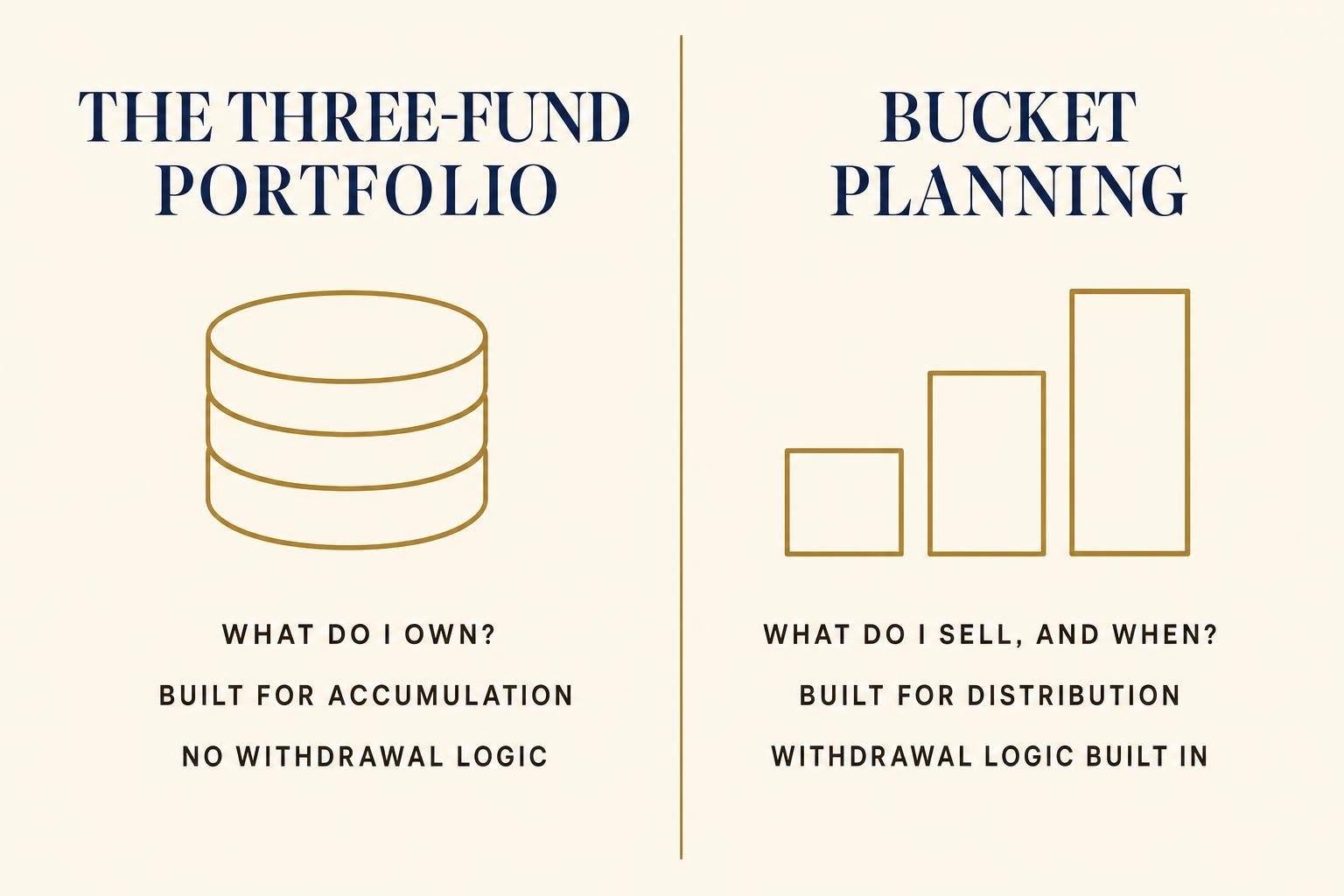
Here’s the cleanest way I can put it. A three-fund portfolio answers “what do I own?” Bucket planning answers “what do I sell, and when?”
While you’re still working and saving, that second question barely exists. You’re not selling anything — you’re buying, every payday, and a downturn is simply a sale on shares. Sequence-of-returns risk, the danger that a bad stretch early in retirement does outsized damage, is a non-issue when you have no withdrawals to fund. This is exactly why the three-fund portfolio feels so complete during the accumulation years. The only question that matters is “what do I own,” and it answers that beautifully.
The day you retire, the second question moves to the front of the room. Now you’re selling to eat, and the order and timing of those sales suddenly matter more than almost anything else. Sequence-of-returns risk stops being an abstraction and becomes the thing that can quietly wreck an otherwise well-built plan.
Where a pure three-fund portfolio quietly fails a retiree
The three-fund portfolio has no withdrawal logic built into it. It tells you what to own and nothing about what to do when you need income. So retirees bolt a rule onto the side of it — usually some version of the 4% rule — that says sell a slice every year regardless of what just happened in the market.
In a good year, that’s harmless. In the first year of a 30% decline, it means selling shares at the bottom to buy groceries — turning a temporary paper loss into a permanent one, and doing it with the shares you needed most for the decades ahead. According to decades of market history and the work FINRA has published on diversification and drawdown risk, markets recover far more often than not — but “far more often than not” is cold comfort if you were a forced seller at the low.
There’s a behavioral failure hiding underneath the math, too. Rebalancing a 60/40 portfolio during a crash — selling bonds to buy more stocks at the exact moment everything is red — is trivially easy on a spreadsheet and genuinely hard when it’s your rent money on the line. A structure that only works if you stay perfectly rational in the worst moments isn’t really a structure. It’s a hope.
Thomas’ Take: The three-fund portfolio doesn’t fail because the funds are wrong. It fails because a great answer to “what do I own” gets asked to do a job it was never built for — decide what you sell in a down market. That’s a bucket question, and no fund lineup answers it.
You don’t have to choose — the Later bucket is a three-fund portfolio
This is the part both camps miss. Buckets are a container. The three-fund portfolio is what you put in the biggest one. They aren’t competitors any more than a house is a competitor with the furniture inside it.
Consider a hypothetical case: Ron and Cheryl, both 64, just retired, with $900,000 sitting in a classic three-fund portfolio and about $5,000 a month in essential expenses. The purist answer is to keep the whole $900,000 invested and withdraw from it every year. The bucket answer doesn’t throw the portfolio out — it gives it a job.
They carve out roughly two to three years of essentials into a Now bucket of cash and short-term bonds. They build the Soon bucket by planning to delay Social Security toward 70 for the larger, survivor-protected benefit, bridging the gap from the Now bucket, and — if the numbers call for it — adding an income-focused annuity to cover the piece Social Security doesn’t. What’s left, still invested in those same three index funds, becomes the Later bucket. Now a 30% drop in the Later bucket doesn’t touch their grocery money for years, which means they’re never forced to sell into the fall. The three-fund portfolio didn’t change. Its context did.
The trade-offs here — how much to hold in cash, when to claim, how big an income floor to build — are exactly the kind of thing worth modeling before you commit. A tool like ProjectionLab lets you run your own portfolio against different withdrawal orders and claiming ages and see how the ending balance and the “do I run out” risk actually move. (ProjectionLab is an affiliate partner; if you subscribe through that link, Confluence Media Group may earn a commission at no additional cost to you. I only point readers toward tools I’d actually use.) If you want to go a layer deeper, which accounts hold which funds matters too — but that’s a refinement on top of the structure, not a replacement for it.
When the three-fund portfolio alone is the right answer
I don’t want to leave the impression that everyone needs buckets. If you’re 35 and decades from retirement, bucket planning is mostly noise for you right now. You have exactly one job — keep buying — and the three-fund portfolio is about as good a vehicle for that job as exists. Building a Now bucket and shopping for an income floor at 35 would be solving a problem you won’t have for thirty years, at the cost of growth you can’t get back.
Buckets earn their keep in the years around the retirement transition — roughly the last five working years and the first five of retirement, when the first big withdrawals collide with the largest portfolio you’ll ever have. That’s when “what do I sell, and when” goes from a non-issue to the whole game. Bring distribution-phase machinery to an accumulation-phase problem and you just slow yourself down. Bring accumulation-phase thinking into distribution and you expose yourself to the one risk that can’t be diversified away.
The bottom line
The three-fund portfolio isn’t wrong. It’s a brilliant answer to a question retirees have quietly stopped asking. While you’re building wealth, “how should I invest?” is the only question that really matters, and three low-cost index funds answer it about as well as anything ever has. The day you start living off the money, a second question takes over: “what do I sell when the market is down?” Bucket planning exists to answer that one.
So don’t retire the three-fund portfolio when you retire. Give it a bucket, a job, and a buffer — so that when the next bad year arrives, it can do the one thing it does best without forcing you to sell into the fall.
Key Takeaways
- The three-fund portfolio answers “what do I own.” Bucket planning answers “what do I sell, and when.” They’re not competitors.
- During accumulation, the withdrawal question barely matters, which is why a three-fund portfolio feels complete. At retirement, that question becomes the whole game.
- A pure three-fund portfolio has no withdrawal logic, so retirees bolt on a rigid rule that can force selling into a downturn — the exact risk bucket planning is built to prevent.
- The cleanest solution is both: keep the three-fund portfolio as your Later bucket, and add a Now bucket and a guaranteed income floor around it.
Frequently Asked Questions
Is bucket planning just a three-fund portfolio with extra steps?
No — they solve different problems. A three-fund portfolio decides how your money is invested. Bucket planning decides how your money is structured for spending, so a market drop doesn’t force you to sell at the wrong time. You can, and often should, use both at once.
Can I keep my three-fund portfolio inside the Later bucket?
Yes, and that’s frequently how it’s done. The buckets are a framework for organizing withdrawals; the Later bucket is your long-horizon growth money, and a low-cost three-fund portfolio is a perfectly reasonable thing to hold there. Bucket planning wraps structure around the portfolio rather than replacing it.
Do younger investors need buckets yet?
Generally not. If retirement is decades away, you have no withdrawals to protect and sequence-of-returns risk isn’t your problem. Buckets start to matter in the five to ten years around the retirement transition, when your first withdrawals meet your largest-ever balance.
This article is published by Confluence Media Group LLC, an independent publisher of educational financial content. Thomas Clark is a Series 65 Investment Advisor Representative. The information provided is for educational and informational purposes only and is not personalized financial, tax, or legal advice. Past performance does not guarantee future results. All investing involves risk, including potential loss of principal. Consult a qualified professional before making financial decisions.
Confluence Media Group LLC is a separate entity from Confluence Capital Management, the investment advisory practice through which Thomas Clark provides advisory services. Advisory services are not offered through this publishing platform.
About Thomas Clark
Thomas Clark is the founder of Confluence Media Group LLC and a Series 65 Investment Advisor Representative. He has spent nearly two decades working with families on retirement planning, with a focus on Social Security optimization, retirement income coordination, and the bucket planning approach to building a guaranteed income floor.
Thomas writes and publishes at thomasclarkadvisor.com and is the author of The Just in Case Binder — a 148-page printable family financial organizer for households who want to make sure the people they love know where everything is.
He lives in North Carolina with his family.
Subscribe to the weekly newsletter · Get the Just in Case Binder

Thomas Clark is a Series 65 licensed investment advisor and experienced trader. He specializes in investing, retirement planning, and market analysis, helping individuals build wealth and make informed financial decisions.
