
The Disabled Adult Child Benefit Most Families Never Claim
When a parent claims Social Security, an adult child disabled before age 22 may qualify for a lifelong benefit on that parent's record. Here's how the disabled adult child benefit works, who qualifies, and why your claiming decision controls when it starts.

If you have a son or daughter who was disabled before they ever had a chance to build a work record, the day you claim Social Security may do far more than start your own check. On the same record, in the same month, it can open a benefit that follows your child for the rest of their life.
Most people have never heard of it. It goes by a few names — the disabled adult child benefit, the Childhood Disability Benefit, or just “DAC” in Social Security’s own shorthand. Whatever you call it, it is one of the most overlooked provisions in the entire program, and the families who need it most are usually the last to find out it exists. Social Security even publishes a plain-language booklet on it, Benefits for Children With Disabilities, that most parents have never seen.
Here is how it works, who qualifies, and why your claiming decision matters more than you’ve been told.
What the disabled adult child benefit actually is
Social Security pays benefits to the dependents of workers, not just the workers themselves. A minor child of a retired worker, for example, can collect a benefit until age 18. Most people know that part.
What they don’t know is that there’s no upper age limit when the child has a qualifying disability that began in childhood. An adult in their 30s, 40s, or 50s can draw a monthly benefit on a parent’s earnings record — the parent’s, not their own — because the law treats them, for this one purpose, as a dependent child who never aged out.
The benefit doesn’t pay on your child’s nonexistent or minimal work history. It pays on yours. That’s the whole point: it’s designed for people who were never able to earn a Social Security record of their own because their disability started too early.
The three doors that all have to open
Three conditions have to line up at the same time. Miss one and the benefit isn’t available — which is exactly why so many eligible families are told “no” by someone who only checked one door.
One: the disability began before age 22. This is the defining rule. The disability doesn’t have to have been diagnosed or documented by 22, but it has to have started before then and meet Social Security’s adult definition of disability. A person who became disabled at 35 does not qualify on a parent’s record, no matter how severe the condition.
Two: the parent is “entitled” on their own record. The benefit can begin when a parent starts collecting Social Security retirement or disability benefits — or when the parent dies, having worked enough to be insured. This is the door your claiming decision controls. Until you file, the child’s benefit on your record simply doesn’t exist yet.
Three: the adult child is unmarried. With narrow exceptions, marriage ends eligibility. I’ll come back to this one, because it’s where good intentions cause the most damage.
How much it pays — and the ceiling nobody mentions
The amount is built on your primary insurance amount, or PIA — the benefit you’d receive at your full retirement age. (If the term is new to you, I walk through how that number is built in how your Social Security benefit is actually calculated.)
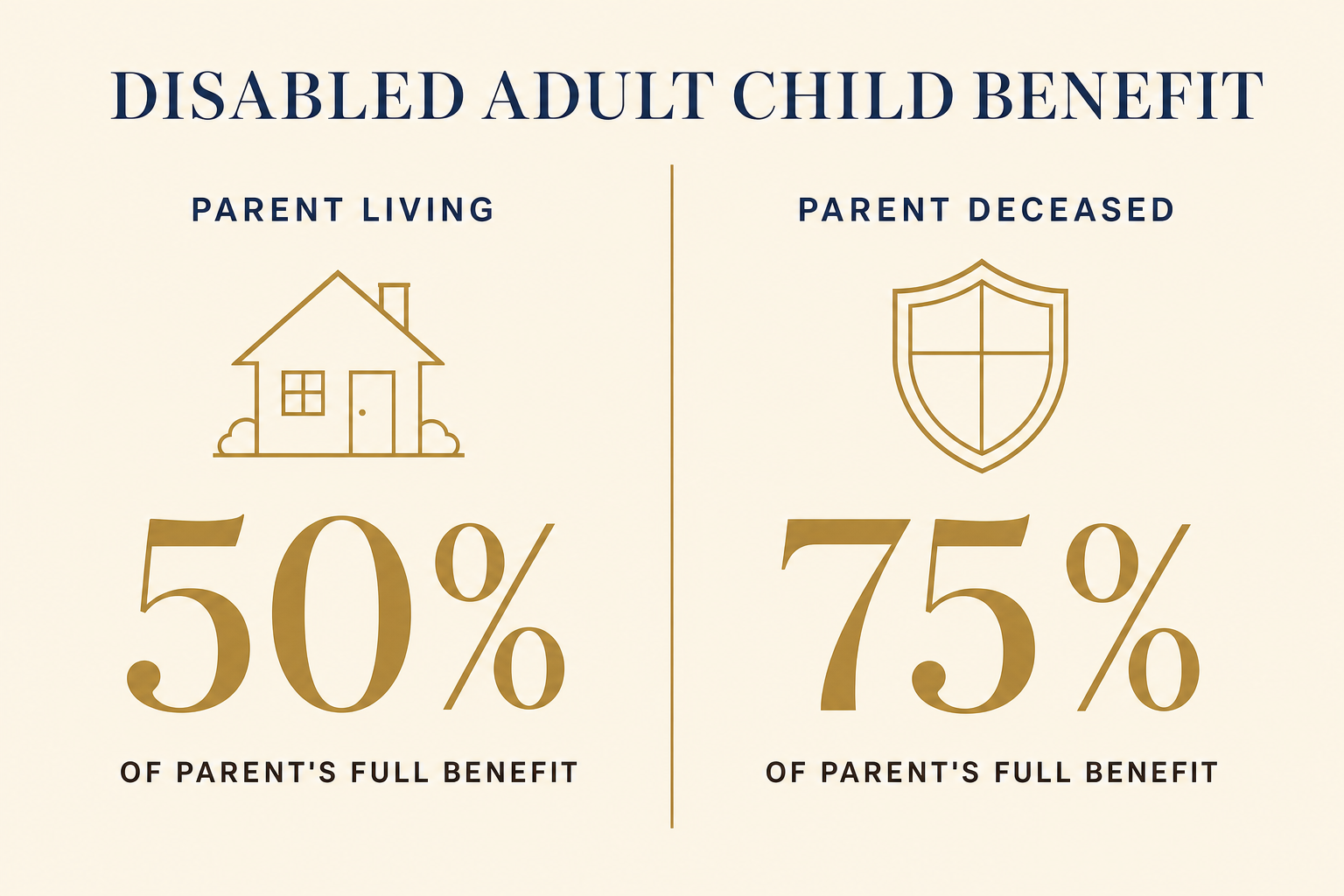
While you’re alive and collecting, a disabled adult child is generally entitled to one-half of your PIA. If you’ve died and the benefit is paid as a survivor benefit, it rises to three-quarters of your PIA. That survivor rate is a feature, not a typo: the benefit is often larger after the parent is gone, precisely when the family’s own support ends.
There is a ceiling, though, and it’s the detail most articles skip. Social Security caps the total paid to everyone drawing on one worker’s record — roughly 150% to 188% of your PIA, depending on your numbers. This is the family maximum. If you, a spouse, and a disabled adult child are all collecting on the same record, the family maximum can trim each dependent benefit so the total stays under the cap. It rarely zeroes anyone out, but it’s why the arithmetic on paper and the arithmetic in the deposit can differ.
A hypothetical that shows the stakes
Consider a hypothetical case. Linda is 64, a recently retired school administrator outside Charlotte. Her son Michael, 38, has had a significant intellectual disability since birth. He lives with Linda, receives a small Supplemental Security Income (SSI) check, and has never been able to work above a nominal level.
Linda had planned to delay her own Social Security to 70 to maximize her check — sensible advice for most people in good health. But Michael’s benefit can’t start until she starts. By waiting six more years to squeeze out a larger personal benefit, she would be leaving Michael’s half-of-PIA benefit unclaimed that entire time.
Say Linda’s PIA is a round $2,800 a month. Once she files, Michael could become eligible for roughly half of that — illustratively about $1,400 a month, subject to the family maximum and far above his modest SSI check. For a household built around one adult’s lifelong care, that is not a rounding error. It can be the difference between a fragile plan and a durable one. These figures are illustrative, not a quote — your own numbers depend entirely on your record.
The point isn’t that Linda should rush to claim at 62. It’s that the standard “wait as long as you can” rule was written for a household of one or two healthy adults. Linda’s household has a third dependent whose income switch is in her hand.
Two traps that quietly end the benefit
The marriage trap. If a disabled adult child marries someone who is not a Social Security beneficiary, the benefit on the parent’s record generally ends — permanently. There’s a narrow exception for marrying another adult who receives certain Social Security benefits, but it is genuinely narrow. Families who don’t know this rule can watch a lifelong benefit disappear at a courthouse. If marriage is ever on the table, that is a question to put to Social Security in writing, in advance — not after.
The work trap — and why it’s less absolute than it sounds. Because this is a disability benefit, the adult child generally can’t be engaged in what Social Security calls substantial gainful activity, or SGA. For 2026, that line is $1,690 a month in earnings for a non-blind individual and $2,830 for someone who is blind. Earning above it can jeopardize the benefit — but part-time, supported, or sub-SGA work usually doesn’t, and Social Security has work incentives designed to let beneficiaries try working without losing everything at once. Don’t let fear of the work rule talk a capable adult out of meaningful work; just know where the line sits.
The Medicaid detail worth its own paragraph
Here’s a trap that looks like good news and bites if you’re not ready for it. When the disabled adult child benefit starts, it often pays more than SSI — which can push the person off SSI entirely. Since SSI eligibility is the thing that automatically carries Medicaid in many states, families panic that they’ve traded a bigger check for lost health coverage.
A federal provision exists precisely for this. When someone loses SSI only because they became entitled to (or got a raise in) a disabled adult child benefit, they can generally keep their Medicaid. The rules have state-level wrinkles, so this is worth confirming with your state Medicaid agency before anything changes — but the headline is that the two don’t have to be a package deal. And after 24 months of entitlement, the disabled adult child also becomes eligible for Medicare, regardless of age.
What this means for your claiming decision
In my Now, Soon, Later bucket-planning framework, guaranteed lifetime income is the foundation of the Soon bucket — the floor that covers the bills no matter what markets do. For a family supporting a disabled adult, that floor has to stretch across two lifetimes, not one, and it has to survive the parent’s death. A disabled adult child benefit is one of the few income sources engineered to do exactly that: it steps up to 75% precisely when you’re no longer there to help.
Most retirement advice treats your claiming age as a decision about you — your break-even, your longevity, your tax bracket. If you have a disabled adult child, that framing isn’t just incomplete; it’s backward. Your filing date may be the single most valuable financial event in your child’s life, and almost no one puts it in those terms. The same instinct that protects a spouse’s survivor benefit — which I covered in the Social Security decision that protects your spouse — applies here with even higher stakes.
None of this means claim early by reflex. It means run the numbers with the whole household on the page. Talk to Social Security about your child’s eligibility before you lock in a strategy built only around your own benefit.
And whatever you decide, write it down where the people who’ll step in can find it. When a parent is the hub of a disabled adult’s entire financial life, an unwritten plan is a crisis waiting to happen. My Just in Case Binder exists for exactly this — a printable place to record the benefits, the account numbers, the contacts, and the instructions so that if something happens to you, the people who love your child aren’t starting from a blank page.
The benefit is already in the law. The only thing standing between an eligible family and a lifetime of support is knowing to ask. Now you know to ask.
Key takeaways
- A person disabled before age 22 can collect Social Security on a parent’s record — for life — through the disabled adult child benefit.
- It generally pays 50% of the parent’s PIA while the parent is living and 75% as a survivor benefit after the parent dies.
- The benefit can’t begin until the parent files for Social Security or dies — so a parent’s claiming decision directly controls when it starts.
- Marriage to a non-beneficiary usually ends it; earning above the 2026 SGA line ($1,690/month non-blind) can jeopardize it.
- Losing SSI to this benefit doesn’t have to mean losing Medicaid — a federal protection exists, and Medicare follows after 24 months.
This article is published by Confluence Media Group LLC, an independent publisher of educational financial content. Thomas Clark is a Series 65 Investment Advisor Representative. The information provided is for educational and informational purposes only and is not personalized financial, tax, or legal advice. Past performance does not guarantee future results. All investing involves risk, including potential loss of principal. Consult a qualified professional before making financial decisions.
Confluence Media Group LLC is a separate entity from Confluence Capital Management, the investment advisory practice through which Thomas Clark provides advisory services. Advisory services are not offered through this publishing platform.
About Thomas Clark
Thomas Clark is the founder of Confluence Media Group LLC and a Series 65 Investment Advisor Representative. He has spent nearly two decades working with families on retirement planning, with a focus on Social Security optimization, retirement income coordination, and the bucket planning approach to building a guaranteed income floor.
Thomas writes and publishes at thomasclarkadvisor.com and is the author of The Just in Case Binder — a 148-page printable family financial organizer for households who want to make sure the people they love know where everything is.
He lives in North Carolina with his family.
Subscribe to the weekly newsletter · Get the Just in Case Binder

Thomas Clark is a Series 65 licensed investment advisor and experienced trader. He specializes in investing, retirement planning, and market analysis, helping individuals build wealth and make informed financial decisions.
