
The Social Security Decision That Protects Your Spouse
For married couples, the higher earner's Social Security claiming age doesn't just size their own check — it sets the survivor benefit one spouse will live on for life. Here's why delaying is better understood as insurance than a longevity bet.

Most people run their Social Security claiming decision as a bet on their own lifespan. Claim early and you get more checks; wait and you get bigger ones. Somewhere out around age 82 or 83, the two paths cross. That’s the “break-even age,” and it’s the number most calculators, and most advisors, put in front of you.
For a married couple, that math misses the most important thing your claiming decision does. When the higher earner delays Social Security, they aren’t just buying themselves a bigger check. They’re buying their spouse a bigger check for the rest of that spouse’s life, however long it runs after they’re gone. That’s not a longevity bet. That’s insurance.
This is one of the highest-leverage retirement decisions a couple will ever make, and it barely shows up in the standard break-even conversation. Let’s fix that.
What happens to Social Security when one spouse dies
Start with the part nobody enjoys thinking about, because everything else follows from it. When one spouse in a married couple dies, the household does not keep both Social Security checks. The survivor keeps the larger of the two benefits and loses the smaller one.
Imagine a couple collecting $2,600 and $1,700 a month. Together that’s $4,300. When one of them passes, the survivor doesn’t move to $4,300, and they don’t keep their own plus a piece of the other. They keep $2,600. The $1,700 simply stops.
So a household that built its budget around two checks suddenly runs on one, and it’s the larger one that matters. This is why the higher earner’s benefit is really a household benefit: it’s the number one of the two of you will live on alone, likely for years. According to the Social Security Administration, that surviving-spouse benefit can equal up to 100% of what the deceased worker was receiving, or entitled to receive, at death.
Read that last line again, because it’s the whole game: what the deceased was receiving at death. Not their benefit at 62. Not their full retirement age amount. Whatever check they had locked in when they died.
The lever: delayed credits pass straight to the survivor
When you delay Social Security past your full retirement age (67 for anyone born in 1960 or later), your benefit grows by about 8% for every year you wait, up to age 70. The SSA calls these delayed retirement credits, and waiting from 67 to 70 adds roughly 24% to your monthly check for life.
Here’s the part the break-even math ignores. Those credits don’t disappear when the higher earner dies. They pass through to the survivor benefit. If the higher earner delayed to 70 and locked in that larger check, the surviving spouse inherits that larger check, not the smaller full-retirement-age version.
So delaying does two jobs at once. It raises the higher earner’s income while both spouses are alive, and it permanently raises the floor the survivor lives on afterward. One decision, two payoffs, and the second one can run for decades.
Claiming early cuts the survivor benefit too
The flip side is just as important, and it’s where a lot of couples quietly hurt the surviving spouse without realizing it. When the higher earner claims early, they lock in a reduced benefit, and that reduced number becomes the survivor’s ceiling.
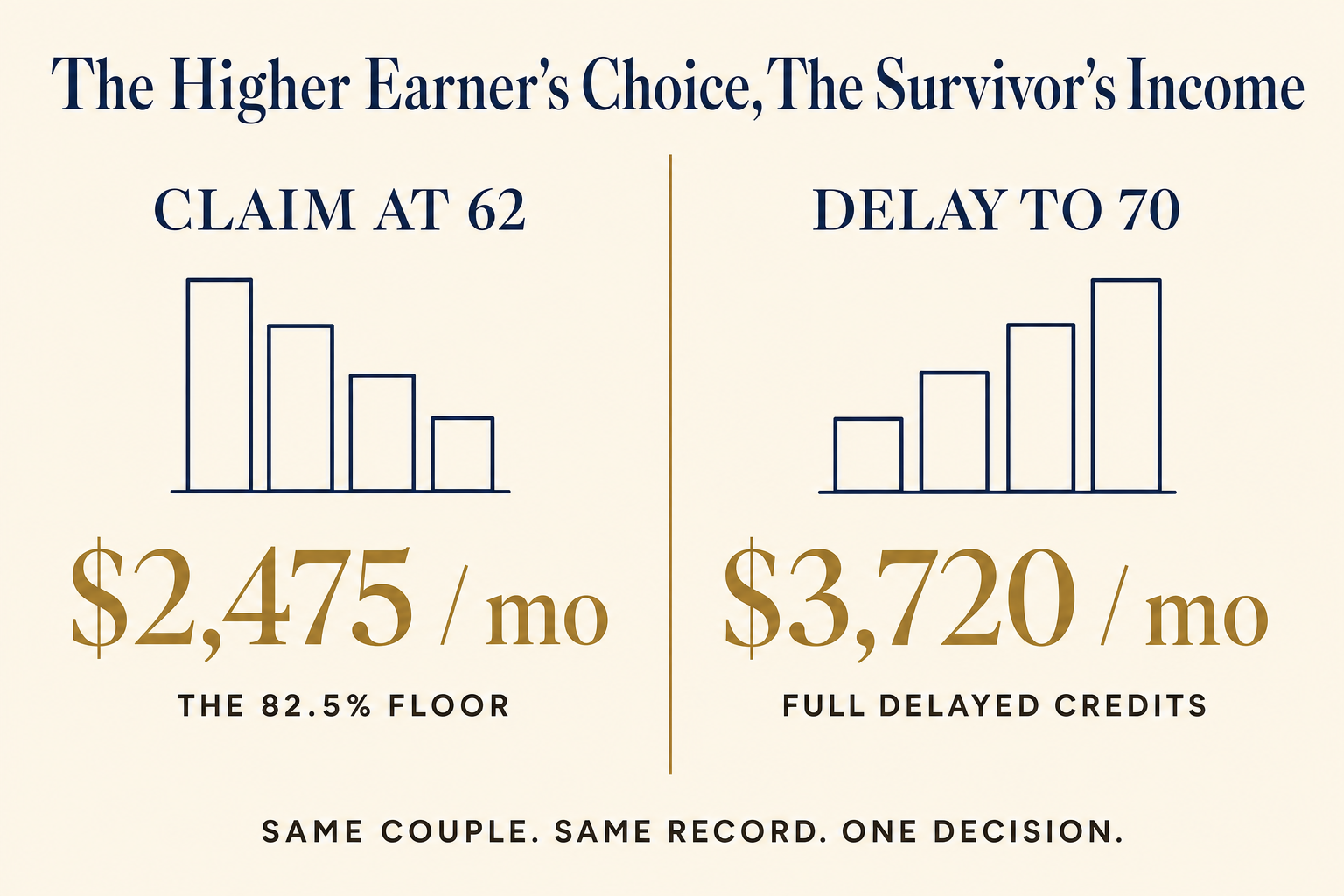
There is a floor built into the rules, at least. If the higher earner claimed early, the survivor benefit can’t drop below 82.5% of the deceased’s primary insurance amount, the benefit they’d have received at full retirement age. Social Security calls this the widow’s limit, and it exists specifically so the survivor isn’t fully penalized by the deceased’s early claim. But a floor of 82.5% is still a long way below the 124% the same person could have locked in by waiting to 70.
Put those two ends together and the higher earner’s claiming choice can swing the survivor’s lifetime income by a third or more. That’s not a rounding error. For the spouse who lives longer, it’s the difference between comfortable and careful.
A hypothetical: Priya and Raj run the numbers
Consider a hypothetical couple: Priya and Raj, both 63, living outside Columbus. Raj was the higher earner and has a primary insurance amount of $3,000 a month at his full retirement age of 67. Priya’s own benefit is smaller. They’re healthy, but longevity runs on Priya’s side of the family, and it’s very possible she outlives Raj by 15 or 20 years.
If Raj claims at 62, he locks in about $2,100 a month, a 30% haircut. When he dies, Priya’s survivor benefit is floored at 82.5% of his PIA, roughly $2,475 a month.
If instead Raj waits until 70, his check grows to about $3,720. That’s what he collects while he’s alive, and it’s what Priya inherits as her survivor benefit when he’s gone. For Priya, that’s the difference between $2,475 and $3,720 a month, about $1,245 more, every month, for the rest of her life.
Those are round, illustrative figures, not a projection of any real benefit. But the mechanism is exactly how the system works. Raj’s decision at 70 isn’t really about whether he lives to 85. It’s about protecting the person most likely to spend a long time on a single check.
Where this fits in bucket planning
Regular readers know I think about retirement income in three buckets: a Now, Soon, and Later framework, where the Soon bucket is a guaranteed income floor built from sources that don’t care what the market does. Social Security is the anchor of that floor for almost every household, and it’s the only piece that’s both guaranteed and inflation-adjusted for life.
When you view the higher earner’s benefit as the survivor’s floor, delaying becomes one of the cleanest ways to strengthen the Soon bucket for the spouse who’ll eventually be on their own. The catch is the gap it creates: waiting until 70 means covering the years in between from somewhere else. That’s exactly what the Now bucket and a Social Security bridge strategy are for, spending down cash and other assets on purpose so the guaranteed check can grow.
This is also why I keep pushing back on the break-even question. Break-even math treats claiming as a solo wager. For couples, the higher earner’s benefit is a joint asset, and the point of waiting isn’t to win a bet on your own longevity. It’s to make sure the survivor never has to.
What the surviving spouse should know
Two rules matter once you’re actually the survivor. First, survivor benefits do not earn delayed credits. Your own retirement benefit grows if you wait past your full retirement age, but a survivor benefit maxes out at your survivor full retirement age. There’s no reason to delay a survivor benefit past that point.
Second, you don’t have to take both at the same time, and you usually shouldn’t. Because survivor benefits and your own retirement benefit are separate, you can often claim one early and switch to the other later. Some survivors take a reduced survivor benefit at 60, then switch to their own maxed-out benefit at 70. Others do the reverse: claim their own benefit early and switch to a full survivor benefit at their survivor FRA. Which order wins depends on whose benefit is larger, and it’s worth running both ways before you file. This coordination sits right alongside spousal benefit rules in the “decisions people get wrong because the two checks look like one” category.
It’s also worth knowing that losing the smaller check often pushes the survivor into a higher tax bracket on the check that remains, a quiet squeeze I’ve written about as the survivor’s penalty. A larger survivor benefit doesn’t erase that, but it gives the surviving spouse more room to absorb it.
The reframe
If you’re the higher earner in a marriage, stop asking whether waiting to claim will pay off for you. Ask whether it will pay off for whichever of you lives longer. Those are different questions, and for most couples the second one is the one that actually matters.
Delaying the higher earner’s benefit is one of the few retirement moves that protects your spouse whether you live to 95 or not. If you die early, they inherit the bigger check sooner. If you live long, you both enjoy the bigger check together. There’s no version where the protection is wasted, and that’s what makes it feel less like a gamble and more like coverage.
Before you or your spouse touch a claiming form, run the numbers both ways, together, as a household. You can start with our free Social Security calculator to see how each of your claiming ages changes not just your own check, but the one the survivor will live on.
Key takeaways
- When one spouse dies, the household keeps the larger Social Security benefit and loses the smaller one, so the higher earner’s check is really the survivor’s future income.
- Delayed retirement credits earned by the higher earner (up to about 24% for waiting from 67 to 70) pass through to the survivor benefit for life.
- Claiming early caps the survivor benefit; the widow’s limit floors it at 82.5% of the deceased’s full-retirement-age amount, still far below what delaying could lock in.
- Survivor benefits stop growing at the survivor’s full retirement age, and you can often claim your own benefit and a survivor benefit in whichever order pays more.
- Delaying the higher earner’s benefit protects the surviving spouse whether the higher earner lives long or not, which is why it’s better understood as insurance than as a longevity bet.
Frequently asked questions
Does the survivor get both Social Security checks?
No. The surviving spouse keeps the higher of the two benefits and loses the lower one. This is why building up the higher earner’s benefit matters so much for the survivor.
If the higher earner delays to 70, does the survivor really get that larger amount?
Yes. A survivor benefit can equal up to 100% of what the deceased was receiving at death, including any delayed retirement credits they earned by waiting past full retirement age.
Should a widow or widower wait until 70 to claim a survivor benefit?
No. Unlike your own retirement benefit, a survivor benefit does not grow past your survivor full retirement age. Waiting beyond that point gains you nothing.
What if the higher earner already claimed early, are we stuck?
The survivor benefit is floored at 82.5% of the deceased’s full-retirement-age benefit, so it won’t fall to the fully reduced amount. And in some cases an early claim can be undone within the first 12 months, which I covered in the Social Security do-over.
This article is published by Confluence Media Group LLC, an independent publisher of educational financial content. Thomas Clark is a Series 65 Investment Advisor Representative. The information provided is for educational and informational purposes only and is not personalized financial, tax, or legal advice. Past performance does not guarantee future results. All investing involves risk, including potential loss of principal. Consult a qualified professional before making financial decisions.
Confluence Media Group LLC is a separate entity from Confluence Capital Management, the investment advisory practice through which Thomas Clark provides advisory services. Advisory services are not offered through this publishing platform.
About Thomas Clark
Thomas Clark is the founder of Confluence Media Group LLC and a Series 65 Investment Advisor Representative. He has spent nearly two decades working with families on retirement planning, with a focus on Social Security optimization, retirement income coordination, and the bucket planning approach to building a guaranteed income floor.
Thomas writes and publishes at thomasclarkadvisor.com and is the author of The Just in Case Binder — a 148-page printable family financial organizer for households who want to make sure the people they love know where everything is.
He lives in North Carolina with his family.
Subscribe to the weekly newsletter · Get the Just in Case Binder

Thomas Clark is a Series 65 licensed investment advisor and experienced trader. He specializes in investing, retirement planning, and market analysis, helping individuals build wealth and make informed financial decisions.
