
Retire Before 70? How to Delay Social Security Anyway
Retiring at 63 doesn't mean you have to claim Social Security at 63. The bridge strategy lets you fund the gap from savings and lock in a permanently larger, guaranteed check for life.

The day you stop working and the day you start Social Security do not have to be the same day. Most people treat them as if they are, and it is one of the most expensive reflexes in all of retirement planning.
Here is the version of the story I see most often. Someone retires at 63, looks at the checking account, feels the paycheck disappear, and files for Social Security within the month. It feels responsible. It feels like turning on income you have earned. But claiming the moment the paycheck stops locks in the smallest benefit you will ever be offered, for the rest of your life and often for your spouse’s life too.
There is a better move, and it has a name: the bridge strategy. You retire when you want to retire, and you spend some of your own savings on purpose to delay Social Security to a later age, so the check you eventually turn on is dramatically larger. This post walks through what waiting is actually worth in 2026 dollars, how to build the bridge, and when it does not make sense.
Why so many people claim the day they stop working
The reason is almost never a careful analysis of break-even ages. It is cash flow. The paycheck ends, the spending does not, and Social Security is sitting right there offering to fill the gap. Turning it on feels like the safe choice.
The instinct is understandable, but it quietly answers the wrong question. The real question is not “how do I replace this paycheck today.” It is “what is the most valuable use of the money I have already saved between now and the age I actually claim.” When you frame it that way, spending down a slice of your own portfolio to buy a bigger lifetime benefit stops looking reckless and starts looking like the best deal on the menu.
What waiting actually buys you
Social Security is one of the few numbers in your retirement plan you can grow with total certainty. For anyone born in 1960 or later, full retirement age is 67. Claim before that and your benefit is permanently reduced. Claim after it and you earn delayed retirement credits worth 8% per year, all the way up to age 70, where the increase stops.
Run the two ends against each other. Claiming at 62 hands you roughly 30% less than your full benefit. Waiting from full retirement age to 70 adds 24% on top. Put those together and the age-70 benefit is about 76% larger than the age-62 benefit for the same worker. That is not a market return you are hoping for; it is a statutory increase written into the formula, one of the legitimately guaranteed things in a plan otherwise full of unknowns.
Two features make the delayed benefit worth even more than that headline number suggests. First, every annual cost-of-living adjustment is calculated as a percentage of your benefit, so a bigger base means every future raise is bigger too, compounding for the rest of your life. Second, when one spouse dies, the survivor generally keeps the larger of the two benefits. Delaying does not just protect you; it sets a higher floor for whichever spouse lives longer, which is usually the wife. The size of the reduction or credit is set the day you claim and it follows you both for life.
The bridge: how to fund the wait
This is where bucket planning does the heavy lifting. In the Now/Soon/Later framework, the Now bucket holds cash and short-term money for near-term living expenses, the Soon bucket holds your guaranteed income floor, and the Later bucket holds market growth. The bridge strategy is simply a deliberate, temporary decision to draw your living expenses from the Now bucket — and if needed, a measured slice of the Later bucket — for the years between retirement and your Social Security start date.
You are not raiding your savings. You are converting a portion of an uncertain, market-exposed pile of money into a larger stream of guaranteed, inflation-adjusted income that lasts as long as you do. That is exactly the job the Soon bucket is supposed to do, and Social Security is the best guaranteed-income instrument most households will ever own — better priced than anything you can buy commercially, and backed by an automatic annual inflation adjustment that private products rarely match on equal terms.
The bridge does not have to reach all the way to 70 to be worth building. Retiring at 63 and bridging only to full retirement age at 67 already erases the early-claiming penalty entirely. Bridging further, to 70, stacks the delayed credits on top. Even a partial bridge — a year or two of delay — buys a permanently larger check. This is not all-or-nothing.
A hypothetical: Ray and Diane, both 63
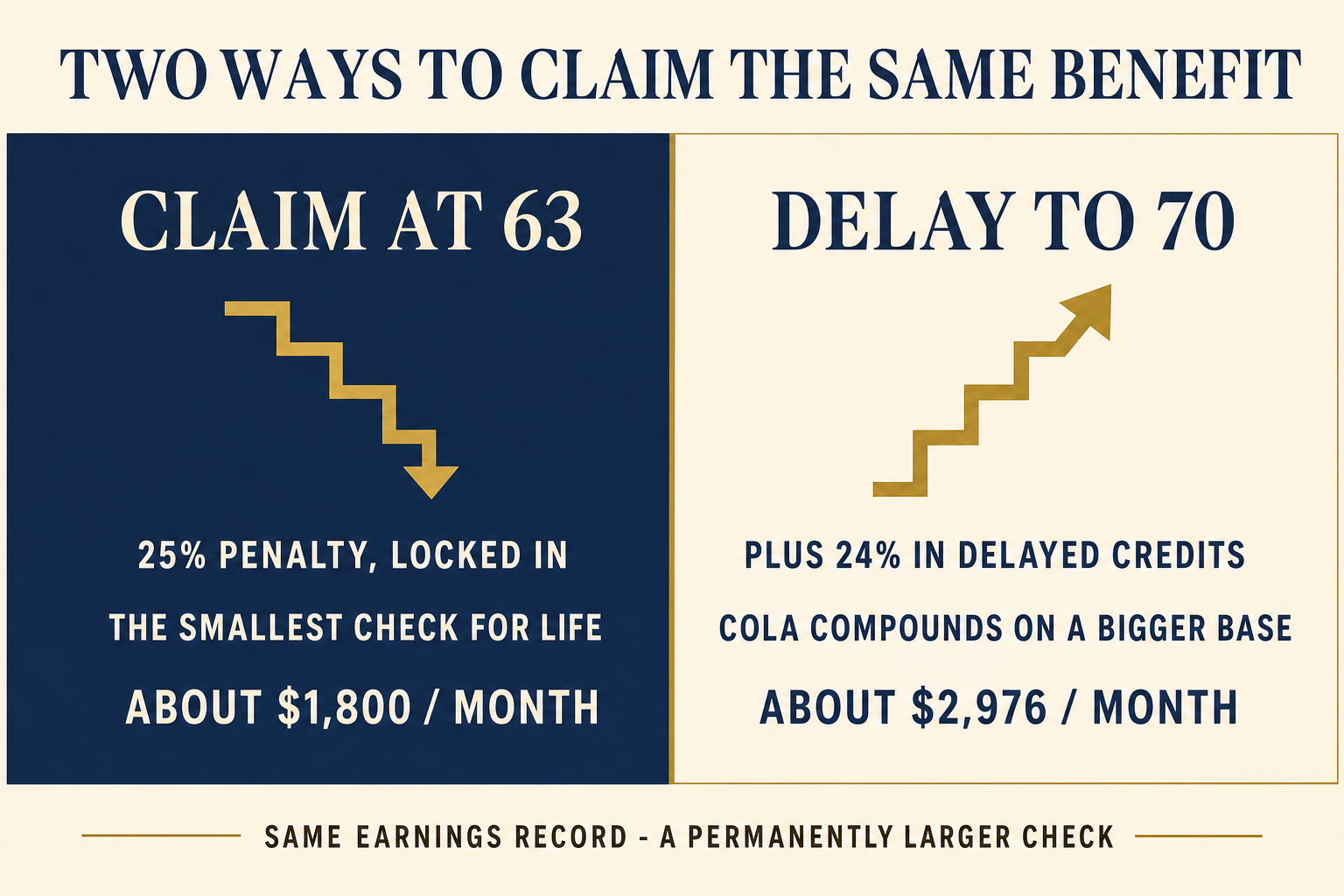
Consider a hypothetical couple. Ray and Diane, both 63, just retired near Charlotte. Ray was the higher earner; his benefit at full retirement age (67) would be about $2,400 a month. If he claims now, at 63, the roughly 25% early-claiming reduction drops that to about $1,800 a month for life. If he instead waits until 70, the same record produces about $2,976 a month — a difference of nearly $1,200 every month, before a single cost-of-living adjustment compounds on the larger figure.
To delay from 63 to 70, Ray needs to replace the income he would otherwise have taken. Say that is roughly $150,000 drawn from their own savings across those seven years. In exchange, that $150,000 of their money converts into about $1,200 more per month — around $14,000 a year — of guaranteed, inflation-adjusted income for the rest of both their lives, because Diane inherits the larger benefit if she outlives him. These are round, illustrative figures, not a projection of anyone’s actual results, but the shape of the trade is the point: a lump sum of uncertain money becomes a much larger stream of certain money.
If a full seven-year bridge is more than their portfolio can comfortably fund, a shorter bridge to 67 still eliminates the 25% penalty and lifts Ray’s floor from $1,800 to the full $2,400. The bridge scales to what the household can afford.
When the bridge does not make sense
I would be doing you a disservice to present this as a universal answer, because it is not. A few situations genuinely argue against delaying.
Health and family history matter. If serious health issues make a long life unlikely, claiming earlier can be the sounder call, and the break-even question deserves an honest look. If you simply do not have enough outside savings to cover living expenses during the bridge years, then Social Security is the floor you need now, and there is no shame in turning it on. And if leaving the largest possible portfolio to heirs matters more to you than maximizing your own guaranteed income, the math points a different direction. The bridge is a powerful default for households with the assets to fund it and a reasonable expectation of a normal-length retirement — not a rule for everyone.
One coordination note if you do delay: your Social Security start date and your Medicare enrollment date are two separate clocks. Delaying your check does not delay Medicare, and missing the Medicare window carries its own lifelong penalty. I covered that trap in detail in a separate post on Medicare timing.
Thomas’ Take: When people hesitate to spend savings to delay, they picture themselves “losing” that money. Flip it around. You are buying the single best-priced lifetime income stream available to an American household — inflation-adjusted, guaranteed, and protective of your spouse — and you are paying for it with a pile of money that was never guaranteed in the first place. That is not a loss. That is the smartest purchase in the plan.
Run your own numbers before you decide
The right claiming age is genuinely personal, and it turns on your benefit amount, your savings, your health, and your spouse’s situation. Before you file the month your paycheck stops, it is worth seeing what a few years of delay would actually do to your own numbers. Our free Social Security calculator lets you compare claiming ages side by side so the trade-off stops being abstract. And if a guaranteed income floor is what you are really after, the piece on sizing your Soon bucket shows how the delayed benefit fits into the larger plan.
Frequently asked questions
Do I have to keep working to delay Social Security?
No. That is the whole point of the bridge strategy. You can retire and delay at the same time by funding your living expenses from savings during the gap years. Working longer is one way to bridge, but it is not the only way.
What if I die before I break even?
If you delayed by spending your own savings rather than someone else’s, you have not handed anything back to the government — you simply drew down more of your portfolio earlier. And because the survivor keeps the larger benefit, a delayed claim often works out best precisely in the households where one spouse lives a long time.
Can I change my mind after I claim?
There is limited room to reverse a claim — a withdrawal within the first 12 months, or a voluntary suspension once you reach full retirement age — but both have strict rules. It is far cleaner to make the delay decision deliberately up front than to try to unwind an early claim later.
This article is published by Confluence Media Group LLC, an independent publisher of educational financial content. Thomas Clark is a Series 65 Investment Advisor Representative. The information provided is for educational and informational purposes only and is not personalized financial, tax, or legal advice. Past performance does not guarantee future results. All investing involves risk, including potential loss of principal. Consult a qualified professional before making financial decisions.
Confluence Media Group LLC is a separate entity from Confluence Capital Management, the investment advisory practice through which Thomas Clark provides advisory services. Advisory services are not offered through this publishing platform.
About Thomas Clark
Thomas Clark is the founder of Confluence Media Group LLC and a Series 65 Investment Advisor Representative. He has spent nearly two decades working with families on retirement planning, with a focus on Social Security optimization, retirement income coordination, and the bucket planning approach to building a guaranteed income floor.
Thomas writes and publishes at thomasclarkadvisor.com and is the author of The Just in Case Binder — a 148-page printable family financial organizer for households who want to make sure the people they love know where everything is.
He lives in North Carolina with his family.
Subscribe to the weekly newsletter · Get the Just in Case Binder

Thomas Clark is a Series 65 licensed investment advisor and experienced trader. He specializes in investing, retirement planning, and market analysis, helping individuals build wealth and make informed financial decisions.
