
How the Social Security COLA Works — and Why It Lags
The 2026 Social Security COLA raised benefits 2.8% — but most retirees misunderstand what the adjustment is and quietly assume it keeps pace with their costs. Here's how the COLA is actually calculated, why it lags the inflation retirees really face, and the two levers you control.

Every January, about 71 million Americans get a raise they didn’t ask for and didn’t earn at work. It’s the Social Security cost-of-living adjustment — the COLA — and for 2026 it came in at 2.8%, worth roughly $56 a month to the average retiree. Most people see the deposit tick up, shrug, and move on.
That shrug is a mistake. The COLA is one of the most valuable features of Social Security — an automatic, compounding, lifetime inflation adjustment that almost no private income source gives you for free. But it comes with a quiet flaw: it’s measured against a shopping cart that isn’t yours. Understand how the number is set, and where it falls short, and you’ll make better decisions about when to claim and how to build the rest of your income.
What the COLA actually is
The COLA is an automatic annual increase to your Social Security benefit, designed to keep it from being eroded by inflation. Congress wrote it into law in 1972 and it took effect in 1975. Before that, benefits only rose when Congress voted to raise them — which meant they often sat flat for years while prices climbed.
Two things make the COLA more powerful than a typical raise. First, it’s permanent: once your benefit steps up, it never steps back down. Second, it compounds. Each year’s adjustment is applied to your already-adjusted benefit, so the increases build on each other the way interest does. A benefit that starts at $2,000 and gets even modest COLAs for twenty years can end up well over $3,000 without you lifting a finger.
This is also why Social Security is the closest thing most people will ever own to a true inflation-adjusted lifetime annuity. A commercial annuity that promised the same feature would cost a small fortune — which is a big part of why I treat delaying Social Security as the foundation of the guaranteed income floor in the Now / Soon / Later bucket framework.
How the 2.8% is actually calculated
Here’s where most explanations wave their hands. The COLA isn’t a number a committee picks. It’s the output of a specific formula tied to a specific price index: the Consumer Price Index for Urban Wage Earners and Clerical Workers, or CPI-W, published monthly by the Bureau of Labor Statistics.
The Social Security Administration takes the average CPI-W for the third quarter — July, August, and September — of the current year and compares it to the same third-quarter average from the last year a COLA was paid. The percentage increase between the two becomes next year’s COLA. For 2026, the math was literally this: (317.265 − 308.729) ÷ 308.729, which works out to 2.8%.
Two practical points fall out of that formula. The COLA is announced in October (the 2026 figure landed on October 24, 2025) but doesn’t reach your check until the January payment. And if third-quarter prices ever fell, the COLA would simply be zero — it can’t be negative, so your benefit never drops.
Thomas’ Take: The COLA feels like a gift from Washington, but it’s really just an arithmetic readout of one price index between two summers. Nobody is deciding whether you “deserve” a raise. That’s worth knowing, because it tells you exactly where the blind spot is — in the index itself.
The blind spot: it measures a basket that isn’t yours
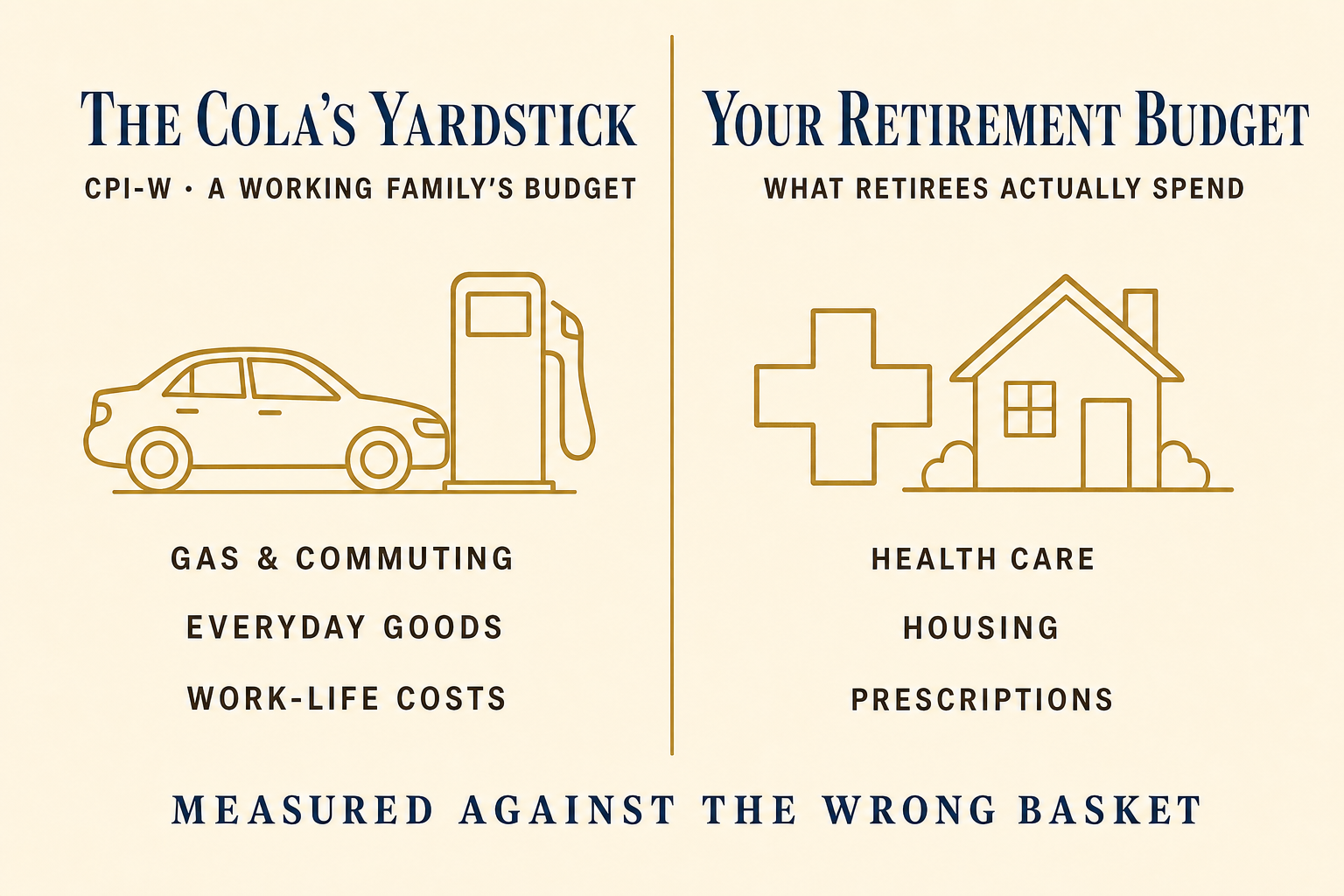
Look at the name of the index again: Urban Wage Earners and Clerical Workers. The CPI-W tracks the spending of working-age households — people with jobs, commutes, and growing families. Its basket is heavy on gasoline, transportation, and the costs of working life.
Retirees spend differently. A typical retiree’s budget leans much harder on health care and housing — precisely the categories that have risen faster than average for years — and much lighter on commuting and work-related costs. So the yardstick used to protect your benefit is calibrated to somebody else’s life.
The Bureau of Labor Statistics even publishes an experimental index built around older Americans, the CPI-E, and over long stretches it tends to run higher than the CPI-W. The gap is small in any single year and easy to dismiss. Over a retirement measured in decades, it adds up. The Senior Citizens League, which tracks this closely, estimates the average Social Security benefit has lost roughly 14% of its buying power since 2010 for exactly this reason. That’s the same slow leak I wrote about in what inflation actually erodes in retirement — and the COLA only partly plugs it.
And Medicare takes a bite before the raise reaches you
There’s a second reason your “raise” can feel smaller than advertised. For most retirees, the Medicare Part B premium is deducted directly from the Social Security check. When that premium rises — and in 2026 the standard Part B premium is $202.90 a month — the increase comes straight out of your COLA before you ever see it.
A “hold harmless” provision protects most beneficiaries from the premium increase actually shrinking their net benefit dollar-for-dollar. But it doesn’t protect you from the erosion. In years when Part B climbs faster than the COLA, a healthy-looking percentage raise can turn into a much smaller net bump in what actually lands in your account. If a Part B surcharge applies to you because of your income, the bite is bigger still — a trap I covered in the piece on the IRMAA surcharge most retirees don’t see coming.
What you can’t control, and the two things you can
You can’t change the CPI-W. You can’t vote the formula into measuring health care more heavily. So the useful question isn’t “how do I get a bigger COLA” — it’s “how do I build a plan that doesn’t depend on the COLA keeping up.” Two levers are entirely in your hands.
Lever one: the size of your base benefit. Because the COLA is a percentage, every dollar of base benefit earns the adjustment every year, forever. A bigger starting check doesn’t just pay you more today — it makes every future raise bigger too. This is the underrated argument for delaying: each year you wait past your full retirement age adds about 8% to your benefit up to age 70, and then the COLA compounds on that larger base for the rest of your life. Delaying isn’t just a bigger check; it’s a bigger raise on top of a bigger check, every January.
Consider a hypothetical case. Cynthia and Gerald each have a full-retirement-age benefit of $2,400. Cynthia claims early at 62 and locks in about $1,680 a month; Gerald waits until 70 and starts at roughly $2,976. Apply the same 2.8% COLA to both, and Cynthia’s raise is about $47 while Gerald’s is about $83 — nearly double the dollars from the identical percentage. Run that forward through twenty years of compounding COLAs and the dollar gap between them widens every single year. Same adjustment, very different outcomes, because it’s applied to different bases. (If you want to see how the claiming-age math and the break-even question interact, I walked through it in why the break-even age is the wrong way to decide.)
Lever two: structure the rest of your income to outrun the gap. If you assume the COLA will perfectly track your personal inflation, you’ll be a little short every year. A better plan builds a guaranteed income floor for essentials from Social Security, any pension, and — where it fits — an income-focused annuity, then keeps a genuine growth engine in the Later bucket whose job is to grow faster than prices over time. The COLA protects the floor partway; your growth allocation is what covers the rest of the erosion.
What to actually do about it
- Stop treating the COLA as free money. It’s inflation insurance that pays out partway — not a real increase in your standard of living.
- If it fits your situation, consider delaying. A larger base benefit compounds every future COLA in your favor for life. Delaying isn’t right for everyone — poor health or a real need for income now can point the other way — but when you can wait, the compounding works for you.
- Plan for a gap, not a match. Assume your personal costs rise a bit faster than your benefit, and size your savings and growth accordingly.
- Watch the Part B deduction. Your gross COLA and your net raise are two different numbers — check both when the January statement arrives.
- Keep growth in the plan. The Later bucket isn’t optional; it’s your defense against the buying-power leak the COLA leaves behind.
Frequently asked questions
When is the COLA announced, and when do I get it? The Social Security Administration announces it in October, based on July–September inflation data. The higher payment shows up starting with the January benefit.
Does the COLA really compound? Yes. Each year’s adjustment is applied to your current benefit, including all prior adjustments, so the increases build on one another over time.
Will the 2027 COLA be bigger than 2.8%? As of mid-2026, the Senior Citizens League projects a 2027 COLA of about 3.8% — higher than this year’s — but that’s an estimate based on inflation running through the summer, not a final number. The official figure won’t be set until the third-quarter data is in and the SSA announces it in October 2026.
Why doesn’t my raise feel like a raise? Usually two reasons: the Medicare Part B premium is deducted before the money reaches you, and the costs that hit retirees hardest — health care and housing — have often risen faster than the CPI-W the COLA is based on.
The COLA is a genuine strength of Social Security, and I don’t want the flaw to overshadow that. It’s an automatic, compounding, downside-protected inflation adjustment you never have to ask for. Just don’t mistake it for a promise that your benefit will keep pace with your actual cost of living. It’s a floor that rises slowly — and the parts of your retirement that keep pace with your real costs are the ones you build around it.
Want to see how your own claiming age changes your base benefit — and therefore every future COLA on top of it? Run your numbers through the free Social Security calculator and see the difference for yourself before you decide when to claim.
This article is published by Confluence Media Group LLC, an independent publisher of educational financial content. Thomas Clark is a Series 65 Investment Advisor Representative. The information provided is for educational and informational purposes only and is not personalized financial, tax, or legal advice. Past performance does not guarantee future results. All investing involves risk, including potential loss of principal. Consult a qualified professional before making financial decisions.
Confluence Media Group LLC is a separate entity from Confluence Capital Management, the investment advisory practice through which Thomas Clark provides advisory services. Advisory services are not offered through this publishing platform.
About Thomas Clark
Thomas Clark is the founder of Confluence Media Group LLC and a Series 65 Investment Advisor Representative. He has spent nearly two decades working with families on retirement planning, with a focus on Social Security optimization, retirement income coordination, and the bucket planning approach to building a guaranteed income floor.
Thomas writes and publishes at thomasclarkadvisor.com and is the author of The Just in Case Binder — a 148-page printable family financial organizer for households who want to make sure the people they love know where everything is.
He lives in North Carolina with his family.
Subscribe to the weekly newsletter · Get the Just in Case Binder

Thomas Clark is a Series 65 licensed investment advisor and experienced trader. He specializes in investing, retirement planning, and market analysis, helping individuals build wealth and make informed financial decisions.
