
IRMAA: The Medicare Surcharge Most Retirees Don’t See Coming
Medicare's IRMAA surcharge can raise your Part B and Part D premiums by hundreds a month once income crosses a hidden threshold — and it's decided by a tax return you filed two years ago. Here's how the 2026 brackets work and the levers that let you plan around the cliff.

You spent decades saving. You delayed Social Security to lock in a bigger check. Last year you did a smart Roth conversion to shrink a future tax bill. Then a plain envelope from the Social Security Administration lands in the mailbox, and it says your Medicare premium is going up — not by a few dollars, but by a few hundred a month.
That surcharge has an ugly acronym: IRMAA. And the reason it blindsides so many new retirees isn’t that it’s hidden. It’s that it looks backward. This year’s premium is decided by a tax return you filed two years ago — which means a move you make today can raise a bill you won’t see until 2028.
Let me walk through exactly how IRMAA works, what the 2026 numbers actually are, and the handful of levers that let you plan around it instead of getting ambushed by it.
What IRMAA actually is
IRMAA stands for the Income-Related Monthly Adjustment Amount. Strip away the jargon and it’s simple: a surcharge added on top of your standard Medicare Part B and Part D premiums once your income crosses a set line.
In 2026, the standard Part B premium is $202.90 per month, per person, according to Medicare.gov. Most people pay exactly that. But if your income is high enough, Medicare adds IRMAA on top — and it applies to both Part B (your outpatient and doctor coverage) and Part D (your prescription drug coverage).
The key phrase is per person. IRMAA isn’t a household bill. It’s charged to each Medicare beneficiary individually, so a married couple where both spouses are enrolled pays the surcharge twice — once for each of them. That’s the first place the number quietly doubles on people.
The two-year lookback — why 2026 is decided by 2024
Here’s the part that catches people off guard. IRMAA looks at your Modified Adjusted Gross Income, or MAGI, from two years ago. Your 2026 Medicare premiums are based on the income reported on your 2024 tax return — the one you filed back in 2025.
MAGI, roughly, is your adjusted gross income plus a few add-backs like tax-exempt municipal bond interest. For most retirees it lands close to the bottom line of the tax return. But “close to” is where the trouble hides, because things you don’t experience as spending money — a Roth conversion, a big capital gain from selling a rental, a distribution from an inherited IRA — all land in MAGI.
The two-year delay is what makes IRMAA feel like an ambush. The year you retire, your income often drops sharply. But Medicare is still looking at the year you were working, or the year you sold the house, or the year you converted a chunk of your IRA. You feel retired. Your premium doesn’t.
The 2026 brackets — and why it’s a cliff, not a ramp
Here are the 2026 income lines and the total monthly Part B premium at each tier. IRMAA is set on a five-step sliding scale on top of the standard premium.
| MAGI — Single filer | MAGI — Married filing jointly | Total monthly Part B (per person) |
|---|---|---|
| $109,000 or less | $218,000 or less | $202.90 (standard) |
| $109,001 – $137,000 | $218,001 – $274,000 | $284.06 |
| $137,001 – $171,000 | $274,001 – $342,000 | $405.80 |
| $171,001 – $205,000 | $342,001 – $410,000 | $527.54 |
| $205,001 – $499,999 | $410,001 – $749,999 | $649.28 |
| $500,000 or more | $750,000 or more | $689.66 |
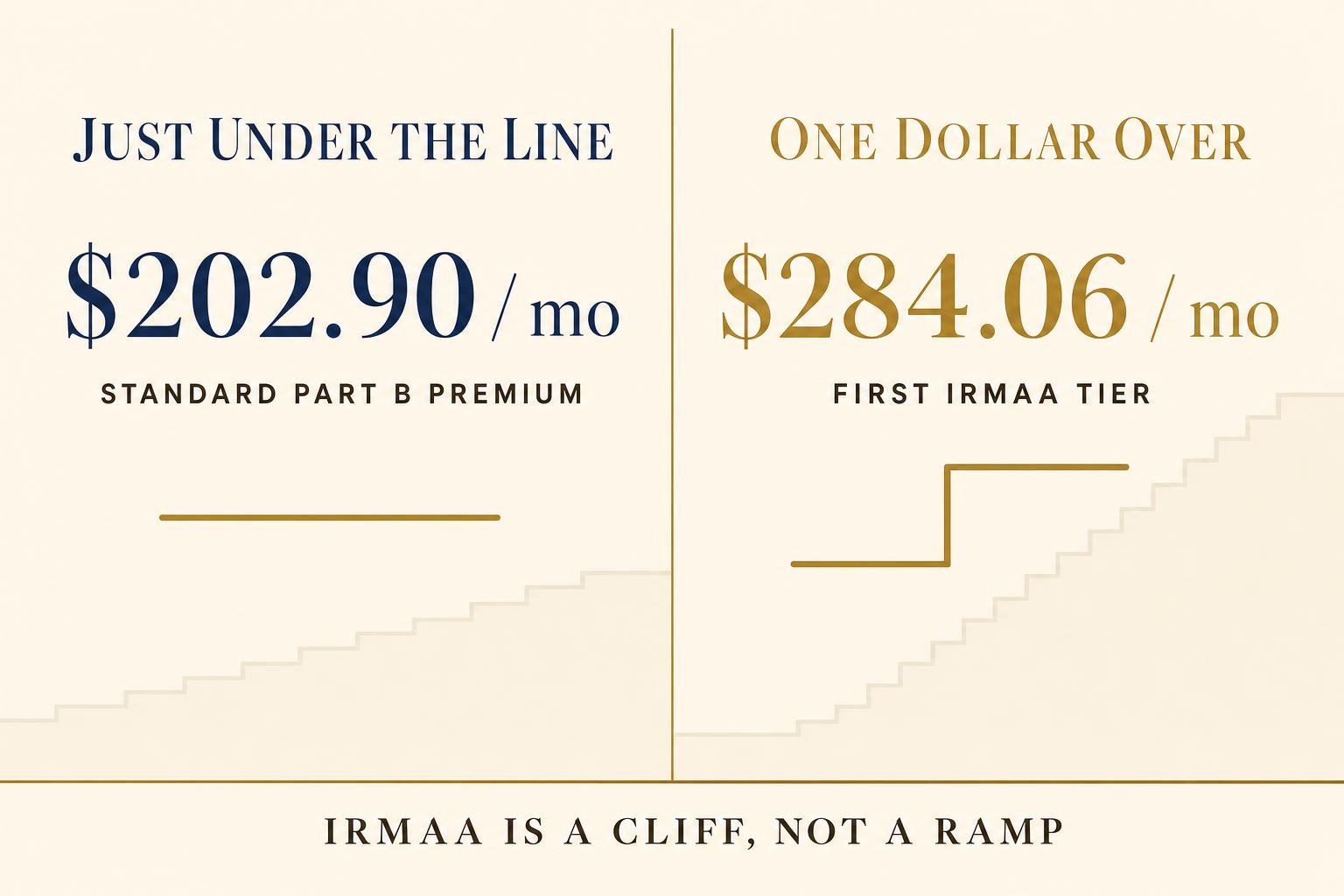
And here is the single most important thing to understand about IRMAA — the part that makes it sharper than the regular tax code: it’s a cliff, not a ramp.
Federal income tax is marginal. When you cross into a higher bracket, only the dollars above the line get taxed at the higher rate; everything underneath stays where it was. IRMAA doesn’t work that way. Cross a threshold by a single dollar and the entire surcharge for that tier applies. For a single filer in 2026, going from $109,000 of MAGI to $109,001 doesn’t nudge the premium — it jumps it from $202.90 to $284.06 a month. That’s about $974 more over the year, triggered by one dollar. Part D then piles its own surcharge on top.
Thomas’ Take: Nothing else in the retirement tax code punishes a single dollar this hard. A $1 overage that costs you nearly a thousand dollars isn’t really a tax — it’s a toll booth you didn’t know was on the road. That’s exactly why the line is worth watching.
A hypothetical: one dollar, two thousand dollars
Consider a hypothetical couple: David and Susan, both 66, who retired last year in suburban Charlotte. Between them they have a $780,000 traditional IRA, a paid-off house, and a plan to delay Social Security toward 70. Their actual spending is modest, so their taxable income this year is low — which is exactly why converting some of that IRA to a Roth while they’re in a low bracket makes sense.
Left alone, that plan is sound. But David and Susan are both already on Medicare. If they size a conversion that pushes their joint MAGI to $218,001 — one dollar over the first joint threshold — they don’t just owe a bit more income tax. Two years later, in 2028, each of their Part B premiums climbs from the standard amount to the first IRMAA tier. Two people, twelve months, plus the Part D surcharge, and that’s well over $2,000 of extra premium — for a single dollar of avoidable income.
The fix isn’t to skip the conversion. It’s to size it to stop just under the line. That one adjustment — a number good planning software finds in about two minutes — is the difference between a smart tax move and a smart tax move that quietly triggers a Medicare penalty.
The levers that actually manage IRMAA
Once you know the cliff is there, you can plan around it. The levers that matter most:
Size Roth conversions to the bracket, not over the cliff. The pre-RMD years between retirement and age 73 are the best window for conversions — but once you’re 63 or older, remember that this year’s MAGI sets your Medicare premium two years out. Convert up to the line, not past it. It’s the same bracket-headroom discipline behind any good Roth conversion window plan; IRMAA just adds a second ceiling to respect.
Use QCDs once RMDs begin. A Qualified Charitable Distribution sends money straight from your IRA to a charity. It satisfies your Required Minimum Distribution but never lands in your AGI or MAGI, so a charitably inclined retiree can use it to stay under an IRMAA line that an ordinary RMD would have breached. The IRS spells out the rules in its RMD guidance.
Watch one-time income events. Selling a rental, realizing a large capital gain, or taking a lump sum from an inherited account can all spike a single year’s MAGI. When the timing is flexible, spreading the sale across two tax years can keep each year under a threshold.
Appeal a life-changing event. This is the lever almost nobody uses. If your income fell because of a life-changing event — and retirement itself counts, along with the death of a spouse, divorce, or loss of pension income — you can file Form SSA-44 and ask Social Security to use your current, lower income instead of the two-year-old return. If you retired this year and your old return still shows a working salary, this form is how you tell Medicare you’re not that person anymore.
Every one of these is really the same move the bucket framework already asks you to make: decide which account funds which year’s income, on purpose, before the year locks in. That’s the whole idea behind the Now, Soon, and Later framework, and the account-by-account version of it in tax-aware bucketing.
Because IRMAA depends on how your withdrawals, conversions, and claiming age interact across several years, it’s one of those problems that’s genuinely hard to eyeball. A planning tool like ProjectionLab lets you model a Roth conversion against the IRMAA thresholds two years out and see the surcharge before you trigger it, not after the letter arrives.
Disclosure: the ProjectionLab link above is an affiliate link. If you subscribe through it, Confluence Media Group may earn a commission at no additional cost to you. I only point readers to tools I’d use myself.
When IRMAA should not drive the decision
Here’s the honest counterweight, because the biggest mistake with IRMAA is overreacting to it.
IRMAA is a one-year surcharge. If a large Roth conversion pushes you into an IRMAA tier for a single year but shrinks a traditional IRA that would otherwise throw off rising RMDs — and a heavier tax bill for the surviving spouse — for the next twenty years, then paying one year of surcharge can be exactly the right call. Don’t let a $2,000 toll talk you out of a $40,000 win.
The rule isn’t “never cross an IRMAA line.” It’s “never cross one by accident.” Cross it on purpose, with the full picture in front of you, or don’t cross it at all. The surcharge is only a trap when you don’t see it coming. This is the same mid-year discipline I wrote about in the mid-year tax planning piece: the moves that get hard in December are the ones you didn’t model in July.
The bottom line
The retirees who get surprised by IRMAA usually aren’t careless — they’re the diligent ones. The moves that trigger it (delaying Social Security, converting to Roth, selling an appreciated asset, even bridging the pre-Medicare years with taxable withdrawals) are the moves careful planners make. The difference between an ambush and a plan is nothing more than knowing the line is there — and knowing your premium is being decided two years before you’ll feel it.
So look at the income you report this year not just as a tax number, but as next decade’s Medicare number too. That’s the whole game.
This article is published by Confluence Media Group LLC, an independent publisher of educational financial content. Thomas Clark is a Series 65 Investment Advisor Representative. The information provided is for educational and informational purposes only and is not personalized financial, tax, or legal advice. Past performance does not guarantee future results. All investing involves risk, including potential loss of principal. Consult a qualified professional before making financial decisions.
Confluence Media Group LLC is a separate entity from Confluence Capital Management, the investment advisory practice through which Thomas Clark provides advisory services. Advisory services are not offered through this publishing platform.
About Thomas Clark
Thomas Clark is the founder of Confluence Media Group LLC and a Series 65 Investment Advisor Representative. He has spent nearly two decades working with families on retirement planning, with a focus on Social Security optimization, retirement income coordination, and the bucket planning approach to building a guaranteed income floor.
Thomas writes and publishes at thomasclarkadvisor.com and is the author of The Just in Case Binder — a 148-page printable family financial organizer for households who want to make sure the people they love know where everything is.
He lives in North Carolina with his family.
Subscribe to the weekly newsletter · Get the Just in Case Binder

Thomas Clark is a Series 65 licensed investment advisor and experienced trader. He specializes in investing, retirement planning, and market analysis, helping individuals build wealth and make informed financial decisions.
