Mid-Year Tax Planning for Retirees: Act Before December
The best retirement tax moves aren't made in April, when the year is already closed - they're made in July. Five mid-year moves (Roth conversions, RMDs, QCDs, IRMAA planning, and harvesting) that get harder as the calendar runs out.

The best tax moves I’ve watched retirees make weren’t made in April. They were made in July.
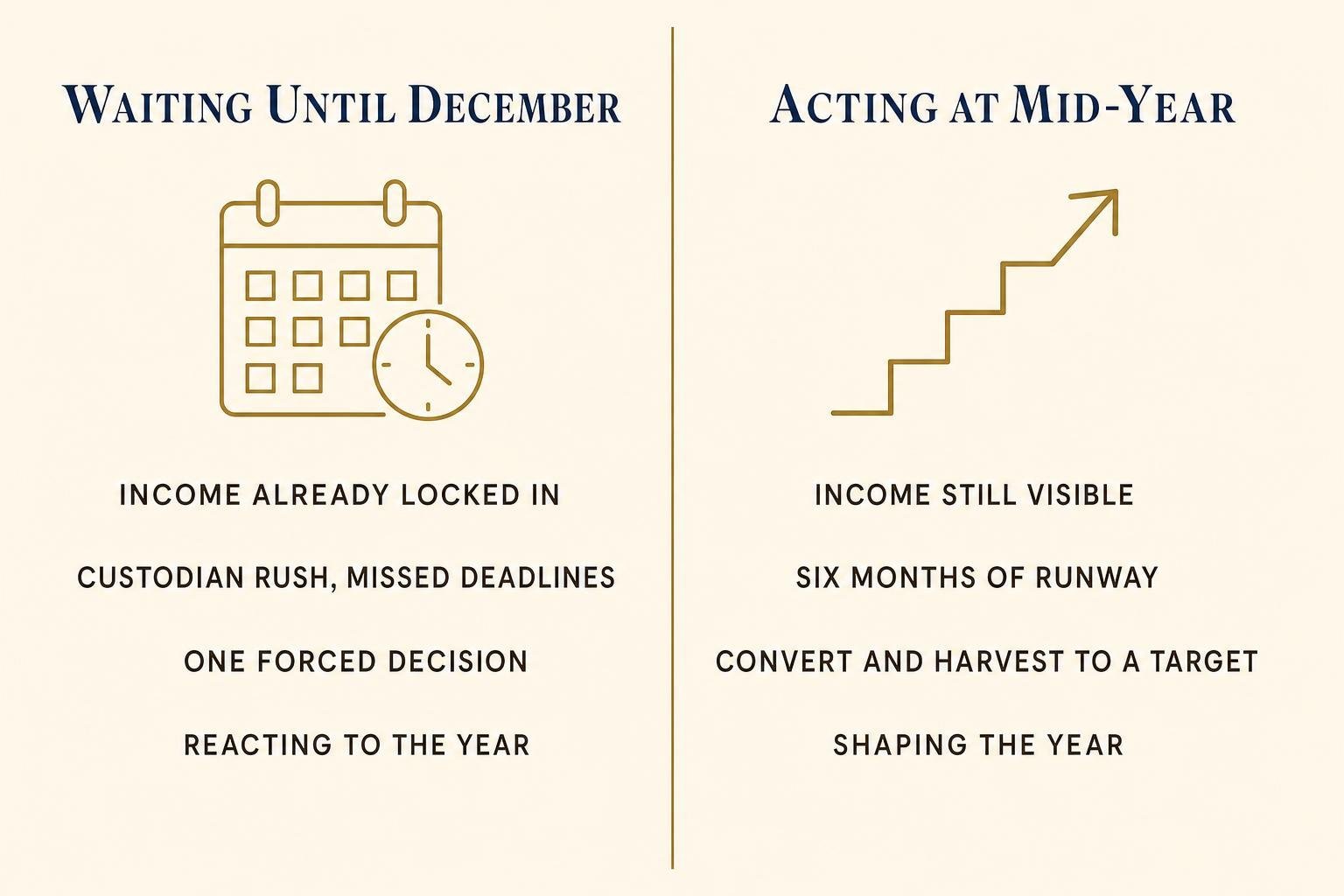
By the time you sit down with your preparer next spring, the year is closed. Every lever that could have lowered your bill has already locked into place. April is where you find out what happened. Mid-year is different. Right now, in the quiet middle of 2026, you still have six months of runway and something rare in tax planning: the ability to act on your income before the numbers are final.
This is the case for treating July — not December — as your real tax-planning season. Below are the five moves that get materially harder as the year runs out, the 2026 numbers that actually matter, and a hypothetical mid-year sweep you can model against your own situation.
Why July beats December
December isn’t planning. It’s triage. Custodians are backed up, markets are doing whatever they’re doing, and most of your year’s income is already sitting in accounts you can’t un-ring. You’re not shaping the year anymore — you’re reacting to it.
The deeper reason mid-year wins is that good tax planning is planning around income you can still see and shape. Six months in, you know most of your fixed inputs — Social Security, any pension, required distributions, interest and dividends — and you still have half a year to add, subtract, or time the flexible ones. That combination of visibility and runway doesn’t exist in April (too late) or January (too early to see the year). It exists now.
Thomas’ Take: Nearly every “year-end tax scramble” I’ve seen was really a mid-year decision someone didn’t make. The panic in December is the interest you pay on planning you skipped in July.
Move 1: Build a full-year income estimate first
This is the master lever, and every other move hangs off it. Before you touch anything, sketch your projected 2026 taxable income. You already have half a year of statements plus your known recurring items. Add them up, annualize the variable pieces, and subtract your deductions.
For 2026, the standard deduction is $32,200 for a married couple filing jointly and $16,100 for a single filer, per the IRS inflation adjustments. If you’re 65 or older, you get an additional standard deduction on top — $1,650 per qualifying spouse for joint filers, $2,050 for singles. And for tax years 2025 through 2028 only, the One Big Beautiful Bill Act added a temporary “senior bonus” deduction of up to $6,000 per person age 65+, which phases out once modified adjusted gross income climbs past $75,000 (single) or $150,000 (joint). That last one is time-limited by design — one more reason a 2026 income plan is worth building now rather than assuming next year looks like this one.
Once you have a projected taxable income, find the top of the bracket you’re sitting in. The gap between your projected income and that ceiling is your workspace for the rest of the year. Everything below is about how to use that gap on purpose.
This is exactly the kind of thing worth modeling rather than eyeballing. I use and recommend ProjectionLab for running a full-year income and tax picture — it lets you test a Roth conversion, a gain sale, or a QCD and see the downstream effect before you pull the trigger. (Disclosure: that’s an affiliate link. If you subscribe through it, Confluence Media Group may earn a commission at no extra cost to you. I only point people to tools I actually think earn their keep.)
Move 2: Size Roth conversions to the bracket, not the calendar
For many retirees, the years between leaving work and the start of required distributions are the lowest-tax years they’ll ever have again. That’s the window to move money from a traditional IRA into a Roth and pay the tax now, at a rate you control, instead of later at a rate the RMD tables and future brackets choose for you.
The mistake I see most often is converting “as much as possible.” The right move is converting to a target — filling the bracket headroom you found in Move 1 without spilling into the next bracket. Mid-year is what makes that precision possible: you can convert in tranches over the second half of the year and adjust as your actual income firms up, rather than guessing in a single December transaction. I’ve written more on that low-bracket window in this piece on the years between retirement and Social Security, and on which account should feed which need in tax-aware bucketing.
Move 3: Mind the two-year shadow (IRMAA)
Here’s the trap that catches thoughtful people: your income today doesn’t just affect this year’s tax bill. It sets your Medicare premiums two years out. The Income-Related Monthly Adjustment Amount — IRMAA — that you’ll pay in 2028 is calculated from your 2026 modified adjusted gross income.
For 2026, the surcharge starts once MAGI passes $109,000 for a single filer or $218,000 for a couple. Medicare publishes the bracket thresholds and premiums each year. And it’s a cliff, not a ramp — a single dollar over a threshold moves you into the higher tier for the entire year, on top of a base Part B premium of $202.90 a month per person.
This is where Move 2 and Move 3 have to be planned together. A Roth conversion that looks nearly free on the margin can quietly push your MAGI across an IRMAA line and hand you a premium surcharge two years later. Mid-year gives you room to size the conversion with the premium cliff in view. December usually doesn’t.
Move 4: Coordinate RMDs and QCDs before the crush
If you’re 73 or older, you have a required minimum distribution to take this year — the RMD age is 73 under SECURE 2.0. Waiting until late December to take it is how people miss it entirely, and a missed RMD carries a penalty. Handling it mid-year takes the deadline risk off the table.
If you’re 70½ or older and charitably inclined, the Qualified Charitable Distribution is one of the most underused tools on this list. In 2026 you can send up to $111,000 directly from your IRA to charity, and it counts toward your RMD while staying off your tax return entirely — the IRS explains how QCDs interact with distributions in its required-distribution guidance. With today’s large standard deduction, most retirees no longer itemize — which means an ordinary charitable gift buys them no tax benefit at all. A QCD sidesteps that: the money never shows up as income in the first place, which also helps on the IRMAA math from Move 3. Doing it mid-year, rather than in the year-end custodian rush, is how you make sure it processes cleanly. If RMDs are new to you, I laid out the common missteps in this guide.
Move 5: Harvest on your schedule — gains and losses
The second half of the year is a long runway for opportunistic harvesting. In taxable accounts, a down position can be sold to bank a capital loss that offsets gains elsewhere — tax-loss harvesting, which I’ve covered in depth here. Less discussed is its mirror image: if your projected income leaves you inside the 0% long-term capital gains bracket, you may be able to sell appreciated positions, pay no federal tax on the gain, and reset your cost basis higher.
Both moves reward patience over panic. Give yourself six months to act when the market cooperates and your income picture is clear, instead of forcing a trade in the last week of December because you ran out of time.
A hypothetical mid-year sweep
Consider a hypothetical couple: David and Susan, both 66, retired last year in suburban Charlotte. They have $780,000 in traditional IRAs, $120,000 in a taxable brokerage account, and a paid-off house. Neither has claimed Social Security yet — they’re delaying toward 70 — so this is one of those rare low-income windows.
Sitting down in July, they estimate their 2026 taxable income at roughly $38,000 after the standard deduction and their age-65 additions. That leaves real headroom before the top of the 12% bracket. So they plan a Roth conversion sized to fill most of that gap — not “as much as possible,” just enough to use the low bracket without spilling over. They check it against the 2028 IRMAA thresholds and confirm they’re nowhere near the $218,000 cliff, so the conversion is clean on the premium side. Neither is 73 yet, so there’s no RMD to coordinate, but they earmark a small QCD plan for once distributions begin. And because their income is low this year, they harvest a modest slice of long-term gains in the taxable account at a 0% rate to reset basis.
None of those moves is exotic. What makes them work is that David and Susan made them in July, with the whole picture visible and months to adjust — not in a December rush against a closing door. Their numbers are illustrative, but the sequence is the point.
Key takeaways
- Start with the income estimate. Your projected full-year taxable income and your bracket headroom are the foundation every other move stands on.
- Convert to a target, not to the maximum. Fill the low bracket during the pre-RMD window; don’t overflow it.
- Remember the two-year shadow. Your 2026 income sets your 2028 Medicare premiums, and IRMAA is a cliff.
- Handle RMDs and QCDs early. A QCD keeps income off your return and satisfies the RMD — but only if it processes in time.
- Give harvesting room to work. Six months of runway beats a single forced trade at year-end.
The December tax scramble is real, but it’s almost never a December problem. It’s a July decision someone didn’t make. You have the runway right now — the visibility to see your year and the months to shape it. That’s the whole advantage of mid-year, and it’s gone by the time the calendar makes the decision for you.
Want more retirement planning that actually makes sense? Subscribe to the weekly newsletter for one clear idea in your inbox each Sunday.
This article is published by Confluence Media Group LLC, an independent publisher of educational financial content. Thomas Clark is a Series 65 Investment Advisor Representative. The information provided is for educational and informational purposes only and is not personalized financial, tax, or legal advice. Past performance does not guarantee future results. All investing involves risk, including potential loss of principal. Consult a qualified professional before making financial decisions.
Confluence Media Group LLC is a separate entity from Confluence Capital Management, the investment advisory practice through which Thomas Clark provides advisory services. Advisory services are not offered through this publishing platform.
About Thomas Clark
Thomas Clark is the founder of Confluence Media Group LLC and a Series 65 Investment Advisor Representative. He has spent nearly two decades working with families on retirement planning, with a focus on Social Security optimization, retirement income coordination, and the bucket planning approach to building a guaranteed income floor.
Thomas writes and publishes at thomasclarkadvisor.com and is the author of The Just in Case Binder — a 148-page printable family financial organizer for households who want to make sure the people they love know where everything is.
He lives in North Carolina with his family.
Subscribe to the weekly newsletter · Get the Just in Case Binder

Thomas Clark is a Series 65 licensed investment advisor and experienced trader. He specializes in investing, retirement planning, and market analysis, helping individuals build wealth and make informed financial decisions.
