
Tax-Loss Harvesting: When It Helps, When It Doesn’t
Tax-loss harvesting can lower your tax bill — or quietly cost you more than it saves. The honest version: what it actually does, when it earns its place, and the wash sale trap that ruins most amateur attempts.

If you’ve ever talked to a financial professional in November or December, you’ve probably heard the phrase tax-loss harvesting spoken in the same tone people use to describe free coffee at work. Of course you should do it. Why wouldn’t you?
Here’s the honest answer: most of the time you probably should, sometimes it’s a wash, and occasionally it costs you more than it saves. The IRS rules around harvesting are specific enough that the difference between “smart move” and “expensive mistake” is one calendar window and one phone call you forgot to make.
This is the version most articles skip — what tax-loss harvesting actually does, the rule that quietly ruins amateur attempts, and the situations where it earns its place in a retirement plan versus the situations where it’s mostly noise.
What tax-loss harvesting actually does
The mechanic is simple. You own an investment in a taxable brokerage account that’s worth less than what you paid for it. You sell it. The IRS lets you use that capital loss to:
- Offset capital gains for the same tax year, dollar for dollar.
- Deduct up to $3,000 of leftover loss against ordinary income (or $1,500 if you’re married filing separately).
- Carry forward anything beyond that, indefinitely, to use in future years.
The dollar-for-dollar offset against gains is the main event. If you took a $20,000 long-term capital gain when you rebalanced earlier in the year, you can use $20,000 of harvested losses to wipe that gain out — and depending on your bracket, save somewhere between $0 and roughly $4,760 in federal tax on the offset. The federal long-term capital gains rate runs from 0% to 23.8% once you include the net investment income tax that kicks in at higher incomes (IRS Topic 409).
The $3,000 ordinary-income deduction is much smaller per year, but it’s why the IRS calls this an “indefinite carryforward.” If you harvest a $30,000 loss in a year with no gains, you deduct $3,000 against ordinary income now and bank $27,000 against future gains. That carryforward never expires while you’re alive.
A few jargon clarifications, since most articles skip them:
- Capital gain — the profit when you sell an investment for more than you paid. Held for one year or less, it’s a short-term gain taxed at your ordinary income rate. Held longer than a year, it’s a long-term gain taxed at the lower capital gains rate. The difference is large.
- Cost basis — what you originally paid for the investment, adjusted for things like reinvested dividends. The IRS taxes you on the difference between your sale price and your basis, not on the sale price itself.
- Taxable account — a regular brokerage account, not a 401(k), IRA, or Roth IRA. Harvesting only works in taxable accounts. Losses inside retirement accounts have no tax consequence to harvest because gains inside those accounts aren’t taxed when they happen, either.
That last point matters more than most people realize, and we’ll come back to it.
The wash sale rule — the trap most amateurs walk into
This is where the strategy quietly breaks for people who try to run it themselves.
The wash sale rule, found at IRS Section 1091, disallows your loss if you buy a “substantially identical” security within 30 days before or 30 days after the sale. That’s a 61-day window — and most people only think about the 30 days after, missing that buying the same thing right before the sale also counts (IRS Publication 550).
A few specifics most explainers leave out:
- “Substantially identical” is the IRS’s call, not yours. Selling SPY at a loss and immediately buying VOO — both broad S&P 500 ETFs — sits in a long-standing gray zone. The IRS has never issued bright-line guidance, and most practitioners treat two ETFs tracking the same index as substantially similar enough to be risky.
- The rule applies across all your accounts — including your spouse’s. If you sell at a loss in your brokerage and your spouse buys the same security in her IRA within 30 days, the loss is disallowed. Because IRAs don’t track basis the way taxable accounts do, that disallowed loss can disappear for tax purposes instead of just being deferred.
- Reinvested dividends count as purchases. If your dividend reinvestment is on, the dividend that hits 25 days after your loss sale becomes a wash sale on a small slice of your loss. Most brokerage platforms handle this correctly on the 1099, but check before you assume it’s clean.
- A normal wash sale doesn’t erase the loss — it defers it. When the rule triggers in a taxable account, the disallowed loss gets added to the cost basis of the replacement shares. You get the loss eventually, when you sell those replacement shares. The danger is when the deferral pushes the loss into an IRA, where it disappears.
The clean fix: when you harvest a loss, replace the sold security with something economically similar but not substantially identical. Sell your large-cap blend fund tracking the S&P 500, buy a different large-cap blend fund tracking the Russell 1000 or a total-market index. You stay invested at roughly the right exposure. You book the loss.
When tax-loss harvesting actually helps
Three conditions need to be true for harvesting to deliver real value:
You have meaningful taxable-account assets. If most of your wealth is inside IRAs, 401(k)s, and Roth IRAs, there’s nothing to harvest. Losses inside those accounts don’t generate deductible events. For a lot of working-age savers who maxed out retirement plans and never opened a brokerage account, the entire conversation is mostly background noise.
You’re in a tax bracket where the savings are real. The federal long-term capital gains rate is 0% for taxable income up to roughly $48,350 for single filers and $96,700 for married filing jointly in 2026. If your taxable income lands inside that 0% bracket, your harvested loss saves you zero federal tax on the gain-offset side. The loss still works against the $3,000 ordinary-income deduction at your ordinary rate, but that’s the smaller lever.
You have current or expected capital gains to offset. A harvested loss with no gains to use it against simply sits as a carryforward. That’s not nothing — it’s an option on future tax savings — but if you don’t expect to realize gains for years, the present value of that option is modest.
Where harvesting is most valuable:
- Pre-retirees with sizable taxable accounts, especially in years where they took gains from rebalancing or a concentrated-position sale
- Recently retired households planning to sell appreciated positions to fund withdrawals from the Now bucket
- Higher-income earners sitting in the 15% or 23.8% long-term capital gains bracket
- Anyone who took a large concentrated-position gain — vested RSUs, sale of a business, inherited stock that got rebalanced — and needs to offset it
When it doesn’t help — and when it actively hurts
A few situations where the marketing energy around harvesting outruns the math:
Most of your money is in retirement accounts. Already covered. If your taxable-account balance is small, the strategy has nothing to work with. Spend the energy on asset location instead — putting the right account types in the right buckets does more for retirement-era tax efficiency than chasing losses inside a small brokerage account.
The 0% long-term capital gains bracket. If you’re a retiree living on Social Security and modest withdrawals, and your taxable income lands in that 0% LTCG bracket, you probably want the opposite of harvesting — tax-gain harvesting, where you deliberately realize gains while the federal tax on them is zero. Harvesting losses in this window is the wrong direction; you’re banking a future-use loss that costs you a present-use 0% gain opportunity.
The wash sale trap turns a loss into a permanent loss. If the disallowed portion ends up replaced inside an IRA — because your dividend reinvestment, automated buying, or spousal IRA triggered the rule — the loss can vanish for tax purposes entirely.
Bid-ask spreads and small portfolios. On thinly traded ETFs or mutual fund share classes with frictional costs, executing the harvest can cost more than the deduction is worth on small dollar amounts. A 0.25% spread on a $5,000 trade is $12.50; the tax saving on a small loss can be smaller.
Resetting the holding-period clock. If you replace your sold position with a “similar but not identical” fund, the holding period restarts on the replacement. If you then need to sell within 12 months, your gain drops to short-term — taxed at your full ordinary income rate, not the lower long-term rate. For long-term holders this rarely bites; for someone making large changes the year before a planned withdrawal, it can.
A hypothetical: Janet walks through a year
Consider a hypothetical case: Janet, 64, recently retired and living outside Charlotte. She has $600,000 in a traditional IRA, $200,000 in a Roth, and $400,000 in a taxable brokerage account. Her ordinary income for the year — Social Security plus a small consulting gig — runs about $52,000.
In May, Janet rebalanced and realized a $25,000 long-term capital gain to fund part of the year’s spending. In October, the broader market is down about 12% and her international fund is sitting on a $30,000 unrealized loss.
Janet has three options.
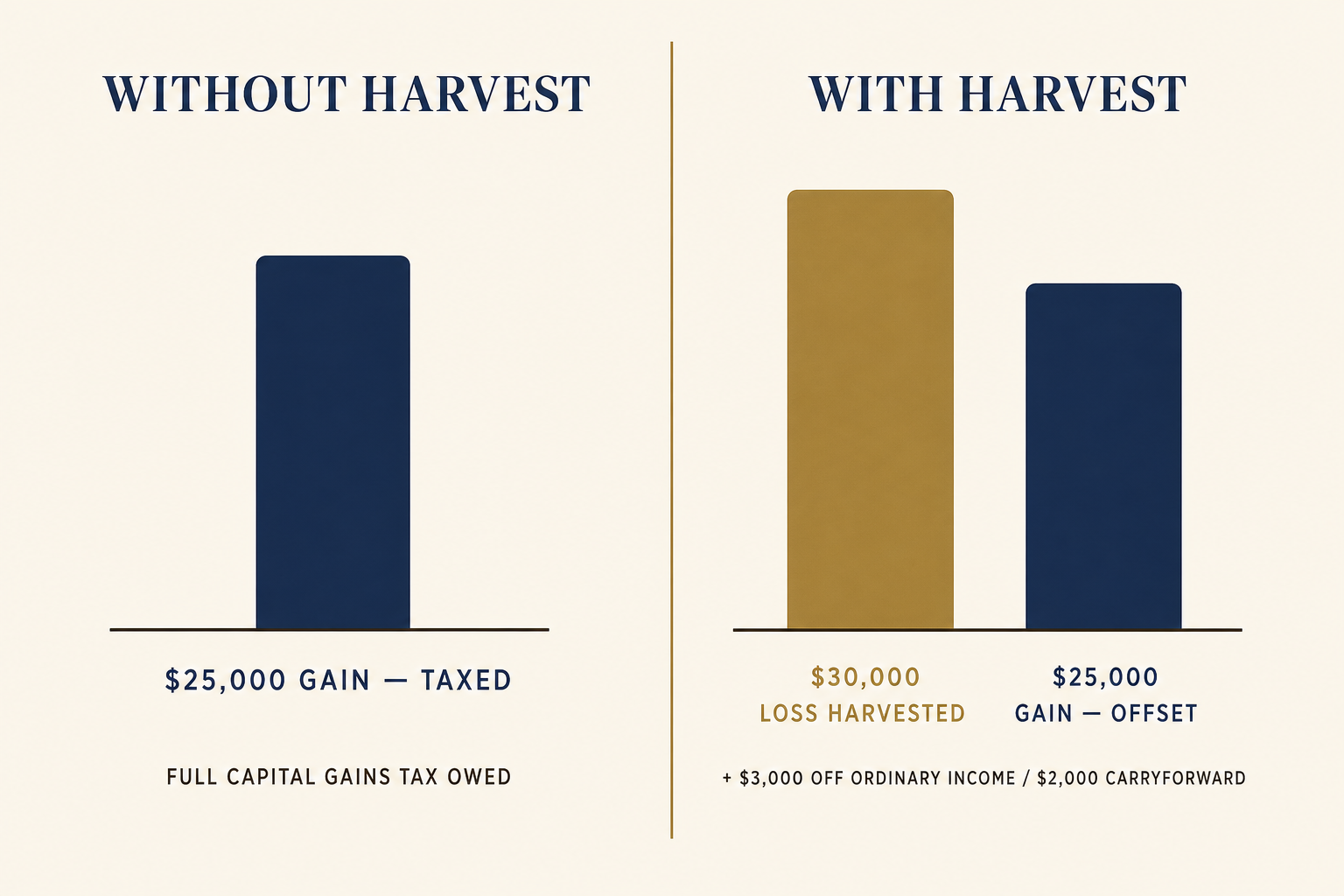
Option 1: Do nothing. The $25,000 gain is taxed. At her income level, she’s straddling the 0% / 15% LTCG bracket — somewhere around $1,500 to $2,500 in federal long-term capital gains tax depending on the exact numbers and her itemized situation.
Option 2: Harvest the $30,000 loss cleanly. Sell the international fund, immediately buy a different international fund with a different index — developed-markets-ex-Japan, say, instead of all-developed-markets. The $30,000 loss wipes out the $25,000 gain (zero capital gains tax this year), and the leftover $5,000 takes $3,000 off her ordinary income with $2,000 carrying forward to next year. The carryforward is itself an option on future tax savings.
Option 3: Harvest, but accidentally trigger a wash sale. She sells the international fund on a Tuesday. The following Monday, her spouse’s IRA executes an automated monthly purchase of the same fund. The IRS disallows the loss on the portion that overlaps — and because the replacement landed inside an IRA, the loss is gone, not deferred. Janet ends the year with the $25,000 gain still taxable and a partial harvest that didn’t land.
Option 2 is the value. Option 3 is the cautionary tale. The difference is six lines on a calendar and one short conversation to coordinate the spousal IRA purchase.
How this fits the bucket framework
For retirees running the Now / Soon / Later bucket framework, tax-loss harvesting lives in the Later bucket — the growth-oriented, market-exposed assets held in taxable accounts. The Soon bucket (guaranteed income from Social Security, pensions, and Fixed Index Annuity income riders) doesn’t generate harvestable losses. The Now bucket (cash and short-duration bonds) usually doesn’t fluctuate enough to make the math interesting.
This matters because a lot of retirement plans don’t actually have much Later-bucket money in taxable accounts. If your accumulation years were 401(k)-heavy, your Later bucket is mostly IRA dollars — and tax-loss harvesting doesn’t apply to those. The strategy is a meaningful tool for a specific subset of plans, not a universal upgrade everyone should reach for.
For households where it does apply, harvesting pairs naturally with two other moves we’ve written about: withdrawal-sequencing decisions in retirement and the Roth conversion windows in the low-income years between retirement and Social Security. The same brackets that make harvesting more or less valuable are the brackets you’re already managing for those other moves.
Key takeaways
- Tax-loss harvesting offsets capital gains dollar-for-dollar and deducts up to $3,000 of leftover loss against ordinary income each year, with the rest carrying forward indefinitely.
- The wash sale rule is the silent killer. The window is 61 days, the rule applies across all your accounts (including your spouse’s), and a wash sale that lands in an IRA can erase the loss entirely.
- The strategy delivers real value only when you have taxable-account assets, sit above the 0% LTCG bracket, and have gains to offset.
- For retirees inside the 0% LTCG bracket, the move you might actually want is the opposite — tax-gain harvesting.
- If most of your wealth is in IRAs, 401(k)s, and Roths, this whole conversation is largely background noise. The bigger levers are account ordering, asset location, and Roth conversion timing.
Tax-loss harvesting earns its place in the right plan and quietly wastes time in the wrong one. The trick isn’t doing it harder — it’s knowing whether your particular situation is one where the math actually pays.
This article is published by Confluence Media Group LLC, an independent publisher of educational financial content. Thomas Clark is a Series 65 Investment Advisor Representative. The information provided is for educational and informational purposes only and is not personalized financial, tax, or legal advice. Past performance does not guarantee future results. All investing involves risk, including potential loss of principal. Consult a qualified professional before making financial decisions.
Confluence Media Group LLC is a separate entity from Confluence Capital Management, the investment advisory practice through which Thomas Clark provides advisory services. Advisory services are not offered through this publishing platform.
About Thomas Clark
Thomas Clark is the founder of Confluence Media Group LLC and a Series 65 Investment Advisor Representative. He has spent nearly two decades working with families on retirement planning, with a focus on Social Security optimization, retirement income coordination, and the bucket planning approach to building a guaranteed income floor.
Thomas writes and publishes at thomasclarkadvisor.com and is the author of The Just in Case Binder — a 148-page printable family financial organizer for households who want to make sure the people they love know where everything is.
He lives in North Carolina with his family.
Subscribe to the weekly newsletter · Get the Just in Case Binder

Thomas Clark is a Series 65 licensed investment advisor and experienced trader. He specializes in investing, retirement planning, and market analysis, helping individuals build wealth and make informed financial decisions.
