
The 7 RMD Mistakes That Quietly Cost Retirees Money
Required Minimum Distributions are mechanical — the IRS calculates the number, the custodian displays it, and the penalty for missing it is automatic. None of that makes the strategic decisions easier. Here are the seven mistakes that quietly cost retirees real money in 2026 — and what to do about each one.

Most retirees don’t think about Required Minimum Distributions until the year they turn 73. By then, the most expensive decisions have already been made.
RMDs are the IRS’s claim on the tax-deferred accounts you’ve spent your career building — Traditional IRAs, 401(k)s, 403(b)s, the whole pre-tax stack. The government waited decades for its cut. Starting in the year you turn 73, you have to calculate a minimum withdrawal, take it out, pay ordinary income tax on it, and report the number. Miss the deadline and the penalty used to be 50% of the missed amount. SECURE Act 2.0 cut that to 25% in 2023, and down to 10% if you correct it within a two-year window. Still steep. Still avoidable.
What makes RMDs trickier than they look is that the rules have moved twice in the last few years. The required start age went from 70½ to 72 under the original SECURE Act in 2019, then to 73 under SECURE Act 2.0 in 2022, and it is scheduled to move to 75 in 2033 for people born in 1960 or later. The penalty changed. The aggregation rules differ across account types. The interaction with Roth conversions has hardened. And the retirees most exposed to all of this are usually working from a 2019-era playbook.
This is the calm walk through the seven mistakes I see most often. Each is correctable in advance. Each is expensive in arrears.
The first-year rule (and the trap most retirees walk into)
The IRS lets you defer your very first RMD until April 1 of the year after you turn 73 — what they call the Required Beginning Date. That sounds like a kindness. It usually isn’t.
If you defer the first one to April, you still owe the second one by December 31 of that same calendar year. Two RMDs landing in a single tax year is how retirees accidentally jump a tax bracket, push their Social Security benefit into a higher taxation tier, and trigger an IRMAA surcharge on their Medicare premiums for the next two years — all at once.
The simple version: in most cases, take your first RMD in the year you actually turn 73, not the April that follows. The deferral only helps if the two-year tax arithmetic actually favors stacking, and that’s rare. Run the projection before you decide. The IRS RMD FAQ lays out the timing rule, but it doesn’t tell you which year is better. That part is yours.
Aggregation: where IRAs and 401(k)s diverge
The aggregation rules are where retirees with multiple accounts trip most often, because intuition runs in the wrong direction.
Traditional IRAs aggregate. You calculate the RMD on each IRA separately, add the numbers up, and pull the total from any one IRA — or any combination you want. If you have three IRAs at three custodians, you can take all three RMDs out of the largest one and leave the other two untouched. The IRS treats the obligation as satisfied.
401(k)s do not aggregate. Each plan must take its own RMD from its own account. If you have three old 401(k)s from three former employers, that’s three separate calculations, three separate distributions, and three separate forms. There’s no pooling allowed.
Inherited IRAs are a third bucket entirely. They aggregate among themselves but not with your own IRAs. A retiree who inherited a Traditional IRA from a parent and also has their own Traditional IRA has two completely separate RMD obligations running in parallel.
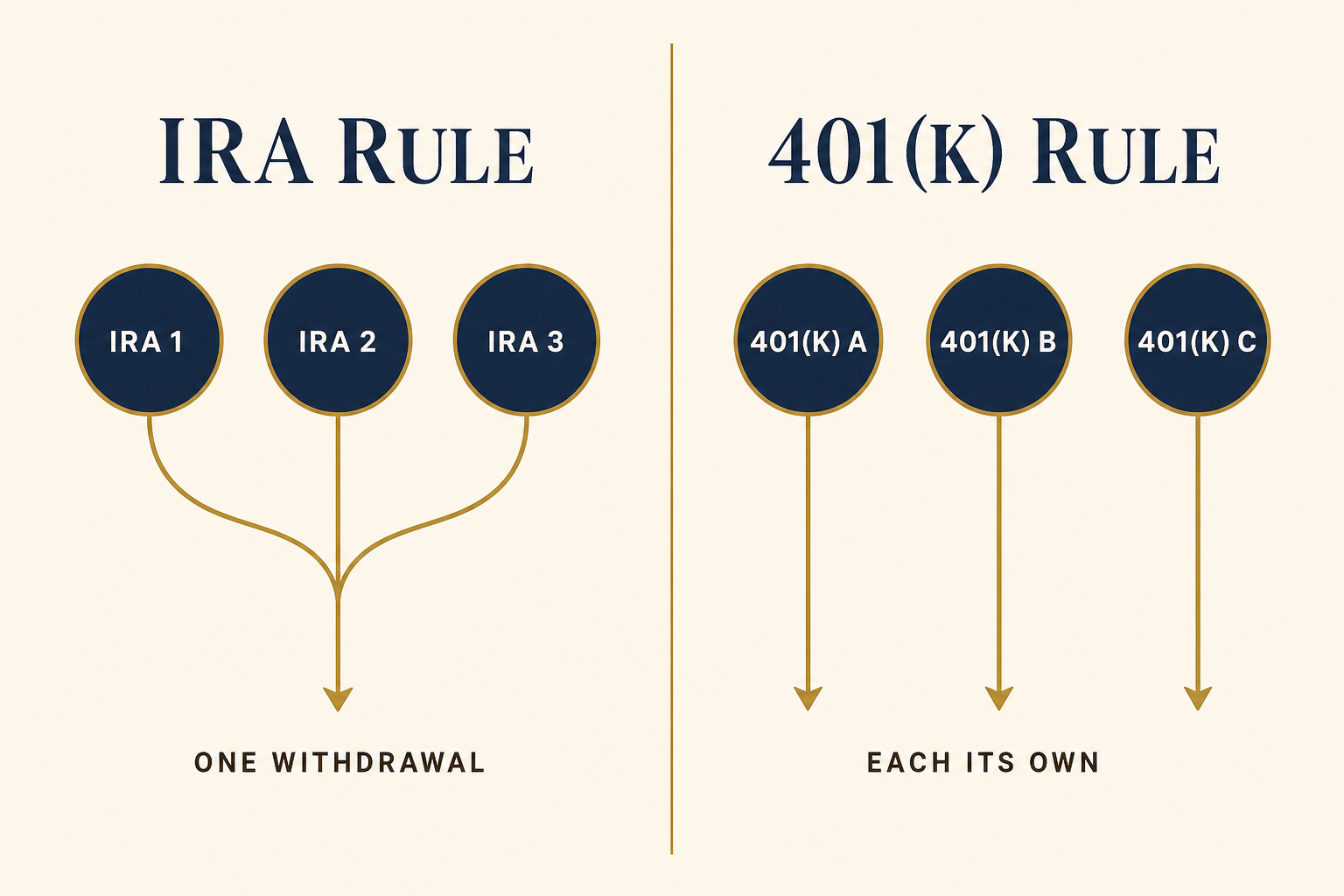
This is why many people approaching 73 consolidate old 401(k)s into a rollover IRA the year before — not to chase fees, but to collapse three RMD obligations into one aggregated number. Cleaner mechanics, fewer deadlines, fewer chances to miss.
Roth conversions have to wait their turn
In a year you owe an RMD, the first dollars out of the account are RMD dollars. You can’t convert those to a Roth — they have to come out as taxable income to you, full stop.
That sounds like trivia until you’ve watched someone reverse a planned $50,000 Roth conversion because they tried to do it before the RMD distribution and accidentally created an excess Roth contribution, which carries its own 6% annual penalty until corrected.
The clean sequence for RMD-year Roth conversions is to take the full RMD first, then convert whatever else you want above that amount. The conversion is taxed on top of the RMD income — there’s no escaping that. But it’s mechanically valid and it doesn’t create cascading penalties.
The bigger point is that the years between retirement and 73 are usually the cheapest Roth conversion years a retiree will ever have. I wrote about that interaction specifically in how a Roth conversion changes Social Security taxation. Once RMDs start adding tens of thousands of dollars of mandatory ordinary income each year, the bracket math on new conversions gets harder fast.
The QCD: the most underused RMD tool
A Qualified Charitable Distribution is a direct transfer from an IRA to a qualified 501(c)(3) charity. Up to $108,000 per person in 2025 — indexed annually for inflation, per the IRS QCD guidance — a QCD counts toward your RMD and never appears in your taxable income.
Here is why that matters. Suppose your RMD this year is $30,000 and you already give $5,000 a year to your church. If you take the full $30,000 as cash, pay ordinary income tax on it, and then write a $5,000 check, you only get a tax benefit from the gift if your total itemized deductions exceed the standard deduction. For most retirees, they don’t. The $5,000 gift is functionally taxed.
Send the same $5,000 to the church as a QCD directly from your IRA, and that $5,000 never enters your taxable income at all. The remaining $25,000 still comes out as taxable cash to you. Your required distribution is satisfied. Your AGI is lower by $5,000, which reduces the share of your Social Security that becomes taxable and lowers your IRMAA exposure on Medicare premiums two years out.
The QCD eligibility age is still 70½ — they didn’t move that threshold when they moved the RMD age. If you’re charitably inclined and you’ve turned 70½, this is the tool.
The bracket bump compounds — plan around it before 73
At age 73, the IRS Uniform Lifetime Table divisor is 26.5, which means your RMD is roughly 3.77% of last year’s ending balance. On a $1 million Traditional IRA, that’s about $37,700 of mandatory ordinary income in year one.
That percentage doesn’t stay flat. It climbs every year. At 80, the divisor is about 22, so the RMD is closer to 4.5%. At 85, it’s about 6.25%. At 90, it’s 9.7%. The withdrawal percentage grows even as the underlying balance is being drawn down.
The math problem this creates is that RMDs land directly on top of whatever Social Security and pension income a retiree already has coming in. For households with substantial pre-tax balances, the RMD alone often pushes the next dollar of income into a higher bracket — and that effect compounds with age.
The pre-RMD window — usually the years between retirement and 73 — is the cheapest tax space most retirees will ever stand in. It is the right time for Roth conversions, capital-gains harvesting in the 0% long-term-gains bracket, and bracket-filling Traditional withdrawals. This is one of the core planning ideas behind the Now/Soon/Later bucket framework and the order in which to drain retirement accounts. Both are easier to execute before RMDs start adding to ordinary income automatically.
December 31, inherited IRAs, and what to do if you miss
After the first one, every subsequent RMD is due December 31. The custodian calculates the number and shows it to you. They generally don’t take the distribution for you unless you specifically set up an automatic schedule.
Setting up automatic RMD distributions at your custodian is the single best deadline-risk hedge. Fidelity, Schwab, Vanguard, and the rest all support it. Pick a monthly, quarterly, or annual cadence and the mechanics handle themselves for life. The number changes every year as your balance and the divisor change — the custodian recalculates.
If you miss anyway: file Form 5329 with a reasonable-cause statement, take the missed amount immediately, and the IRS has historically been forgiving. The 25% penalty drops to 10% if the miss is corrected within the two-year window. Don’t ignore it — fix it. The agency is faster to forgive a self-reported miss than a discovered one.
Inherited IRAs run on a separate clock. Under SECURE Act 1.0, most non-spouse beneficiaries who inherited after 2019 must empty the account within ten years. The IRS finalized rules in 2024 requiring annual RMDs during that ten-year window for non-eligible-designated beneficiaries whose original owner was already taking RMDs. Those annual distributions were waived through 2024 while the rules were being finalized; they began being enforced in 2025. If you inherited an IRA from a parent in the last few years, those annual obligations now apply to you — and the ten-year drain is still due on top of that.
A hypothetical walk-through: Janet at 73
Consider a hypothetical retiree, Janet, 73, just finishing her first year drawing from her retirement accounts. She has $850,000 in a Traditional IRA, $120,000 in an old 401(k) from her career as a hospital administrator, and a $75,000 Roth IRA from a conversion she did during a sabbatical year. She gives $4,000 annually to her church.
Her 2026 RMD calculation looks like this:
- Traditional IRA: $850,000 ÷ 26.5 = $32,075
- Old 401(k): $120,000 ÷ 26.5 = $4,528
- Roth IRA: $0 (Roth IRAs have no RMD during the original owner’s lifetime)
- Total required: $36,603
The aggregation rules say Janet can pull the entire $32,075 from her IRA in any combination she chooses. The $4,528 must come specifically from the 401(k); she can’t take it from the IRA on the 401(k)’s behalf. If her plan had been to consolidate the old 401(k) into the IRA before 2026, she’d have one $36,603 number coming out of one account instead of two separate distributions running on two separate calendars.
If Janet directs $4,000 of the IRA RMD to her church via QCD, the IRS treats $4,000 of her RMD as satisfied and the $4,000 never appears in her taxable income. She still takes the remaining $28,075 from the IRA as taxable cash. Her required total is still $36,603 — she has just changed the tax treatment on $4,000 of it.
If she’d instead taken the full $32,075 as cash and then written a $4,000 check, she’d only get a deduction if her total itemized deductions exceeded the standard deduction for a single filer over 65 — a bar most retirees never clear once the mortgage is paid off. The QCD bypasses the bar entirely.
The thread running through all seven of these is that RMDs are mechanical. The IRS will calculate the right number. The custodian will display it. The penalty for missing it is automatic. None of that mechanical certainty makes the strategic decisions easier — when to take the first one, which account to pull from, whether to convert before or after, whether to send part to charity, whether to automate or take it as part of a broader annual tax conversation.
The best year to start preparing for RMDs is the year you stop working, not the year you turn 73. The window between retirement and 73 is some of the cheapest tax space a retiree will ever stand in — low ordinary income, room in the lower brackets, time to convert Traditional dollars to Roth dollars at known rates. Once the RMDs start landing on top, the bracket math gets harder fast.
The plan most retirees remember was built for a 70½ start age and a 50% miss penalty. Update the plan before the calendar updates you.
This article is published by Confluence Media Group LLC, an independent publisher of educational financial content. Thomas Clark is a Series 65 Investment Advisor Representative. The information provided is for educational and informational purposes only and is not personalized financial, tax, or legal advice. Past performance does not guarantee future results. All investing involves risk, including potential loss of principal. Consult a qualified professional before making financial decisions.
Confluence Media Group LLC is a separate entity from Confluence Capital Management, the investment advisory practice through which Thomas Clark provides advisory services. Advisory services are not offered through this publishing platform.
About Thomas Clark
Thomas Clark is the founder of Confluence Media Group LLC and a Series 65 Investment Advisor Representative. He has spent nearly two decades working with families on retirement planning, with a focus on Social Security optimization, retirement income coordination, and the bucket planning approach to building a guaranteed income floor.
Thomas writes and publishes at thomasclarkadvisor.com and is the author of The Just in Case Binder — a 148-page printable family financial organizer for households who want to make sure the people they love know where everything is.
He lives in North Carolina with his family.
Subscribe to the weekly newsletter · Get the Just in Case Binder

Thomas Clark is a Series 65 licensed investment advisor and experienced trader. He specializes in investing, retirement planning, and market analysis, helping individuals build wealth and make informed financial decisions.
