
Tax-Aware Bucketing: The Right Accounts in Each Bucket
Bucket planning tells you how much to hold and when you'll need it, but not which account each bucket should come from. Tax-aware bucketing adds that missing layer, matching taxable, tax-deferred, and Roth dollars to the right bucket.
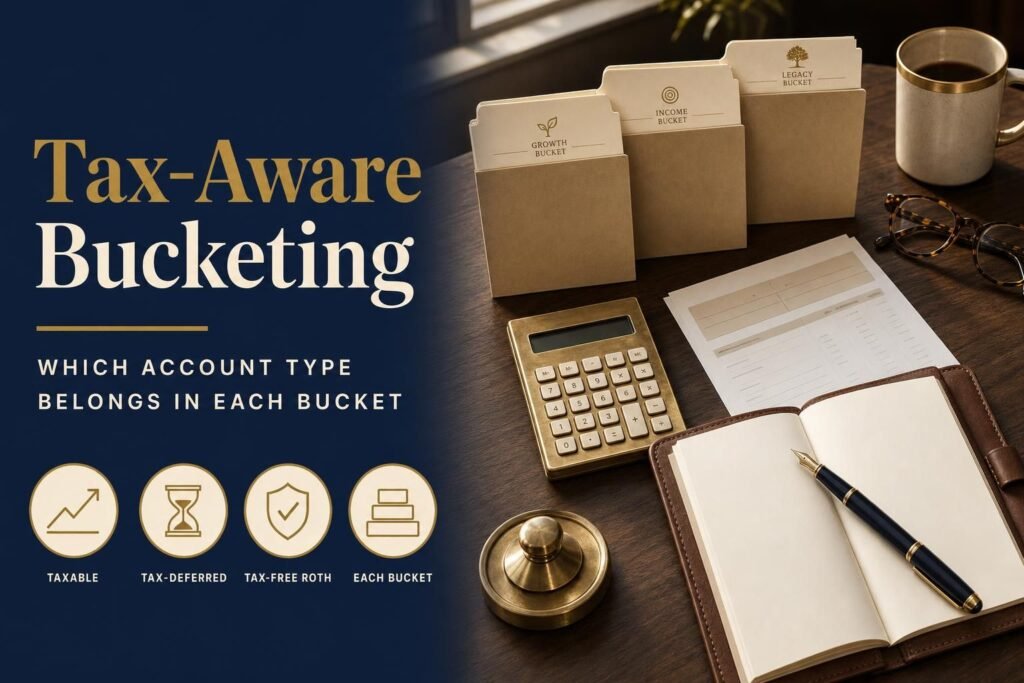
Bucket planning answers two questions beautifully and one question not at all. It tells you how much money to hold and when you’ll need it — near-term cash in one bucket, a guaranteed income floor in the next, long-term growth in the last. What the standard version never asks is the question that quietly decides your tax bill for the next thirty years: which account does each bucket’s money actually come out of?
Two retirees can run the identical Now, Soon, and Later structure and pay wildly different amounts of lifetime tax, simply because one of them thought about the tax character of each dollar and the other didn’t. That second layer — matching account types to buckets, not just amounts to buckets — is what I call tax-aware bucketing. It’s the part of the framework most people skip, and it’s where a lot of the real money is.
This builds directly on the Now, Soon, and Later framework. If you’re new to it, start there. If you already have your buckets sized, this is the overlay that makes them tax-efficient.
You have two dimensions, not one
Every dollar you’ve saved sits at the intersection of two things: when you’ll spend it, and how it’s taxed when you do. Bucket planning organizes the first dimension. Tax-aware bucketing adds the second on top.
The time dimension you already know — Now, Soon, Later, sorted by horizon. The tax dimension sorts every account you own into exactly three categories, regardless of what’s inside it.
Taxable money is your brokerage account, your savings, your CDs. You’ve already paid income tax on what went in; from here you owe tax only on the growth — at favorable long-term capital gains rates if you hold more than a year, and your heirs get a step-up in basis that can erase the embedded gain entirely. It’s the most flexible money you have.
Tax-deferred money is your traditional IRA and 401(k). You got a deduction going in, the money grew untaxed, and every dollar that comes out is taxed as ordinary income. The IRS eventually forces the issue through required minimum distributions starting at age 73. This is the bucket the tax code has a lien on.
Tax-free money is your Roth IRA and Roth 401(k). You paid tax on the way in, and from then on it’s done — tax-free growth, tax-free withdrawals, no required distributions during your lifetime, and a tax-free inheritance for whoever gets it. Dollar for dollar, it’s the most valuable money you own.
Matching the accounts to the buckets
Here’s the overlay. It isn’t a rigid rule — it’s a default you adjust for your own situation — but the logic holds for most households.
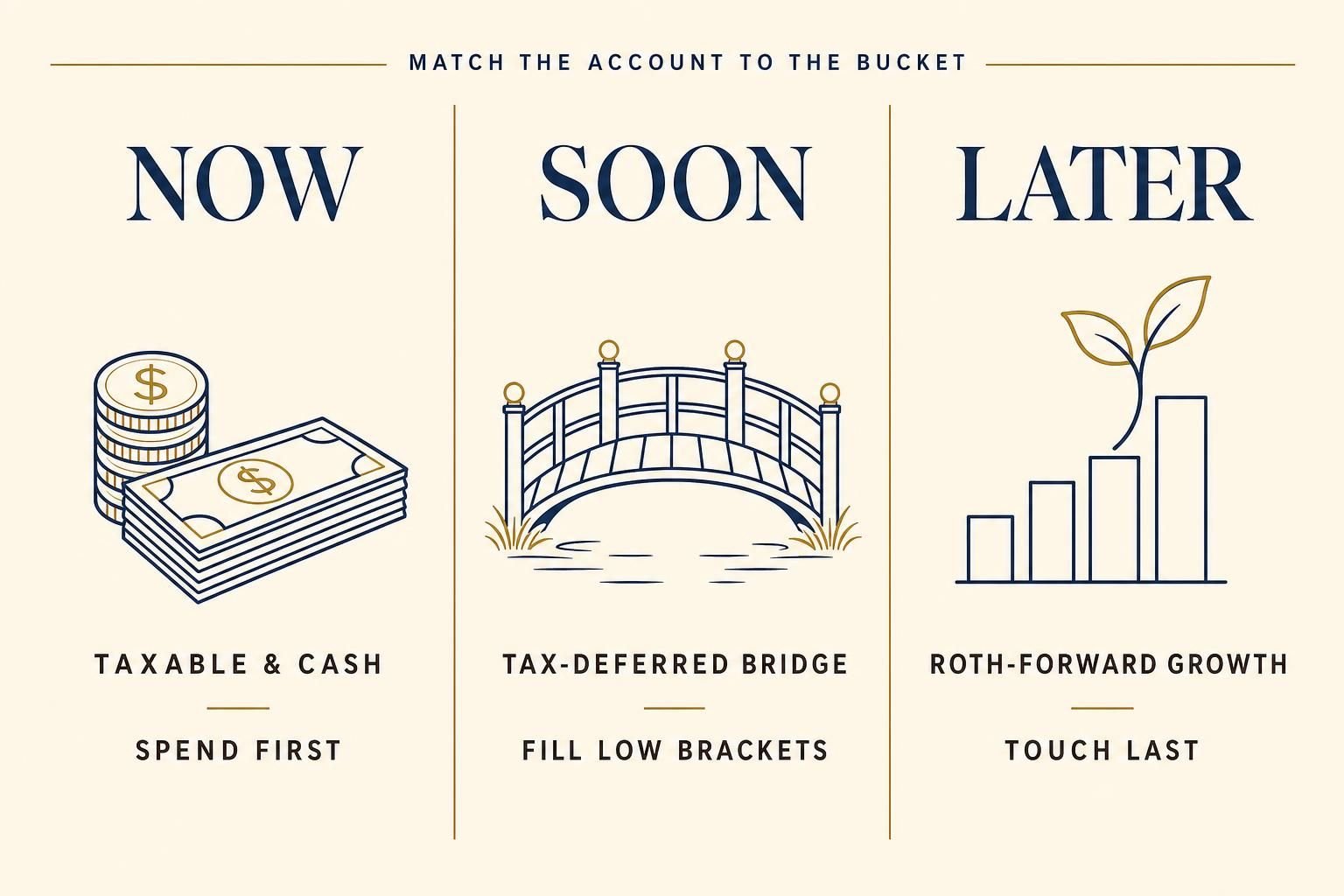
Your Now bucket should come from taxable and cash. This is the one to three years of spending money you keep liquid, and you want it somewhere you can reach without a penalty, without a forced ordinary-income event, and without disturbing anything that’s growing. Pulling your everyday living expenses from a taxable account generates little or no tax — you’re spending money you already paid tax on, plus modest gains. Funding daily life out of a traditional IRA instead would needlessly inflate your taxable income every single year.
Your Soon bucket is mostly guaranteed income — Social Security, a pension, an income-focused Fixed Index Annuity — and the tax character of those streams is largely set for you. Where tax-aware bucketing matters here is the bridge: the years before Social Security or a pension kicks in, when you’re living on portfolio withdrawals. Those bridge dollars are the right time to tap the tax-deferred accounts deliberately, filling up the lower tax brackets while your other income is low. You’re voluntarily draining the bucket the IRS has a claim on, at rates you control, instead of letting it compound into an RMD problem later.
Your Later bucket is the growth engine, and this is where Roth earns its place. Tax-free growth is worth the most where growth is expected to be the highest, so your most aggressive, longest-horizon holdings belong in the Roth. The traditional IRA can hold your steadier, more conservative growth — keeping it from ballooning into oversized RMDs — and the equities you hold in taxable get both the preferential capital-gains rate and the step-up for your heirs. This is the bucket-level cousin of asset location: same instinct, applied to which bucket holds which tax character.
The mistake almost everyone makes with the Roth
Here’s where I’ll take a stronger position than most planners will. The single most common tax-aware bucketing error I see is treating the Roth as Now-bucket money — spending it first because “it’s tax-free, so it’s free to use.”
That’s exactly backwards. The Roth is the last account you should touch, not the first. It’s the only money that grows tax-free for the rest of your life, the only money with no RMD forcing it out, and the best possible thing to leave to a spouse or child because they inherit it tax-free too. Spending it early to avoid a tax bill today means trading your most valuable, most flexible asset to protect your least valuable one. When you drain the Roth in your sixties to keep your taxable income down, you’re winning a small battle and losing the war.
The related mistake is filling all three buckets proportionally from the same account — selling a slice of everything to raise cash, every time. That ignores the tax dimension entirely and usually means realizing ordinary income you didn’t have to. The whole point of tax-aware bucketing is that the buckets draw from different account types on purpose.
A hypothetical: David and Susan map their accounts
Consider a hypothetical case. David and Susan are both 64, recently retired outside Raleigh, with essentials of about $5,000 a month. They have three pools of money: roughly $250,000 in a taxable brokerage account, $700,000 in traditional IRAs and old 401(k)s, and $200,000 in Roth IRAs. They plan to delay Social Security until 70, which leaves a six-year bridge to fund.
Under plain bucket planning, they’d just decide how much goes in Now, Soon, and Later. Under tax-aware bucketing, they also decide which dollars do each job. Their Now bucket — about two years of the gap between spending and guaranteed income — comes from the taxable account and cash, generating almost no tax to live on. The bridge to 70 gets funded from the traditional IRA, pulling roughly enough each year to fill the 12% bracket without spilling into the next one. Those same low-income bridge years double as a window for Roth conversions, moving more money into the tax-free column while it’s cheap to do so.
Meanwhile the $200,000 Roth doesn’t get touched at all. It stays fully invested in their most growth-oriented holdings, compounding tax-free as the Later bucket’s core. The traditional IRA, steadily drawn down through the bridge years, is smaller by the time RMDs begin — which means smaller forced distributions and a lower tax drag for the rest of their lives. The numbers here are illustrative, not a forecast, but the shape is the lesson: same buckets, sequenced out of the right accounts.
Where the payoff actually shows up
Tax-aware bucketing isn’t about a clever trick in any single year. It pays off as a compounding advantage across three fronts at once.
It smooths your tax brackets, because you’re choosing which type of income to realize each year rather than being shoved into ordinary income by where your spending money happens to live. It shrinks the RMD problem, because deliberately drawing down tax-deferred money in low-income years leaves a smaller balance to be force-distributed later — a theme I cover in detail in the most common RMD mistakes. And it improves what you leave behind, because the asset that survives longest is the tax-free one your heirs receive without a tax bill.
None of this requires predicting markets or chasing returns. It’s pure structure — the same calm, decide-it-in-advance discipline the bucket framework is built on, extended one layer deeper. If you want to see how draining your accounts in a different order changes your lifetime tax and your ending balance, a modeling tool like ProjectionLab lets you run your own account mix against different withdrawal sequences before you commit to one. (ProjectionLab is an affiliate partner; if you subscribe through that link, Confluence Media Group may earn a commission at no additional cost to you. I only point readers toward tools I’d actually use.)
Build the overlay before you need it
Most retirees get the buckets right and the accounts wrong. They size their cash cushion, build a real income floor, and keep their growth invested — and then they fund the whole thing by selling a little of everything, or by spending the Roth first because it feels free. The structure is sound and the plumbing undoes it.
So once your buckets are sized, add the second question to each one: which account does this money come from? Taxable for Now, tax-deferred for the bridge inside Soon, Roth-forward for Later, and the Roth touched last of all. Write that down next to your bucket plan while things are calm. It’s the difference between a plan that’s organized and a plan that’s also tax-efficient — and over a thirty-year retirement, that difference is measured in real money.
Key takeaways
- Bucket planning sorts money by when you’ll spend it. Tax-aware bucketing adds how it’s taxed — sorting every account into taxable, tax-deferred, or tax-free.
- Fund the Now bucket from taxable and cash, bridge the Soon bucket from tax-deferred accounts to fill low brackets, and keep your highest-growth holdings in the Roth as the core of the Later bucket.
- The Roth is the last account to spend, not the first — it grows tax-free for life, has no required distributions, and passes to heirs tax-free.
- Deliberately drawing down tax-deferred money in low-income years shrinks future RMDs and smooths your brackets.
- Don’t fund every bucket proportionally from the same account; the point is to draw different tax characters at different times on purpose.
Frequently asked questions
Isn’t it simpler to just keep the same investment mix in every account?
Simpler, but more expensive. Holding the identical mix everywhere ignores the tax dimension — you end up realizing ordinary income to fund spending and leaving tax-free Roth growth on the table. Matching tax character to bucket job is a one-time setup that pays off every year after.
What if most of my money is in a traditional 401(k)?
That’s common, and it makes the low-income bridge years before Social Security even more valuable. Those are the years to draw the tax-deferred bucket down on purpose and consider Roth conversions, so you’re not handed an oversized RMD and a higher bracket in your seventies. Start by sizing your income floor, then plan the drawdown around it.
Does the order I withdraw accounts in still matter if I do this?
Yes — tax-aware bucketing and withdrawal sequencing are two sides of the same coin. Deciding which account funds which bucket is the same decision as deciding the order you drain your accounts. The bucket overlay just makes that order intentional instead of accidental.
This article is published by Confluence Media Group LLC, an independent publisher of educational financial content. Thomas Clark is a Series 65 Investment Advisor Representative. The information provided is for educational and informational purposes only and is not personalized financial, tax, or legal advice. Past performance does not guarantee future results. All investing involves risk, including potential loss of principal. Consult a qualified professional before making financial decisions.
Confluence Media Group LLC is a separate entity from Confluence Capital Management, the investment advisory practice through which Thomas Clark provides advisory services. Advisory services are not offered through this publishing platform.
About Thomas Clark
Thomas Clark is the founder of Confluence Media Group LLC and a Series 65 Investment Advisor Representative. He has spent nearly two decades working with families on retirement planning, with a focus on Social Security optimization, retirement income coordination, and the bucket planning approach to building a guaranteed income floor.
Thomas writes and publishes at thomasclarkadvisor.com and is the author of The Just in Case Binder — a 148-page printable family financial organizer for households who want to make sure the people they love know where everything is.
He lives in North Carolina with his family.
Subscribe to the weekly newsletter · Get the Just in Case Binder

Thomas Clark is a Series 65 licensed investment advisor and experienced trader. He specializes in investing, retirement planning, and market analysis, helping individuals build wealth and make informed financial decisions.
