
The Survivor’s Penalty: A Retirement Tax Trap to Plan For
When the first spouse dies, the survivor usually files as single — halving the standard deduction and compressing the brackets even as income falls. Here is why the survivor's penalty happens, and the moves that soften it years before it arrives.

Most retirement plans are built for two people. The tax code is not. The day one spouse dies, the survivor doesn’t just lose a partner — they often move into a higher tax bracket on a smaller income. Planners call it the survivor’s penalty, and it’s one of the few retirement tax events you can see coming years in advance and still do something about.
It rarely shows up in a retirement projection because most planning software quietly assumes a married couple files jointly all the way to age 90. Real life doesn’t cooperate. In most married households, one spouse outlives the other by years — sometimes a decade or more — and every one of those years is filed as a single taxpayer. Here’s what actually changes, why the bill can climb even as the income falls, and the moves that soften it.
What the survivor’s penalty actually is
When the first spouse dies, the surviving spouse can usually file a joint return for that final year. After that, unless they’re supporting a dependent child, they file as a single taxpayer. That single switch — from married filing jointly to single — is where the penalty lives.
The household income drops, but rarely by half. The survivor keeps the larger of the two Social Security checks and loses the smaller one. The retirement accounts are still there, and the required minimum distributions on them keep coming. A pension may continue at a survivor percentage, or it may stop entirely, depending on the election made years earlier. So income falls modestly. The problem is that the tax brackets, the standard deduction, and the Medicare thresholds that apply to that income all get cut roughly in half at the same time.
Why the tax bill can rise even as income falls
Three forces compound here, and they all push the same direction.
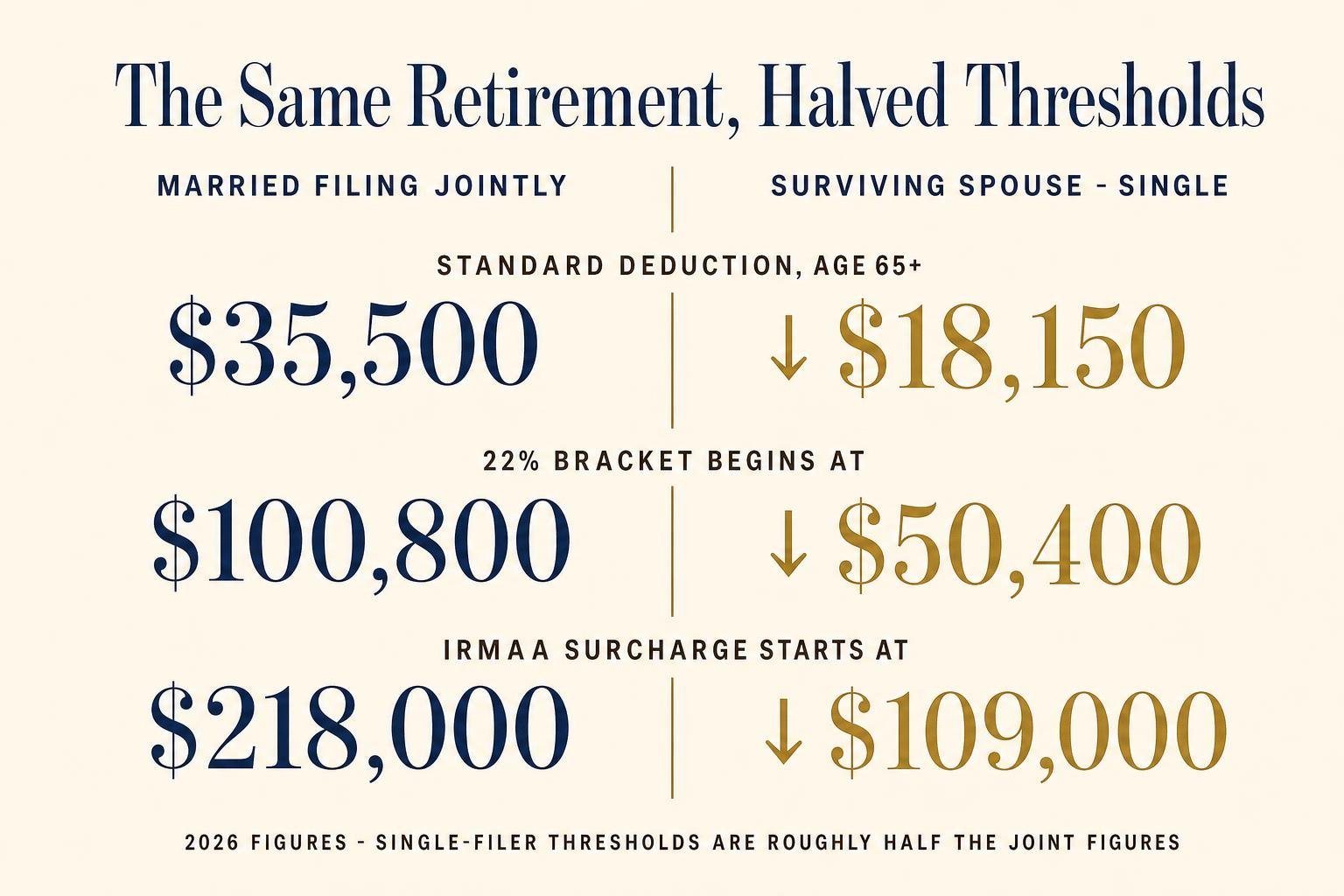
The standard deduction is nearly halved. For 2026, a married couple filing jointly gets a $32,200 standard deduction, plus an extra $1,650 for each spouse who’s 65 or older — roughly $35,500 for a retired couple. A single filer 65 or older gets $16,100 plus a $2,050 addition, about $18,150. Same person, same home, but almost twice as much of their income is now exposed to tax. (The figures come from the IRS 2026 inflation adjustments.)
The brackets compress. For a couple, the 12% bracket runs up to $100,800 of taxable income before the 22% rate kicks in. For a single filer, that jump to 22% happens at just $50,400. The survivor can have well under half the household’s former income and still find a chunk of it taxed at a higher marginal rate than the couple ever paid.
More of the Social Security check becomes taxable. The income thresholds that determine how much of your Social Security is taxed were written into law decades ago and have never been adjusted for inflation. A single filer starts having up to 85% of benefits taxed once “provisional income” passes $34,000; for a couple it’s $44,000. Because those thresholds are so low, a survivor living on one Social Security check plus IRA withdrawals often sees a larger share of that check pulled into taxable income than the couple did. The IRS explains the provisional-income math here.
There’s a fourth trip-wire waiting in the Medicare system. The income-related monthly adjustment amount, or IRMAA, adds a surcharge to Part B and Part D premiums once income crosses a line. For 2026 that line sits at $109,000 for a single filer and $218,000 for a couple — again, exactly half. A survivor with a large required distribution or a one-time capital gain can cross $109,000 and trigger a Medicare surcharge that the $218,000 joint threshold never brought into play. Medicare.gov lays out how the surcharge works; note that it’s based on your income from two years earlier, so the year it lands can catch people off guard.
A hypothetical: David and Susan
Consider a hypothetical case. David and Susan, both 73, are retired in suburban Charlotte. David collects $3,400 a month from Social Security; Susan collects $1,800. They have a $700,000 traditional IRA that throws off about $28,000 a year in required distributions. Filing jointly, their taxable income lands around $85,000 — comfortably inside the 12% bracket, with their standard deduction of roughly $35,500 shielding a big slice of the total.
David dies in the spring. The following year, Susan files as a single taxpayer. She keeps David’s $3,400 benefit and gives up her own $1,800 — household Social Security falls from about $62,000 a year to roughly $41,000. The IRA is now hers, and the required distributions continue at a similar level. Her total income has dropped meaningfully. Yet her standard deduction is now about $18,150, the 22% bracket starts at $50,400 instead of $100,800, and more of her Social Security is taxable. On less income, her effective tax rate can land noticeably higher than what she and David paid together. In a year with a larger withdrawal, she may also brush the $109,000 IRMAA line and pick up a Medicare surcharge on top.
Nothing about Susan’s spending got easier. The tax code just started treating her as if it had.
The move that actually helps: plan for two, tax for one
Here’s the stance most retirement plans miss, because the software rarely models it: the best time to manage the survivor’s penalty is during the years both spouses are alive and filing jointly. Those are the years with the widest brackets and the biggest standard deduction — the cheapest tax years the household will ever see.
Thomas’ Take — I’d rather a couple deliberately pay some tax in the 12% or 22% bracket today than leave a survivor to draw down a large traditional IRA at single rates later. The raw bracket math can look neutral in any single year. It stops looking neutral the moment you run the return the survivor will actually file.
The primary tool is the Roth conversion. Converting a portion of the traditional IRA to a Roth during the joint-filing years — filling up the wide MFJ brackets on purpose — shrinks the traditional balance the survivor would otherwise be forced to withdraw at compressed single-filer rates. It also removes future required distributions from that money entirely, since Roth accounts have none for the original owner. This is the same low-bracket window I’ve written about for the years between retirement and Social Security, now with a second reason to use it.
This is exactly the kind of thing worth modeling rather than eyeballing. I use and recommend ProjectionLab for this — it lets you build the joint return and the survivor’s single return side by side and test how conversions today change the tax the survivor pays for the rest of their life. (Disclosure: that’s an affiliate link. If you subscribe through it, Confluence Media Group may earn a commission at no extra cost to you. I only point people to tools I actually think earn their keep.)
Where bucket planning fits
The survivor’s penalty is a tax problem, but the defense is built into the income floor. In the Now / Soon / Later framework, the Soon bucket is the guaranteed income the survivor will still be living on. Two decisions made years ahead determine how sturdy that floor is once the household is down to one person.
First, claiming age. Delaying the higher earner’s Social Security raises the survivor benefit, because the survivor keeps the larger check — so a decision that looks like “his benefit” is really the household’s survivor insurance. It’s the same logic behind survivor benefit timing. Second, the pension election: a single-life payout is larger while both are alive and vanishes at the first death, while a joint-and-survivor election trades a smaller monthly check for one that keeps paying the survivor. The right answer depends on the household, but it should never be made without the survivor’s return in view.
On the growth side, a Roth-forward Later bucket hands the survivor a pool of money they can draw on tax-free and that carries no required distributions — the opposite of the traditional IRA that drives the penalty. Managed together, these choices don’t erase the switch to single brackets, but they decide how much it stings.
Key takeaways
- When the first spouse dies, the survivor typically files as single the following year — halving the standard deduction and compressing the brackets, even as income falls.
- The survivor keeps the larger Social Security benefit and loses the smaller, so household income drops but not in step with the tax thresholds.
- Because Social Security taxation thresholds and the $109,000 IRMAA line for singles are roughly half the joint figures, a survivor can pay a higher effective rate — and face a Medicare surcharge — on less income.
- The strongest defense is acting during the joint-filing years: Roth conversions into the wide MFJ brackets, a survivor-aware claiming and pension strategy, and a Roth-forward Later bucket.
- Run the return the survivor will actually file, not just the joint one. That’s where the penalty is visible — and where it’s cheapest to prevent.
The survivor’s penalty isn’t a reason for anxiety; it’s a planning date on the calendar you can’t see yet. The couples who handle it best don’t do anything dramatic. They just spend a few of their good, low-bracket years making the future single filer’s life a little easier — because one of them is going to be that person, and neither of them knows which.
This article is published by Confluence Media Group LLC, an independent publisher of educational financial content. Thomas Clark is a Series 65 Investment Advisor Representative. The information provided is for educational and informational purposes only and is not personalized financial, tax, or legal advice. Past performance does not guarantee future results. All investing involves risk, including potential loss of principal. Consult a qualified professional before making financial decisions.
Confluence Media Group LLC is a separate entity from Confluence Capital Management, the investment advisory practice through which Thomas Clark provides advisory services. Advisory services are not offered through this publishing platform.
About Thomas Clark
Thomas Clark is the founder of Confluence Media Group LLC and a Series 65 Investment Advisor Representative. He has spent nearly two decades working with families on retirement planning, with a focus on Social Security optimization, retirement income coordination, and the bucket planning approach to building a guaranteed income floor.
Thomas writes and publishes at thomasclarkadvisor.com and is the author of The Just in Case Binder — a 148-page printable family financial organizer for households who want to make sure the people they love know where everything is.
He lives in North Carolina with his family.
Subscribe to the weekly newsletter · Get the Just in Case Binder

Thomas Clark is a Series 65 licensed investment advisor and experienced trader. He specializes in investing, retirement planning, and market analysis, helping individuals build wealth and make informed financial decisions.
